
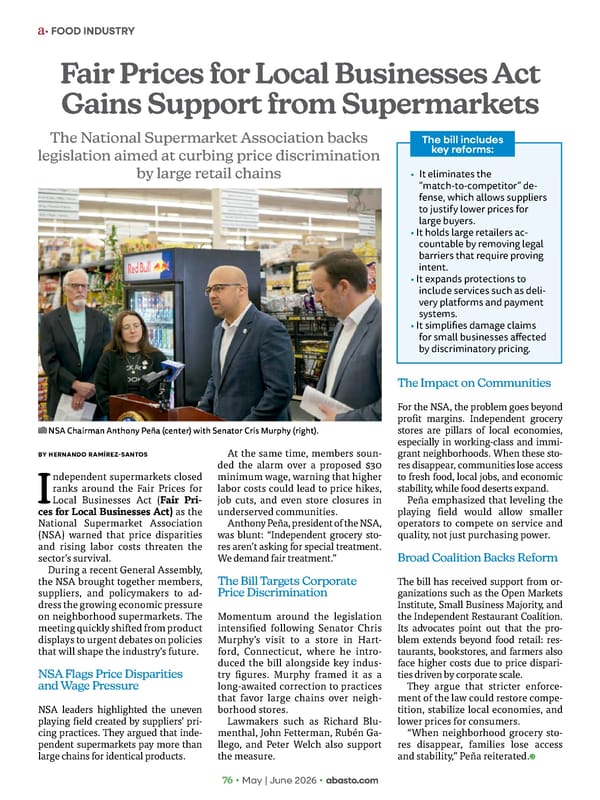
76 • May | June 2026 • abasto.com BY HERNANDO RAMÍREZ-SANTOS I ndependent supermarkets closed ranks around the Fair Prices for Local Businesses Act ( Fair Pri- ces for Local Businesses Act) as the National Supermarket Association (NSA) warned that price disparities and rising labor costs threaten the sector’s survival. During a recent General Assembly, the NSA brought together members, suppliers, and policymakers to ad- dress the growing economic pressure on neighborhood supermarkets. The meeting quickly shifted from product displays to urgent debates on policies that will shape the industry’s future. NSA Flags Price Disparities and Wage Pressure NSA leaders highlighted the uneven playing field created by suppliers’ pri- cing practices. They argued that inde- pendent supermarkets pay more than large chains for identical products. Fair Prices for Local Businesses Act Gains Support from Supermarkets The National Supermarket Association backs legislation aimed at curbing price discrimination by large retail chains At the same time, members soun- ded the alarm over a proposed $30 minimum wage, warning that higher labor costs could lead to price hikes, job cuts, and even store closures in underserved communities. Anthony Peña, president of the NSA, was blunt: “Independent grocery sto- res aren’t asking for special treatment. We demand fair treatment.” The Bill Targets Corporate Price Discrimination Momentum around the legislation intensified following Senator Chris Murphy’s visit to a store in Hart- ford, Connecticut, where he intro- duced the bill alongside key indus- try figures. Murphy framed it as a long-awaited correction to practices that favor large chains over neigh- borhood stores. Lawmakers such as Richard Blu- menthal, John Fetterman, Rubén Ga- llego, and Peter Welch also support the measure. The Impact on Communities For the NSA, the problem goes beyond profit margins. Independent grocery stores are pillars of local economies, especially in working-class and immi- grant neighborhoods. When these sto- res disappear, communities lose access to fresh food, local jobs, and economic stability, while food deserts expand. Peña emphasized that leveling the playing field would allow smaller operators to compete on service and quality, not just purchasing power. Broad Coalition Backs Reform The bill has received support from or- ganizations such as the Open Markets Institute, Small Business Majority, and the Independent Restaurant Coalition. Its advocates point out that the pro- blem extends beyond food retail: res- taurants, bookstores, and farmers also face higher costs due to price dispari- ties driven by corporate scale. They argue that stricter enforce- ment of the law could restore compe- tition, stabilize local economies, and lower prices for consumers. “When neighborhood grocery sto- res disappear, families lose access and stability,” Peña reiterated. The bill includes key reforms: • It eliminates the “match-to-competitor” de- fense, which allows suppliers to justify lower prices for large buyers. • It holds large retailers ac- countable by removing legal barriers that require proving intent. • It expands protections to include services such as deli- very platforms and payment systems. • It simplifies damage claims for small businesses affected by discriminatory pricing. NSA Chairman Anthony Peña (center) with Senator Cris Murphy (right). • FOOD INDUSTRY
 Abasto Magazine - May/June 2026 ENGLISH Page 123 Page 125