
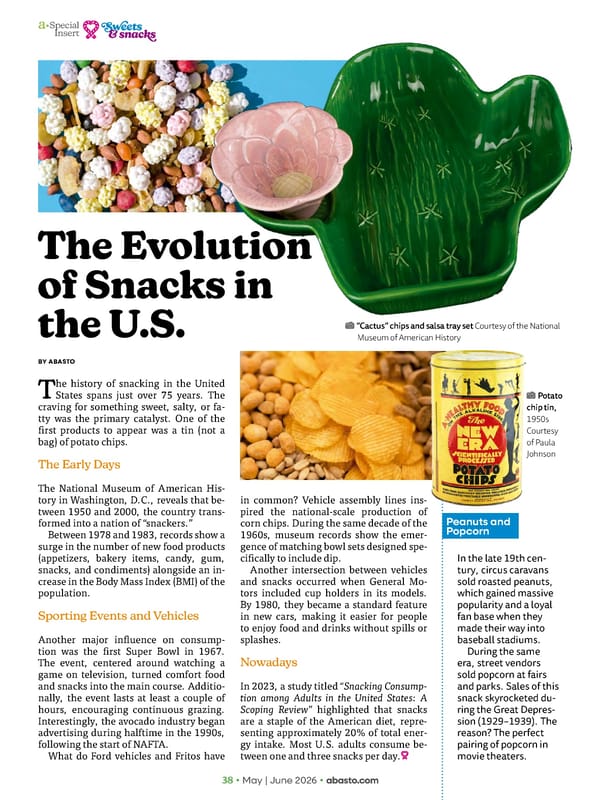
38 • May | June 2026 • abasto.com Peanuts and Popcorn BY ABASTO T he history of snacking in the United States spans just over 75 years. The craving for something sweet, salty, or fa- tty was the primary catalyst. One of the first products to appear was a tin (not a bag) of potato chips. The Early Days The National Museum of American His- tory in Washington, D.C., reveals that be- tween 1950 and 2000, the country trans- formed into a nation of “snackers.” Between 1978 and 1983, records show a surge in the number of new food products (appetizers, bakery items, candy, gum, snacks, and condiments) alongside an in- crease in the Body Mass Index (BMI) of the population. Sporting Events and Vehicles Another major influence on consump- tion was the first Super Bowl in 1967. The event, centered around watching a game on television, turned comfort food and snacks into the main course. Additio- nally, the event lasts at least a couple of hours, encouraging continuous grazing. Interestingly, the avocado industry began advertising during halftime in the 1990s, following the start of NAFTA. What do Ford vehicles and Fritos have The Evolution of Snacks in the U.S. in common? Vehicle assembly lines ins- pired the national-scale production of corn chips. During the same decade of the 1960s, museum records show the emer- gence of matching bowl sets designed spe- cifically to include dip. Another intersection between vehicles and snacks occurred when General Mo- tors included cup holders in its models. By 1980, they became a standard feature in new cars, making it easier for people to enjoy food and drinks without spills or splashes. Nowadays In 2023, a study titled “Snacking Consump- tion among Adults in the United States: A Scoping Review” highlighted that snacks are a staple of the American diet, repre- senting approximately 20% of total ener- gy intake. Most U.S. adults consume be- tween one and three snacks per day. In the late 19th cen- tury, circus caravans sold roasted peanuts, which gained massive popularity and a loyal fan base when they made their way into baseball stadiums. During the same era, street vendors sold popcorn at fairs and parks. Sales of this snack skyrocketed du- ring the Great Depres- sion (1929–1939). The reason? The perfect pairing of popcorn in movie theaters. “Cactus” chips and salsa tray set Courtesy of the National Museum of American History Potato chip tin, 1950s Courtesy of Paula Johnson Special Insert Sweets & snacks
 Abasto Magazine - May/June 2026 ENGLISH Page 87 Page 89