
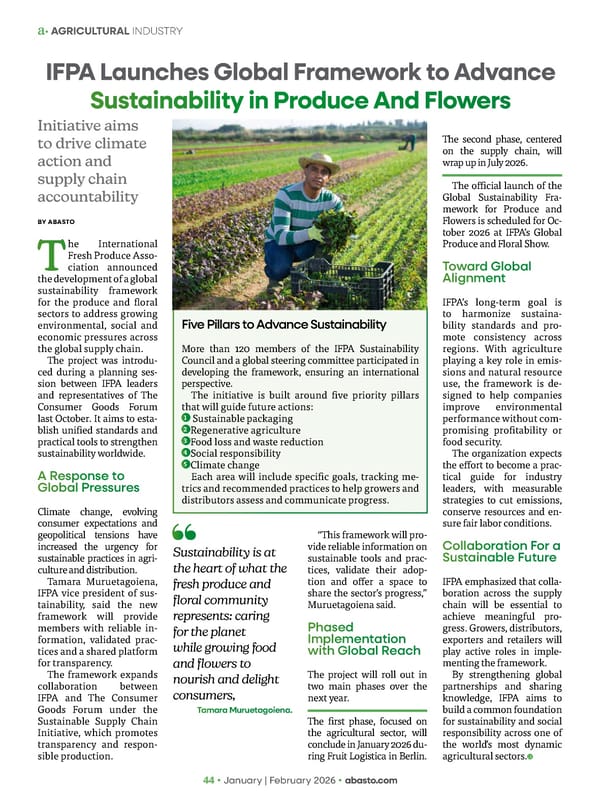
44 January | February 2026 abasto.com AGRICULTURAL INDUSTRY Initiative aims to drive climate action and supply chain accountability BY ABASTO T he International Fresh Produce Asso- ciation announced the development of a global sustainability framework for the produce and floral sectors to address growing environmental, social and economic pressures across the global supply chain. The project was introdu- ced during a planning ses- sion between IFPA leaders and representatives of The Consumer Goods Forum last October. It aims to esta- blish unified standards and practical tools to strengthen sustainability worldwide. A Response to Global Pressures Climate change, evolving consumer expectations and geopolitical tensions have increased the urgency for sustainable practices in agri- culture and distribution. Tamara Muruetagoiena, IFPA vice president of sus- tainability, said the new framework will provide members with reliable in- formation, validated prac- tices and a shared platform for transparency. The framework expands collaboration between IFPA and The Consumer Goods Forum under the Sustainable Supply Chain Initiative, which promotes transparency and respon- sible production. IFPA Launches Global Framework to Advance Sustainability in Produce And Flowers Sustainability is at the heart of what the fresh produce and floral community represents: caring for the planet while growing food and flowers to nourish and delight consumers, Tamara Muruetagoiena. This framework will pro- vide reliable information on sustainable tools and prac- tices, validate their adop- tion and offer a space to share the sectors progress, Muruetagoiena said. Phased Implementation with Global Reach The project will roll out in two main phases over the next year. The first phase, focused on the agricultural sector, will conclude in January 2026 du- ring Fruit Logistica in Berlin. The second phase, centered on the supply chain, will wrap up in July 2026. The official launch of the Global Sustainability Fra- mework for Produce and Flowers is scheduled for Oc- tober 2026 at IFPAs Global Produce and Floral Show. Toward Global Alignment IFPAs long-term goal is to harmonize sustaina- bility standards and pro- mote consistency across regions. With agriculture playing a key role in emis- sions and natural resource use, the framework is de- signed to help companies improve environmental performance without com- promising profitability or food security. The organization expects the effort to become a prac- tical guide for industry leaders, with measurable strategies to cut emissions, conserve resources and en- sure fair labor conditions. Collaboration For a Sustainable Future IFPA emphasized that colla- boration across the supply chain will be essential to achieve meaningful pro- gress. Growers, distributors, exporters and retailers will play active roles in imple- menting the framework. By strengthening global partnerships and sharing knowledge, IFPA aims to build a common foundation for sustainability and social responsibility across one of the worlds most dynamic agricultural sectors. Five Pillars to Advance Sustainability More than 120 members of the IFPA Sustainability Council and a global steering committee participated in developing the framework, ensuring an international perspective. The initiative is built around five priority pillars that will guide future actions: 1 Sustainable packaging 2 Regenerative agriculture 3 Food loss and waste reduction 4 Social responsibility 5 Climate change Each area will include specific goals, tracking me- trics and recommended practices to help growers and distributors assess and communicate progress.
 Abasto Magazine January / February 2026 ENGLISH Page 43 Page 45