
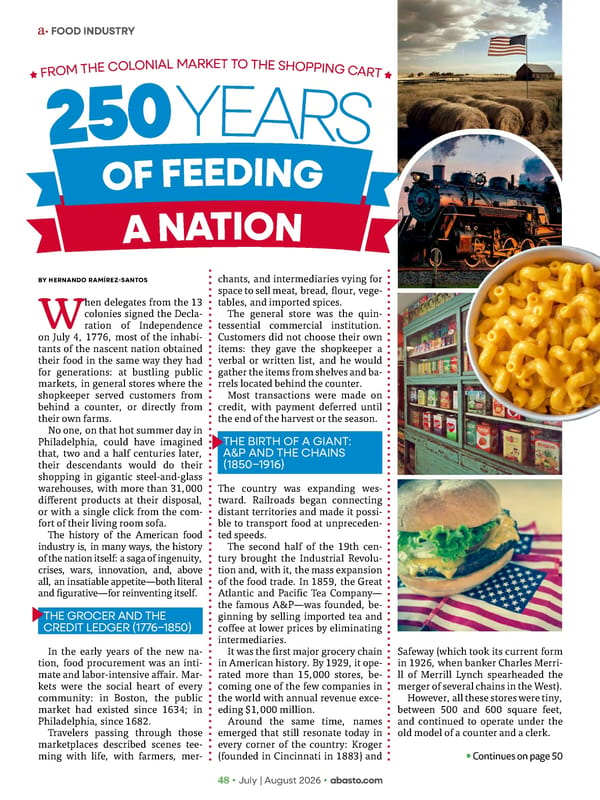
48 • July | August 2026 • abasto.com BY HERNANDO RAMÍREZ-SANTOS W hen delegates from the 13 colonies signed the Decla- ration of Independence on July 4, 1776, most of the inhabi- tants of the nascent nation obtained their food in the same way they had for generations: at bustling public markets, in general stores where the shopkeeper served customers from behind a counter, or directly from their own farms. No one, on that hot summer day in Philadelphia, could have imagined that, two and a half centuries later, their descendants would do their shopping in gigantic steel-and-glass warehouses, with more than 31,000 different products at their disposal, or with a single click from the com- fort of their living room sofa. The history of the American food industry is, in many ways, the history of the nation itself: a saga of ingenuity, crises, wars, innovation, and, above all, an insatiable appetite—both literal and figurative—for reinventing itself. THE GROCER AND THE CREDIT LEDGER (1776–1850) In the early years of the new na- tion, food procurement was an inti- mate and labor-intensive affair. Mar- kets were the social heart of every community: in Boston, the public market had existed since 1634; in Philadelphia, since 1682. Travelers passing through those marketplaces described scenes tee- ming with life, with farmers, mer- chants, and intermediaries vying for space to sell meat, bread, flour, vege- tables, and imported spices. The general store was the quin- tessential commercial institution. Customers did not choose their own items: they gave the shopkeeper a verbal or written list, and he would gather the items from shelves and ba- rrels located behind the counter. Most transactions were made on credit, with payment deferred until the end of the harvest or the season. THE BIRTH OF A GIANT: A&P AND THE CHAINS (1850–1916) The country was expanding wes- tward. Railroads began connecting distant territories and made it possi- ble to transport food at unpreceden- ted speeds. The second half of the 19th cen- tury brought the Industrial Revolu- tion and, with it, the mass expansion of the food trade. In 1859, the Great Atlantic and Pacific Tea Company— the famous A&P—was founded, be- ginning by selling imported tea and coffee at lower prices by eliminating intermediaries. It was the first major grocery chain in American history. By 1929, it ope- rated more than 15,000 stores, be- coming one of the few companies in the world with annual revenue exce- eding $1,000 million. Around the same time, names emerged that still resonate today in every corner of the country: Kroger (founded in Cincinnati in 1883) and Safeway (which took its current form in 1926, when banker Charles Merri- ll of Merrill Lynch spearheaded the merger of several chains in the West). However, all these stores were tiny, between 500 and 600 square feet, and continued to operate under the old model of a counter and a clerk. A N A T I O N O F F E E D I N G 2 5 0 Y E A R S F R O M T H E C O L O N I A L M A R K E T T O T H E S H O P P I N G C A R T • FOOD INDUSTRY • Continues on page 50
 Abasto Magazine - July/August 2026 english Page 47 Page 49