Abasto Magazine - July/August 2026 english
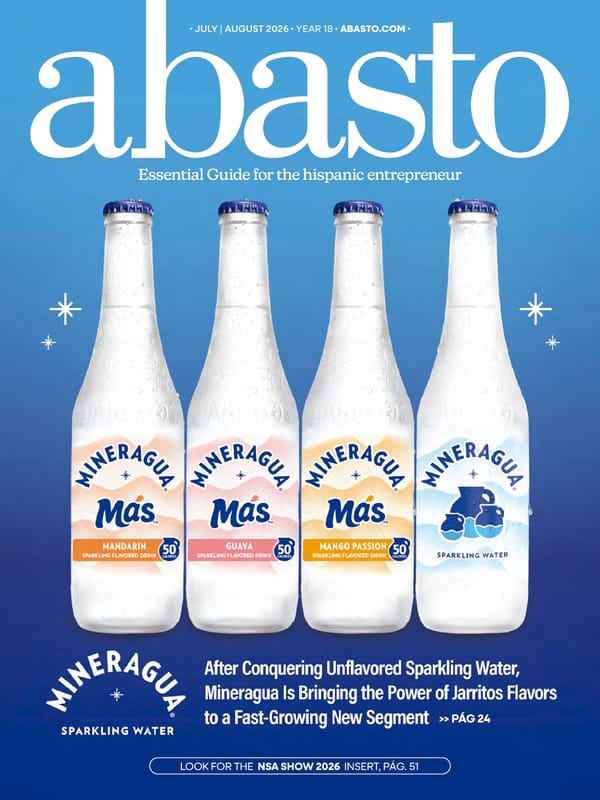
This edition highlights Mineragua's introduction of Jarritos flavors into the sparkling water market.
Essential Guide for the hispanic entrepreneur • JULY | AUGUST 2026 • YEAR 18 • ABASTO.COM • >> PÁG 24 LOOK FOR THE NSA SHOW 2026 INSERT, PÁG. 51
3 • July | August 2026 • abasto.com
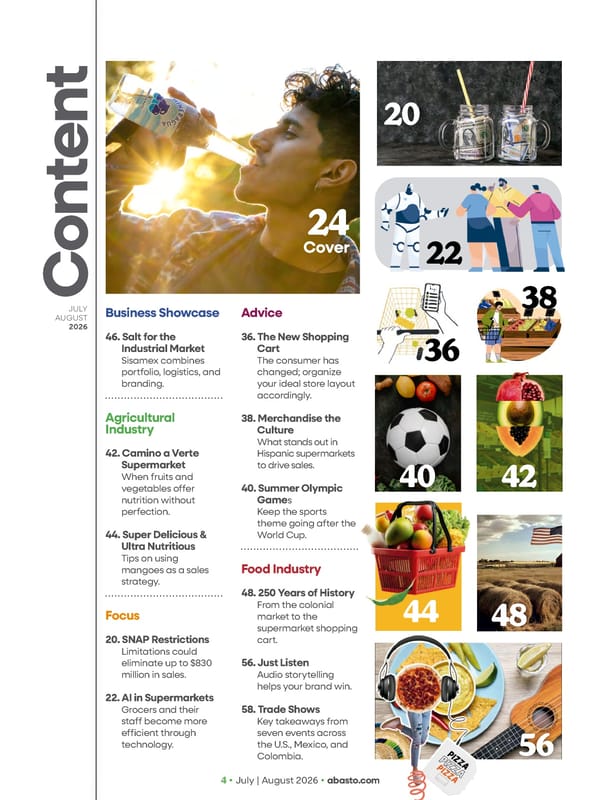
4 • July | August 2026 • abasto.com JULY AUGUST 2026 Business Showcase 46. Salt for the Industrial Market Sisamex combines portfolio, logistics, and branding. Agricultural Industry 42. Camino a Verte Supermarket When fruits and vegetables offer nutrition without perfection. 44. Super Delicious & Ultra Nutritious Tips on using mangoes as a sales strategy. Focus 20. SNAP Restrictions Limitations could eliminate up to $830 million in sales. 22. AI in Supermarkets Grocers and their staff become more efficient through technology. Advice 36. The New Shopping Cart The consumer has changed; organize your ideal store layout accordingly. 38. Merchandise the Culture What stands out in Hispanic supermarkets to drive sales. 40. Summer Olympic Game s Keep the sports theme going after the World Cup. Food Industry 48. 250 Years of History From the colonial market to the supermarket shopping cart. 56. Just Listen Audio storytelling helps your brand win. 58. Trade Shows Key takeaways from seven events across the U.S., Mexico, and Colombia. Cover 24 48 42 40 38 36 56 20 22 Content 44
5 • July | August 2026 • abasto.com
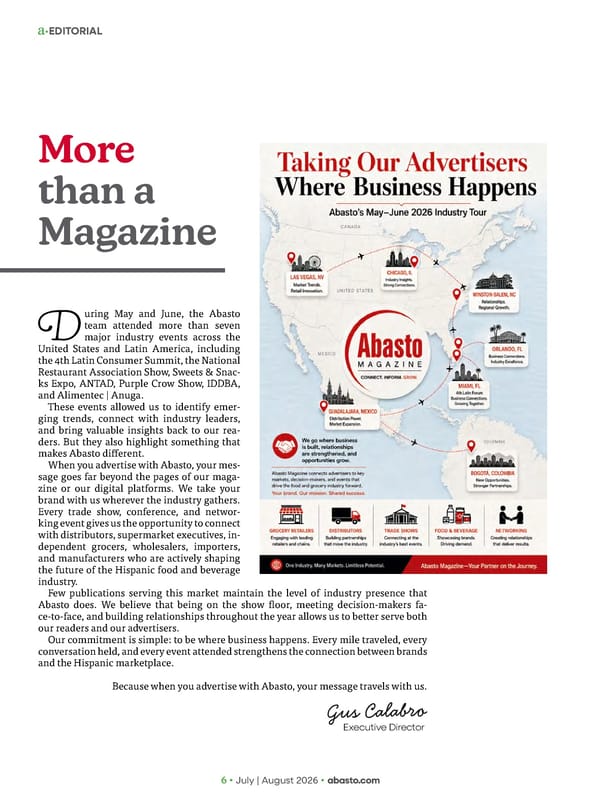
6 • July | August 2026 • abasto.com More than a Magazine D uring May and June, the Abasto team attended more than seven major industry events across the United States and Latin America, including the 4th Latin Consumer Summit, the National Restaurant Association Show, Sweets & Snac- ks Expo, ANTAD, Purple Crow Show, IDDBA, and Alimentec | Anuga. These events allowed us to identify emer- ging trends, connect with industry leaders, and bring valuable insights back to our rea- ders. But they also highlight something that makes Abasto different. When you advertise with Abasto, your mes- sage goes far beyond the pages of our maga- zine or our digital platforms. We take your brand with us wherever the industry gathers. Every trade show, conference, and networ- king event gives us the opportunity to connect with distributors, supermarket executives, in- dependent grocers, wholesalers, importers, and manufacturers who are actively shaping the future of the Hispanic food and beverage industry. Few publications serving this market maintain the level of industry presence that Abasto does. We believe that being on the show floor, meeting decision-makers fa- ce-to-face, and building relationships throughout the year allows us to better serve both our readers and our advertisers. Our commitment is simple: to be where business happens. Every mile traveled, every conversation held, and every event attended strengthens the connection between brands and the Hispanic marketplace. Because when you advertise with Abasto, your message travels with us. Executive Director • EDITORIAL
7 • July | August 2026 • abasto.com
8 • July | August 2026 • abasto.com Abasto es una revista bimestral de circulación nacional publicada por Hispanic Marketing Consultants, Inc. P.O. Box 20577 Wins- ton-Salem, NC 27101. Todos los derechos reservados. Prohibida la reproducción parcial o total de su contenido sin previa autori- zación del Editor. Abasto investiga la seriedad de sus anunciantes, pero no se hace responsable del contenido de las ofertas. Las opiniones expresadas por los autores y contribuyentes que colaboran en esta revista no son necesariamente compartidas por los editores o representantes de HMC (Hispanic Marketing Consultants) Abasto Media. Abastomedia Abastomagazine Abasto | Food & Beverage Business News abasto Director Gustavo Calabro gcalabro@abasto.com 336.724.9718 x.204 Diseño Gráfico / Graphic Design Orlando Rivera orlando.rivera@abasto.com 336.724.9718 Departamento Editorial / Editorial Department Hernando Ramírez-Santos hramirezsantos@abasto.com 336.724.9718 x.201 Violeta Montes de Oca vmontesdeoca@abasto.com 336.724.9718 x.203 Cuentas Nacionales / National Accounts Eliana Lankerd elankerd@abasto.com 336.724.9718 x.202 Ventas México-Latam / Sales Representative LATAM Marcela Cháves dianac@abasto.com 336.724.9718 x.206 Xóchitl Oliva xoliva@abasto.com 713.363.0385 Juan Pablo Madero jpmadero@abasto.com 52.1.333.167. 8502 Inteligencia Empresarial / Business Intelligence Luke Ostertag luke.osterag@abasto.com Administración & Eventos / Administration & Events Fernanda P. Walker fernanda.pineros@abasto.com 336.724.9718 x.213 Redes Sociales / Social Media Danna Guevara dannag@abasto.com Publicidad / Advertising advertising@abasto.com | 336.486.2424 Suscripciones / Subscriptions info@abasto.com • Ana María Triana Psychologist & Business Consultant. She is Marketing Director of AnaBella Dried Food. • Ramón Portilla Founder HumanX Insights. Visionary leader in customer insights. Passionate about CX. Innovator in Insights technology • Julio Ibáñez International Retail Executive and Advisor and President of the Hispanic Retail Chamber of Commerce • Diana Leza Sheehan Founder of PDG Insights with over 25 years of experience, she helps brands and retailers make strategic decisions using data. • Doreen Colondres. Latina chef, tireless traveler, graduate and certified in gastronomy and wines, and owner of the Vitis House school. • Ken Ninomiya Omnichannel marketing and e-commerce ex- pert. Award-winning marketing professional, professor, author, and strategist. • Ricardo Gaitán Branding specialist. Master in Marketing Mana- gement Universidad San Plablo. Author of the book: “101 useful branding tips” • Ron Margulis Director de RAM Communications, LLC. He is a journa- list specializing in the food industry. • Mary Coppola Heslep Creative Director at Ten Acre Marketing. She was Vice President of Marketing at the United Fresh Produce Association. Collaborators
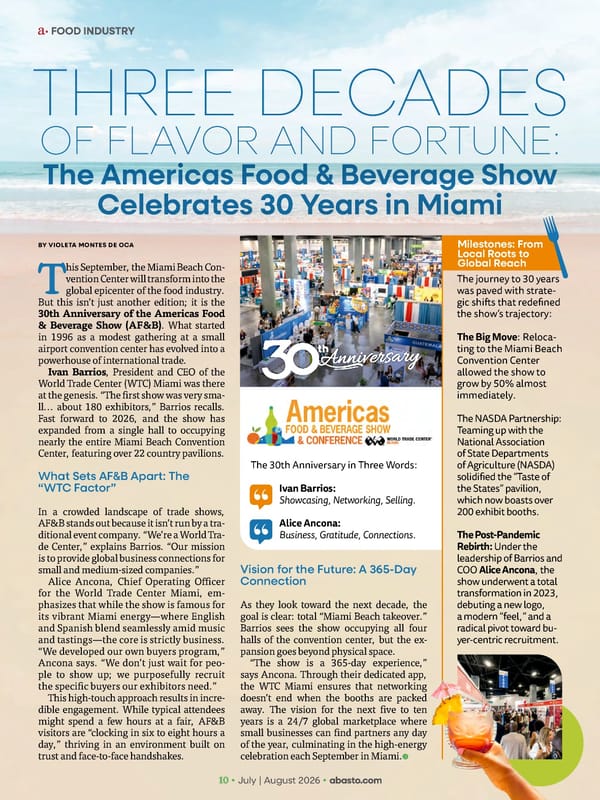
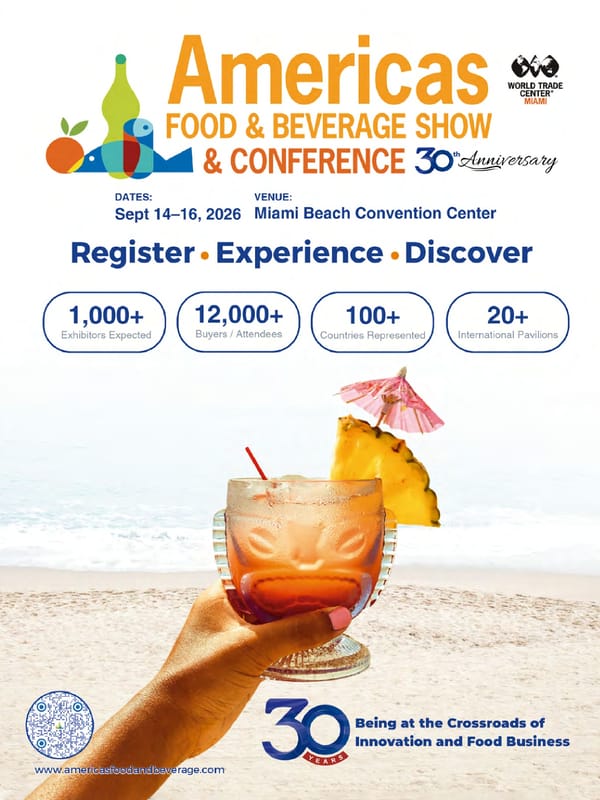
BY VIOLETA MONTES DE OCA T his September, the Miami Beach Con- vention Center will transform into the global epicenter of the food industry. But this isn’t just another edition; it is the 30th Anniversary of the Americas Food & Beverage Show (AF&B) . What started in 1996 as a modest gathering at a small airport convention center has evolved into a powerhouse of international trade. Ivan Barrios , President and CEO of the World Trade Center (WTC) Miami was there at the genesis. “The first show was very sma- ll... about 180 exhibitors,” Barrios recalls. Fast forward to 2026, and the show has expanded from a single hall to occupying nearly the entire Miami Beach Convention Center, featuring over 22 country pavilions. What Sets AF&B Apart: The “WTC Factor” In a crowded landscape of trade shows, AF&B stands out because it isn’t run by a tra- ditional event company. “We’re a World Tra- de Center,” explains Barrios. “Our mission is to provide global business connections for small and medium-sized companies.” Alice Ancona, Chief Operating Officer for the World Trade Center Miami, em- phasizes that while the show is famous for its vibrant Miami energy—where English and Spanish blend seamlessly amid music and tastings—the core is strictly business. “We developed our own buyers program,” Ancona says. “We don’t just wait for peo- ple to show up; we purposefully recruit the specific buyers our exhibitors need.” This high-touch approach results in incre- dible engagement. While typical attendees might spend a few hours at a fair, AF&B visitors are “clocking in six to eight hours a day,” thriving in an environment built on trust and face-to-face handshakes. THREE DECADES OF FLAVOR AND FORTUNE: The Americas Food & Beverage Show Celebrates 30 Years in Miami The journey to 30 years was paved with strate- gic shifts that redefined the show’s trajectory: The Big Move : Reloca- ting to the Miami Beach Convention Center allowed the show to grow by 50% almost immediately. The NASDA Partnership: Teaming up with the National Association of State Departments of Agriculture (NASDA) solidified the “Taste of the States” pavilion, which now boasts over 200 exhibit booths. The Post-Pandemic Rebirth: Under the leadership of Barrios and COO Alice Ancona , the show underwent a total transformation in 2023, debuting a new logo, a modern “feel,” and a radical pivot toward bu- yer-centric recruitment. Vision for the Future: A 365-Day Connection As they look toward the next decade, the goal is clear: total “Miami Beach takeover.” Barrios sees the show occupying all four halls of the convention center, but the ex- pansion goes beyond physical space. “The show is a 365-day experience,” says Ancona. Through their dedicated app, the WTC Miami ensures that networking doesn’t end when the booths are packed away. The vision for the next five to ten years is a 24/7 global marketplace where small businesses can find partners any day of the year, culminating in the high-energy celebration each September in Miami. Milestones: From Local Roots to Global Reach The 30th Anniversary in Three Words: Ivan Barrios: Showcasing, Networking, Selling. Alice Ancona: Business, Gratitude, Connections. 10 • July | August 2026 • abasto.com • FOOD INDUSTRY
11 • July | August 2026 • abasto.com
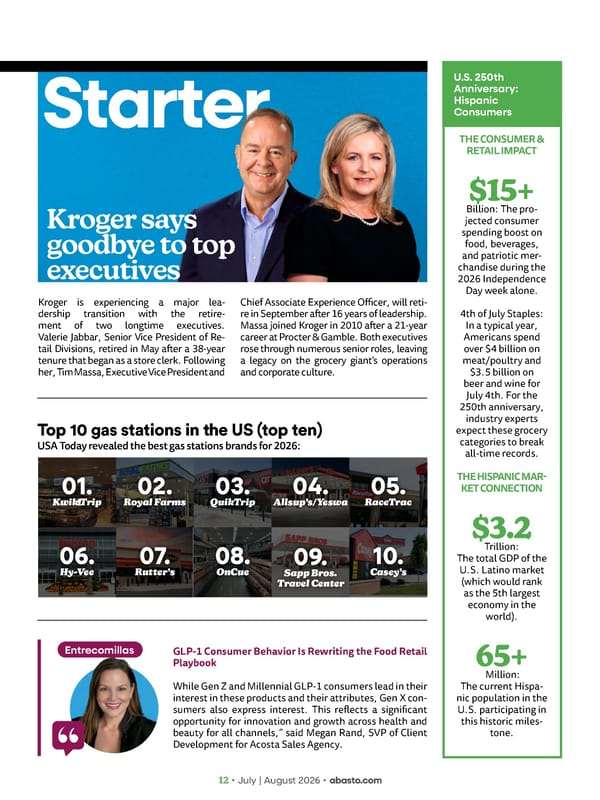
12 • July | August 2026 • abasto.com Top 10 gas stations in the US (top ten) USA Today revealed the best gas stations brands for 2026: 02. Royal Farms 01. 1. Kwik Trip 03. QuikTrip 08. OnCue 04. Allsup’s/Yeswa 09. Sapp Bros. Travel Center 07. Rutter’s 06. Hy-Vee 05. RaceTrac 10. Casey’s Kroger is experiencing a major lea- dership transition with the retire- ment of two longtime executives. Valerie Jabbar, Senior Vice President of Re- tail Divisions, retired in May after a 38-year tenure that began as a store clerk. Following her, Tim Massa, Executive Vice President and Chief Associate Experience Officer, will reti- re in September after 16 years of leadership. Massa joined Kroger in 2010 after a 21-year career at Procter & Gamble. Both executives rose through numerous senior roles, leaving a legacy on the grocery giant’s operations and corporate culture. U.S. 250th Anniversary: Hispanic Consumers THE CONSUMER & RETAIL IMPACT $15+ Billion: The pro- jected consumer spending boost on food, beverages, and patriotic mer- chandise during the 2026 Independence Day week alone. 4th of July Staples: In a typical year, Americans spend over $4 billion on meat/poultry and $3.5 billion on beer and wine for July 4th. For the 250th anniversary, industry experts expect these grocery categories to break all-time records. THE HISPANIC MAR- KET CONNECTION $3.2 Trillion: The total GDP of the U.S. Latino market (which would rank as the 5th largest economy in the world). 65+ Million: The current Hispa- nic population in the U.S. participating in this historic miles- tone. GLP-1 Consumer Behavior Is Rewriting the Food Retail Playbook While Gen Z and Millennial GLP-1 consumers lead in their interest in these products and their attributes, Gen X con- sumers also express interest. This reflects a significant opportunity for innovation and growth across health and beauty for all channels,” said Megan Rand, SVP of Client Development for Acosta Sales Agency. Entrecomillas Starter Kroger says goodbye to top executives
13 • July | August 2026 • abasto.com

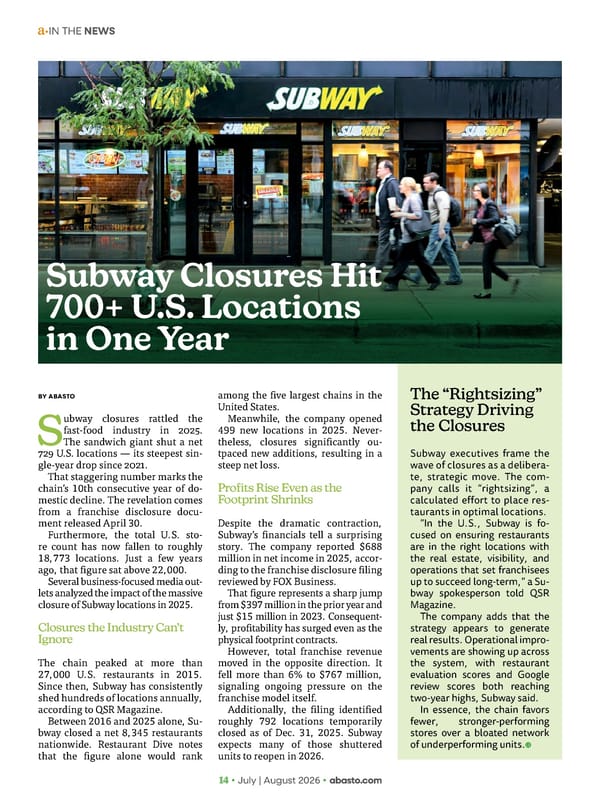
14 • July | August 2026 • abasto.com • IN THE NEWS BY ABASTO S ubway closures rattled the fast-food industry in 2025. The sandwich giant shut a net 729 U.S. locations — its steepest sin- gle-year drop since 2021. That staggering number marks the chain’s 10th consecutive year of do- mestic decline. The revelation comes from a franchise disclosure docu- ment released April 30. Furthermore, the total U.S. sto- re count has now fallen to roughly 18,773 locations. Just a few years ago, that figure sat above 22,000. Several business-focused media out- lets analyzed the impact of the massive closure of Subway locations in 2025. Closures the Industry Can’t Ignore The chain peaked at more than 27,000 U.S. restaurants in 2015. Since then, Subway has consistently shed hundreds of locations annually, according to QSR Magazine. Between 2016 and 2025 alone, Su- bway closed a net 8,345 restaurants nationwide. Restaurant Dive notes that the figure alone would rank among the five largest chains in the United States. Meanwhile, the company opened 499 new locations in 2025. Never- theless, closures significantly ou- tpaced new additions, resulting in a steep net loss. Profits Rise Even as the Footprint Shrinks Despite the dramatic contraction, Subway’s financials tell a surprising story. The company reported $688 million in net income in 2025, accor- ding to the franchise disclosure filing reviewed by FOX Business. That figure represents a sharp jump from $397 million in the prior year and just $15 million in 2023. Consequent- ly, profitability has surged even as the physical footprint contracts. However, total franchise revenue moved in the opposite direction. It fell more than 6% to $767 million, signaling ongoing pressure on the franchise model itself. Additionally, the filing identified roughly 792 locations temporarily closed as of Dec. 31, 2025. Subway expects many of those shuttered units to reopen in 2026. The “Rightsizing” Strategy Driving the Closures Subway executives frame the wave of closures as a delibera- te, strategic move. The com- pany calls it “rightsizing”, a calculated effort to place res- taurants in optimal locations. “In the U.S., Subway is fo- cused on ensuring restaurants are in the right locations with the real estate, visibility, and operations that set franchisees up to succeed long-term,” a Su- bway spokesperson told QSR Magazine. The company adds that the strategy appears to generate real results. Operational impro- vements are showing up across the system, with restaurant evaluation scores and Google review scores both reaching two-year highs, Subway said. In essence, the chain favors fewer, stronger-performing stores over a bloated network of underperforming units. Subway Closures Hit 700+ U.S. Locations in One Year
15 • July | August 2026 • abasto.com
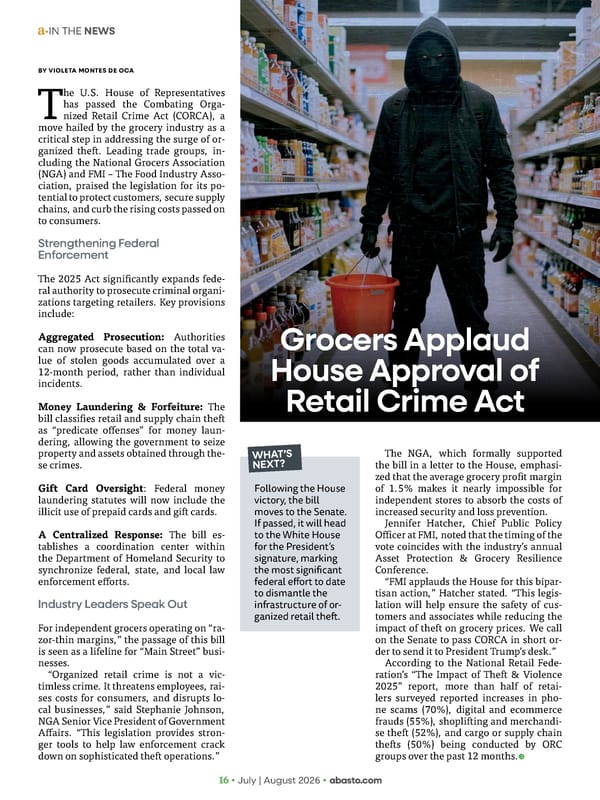
16 • July | August 2026 • abasto.com BY VIOLETA MONTES DE OCA T he U.S. House of Representatives has passed the Combating Orga- nized Retail Crime Act (CORCA), a move hailed by the grocery industry as a critical step in addressing the surge of or- ganized theft. Leading trade groups, in- cluding the National Grocers Association (NGA) and FMI – The Food Industry Asso- ciation, praised the legislation for its po- tential to protect customers, secure supply chains, and curb the rising costs passed on to consumers. Strengthening Federal Enforcement The 2025 Act significantly expands fede- ral authority to prosecute criminal organi- zations targeting retailers. Key provisions include: Aggregated Prosecution: Authorities can now prosecute based on the total va- lue of stolen goods accumulated over a 12-month period, rather than individual incidents. Money Laundering & Forfeiture: The bill classifies retail and supply chain theft as “predicate offenses” for money laun- dering, allowing the government to seize property and assets obtained through the- se crimes. Gift Card Oversight : Federal money laundering statutes will now include the illicit use of prepaid cards and gift cards. A Centralized Response: The bill es- tablishes a coordination center within the Department of Homeland Security to synchronize federal, state, and local law enforcement efforts. Industry Leaders Speak Out For independent grocers operating on “ra- zor-thin margins,” the passage of this bill is seen as a lifeline for “Main Street” busi- nesses. “Organized retail crime is not a vic- timless crime. It threatens employees, rai- ses costs for consumers, and disrupts lo- cal businesses,” said Stephanie Johnson, NGA Senior Vice President of Government Affairs. “This legislation provides stron- ger tools to help law enforcement crack down on sophisticated theft operations.” The NGA, which formally supported the bill in a letter to the House, emphasi- zed that the average grocery profit margin of 1.5% makes it nearly impossible for independent stores to absorb the costs of increased security and loss prevention. Jennifer Hatcher, Chief Public Policy Officer at FMI, noted that the timing of the vote coincides with the industry’s annual Asset Protection & Grocery Resilience Conference. “FMI applauds the House for this bipar- tisan action,” Hatcher stated. “This legis- lation will help ensure the safety of cus- tomers and associates while reducing the impact of theft on grocery prices. We call on the Senate to pass CORCA in short or- der to send it to President Trump’s desk.” According to the National Retail Fede- ration’s “The Impact of Theft & Violence 2025” report, more than half of retai- lers surveyed reported increases in pho- ne scams (70%), digital and ecommerce frauds (55%), shoplifting and merchandi- se theft (52%), and cargo or supply chain thefts (50%) being conducted by ORC groups over the past 12 months. Following the House victory, the bill moves to the Senate. If passed, it will head to the White House for the President’s signature, marking the most significant federal effort to date to dismantle the infrastructure of or- ganized retail theft. Grocers Applaud House Approval of Retail Crime Act WHAT’S NEXT? • IN THE NEWS
17 • July | August 2026 • abasto.com
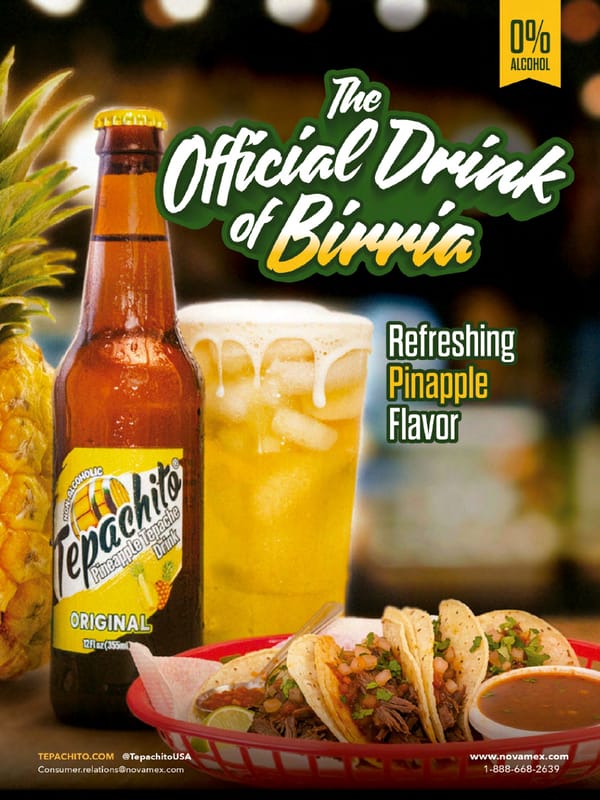
18 • July | August 2026 • abasto.com BY ABASTO T he 13th edition of Alimentec | Anu- ga Select Colombia 2026, held at Corferias (Bogotá), concluded with resounding success. This year marked a historic milestone with the event’s for- mal integration into the global Anuga ne- twork, the world’s largest specialized trade fair ecosystem. The event attracted more than 39,000 trade visitors and brought together more than 650 exhibitors with delegations from 22 countries. On the business front, the trade show exceeded expectations by generating pro- jected business deals worth more than 16 million USD and securing 1,270 business meetings through a business matchma- king session that connected 107 national and international buyers from 18 coun- tries with 384 exhibitors. Well-established companies took advan- tage of the event to expand: Grupo Diana officially launched its institutional line, “Diana Profesional.” At the same time, Aví- cola El Guamito secured market entries into destinations as diverse as Chile and Greece. The Highlight of Alimentec The central theme of the fair was “Origin Matters,” in response to a strong global trend in which consumers demand transparency about the origin and impact of food. The new unprocessed foods pavilion, focused on the value of origin, became one of the most popular stops for industry professionals. In addition to its commercial success, the fair stood out for its robust academic and experiential components, offering 168 activities (including 143 talks, 17 workshops, and 8 masterclasses) led by approximately 220 speakers. These activities were distributed across nine specialized zones, such as the Food Innovation Summit and Cooking Shows. One of the most memorable moments was the qualifying round of the Paco To- rreblanca International Haute Pâtisserie Award, where chef Jonathan Buitrago won the professional category with his “Macondo” cake, securing his spot to re- present Colombia in the final in Spain. Corferias and Koelnmesse are planning the next edition of Alimentec for June 6–9, 2028. Colombia’s Alimentec 2026 Draws 39,000 Buyers, Joins Anuga Network Save the date: AT THE HALLWAYS 1. Cristian Guarín and Alberto Almanza, organizers. 2. Luis García of Salsa Huichol. 3. Pelayo Soneira of AVANTI. 4. Isabella Vernaza of Ventonilli. 5. José Abad and Sergio Sarmiento of Alquería Colombia. 6. José Calderón and Luis Hernández of Coope- rativa Colanta. 1 2 3 5 6 4 • TRADE SHOWS
19 • July | August 2026 • abasto.com

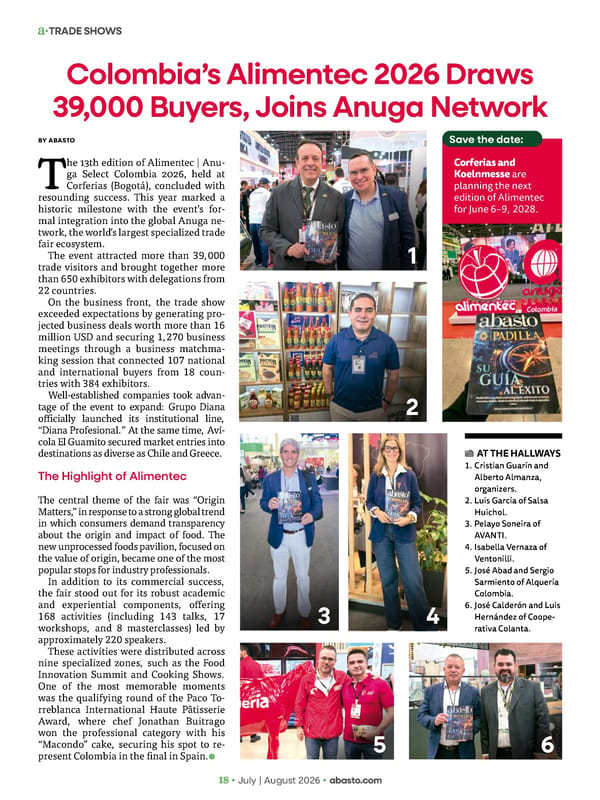
20 • Julio | Agosto 2026 • abasto.com BY ABASTO S NAP food restrictions sweeping across 19 states could wipe out up to $830 million in soda, candy, and energy drink sales by year’s end, according to new Numerator research. The consumer data firm released its “SNAP in Transition” report, combining verified purchase data with a survey of over 1,000 SNAP households. Together, they paint a sharp picture of a program under significant structural pressure. Three Disruptions Hit SNAP at Once The program recently absorbed three si- multaneous shocks. First, a government benefit blackout hit in November 2025. Se- cond, states began rolling out Food Restric- tion Waivers. Third, the One Big Beautiful Bill Act (OBBBA) tightened participant eligi- bility nationwide. The 43-day government shutdown — the longest in U.S. history — triggered imme- diate behavioral changes. Weekly grocery spending among SNAP households fell 10%, dropping from $233 to $210 between early and late October. Consumers cut deferrable categories first. SNAP Food Restrictions Put $830M in Grocery Sales at Risk Hardware purchases dropped 18%, fast food restaurant desserts fell 10%, and be- verages declined 6% during the four-week period ending Nov. 9, 2025. Retailers felt the traffic pain acutely. 7-Eleven lost 18% of SNAP shopper visits, Amazon dropped 17%, and Shell, Circle K, and Wawa each recorded double-digit declines. SNAP Food Restrictions Reshape Eligible Purchases Food Restriction Waivers now represent the program’s most structural long-term change. By the end of 2026, 19 states will carry active waivers, covering roughly one- third of all SNAP participants, approximate- ly 7.5 million households. The restrictions target soda, candy, and energy drinks. Critically, these categories already see higher engagement in waiver states. In active FRW states, soft drinks were present in 23% of SNAP trips, compared with 18% in non-waiver states. Candy showed similar patterns, 21% trip inclusion in FRW states versus 17% el- sewhere. Energy drinks registered at 10% versus 8%. These numbers signal the res- trictions arrive exactly where SNAP dollars flow most freely. Consumers Plan to Adapt, But Sales Will Still Suffer Shopper awareness is high. A notable 86% of SNAP households in FRW states say they already know restrictions are coming. Many plan to adjust their spending rather than go without. For soda, 63% of SNAP consumers say they would spend non-SNAP dollars to keep buying — either at the same level or trading down to cheaper alternatives. Candy drew 60% saying the same. Energy drinks trailed at 45%. Still, losses will accumulate. Numera- tor projects soda could absorb up to $430 million in sales declines. Candy faces up to $300 million in risk. Energy drinks round out the exposure at $100 million. What Retailers and Brands Should Do Now Numerator closes the report with a strategic framework: Discern, De-average, and Defend. Brands should carefully profile SNAP shoppers and distinguish between pullbacks stemming from lost benefits and those from restricted eligibi- lity. They should also resist uniform national strategies, since category and geographic pressures vary widely. Most important- ly, they must lean into value. SNAP shoppers are acti- vely seeking utility, durability, and cost efficiency, and retailers that deliver those signals clearly will hold their share in a tightening envi- ronment. • ECONOMY FOCUS
21 • July | August 2026 • abasto.com
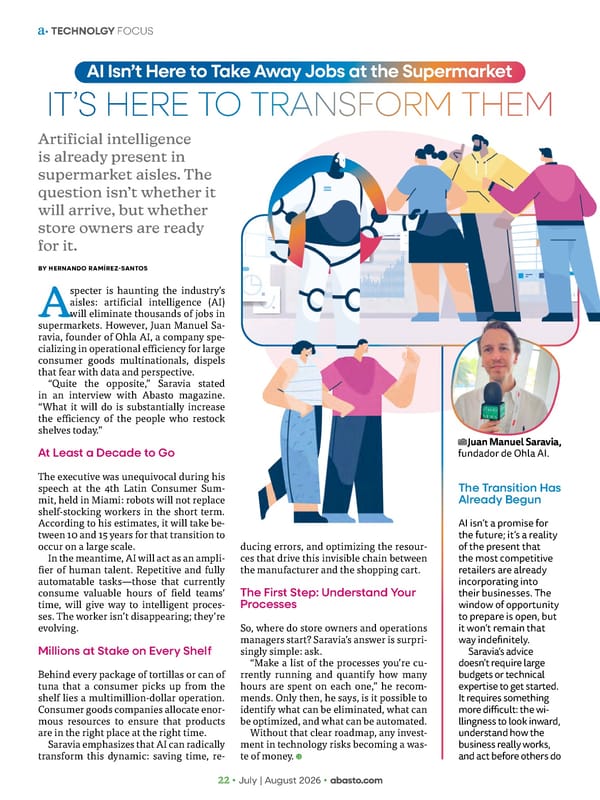
22 • July | August 2026 • abasto.com BY HERNANDO RAMÍREZ-SANTOS A specter is haunting the industry’s aisles: artificial intelligence (AI) will eliminate thousands of jobs in supermarkets. However, Juan Manuel Sa- ravia, founder of Ohla AI, a company spe- cializing in operational efficiency for large consumer goods multinationals, dispels that fear with data and perspective. “Quite the opposite,” Saravia stated in an interview with Abasto magazine. “What it will do is substantially increase the efficiency of the people who restock shelves today.” At Least a Decade to Go The executive was unequivocal during his speech at the 4th Latin Consumer Sum- mit, held in Miami: robots will not replace shelf-stocking workers in the short term. According to his estimates, it will take be- tween 10 and 15 years for that transition to occur on a large scale. In the meantime, AI will act as an ampli- fier of human talent. Repetitive and fully automatable tasks—those that currently consume valuable hours of field teams’ time, will give way to intelligent proces- ses. The worker isn’t disappearing; they’re evolving. Millions at Stake on Every Shelf Behind every package of tortillas or can of tuna that a consumer picks up from the shelf lies a multimillion-dollar operation. Consumer goods companies allocate enor- mous resources to ensure that products are in the right place at the right time. Saravia emphasizes that AI can radically transform this dynamic: saving time, re- IT’S HERE TO TRANSFORM THEM Artificial intelligence is already present in supermarket aisles. The question isn’t whether it will arrive, but whether store owners are ready for it. ducing errors, and optimizing the resour- ces that drive this invisible chain between the manufacturer and the shopping cart. The First Step: Understand Your Processes So, where do store owners and operations managers start? Saravia’s answer is surpri- singly simple: ask. “Make a list of the processes you’re cu- rrently running and quantify how many hours are spent on each one,” he recom- mends. Only then, he says, is it possible to identify what can be eliminated, what can be optimized, and what can be automated. Without that clear roadmap, any invest- ment in technology risks becoming a was- te of money. The Transition Has Already Begun AI isn’t a promise for the future; it’s a reality of the present that the most competitive retailers are already incorporating into their businesses. The window of opportunity to prepare is open, but it won’t remain that way indefinitely. Saravia’s advice doesn’t require large budgets or technical expertise to get started. It requires something more difficult: the wi- llingness to look inward, understand how the business really works, and act before others do AI Isn’t Here to Take Away Jobs at the Supermarket J uan Manuel Saravia, fundador de Ohla AI. • TECHNOLGY FOCUS
23 • July | August 2026 • abasto.com
24 • July | August 2026 • abasto.com THE NEXT WAVE OF SPARKLE AFTER MASTERING UNFLAVORED SPARKLING WATER, MINERAGUA IS BRINGING THE POWER OF JARRITOS FLAVORS TO A FAST-GROWING NEW SEGMENT FROM RISING BRAND TO CATEGORY LEADER Mineragua’s growth story has been years in the making. Built on authentic Mexican heri- tage, bold carbonation, and a distinctive mi- neral profile, the brand has steadily expan- ded its presence across grocery, convenience, club, and independent retail channels. Earlier this year, that momentum recei- ved national validation when Mineragua was named the No. 1 sparkling water in a blind taste test conducted by Serious Eats , outperforming some of the category’s most recognized brands. TURNING OPPORTUNITY INTO GROWTH As supply disruptions created challenges for some mineral water brands in the Uni- ted States, retailers searched for dependa- ble alternatives. Mineragua was uniquely positioned to step in, offering premium glass packaging, lasting carbonation, strong consumer lo- yalty, and consistent supply. What began as an opportunity quickly became a market shift, as more consumers discovered, and stayed with the brand. DISTRIBUTION IS GOOD. VISIBILITY IS BETTER Adding Mineragua to the shelves is just the first step. Retailers looking to maxi- mize sales can promote the brand through display activities, placement in refrigera- ted display cases, and secondary display locations. The stores seeing the strongest results are those giving shoppers multiple opportuni- ties to find the brand throughout the store. ARTICLE COURTESY NOVAMEX • OUR COVER
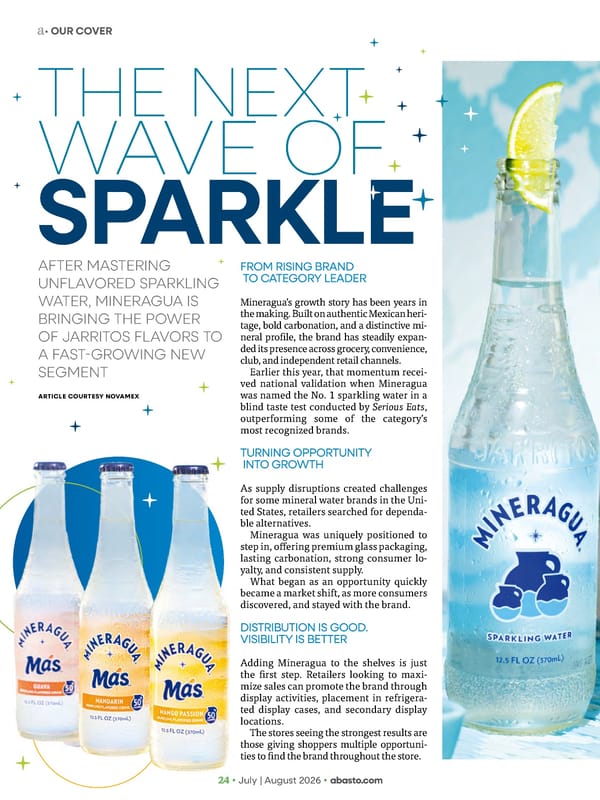
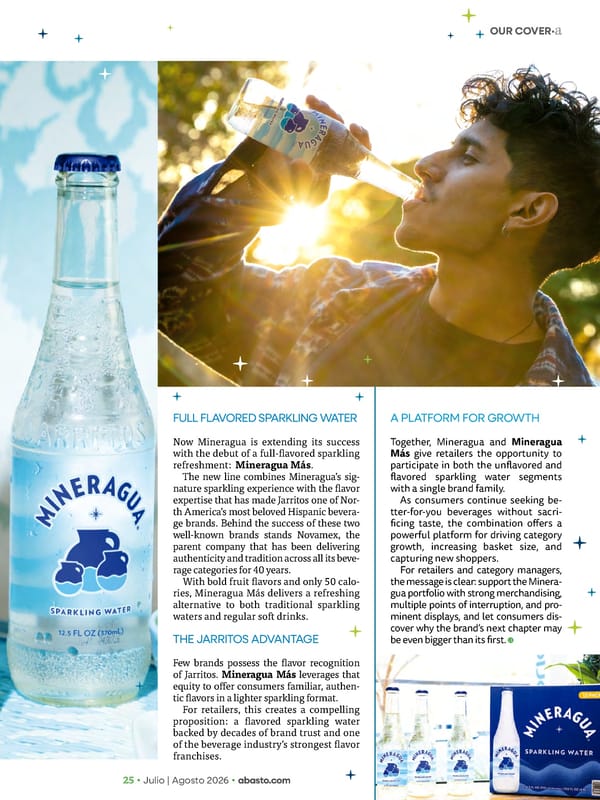
25 • Julio | Agosto 2026 • abasto.com OUR COVER • FULL FLAVORED SPARKLING WATER Now Mineragua is extending its success with the debut of a full-flavored sparkling refreshment: Mineragua Más . The new line combines Mineragua’s sig- nature sparkling experience with the flavor expertise that has made Jarritos one of Nor- th America’s most beloved Hispanic bevera- ge brands. Behind the success of these two well-known brands stands Novamex, the parent company that has been delivering authenticity and tradition across all its beve- rage categories for 40 years. With bold fruit flavors and only 50 calo- ries, Mineragua Más delivers a refreshing alternative to both traditional sparkling waters and regular soft drinks. THE JARRITOS ADVANTAGE Few brands possess the flavor recognition of Jarritos. Mineragua Más leverages that equity to offer consumers familiar, authen- tic flavors in a lighter sparkling format. For retailers, this creates a compelling proposition: a flavored sparkling water backed by decades of brand trust and one of the beverage industry’s strongest flavor franchises. A PLATFORM FOR GROWTH Together, Mineragua and Mineragua Más give retailers the opportunity to participate in both the unflavored and flavored sparkling water segments with a single brand family. As consumers continue seeking be- tter-for-you beverages without sacri- ficing taste, the combination offers a powerful platform for driving category growth, increasing basket size, and capturing new shoppers. For retailers and category managers, the message is clear: support the Minera- gua portfolio with strong merchandising, multiple points of interruption, and pro- minent displays, and let consumers dis- cover why the brand’s next chapter may be even bigger than its first.
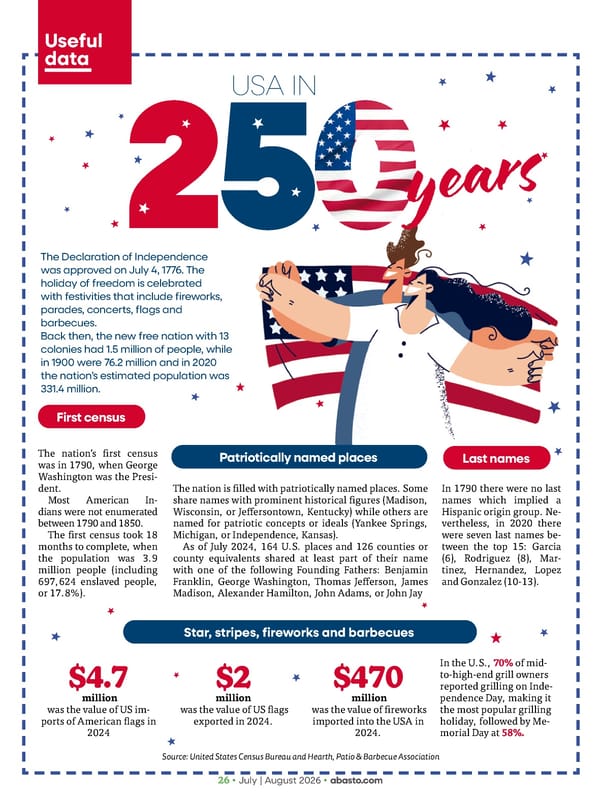
26 • July | August 2026 • abasto.com The Declaration of Independence was approved on July 4, 1776. The holiday of freedom is celebrated with festivities that include fireworks, parades, concerts, flags and barbecues. Back then, the new free nation with 13 colonies had 1.5 million of people, while in 1900 were 76.2 million and in 2020 the nation’s estimated population was 331.4 million. First census Patriotically named places Last names Star, stripes, fireworks and barbecues $4.7 million was the value of US im- ports of American flags in 2024 $2 million was the value of US flags exported in 2024. $470 million was the value of fireworks imported into the USA in 2024. In the U.S., 70% of mid- to-high-end grill owners reported grilling on Inde- pendence Day, making it the most popular grilling holiday, followed by Me- morial Day at 58%. USA IN The nation is filled with patriotically named places. Some share names with prominent historical figures (Madison, Wisconsin, or Jeffersontown, Kentucky) while others are named for patriotic concepts or ideals (Yankee Springs, Michigan, or Independence, Kansas). As of July 2024, 164 U.S. places and 126 counties or county equivalents shared at least part of their name with one of the following Founding Fathers: Benjamin Franklin, George Washington, Thomas Jefferson, James Madison, Alexander Hamilton, John Adams, or John Jay Source: United States Census Bureau and Hearth, Patio & Barbecue Association Useful data The nation’s first census was in 1790, when George Washington was the Presi- dent. Most American In- dians were not enumerated between 1790 and 1850. The first census took 18 months to complete, when the population was 3.9 million people (including 697,624 enslaved people, or 17.8%). In 1790 there were no last names which implied a Hispanic origin group. Ne- vertheless, in 2020 there were seven last names be- tween the top 15: Garcia (6), Rodriguez (8), Mar- tinez, Hernandez, Lopez and Gonzalez (10-13).
27 • July | August 2026 • abasto.com
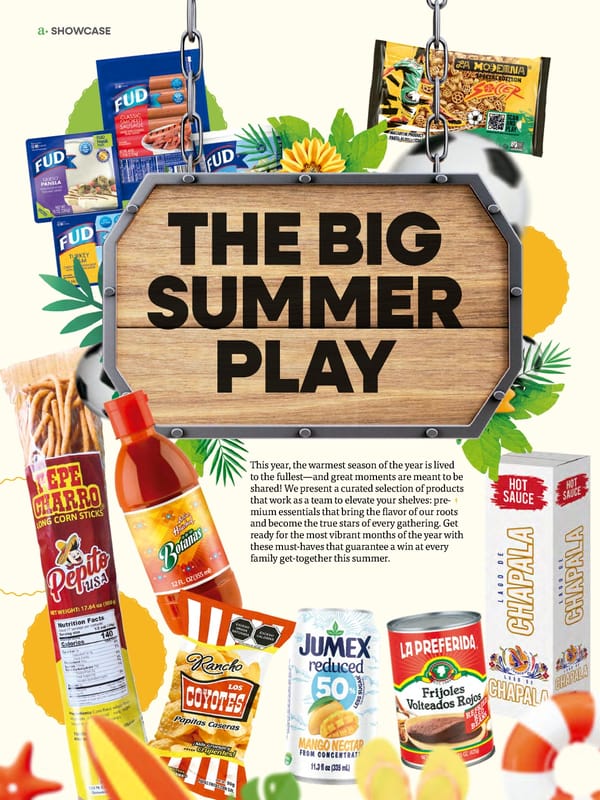
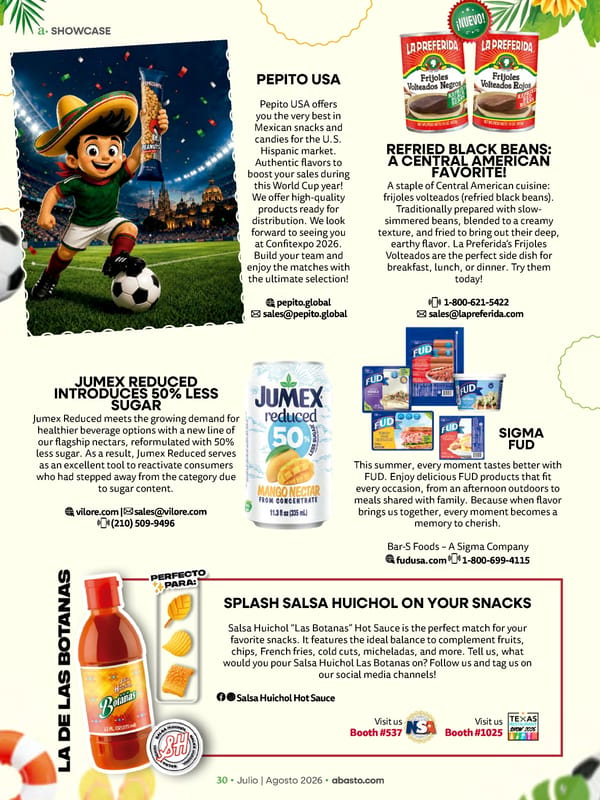
THE BIG SUMMER PLAY This year, the warmest season of the year is lived to the fullest—and great moments are meant to be shared! We present a curated selection of products that work as a team to elevate your shelves: pre- mium essentials that bring the flavor of our roots and become the true stars of every gathering. Get ready for the most vibrant months of the year with these must-haves that guarantee a win at every family get-together this summer. • SHOWCASE
29 • July | August 2026 • abasto.com
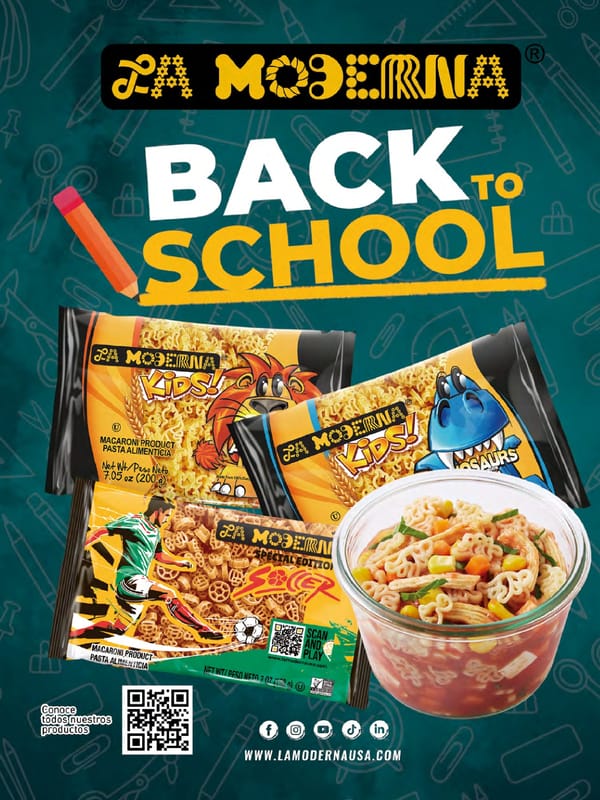
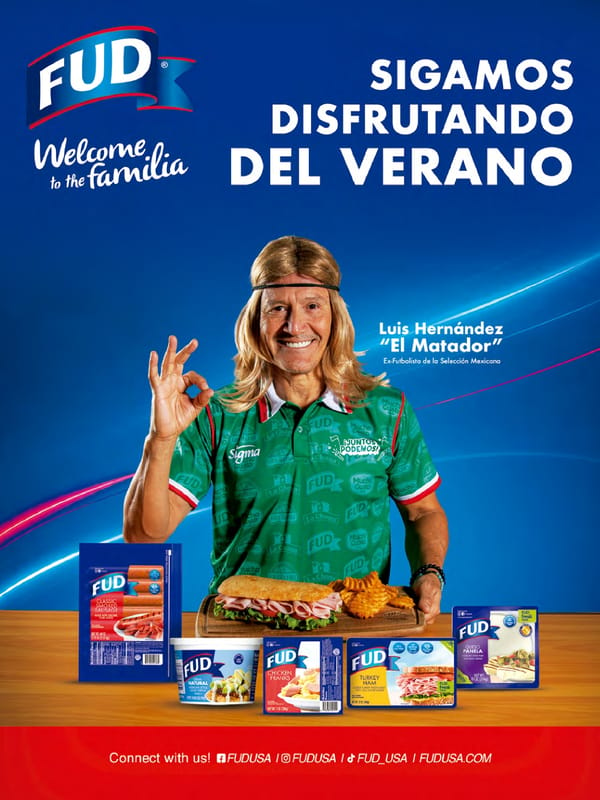
PEPITO USA Pepito USA offers you the very best in Mexican snacks and candies for the U.S. Hispanic market. Authentic flavors to boost your sales during this World Cup year! We offer high-quality products ready for distribution. We look forward to seeing you at Confitexpo 2026. Build your team and enjoy the matches with the ultimate selection! pepito.global sales@pepito.global 30 • Julio | Agosto 2026 • abasto.com SPLASH SALSA HUICHOL ON YOUR SNACKS Salsa Huichol “Las Botanas” Hot Sauce is the perfect match for your favorite snacks. It features the ideal balance to complement fruits, chips, French fries, cold cuts, micheladas, and more. Tell us, what would you pour Salsa Huichol Las Botanas on? Follow us and tag us on our social media channels! Salsa Huichol Hot Sauce Visit us Booth #537 Visit us Booth #1025 • SHOWCASE REFRIED BLACK BEANS: A CENTRAL AMERICAN FAVORITE! A staple of Central American cuisine: frijoles volteados (refried black beans). Traditionally prepared with slow- simmered beans, blended to a creamy texture, and fried to bring out their deep, earthy flavor. La Preferida’s Frijoles Volteados are the perfect side dish for breakfast, lunch, or dinner. Try them today! 1-800-621-5422 sales@lapreferida.com This summer, every moment tastes better with FUD. Enjoy delicious FUD products that fit every occasion, from an afternoon outdoors to meals shared with family. Because when flavor brings us together, every moment becomes a memory to cherish. Bar-S Foods – A Sigma Company fudusa.com 1-800-699-4115 SIGMA FUD JUMEX REDUCED INTRODUCES 50% LESS SUGAR Jumex Reduced meets the growing demand for healthier beverage options with a new line of our flagship nectars, reformulated with 50% less sugar. As a result, Jumex Reduced serves as an excellent tool to reactivate consumers who had stepped away from the category due to sugar content. vilore.com | sales@vilore.com (210) 509-9496
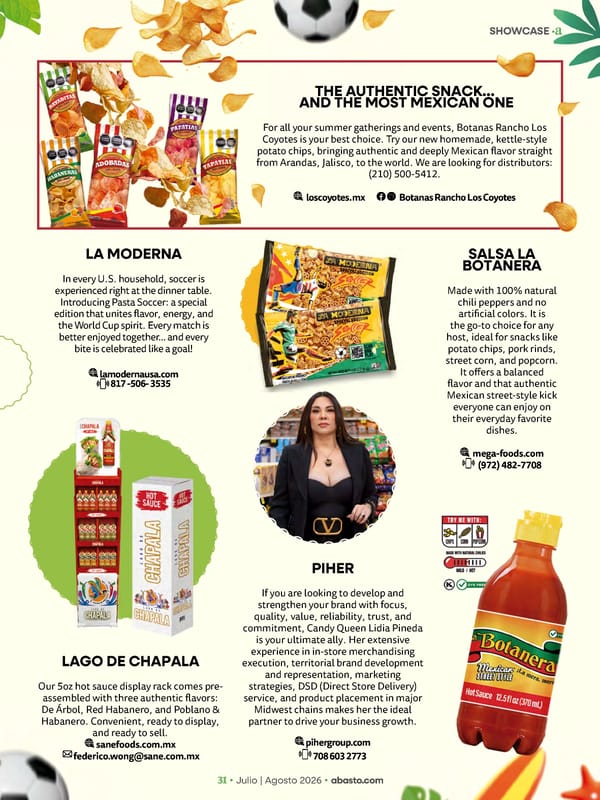
SHOWCASE • THE AUTHENTIC SNACK... AND THE MOST MEXICAN ONE For all your summer gatherings and events, Botanas Rancho Los Coyotes is your best choice. Try our new homemade, kettle-style potato chips, bringing authentic and deeply Mexican flavor straight from Arandas, Jalisco, to the world. We are looking for distributors: (210) 500-5412. loscoyotes.mx Botanas Rancho Los Coyotes 31 • Julio | Agosto 2026 • abasto.com LAGO DE CHAPALA Our 5oz hot sauce display rack comes pre- assembled with three authentic flavors: De Árbol, Red Habanero, and Poblano & Habanero. Convenient, ready to display, and ready to sell. sanefoods.com.mx federico.wong@sane.com.mx SALSA LA BOTANERA Made with 100% natural chili peppers and no artificial colors. It is the go-to choice for any host, ideal for snacks like potato chips, pork rinds, street corn, and popcorn. It offers a balanced flavor and that authentic Mexican street-style kick everyone can enjoy on their everyday favorite dishes. mega-foods.com (972) 482-7708 LA MODERNA In every U.S. household, soccer is experienced right at the dinner table. Introducing Pasta Soccer: a special edition that unites flavor, energy, and the World Cup spirit. Every match is better enjoyed together... and every bite is celebrated like a goal! lamodernausa.com 817 -506- 3535 PIHER If you are looking to develop and strengthen your brand with focus, quality, value, reliability, trust, and commitment, Candy Queen Lidia Pineda is your ultimate ally. Her extensive experience in in-store merchandising execution, territorial brand development and representation, marketing strategies, DSD (Direct Store Delivery) service, and product placement in major Midwest chains makes her the ideal partner to drive your business growth. pihergroup.com 708 603 2773
32 • July | August 2026 • abasto.com POR RICARDO GAITÁN ANALISTA DE MARCA D uring the World Cup, FIFA’s commercial ecosystem rea- ches its peak: official sponsors and advertising brands implement global strategies for brand positio- ning, regional presence, and engage- ment with diverse audiences through stadiums, the media, and digital pla- tforms. By 2026, record investment in brand activations is expected, dri- ven by the tournament being held in three markets of enormous impor- tance to the sports industry: the Uni- ted States, Mexico, and Canada. The commercial structure combi- nes global partners with broad image rights, official tournament sponsors, and regional partners that comple- ment the brands’ presence across di- fferent layers of the event. Advertising Tool It is in this context that “opportunity marketing” emerges—an unconven- tional practice that FIFA has been combating for decades, and one that starkly reveals how the attention eco- nomy works today. The persistence of this advertising The World Cup and Opportunity Marketing tool demonstrates that, when visibili- ty is worth millions, there will always be brands willing to get a piece of the pie, without paying. The opportunity marketing strate- gy consists of creating an association with the event through parallel cam- paigns, a presence in nearby settings, themed messages, and high-impact actions that capitalize on public en- thusiasm, without crossing the boun- daries of established sponsorship. Events such as the World Cup, the Olympics, the Tour de France, and Formula 1, among others, drive up sales not only of sporting goods and mass-market consumer products like beverages and food but also of travel agencies, transportation services, te- levision broadcasts, stadium admis- sions, and more. Significant Profits The goal is not only to gain visibility by capitalizing on an already enga- ged audience but also to generate fi- nancial profits. One of the most frequently cited examples is Nike’s campaign during the 2012 Olympic Games. Although the German brand Adidas was the offi- cial sponsor, Nike launched the “Find Your Greatness” campaign without using the event’s official symbols. The American company mana- ged to insert itself into the global conversation and compete with the official sponsor for media attention. That episode encapsulates the logic of opportunity marketing: it doesn’t need to invade the event to affect the symbolic and commercial value of those who paid to be there. Opportunity marketing has be- come increasingly sophisticated as sponsorship globalizes and techno- logy expands the range of exposure channels. The Consequences Today, any brand can establish a pre- sence at a World Cup event throu- gh social media, urban activations, athlete sponsorships, or audiovisual campaigns designed to evoke any event without mentioning it directly. In this scenario, opportunistic marketing is the logical consequence of an ecosystem in which the atten- tion economy is the top prize and the boundaries between what is official and what is implied are increasingly blurred. The fundamental question is no lon- ger how to curb the phenomenon, but rather to what extent the very business model of mega-events—with the astro- nomical fees they charge brands to be official sponsors—has created the con- ditions for it to thrive. • ADVICE

33 • July | August 2026 • abasto.com

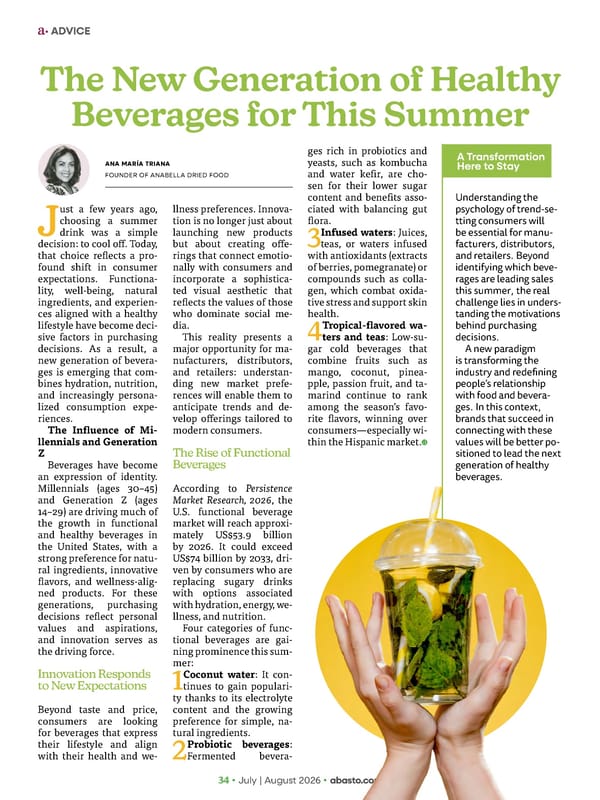
34 • July | August 2026 • abasto.com ANA MARÍA TRIANA FOUNDER OF ANABELLA DRIED FOOD The New Generation of Healthy Beverages for This Summer ges rich in probiotics and yeasts, such as kombucha and water kefir, are cho- sen for their lower sugar content and benefits asso- ciated with balancing gut flora. 3 Infused waters : Juices, teas, or waters infused with antioxidants (extracts of berries, pomegranate) or compounds such as colla- gen, which combat oxida- tive stress and support skin health. 4 Tropical-flavored wa- ters and teas : Low-su- gar cold beverages that combine fruits such as mango, coconut, pinea- pple, passion fruit, and ta- marind continue to rank among the season’s favo- rite flavors, winning over consumers—especially wi- thin the Hispanic market. Understanding the psychology of trend-se- tting consumers will be essential for manu- facturers, distributors, and retailers. Beyond identifying which beve- rages are leading sales this summer, the real challenge lies in unders- tanding the motivations behind purchasing decisions. A new paradigm is transforming the industry and redefining people’s relationship with food and bevera- ges. In this context, brands that succeed in connecting with these values will be better po- sitioned to lead the next generation of healthy beverages. A Transformation Here to Stay J ust a few years ago, choosing a summer drink was a simple decision: to cool off. Today, that choice reflects a pro- found shift in consumer expectations. Functiona- lity, well-being, natural ingredients, and experien- ces aligned with a healthy lifestyle have become deci- sive factors in purchasing decisions. As a result, a new generation of bevera- ges is emerging that com- bines hydration, nutrition, and increasingly persona- lized consumption expe- riences. The Influence of Mi- llennials and Generation Z Beverages have become an expression of identity. Millennials (ages 30–45) and Generation Z (ages 14–29) are driving much of the growth in functional and healthy beverages in the United States, with a strong preference for natu- ral ingredients, innovative flavors, and wellness-alig- ned products. For these generations, purchasing decisions reflect personal values and aspirations, and innovation serves as the driving force. Innovation Responds to New Expectations Beyond taste and price, consumers are looking for beverages that express their lifestyle and align with their health and we- llness preferences. Innova- tion is no longer just about launching new products but about creating offe- rings that connect emotio- nally with consumers and incorporate a sophistica- ted visual aesthetic that reflects the values of those who dominate social me- dia. This reality presents a major opportunity for ma- nufacturers, distributors, and retailers: understan- ding new market prefe- rences will enable them to anticipate trends and de- velop offerings tailored to modern consumers. The Rise of Functional Beverages According to Persistence Market Research, 2026 , the U.S. functional beverage market will reach approxi- mately US$53.9 billion by 2026. It could exceed US$74 billion by 2033, dri- ven by consumers who are replacing sugary drinks with options associated with hydration, energy, we- llness, and nutrition. Four categories of func- tional beverages are gai- ning prominence this sum- mer: 1 Coconut water : It con- tinues to gain populari- ty thanks to its electrolyte content and the growing preference for simple, na- tural ingredients. 2 Probiotic beverages : Fermented bevera- • ADVICE
35 • July | August 2026 • abasto.com
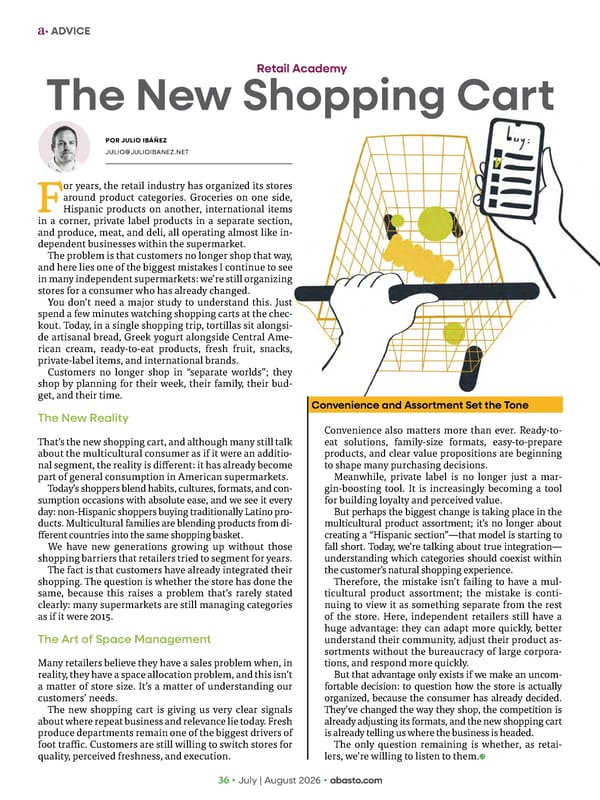
36 • July | August 2026 • abasto.com POR JULIO IBÁÑEZ JULIO@JULIOIBANEZ.NET F or years, the retail industry has organized its stores around product categories. Groceries on one side, Hispanic products on another, international items in a corner, private label products in a separate section, and produce, meat, and deli, all operating almost like in- dependent businesses within the supermarket. The problem is that customers no longer shop that way, and here lies one of the biggest mistakes I continue to see in many independent supermarkets: we’re still organizing stores for a consumer who has already changed. You don’t need a major study to understand this. Just spend a few minutes watching shopping carts at the chec- kout. Today, in a single shopping trip, tortillas sit alongsi- de artisanal bread, Greek yogurt alongside Central Ame- rican cream, ready-to-eat products, fresh fruit, snacks, private-label items, and international brands. Customers no longer shop in “separate worlds”; they shop by planning for their week, their family, their bud- get, and their time. The New Reality That’s the new shopping cart, and although many still talk about the multicultural consumer as if it were an additio- nal segment, the reality is different: it has already become part of general consumption in American supermarkets. Today’s shoppers blend habits, cultures, formats, and con- sumption occasions with absolute ease, and we see it every day: non-Hispanic shoppers buying traditionally Latino pro- ducts. Multicultural families are blending products from di- fferent countries into the same shopping basket. We have new generations growing up without those shopping barriers that retailers tried to segment for years. The fact is that customers have already integrated their shopping. The question is whether the store has done the same, because this raises a problem that’s rarely stated clearly: many supermarkets are still managing categories as if it were 2015. The Art of Space Management Many retailers believe they have a sales problem when, in reality, they have a space allocation problem, and this isn’t a matter of store size. It’s a matter of understanding our customers’ needs. The new shopping cart is giving us very clear signals about where repeat business and relevance lie today. Fresh produce departments remain one of the biggest drivers of foot traffic. Customers are still willing to switch stores for quality, perceived freshness, and execution. The New Shopping Cart Retail Academy Convenience and Assortment Set the Tone • ADVICE Convenience also matters more than ever. Ready-to- eat solutions, family-size formats, easy-to-prepare products, and clear value propositions are beginning to shape many purchasing decisions. Meanwhile, private label is no longer just a mar- gin-boosting tool. It is increasingly becoming a tool for building loyalty and perceived value. But perhaps the biggest change is taking place in the multicultural product assortment; it’s no longer about creating a “Hispanic section”—that model is starting to fall short. Today, we’re talking about true integration— understanding which categories should coexist within the customer’s natural shopping experience. Therefore, the mistake isn’t failing to have a mul- ticultural product assortment; the mistake is conti- nuing to view it as something separate from the rest of the store. Here, independent retailers still have a huge advantage: they can adapt more quickly, better understand their community, adjust their product as- sortments without the bureaucracy of large corpora- tions, and respond more quickly. But that advantage only exists if we make an uncom- fortable decision: to question how the store is actually organized, because the consumer has already decided. They’ve changed the way they shop, the competition is already adjusting its formats, and the new shopping cart is already telling us where the business is headed. The only question remaining is whether, as retai- lers, we’re willing to listen to them.
37 • July | August 2026 • abasto.com
38 • July | August 2026 • abasto.com • ADVICE POR DIANA LEZA DIANA@PDGINSIGHTS.COM W alk into any independent Latino grocery store on a busy Saturday morning and you’ll see something national grocery chains rarely replicate: a deeply loyal, culturally connected shopper who came specifically for this store, these products, and this experience. Con- sumers are embracing these retailers, and strong regional players are capi- talizing on that momentum by expan- ding their footprint. New data from PDG Insights’ March 2026 US Diverse Consumer Pulse Study puts hard numbers be- hind what the industry has long sen- sed: independent Latino retailers are not a niche channel. They are a grow- th channel with strong appeal to a broad consumer base. The Growth Opportunity Hiding in Independent Latino Grocery What Shoppers Are Really Buying While fresh produce tops sales, the true engine driving this channel is unique, traditional products. Peri- shables lead in overall volume, but traditional ingredients serve as the key differentiator: 62% of Latinos and 35% of the general population shop here for items they cannot find at national chains—a competitive ad- vantage that is difficult to replicate. Fresh meat from the butcher coun- ter, bakery items (including pan dul- ce and fresh tortillas), and prepared foods (such as tamales and hot dishes from the deli section) round out the top purchasing categories. These are not quick pantry-stocking trips; they are destination shopping experien- ces. The Opportunity for CPG Brands and Retail Partners Historically underserved by major Consumer Packaged Goods (CPG) brands, the independent Latino su- permarket represents a commercial goldmine today. Investing in this channel not only allows brands to reach key Hispanic consumers, but it also captures an expanding cross-cul- tural market seeking authentic culi- nary experiences. For manufacturers, this means showing up with the right assort- ment and a clear commitment to the retailers who are already winning shopper loyalty. For traditional retai- lers, the message is equally vital: do not underestimate local Latino su- permarkets. The expansion of their footprint is bringing them into much more direct competition with natio- nal and regional chains. A Growing Channel with Cultural Fluency More than 30% of Latino con- sumers shopped at a Hispanic grocery store, supermarket, or bodega in the past 12 months to purchase groceries, personal care products, or household goods. This penetration rate is five times higher than that of general popu- lation shoppers and represents a significant increase from the 26% recorded in August 2024. The success of independent La- tino supermarkets goes beyond mere convenience. Although 30% of Latino shoppers live less than a mile away from these sto- res, the cultural draw is so strong that they are willing to travel 2 to 5 miles to shop there, surpassing the travel habits of the general po- pulation. Furthermore, this retail for- mat attracts 60% of consumers under the age of 45 from the ge- neral population, revealing high cross-cultural potential.
39 • July | August 2026 • abasto.com
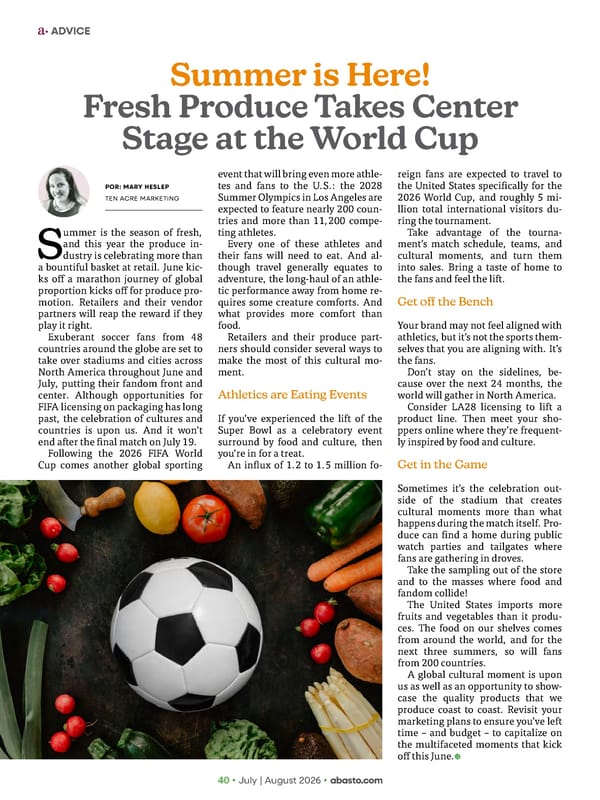
40 • July | August 2026 • abasto.com Summer is Here! Fresh Produce Takes Center Stage at the World Cup S ummer is the season of fresh, and this year the produce in- dustry is celebrating more than a bountiful basket at retail. June kic- ks off a marathon journey of global proportion kicks off for produce pro- motion. Retailers and their vendor partners will reap the reward if they play it right. Exuberant soccer fans from 48 countries around the globe are set to take over stadiums and cities across North America throughout June and July, putting their fandom front and center. Although opportunities for FIFA licensing on packaging has long past, the celebration of cultures and countries is upon us. And it won’t end after the final match on July 19. Following the 2026 FIFA World Cup comes another global sporting event that will bring even more athle- tes and fans to the U.S.: the 2028 Summer Olympics in Los Angeles are expected to feature nearly 200 coun- tries and more than 11,200 compe- ting athletes. Every one of these athletes and their fans will need to eat. And al- though travel generally equates to adventure, the long-haul of an athle- tic performance away from home re- quires some creature comforts. And what provides more comfort than food. Retailers and their produce part- ners should consider several ways to make the most of this cultural mo- ment. Athletics are Eating Events If you’ve experienced the lift of the Super Bowl as a celebratory event surround by food and culture, then you’re in for a treat. An influx of 1.2 to 1.5 million fo- reign fans are expected to travel to the United States specifically for the 2026 World Cup, and roughly 5 mi- llion total international visitors du- ring the tournament. Take advantage of the tourna- ment’s match schedule, teams, and cultural moments, and turn them into sales. Bring a taste of home to the fans and feel the lift. Get off the Bench Your brand may not feel aligned with athletics, but it’s not the sports them- selves that you are aligning with. It’s the fans. Don’t stay on the sidelines, be- cause over the next 24 months, the world will gather in North America. Consider LA28 licensing to lift a product line. Then meet your sho- ppers online where they’re frequent- ly inspired by food and culture. Get in the Game Sometimes it’s the celebration out- side of the stadium that creates cultural moments more than what happens during the match itself. Pro- duce can find a home during public watch parties and tailgates where fans are gathering in droves. Take the sampling out of the store and to the masses where food and fandom collide! The United States imports more fruits and vegetables than it produ- ces. The food on our shelves comes from around the world, and for the next three summers, so will fans from 200 countries. A global cultural moment is upon us as well as an opportunity to show- case the quality products that we produce coast to coast. Revisit your marketing plans to ensure you’ve left time – and budget – to capitalize on the multifaceted moments that kick off this June. • ADVICE POR: MARY HESLEP TEN ACRE MARKETING
41 • July | August 2026 • abasto.com
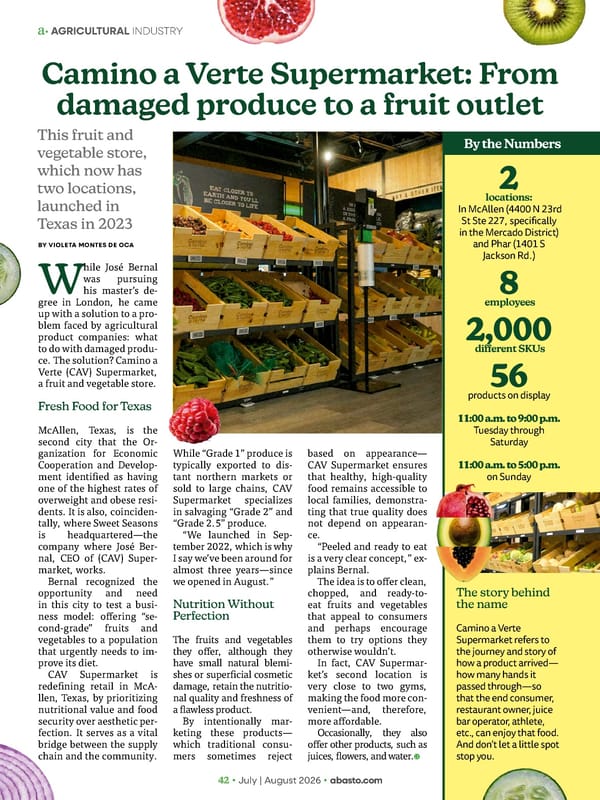
42 • July | August 2026 • abasto.com BY VIOLETA MONTES DE OCA W hile José Bernal was pursuing his master’s de- gree in London, he came up with a solution to a pro- blem faced by agricultural product companies: what to do with damaged produ- ce. The solution? Camino a Verte (CAV) Supermarket, a fruit and vegetable store. Fresh Food for Texas McAllen, Texas, is the second city that the Or- ganization for Economic Cooperation and Develop- ment identified as having one of the highest rates of overweight and obese resi- dents. It is also, coinciden- tally, where Sweet Seasons is headquartered—the company where José Ber- nal, CEO of (CAV) Super- market, works. Bernal recognized the opportunity and need in this city to test a busi- ness model: offering “se- cond-grade” fruits and vegetables to a population that urgently needs to im- prove its diet. CAV Supermarket is redefining retail in McA- llen, Texas, by prioritizing nutritional value and food security over aesthetic per- fection. It serves as a vital bridge between the supply chain and the community. Camino a Verte Supermarket: From damaged produce to a fruit outlet This fruit and vegetable store, which now has two locations, launched in Texas in 2023 The story behind the name Camino a Verte Supermarket refers to the journey and story of how a product arrived— how many hands it passed through—so that the end consumer, restaurant owner, juice bar operator, athlete, etc., can enjoy that food. And don’t let a little spot stop you. While “Grade 1” produce is typically exported to dis- tant northern markets or sold to large chains, CAV Supermarket specializes in salvaging “Grade 2” and “Grade 2.5” produce. “We launched in Sep- tember 2022, which is why I say we’ve been around for almost three years—since we opened in August.” Nutrition Without Perfection The fruits and vegetables they offer, although they have small natural blemi- shes or superficial cosmetic damage, retain the nutritio- nal quality and freshness of a flawless product. By intentionally mar- keting these products— which traditional consu- mers sometimes reject based on appearance— CAV Supermarket ensures that healthy, high-quality food remains accessible to local families, demonstra- ting that true quality does not depend on appearan- ce. “Peeled and ready to eat is a very clear concept,” ex- plains Bernal. The idea is to offer clean, chopped, and ready-to- eat fruits and vegetables that appeal to consumers and perhaps encourage them to try options they otherwise wouldn’t. In fact, CAV Supermar- ket’s second location is very close to two gyms, making the food more con- venient—and, therefore, more affordable. Occasionally, they also offer other products, such as juices, flowers, and water. 2 locations: In McAllen (4400 N 23rd St Ste 227, specifically in the Mercado District) and Phar (1401 S Jackson Rd.) 8 employees 2,000 different SKUs 56 products on display 11:00 a.m. to 9:00 p.m. Tuesday through Saturday 11:00 a.m. to 5:00 p.m. on Sunday By the Numbers • AGRICULTURAL INDUSTRY
43 • July | August 2026 • abasto.com
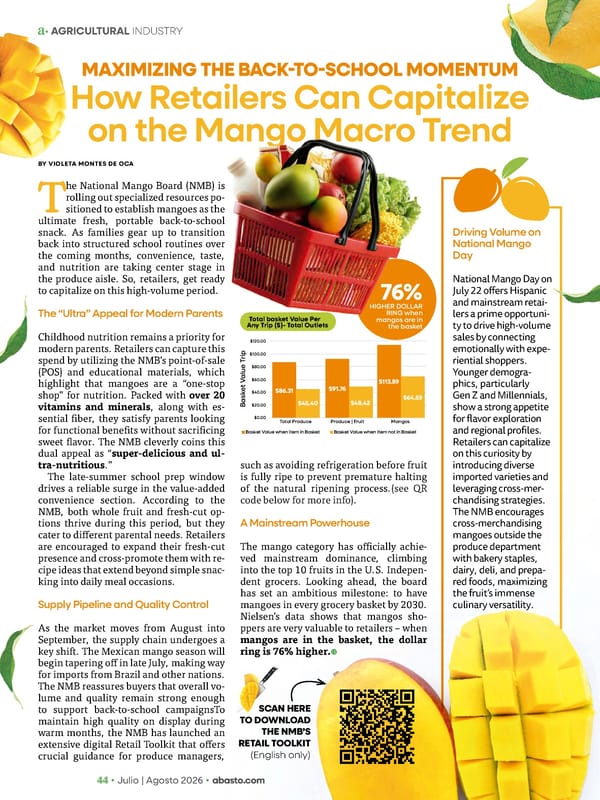
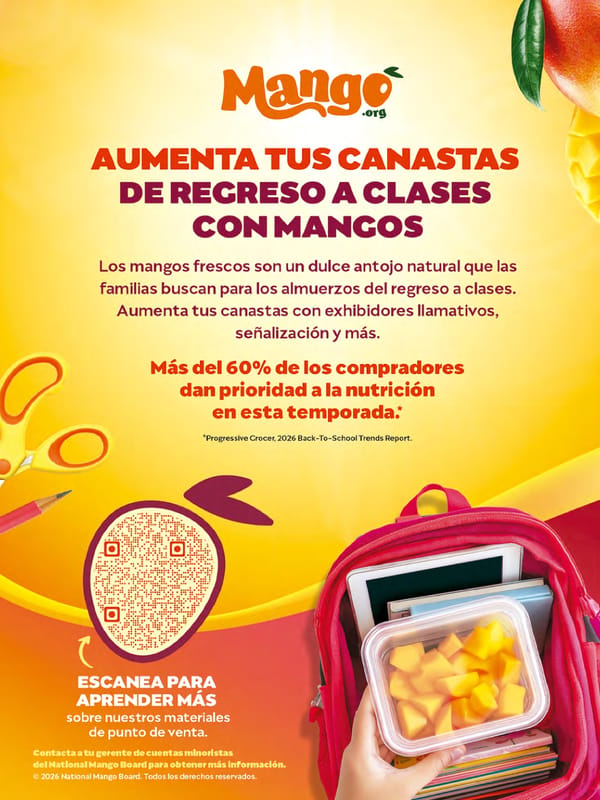
44 • Julio | Agosto 2026 • abasto.com MAXIMIZING THE BACK-TO-SCHOOL MOMENTUM How Retailers Can Capitalize on the Mango Macro Trend Basket Value when item in Basket Basket Value when item not in Basket $120.00 Basket Value Trip Total Produce $0.00 $20.00 $40.00 $60.00 $80.00 $100.00 Produce | Fruit Mangos Total basket Value Per Any Trip ($)- Total Outlets $86.31 $91.76 $48.42 $113.89 $64.59 $45.40 76% HIGHER DOLLAR RING when mangos are in the basket BY VIOLETA MONTES DE OCA T he National Mango Board (NMB) is rolling out specialized resources po- sitioned to establish mangoes as the ultimate fresh, portable back-to-school snack. As families gear up to transition back into structured school routines over the coming months, convenience, taste, and nutrition are taking center stage in the produce aisle. So, retailers, get ready to capitalize on this high-volume period. The “Ultra” Appeal for Modern Parents Childhood nutrition remains a priority for modern parents. Retailers can capture this spend by utilizing the NMB’s point-of-sale (POS) and educational materials, which highlight that mangoes are a “one-stop shop” for nutrition. Packed with over 20 vitamins and minerals , along with es- sential fiber, they satisfy parents looking for functional benefits without sacrificing sweet flavor. The NMB cleverly coins this dual appeal as “ super-delicious and ul- tra-nutritious .” The late-summer school prep window drives a reliable surge in the value-added convenience section. According to the NMB, both whole fruit and fresh-cut op- tions thrive during this period, but they cater to different parental needs. Retailers are encouraged to expand their fresh-cut presence and cross-promote them with re- cipe ideas that extend beyond simple snac- king into daily meal occasions. Supply Pipeline and Quality Control As the market moves from August into September, the supply chain undergoes a key shift. The Mexican mango season will begin tapering off in late July, making way for imports from Brazil and other nations. The NMB reassures buyers that overall vo- lume and quality remain strong enough to support back-to-school campaignsTo maintain high quality on display during warm months, the NMB has launched an extensive digital Retail Toolkit that offers crucial guidance for produce managers, Driving Volume on National Mango Day National Mango Day on July 22 offers Hispanic and mainstream retai- lers a prime opportuni- ty to drive high-volume sales by connecting emotionally with expe- riential shoppers. Younger demogra- phics, particularly Gen Z and Millennials, show a strong appetite for flavor exploration and regional profiles. Retailers can capitalize on this curiosity by introducing diverse imported varieties and leveraging cross-mer- chandising strategies. The NMB encourages cross-merchandising mangoes outside the produce department with bakery staples, dairy, deli, and prepa- red foods, maximizing the fruit’s immense culinary versatility. SCAN HERE TO DOWNLOAD THE NMB’S RETAIL TOOLKIT (English only) such as avoiding refrigeration before fruit is fully ripe to prevent premature halting of the natural ripening process.(see QR code below for more info). A Mainstream Powerhouse The mango category has officially achie- ved mainstream dominance, climbing into the top 10 fruits in the U.S. Indepen- dent grocers. Looking ahead, the board has set an ambitious milestone: to have mangoes in every grocery basket by 2030. Nielsen’s data shows that mangos sho- ppers are very valuable to retailers – when mangos are in the basket, the dollar ring is 76% higher. • AGRICULTURAL INDUSTRY
45 • July | August 2026 • abasto.com
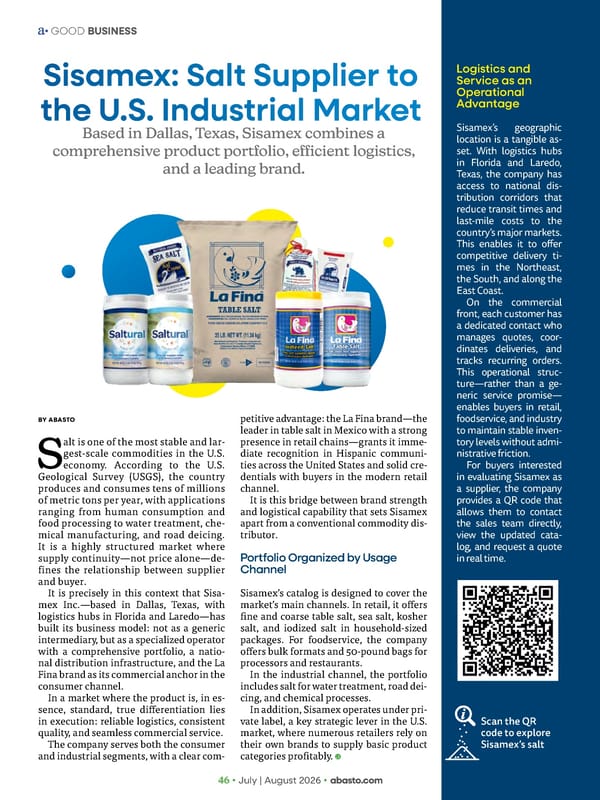
46 • July | August 2026 • abasto.com • GOOD BUSINESS BY ABASTO S alt is one of the most stable and lar- gest-scale commodities in the U.S. economy. According to the U.S. Geological Survey (USGS), the country produces and consumes tens of millions of metric tons per year, with applications ranging from human consumption and food processing to water treatment, che- mical manufacturing, and road deicing. It is a highly structured market where supply continuity—not price alone—de- fines the relationship between supplier and buyer. It is precisely in this context that Sisa- mex Inc.—based in Dallas, Texas, with logistics hubs in Florida and Laredo—has built its business model: not as a generic intermediary, but as a specialized operator with a comprehensive portfolio, a natio- nal distribution infrastructure, and the La Fina brand as its commercial anchor in the consumer channel. In a market where the product is, in es- sence, standard, true differentiation lies in execution: reliable logistics, consistent quality, and seamless commercial service. The company serves both the consumer and industrial segments, with a clear com- petitive advantage: the La Fina brand—the leader in table salt in Mexico with a strong presence in retail chains—grants it imme- diate recognition in Hispanic communi- ties across the United States and solid cre- dentials with buyers in the modern retail channel. It is this bridge between brand strength and logistical capability that sets Sisamex apart from a conventional commodity dis- tributor. Portfolio Organized by Usage Channel Sisamex’s catalog is designed to cover the market’s main channels. In retail, it offers fine and coarse table salt, sea salt, kosher salt, and iodized salt in household-sized packages. For foodservice, the company offers bulk formats and 50-pound bags for processors and restaurants. In the industrial channel, the portfolio includes salt for water treatment, road dei- cing, and chemical processes. In addition, Sisamex operates under pri- vate label, a key strategic lever in the U.S. market, where numerous retailers rely on their own brands to supply basic product categories profitably. Sisamex: Salt Supplier to the U.S. Industrial Market Scan the QR code to explore Sisamex’s salt Based in Dallas, Texas, Sisamex combines a comprehensive product portfolio, efficient logistics, and a leading brand. Logistics and Service as an Operational Advantage Sisamex’s geographic location is a tangible as- set. With logistics hubs in Florida and Laredo, Texas, the company has access to national dis- tribution corridors that reduce transit times and last-mile costs to the country’s major markets. This enables it to offer competitive delivery ti- mes in the Northeast, the South, and along the East Coast. On the commercial front, each customer has a dedicated contact who manages quotes, coor- dinates deliveries, and tracks recurring orders. This operational struc- ture—rather than a ge- neric service promise— enables buyers in retail, foodservice, and industry to maintain stable inven- tory levels without admi- nistrative friction. For buyers interested in evaluating Sisamex as a supplier, the company provides a QR code that allows them to contact the sales team directly, view the updated cata- log, and request a quote in real time.
47 • July | August 2026 • abasto.com
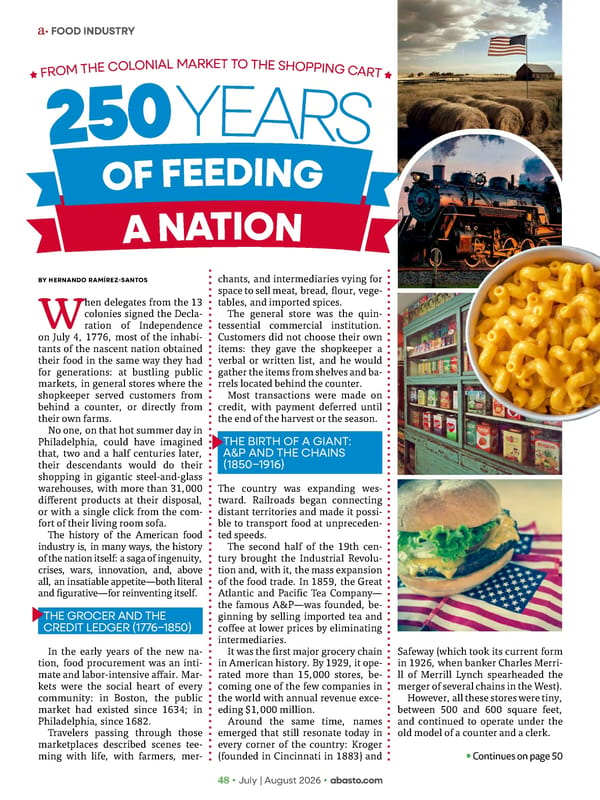
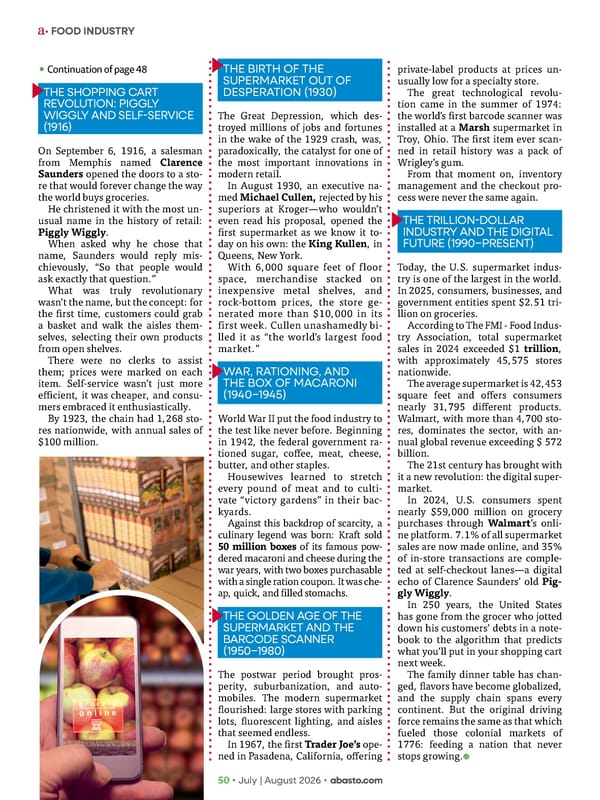
48 • July | August 2026 • abasto.com BY HERNANDO RAMÍREZ-SANTOS W hen delegates from the 13 colonies signed the Decla- ration of Independence on July 4, 1776, most of the inhabi- tants of the nascent nation obtained their food in the same way they had for generations: at bustling public markets, in general stores where the shopkeeper served customers from behind a counter, or directly from their own farms. No one, on that hot summer day in Philadelphia, could have imagined that, two and a half centuries later, their descendants would do their shopping in gigantic steel-and-glass warehouses, with more than 31,000 different products at their disposal, or with a single click from the com- fort of their living room sofa. The history of the American food industry is, in many ways, the history of the nation itself: a saga of ingenuity, crises, wars, innovation, and, above all, an insatiable appetite—both literal and figurative—for reinventing itself. THE GROCER AND THE CREDIT LEDGER (1776–1850) In the early years of the new na- tion, food procurement was an inti- mate and labor-intensive affair. Mar- kets were the social heart of every community: in Boston, the public market had existed since 1634; in Philadelphia, since 1682. Travelers passing through those marketplaces described scenes tee- ming with life, with farmers, mer- chants, and intermediaries vying for space to sell meat, bread, flour, vege- tables, and imported spices. The general store was the quin- tessential commercial institution. Customers did not choose their own items: they gave the shopkeeper a verbal or written list, and he would gather the items from shelves and ba- rrels located behind the counter. Most transactions were made on credit, with payment deferred until the end of the harvest or the season. THE BIRTH OF A GIANT: A&P AND THE CHAINS (1850–1916) The country was expanding wes- tward. Railroads began connecting distant territories and made it possi- ble to transport food at unpreceden- ted speeds. The second half of the 19th cen- tury brought the Industrial Revolu- tion and, with it, the mass expansion of the food trade. In 1859, the Great Atlantic and Pacific Tea Company— the famous A&P—was founded, be- ginning by selling imported tea and coffee at lower prices by eliminating intermediaries. It was the first major grocery chain in American history. By 1929, it ope- rated more than 15,000 stores, be- coming one of the few companies in the world with annual revenue exce- eding $1,000 million. Around the same time, names emerged that still resonate today in every corner of the country: Kroger (founded in Cincinnati in 1883) and Safeway (which took its current form in 1926, when banker Charles Merri- ll of Merrill Lynch spearheaded the merger of several chains in the West). However, all these stores were tiny, between 500 and 600 square feet, and continued to operate under the old model of a counter and a clerk. A N A T I O N O F F E E D I N G 2 5 0 Y E A R S F R O M T H E C O L O N I A L M A R K E T T O T H E S H O P P I N G C A R T • FOOD INDUSTRY • Continues on page 50
49 • July | August 2026 • abasto.com
50 • July | August 2026 • abasto.com THE SHOPPING CART REVOLUTION: PIGGLY WIGGLY AND SELF-SERVICE (1916) On September 6, 1916, a salesman from Memphis named Clarence Saunders opened the doors to a sto- re that would forever change the way the world buys groceries. He christened it with the most un- usual name in the history of retail: Piggly Wiggly . When asked why he chose that name, Saunders would reply mis- chievously, “So that people would ask exactly that question.” What was truly revolutionary wasn’t the name, but the concept: for the first time, customers could grab a basket and walk the aisles them- selves, selecting their own products from open shelves. There were no clerks to assist them; prices were marked on each item. Self-service wasn’t just more efficient, it was cheaper, and consu- mers embraced it enthusiastically. By 1923, the chain had 1,268 sto- res nationwide, with annual sales of $100 million. THE BIRTH OF THE SUPERMARKET OUT OF DESPERATION (1930) The Great Depression, which des- troyed millions of jobs and fortunes in the wake of the 1929 crash, was, paradoxically, the catalyst for one of the most important innovations in modern retail. In August 1930, an executive na- med Michael Cullen, rejected by his superiors at Kroger—who wouldn’t even read his proposal, opened the first supermarket as we know it to- day on his own: the King Kullen , in Queens, New York. With 6,000 square feet of floor space, merchandise stacked on inexpensive metal shelves, and rock-bottom prices, the store ge- nerated more than $10,000 in its first week. Cullen unashamedly bi- lled it as “the world’s largest food market.” WAR, RATIONING, AND THE BOX OF MACARONI (1940–1945) World War II put the food industry to the test like never before. Beginning in 1942, the federal government ra- tioned sugar, coffee, meat, cheese, butter, and other staples. Housewives learned to stretch every pound of meat and to culti- vate “victory gardens” in their bac- kyards. Against this backdrop of scarcity, a culinary legend was born: Kraft sold 50 million boxes of its famous pow- dered macaroni and cheese during the war years, with two boxes purchasable with a single ration coupon. It was che- ap, quick, and filled stomachs. THE GOLDEN AGE OF THE SUPERMARKET AND THE BARCODE SCANNER (1950–1980) The postwar period brought pros- perity, suburbanization, and auto- mobiles. The modern supermarket flourished: large stores with parking lots, fluorescent lighting, and aisles that seemed endless. In 1967, the first Trader Joe’s ope- ned in Pasadena, California, offering private-label products at prices un- usually low for a specialty store. The great technological revolu- tion came in the summer of 1974: the world’s first barcode scanner was installed at a Marsh supermarket in Troy, Ohio. The first item ever scan- ned in retail history was a pack of Wrigley’s gum. From that moment on, inventory management and the checkout pro- cess were never the same again. THE TRILLION-DOLLAR INDUSTRY AND THE DIGITAL FUTURE (1990–PRESENT) Today, the U.S. supermarket indus- try is one of the largest in the world. In 2025, consumers, businesses, and government entities spent $2.51 tri- llion on groceries. According to The FMI - Food Indus- try Association, total supermarket sales in 2024 exceeded $1 trillion , with approximately 45,575 stores nationwide. The average supermarket is 42,453 square feet and offers consumers nearly 31,795 different products. Walmart, with more than 4,700 sto- res, dominates the sector, with an- nual global revenue exceeding $ 572 billion. The 21st century has brought with it a new revolution: the digital super- market. In 2024, U.S. consumers spent nearly $59,000 million on grocery purchases through Walmart ’s onli- ne platform. 7.1% of all supermarket sales are now made online, and 35% of in-store transactions are comple- ted at self-checkout lanes—a digital echo of Clarence Saunders’ old Pig- gly Wiggly . In 250 years, the United States has gone from the grocer who jotted down his customers’ debts in a note- book to the algorithm that predicts what you’ll put in your shopping cart next week. The family dinner table has chan- ged, flavors have become globalized, and the supply chain spans every continent. But the original driving force remains the same as that which fueled those colonial markets of 1776: feeding a nation that never stops growing. • FOOD INDUSTRY • Continuation of page 48
>> 28 A HUB OF OPPORTUNITY NSA TRADE SHOW 2026: • JULY | AUGUST 2026 • YEAR 18 • ABASTO.COM • The gateway for brands looking to position themselves in independent supermarkets across the Northeast US
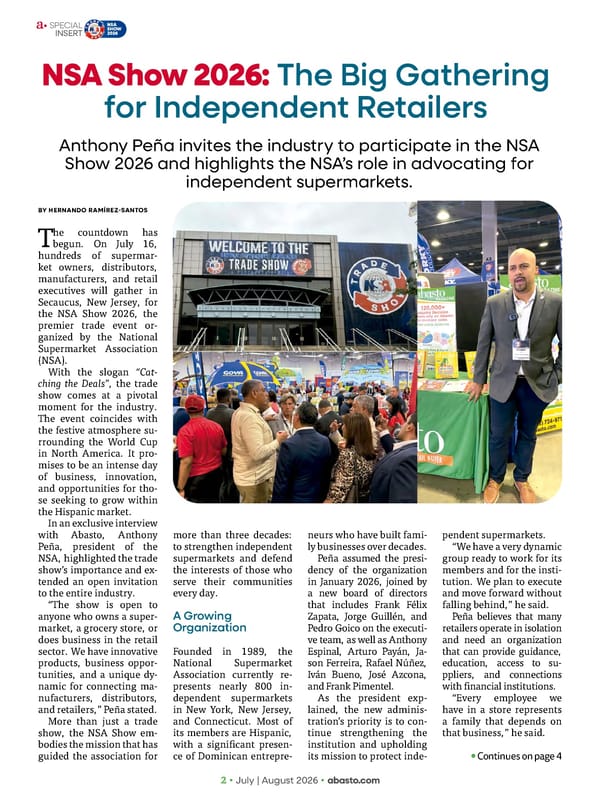
2 • July | August 2026 • abasto.com • Continues on page 4 BY HERNANDO RAMÍREZ-SANTOS T he countdown has begun. On July 16, hundreds of supermar- ket owners, distributors, manufacturers, and retail executives will gather in Secaucus, New Jersey, for the NSA Show 2026, the premier trade event or- ganized by the National Supermarket Association (NSA). With the slogan “Cat- ching the Deals”, the trade show comes at a pivotal moment for the industry. The event coincides with the festive atmosphere su- rrounding the World Cup in North America. It pro- mises to be an intense day of business, innovation, and opportunities for tho- se seeking to grow within the Hispanic market. In an exclusive interview with Abasto, Anthony Peña, president of the NSA, highlighted the trade show’s importance and ex- tended an open invitation to the entire industry. “The show is open to anyone who owns a super- market, a grocery store, or does business in the retail sector. We have innovative products, business oppor- tunities, and a unique dy- namic for connecting ma- nufacturers, distributors, and retailers,” Peña stated. More than just a trade show, the NSA Show em- bodies the mission that has guided the association for NSA Show 2026: The Big Gathering for Independent Retailers Anthony Peña invites the industry to participate in the NSA Show 2026 and highlights the NSA’s role in advocating for independent supermarkets. more than three decades: to strengthen independent supermarkets and defend the interests of those who serve their communities every day. A Growing Organization Founded in 1989, the National Supermarket Association currently re- presents nearly 800 in- dependent supermarkets in New York, New Jersey, and Connecticut. Most of its members are Hispanic, with a significant presen- ce of Dominican entrepre- neurs who have built fami- ly businesses over decades. Peña assumed the presi- dency of the organization in January 2026, joined by a new board of directors that includes Frank Félix Zapata, Jorge Guillén, and Pedro Goico on the executi- ve team, as well as Anthony Espinal, Arturo Payán, Ja- son Ferreira, Rafael Núñez, Iván Bueno, José Azcona, and Frank Pimentel. As the president exp- lained, the new adminis- tration’s priority is to con- tinue strengthening the institution and upholding its mission to protect inde- SPECIAL INSERT NSA SHOW 2026 pendent supermarkets. “We have a very dynamic group ready to work for its members and for the insti- tution. We plan to execute and move forward without falling behind,” he said. Peña believes that many retailers operate in isolation and need an organization that can provide guidance, education, access to su- ppliers, and connections with financial institutions. “Every employee we have in a store represents a family that depends on that business,” he said.
3 • July | August 2026 • abasto.com 42
4 • July | August 2026 • abasto.com • Continuation of page 2 Costs Putting Pressure on the Sector As the organization grows, so do the challenges. During his conversation with Abasto, Peña expres- sed concern about poli- cies promoted by the New York City administration to create government-run supermarkets. “Many of our members have served these neigh- borhoods for years without asking for anything in re- turn. That’s why it’s demo- ralizing to be portrayed as if we were responsible for the problem,” he commented. For Peña, the real cha- llenge lies not in the wi- llingness of business owners but in the rising operating costs they face. “The main problem is costs, which are becoming unsustainable,” he explai- ned. Unlike residential te- nants, business owners have few protections when they must renegotiate lease agreements. This situation can result in sig- nificant rent increases that ultimately affect the entire operation. According to Peña, the NSA has presented concre- te proposals to help reduce costs and improve prices for consumers. Still, he asserts that the authorities have not yet shown suffi- cient willingness to listen to the sector. Safety: An Ongoing Struggle Safety is also a top priority on the association’s agenda. Although the state has toughened penalties against those who attack essential workers, Peña believes there is still a gap between the law and its effective enforcement. “Our job is to ensure that these laws are enforced,” he stated. In response to this situa- tion, the NSA has stren- gthened its collaboration with the New York Police Department. One of the most promi- sing projects is the pilot program called Adopt a Store, initially implemen- ted in the Bronx. The NSA Show: Much More Than a Trade Show All the expertise the NSA has accumulated is reflected each year at its trade show. The 2026 NSA Show will take place from 9 a.m. to 5 p.m. at the Meadowlands Exposition Center in Se- caucus. The day before, on July 15, attendees will participate in the opening ceremony, which will fea- ture Peter Unanue, co-pre- sident of Goya Foods, as the keynote speaker. In addition, industry lea- ders will discuss the trends transforming the food and beverage industry. One of the most anticipa- ted features will be the B2B platform, designed to help international brands enter the U.S. market through direct meetings with dis- tributors and retailers. “Companies will be able to speak directly with tho- se who know the market and, in many cases, even finalize purchase orders during the event,” explai- ned Peña. The trade show will also recognize Atún Real de Ecuador as International Company of the Year and highlight strategic part- nerships such as the one developed with Porky in the protein category. Furthermore, the NSA will pay tribute to William Rodríguez, former presi- dent of the organization and one of the original dri- ving forces behind the trade show, by naming the award the William Rodríguez Com- pany of the Year Award. “We’re very proud of our show because it represents everything we stand for as an organization,” Peña concluded. SPECIAL INSERT NSA SHOW 2026
5 • July | August 2026 • abasto.com
6 • July | August 2026 • abasto.com BY ABASTO T he National Grocers Association (NGA) re- leased a new report finding that independent grocers drive $557.5B in economic activity, underscoring their vital role in the U.S. eco- nomy despite costs. The new Economic Im- pact Analysis quantifies the substantial role America’s independent supermarket operators play in the na- tion’s economy. Conducted by Arizona State University, the report finds that the in- dependent grocery industry generates $557.5 billion in total annual economic acti- vity, representing nearly 2.0 percent of U.S. gross domes- tic product, even as commu- nity grocers contend with inflation, supply chain dis- ruption, rising costs, and an increasingly uneven com- petitive landscape. The report underscores the vital role independent grocers play as a strong and growing force in the Ame- rican economy and in com- munities across the coun- try. From supporting Main Street jobs to sustaining local supply chains, inde- pendent supermarkets con- tinue to drive economic ac- tivity in every region of the nation while serving as trus- ted community anchors. “Independent grocers are helping power the American economy from the ground up,” said Greg Ferrara, NGA president and CEO. “These are Main Street businesses creating jobs, supporting families, and reinvesting in the commu- nities they serve every sin- gle day. A strong indepen- dent grocery sector means stronger local economies, stronger supply chains, and stronger communities across America. NGA will continue advocating for po- licies that help these busi- nesses compete, grow, and continue delivering for the American people.” Independent Grocers Drive $557.5B Yearly NGA REPORT: $557.5 billion in total annual economic output, representing near- ly 2.0% of the entire U.S. economy. $353.5 billion in direct retail sales, ac- counting for 38.4% of the $920 billion U.S. food re- tailing sector. 1.58x multiplier effect, meaning every $1 in in- dependent grocery sales generates an additional $0.58 in supply chain and household spending na- tionwide. 1.48 million American jobs supported, including 1.14 million di- rectly employed, plus an additional 340,000 su- pported through supply chain and induced activity. $115.2 billion in annual worker income, with average industry-wide earnings of $77,628, well above the U.S. median wage. $191.3 billion in value-added economic activity, capturing the merchandising, logistics, and distribution services independents provide. $27.3 billion in combined annual tax revenue: $4.7 billion fede- ral, $10.2 billion state, and $12.4 billion local. These dollars fund schools, pu- blic safety, roads, and re- creation in communities nationwide. Independent Grocers’ National Footprint SPECIAL INSERT NSA SHOW 2026
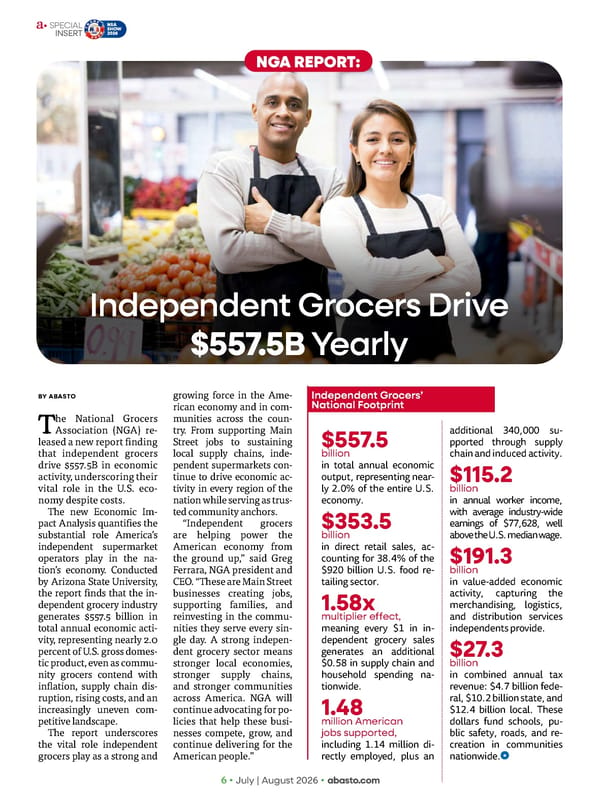
7 • July | August 2026 • abasto.com
8 • July | August 2026 • abasto.com BY HERNANDO RAMÍREZ-SANTOS L orenzo Piña grew up in the Dominican Re- public. He studied finance and international trade and worked for multinational companies until he arrived in the United States with one certainty: there was an opportunity that no one was taking advantage of. In 2004, he founded Glo- bal Trade Bridge, with the mission of creating a strong commercial link between Latin American brands and the U.S. market. What be- gan as a small representati- ve agency has evolved into a comprehensive import, export, logistics, and dis- tribution operation serving partners across the U.S. What No One Was Explaining to the Brands Piña, the company’s CEO and president, saw some- thing many others over- looked: simply having a high-quality Latin Ameri- can product wasn’t enough to bring it to the U.S. “You can’t imagine how many large companies don’t know what pallet format we need here,” he recalls candidly. That gap between Latin TWENTY YEARS OPENING DOORS FOR LATIN AMERICAN BRANDS Global Trade Bridge Excels at Every Stage of the Market To enter and grow in the U.S., your company needs this partner American manufacturers and the U.S. market was the real problem. And Global Trade Bridge was created precisely to solve it. Growing from the Inside Out, Step by Step Growth wasn’t immediate or easy. “The strap comes from the leather,” says Piña, and that philosophy guided every decision. First, one brand put its trust in them; then another; then yet ano- ther. “There was a lot of trial and error, always with the support of brands that to- day—20 years later—are still with us,” he acknowle- dges. That’s how they built their reputation: with re- sults, not promises. A Service that Leaves no Stone Unturned Today, Global Trade Bridge supports its partners from FDA registration to the last supermarket shelf. They have trademark at- torneys, in-house marke- ting teams, and a distribu- tion network that reaches across the entire U.S. “We’re involved in everything,” says Piña, “from major chains to the small grocery store in Upper Manhattan.” Game-Changing Information Many brands sell well, but they don’t know exactly to whom or where. Piña saw this and solved it: his com- pany shares open data with each partner on pricing, coverage, competition, and in-store presence. “We keep our books open with them,” he assures. That transparency builds trust and, above all, leads to better business decisions. The Latino Consumer has Already Changed Second- and third-genera- tion Hispanics in the U.S. don’t cook like their grand- mothers, but they still crave those flavors. “The young person who grew up here prefers to have the product served to them, but in a more convenient way,” exp- lains Piña. Frozen empanadas, re- ady-to-drink juices, tortillas ready to heat up: the mar- ket is evolving, and Glo- bal Trade Bridge has been anticipating this trend for years. Advice from Someone Who’s Been There For those who dream of ge- tting their brand onto U.S. store shelves, Piña has an honest message: “A lot of hard work and patience. You can make it here, but not overnight.” And he adds something he says with conviction: “I haven’t made it yet.” That humility, combined with 20 years of proven results, is perhaps the strongest ar- gument for entrusting your brand to him. Global Trade Bridge at the NSA Show On July 16 in New Jersey, Global Trade Bridge will be pre- sent at the National Supermarket Asso- ciation trade show. For Piña, this event is unique: “It’s the only trade show whe- re you can sell to and connect with 500 or 600 independent su- permarkets at once.” A business oppor- tunity that no La- tin American brand should miss. SPECIAL INSERT NSA SHOW 2026
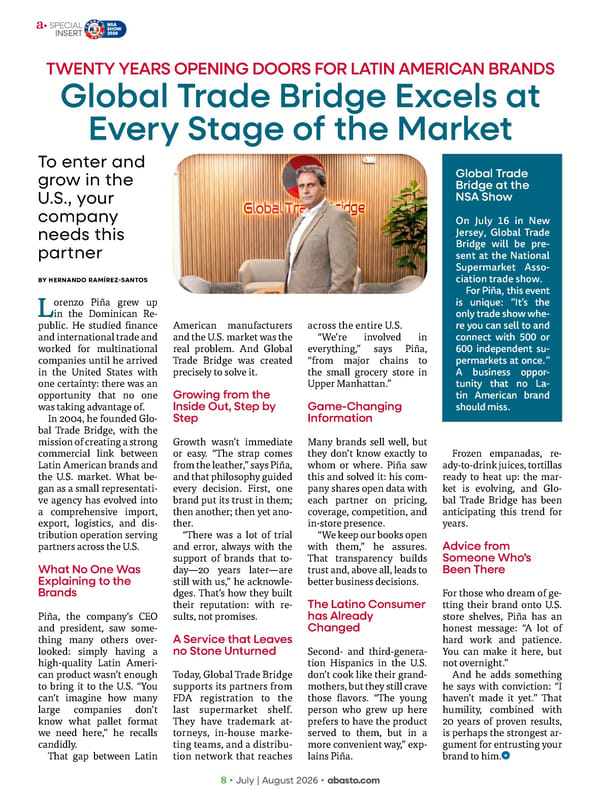
9 • July | August 2026 • abasto.com
10 • July | August 2026 • abasto.com BY HERNANDO RAMÍREZ-SANTOS T hey seem harmless. They’re tiny electro- nic screens attached to the edge of the shelf. They connect via Wi-Fi or Blue- tooth to the supermarket’s central server, allowing prices for hundreds of pro- ducts to be changed in a matter of seconds. They’re called ESL, short for Elec- tronic Shelf Labels. But they can become a threat to consumers and a risk to store owners. The- re is a growing movement against the use of this te- chnology due to the mani- pulation supermarkets can employ to raise product prices on the same day. The technology is not new. European supermar- kets have been installing them for two decades, and it is estimated that nearly led patents related to auto- mated price adjustments using artificial intelligence, which fuels mistrust. Who- le Foods, Amazon Fresh, and Kroger also use them. Proponents of the tech- nology cite efficiency ar- guments. Amanda Bailey, a manager at a Walmart store in Ohio, says that the time spent repricing products has fallen by 75% and that this savings translates into better cus- tomer service. Manufacturers also hi- ghlight environmental benefits: less paper waste and updates without hu- man intervention. Electronic price tags promise operational efficiency for supermarkets, but customers and various organizations see them as a threat. You decide. 80% of them already use them. But in the United States, adoption rates are barely between 5% and 10%, and the current ra- pid expansion is sparking a reaction the industry did not anticipate: massive consumer backlash and an unprecedented wave of le- gislative action. Walmart Leads the Digital Charge Walmart plans to have electronic price tags in 100% of its U.S. stores by the end of 2026. The com- pany assures that any price change will require an em- ployee’s approval. However, it has also fi- Opportunity or Time Bomb? SPECIAL INSERT NSA SHOW 2026 • Continues on page 12 ELECTRONIC PRICE TAGS:
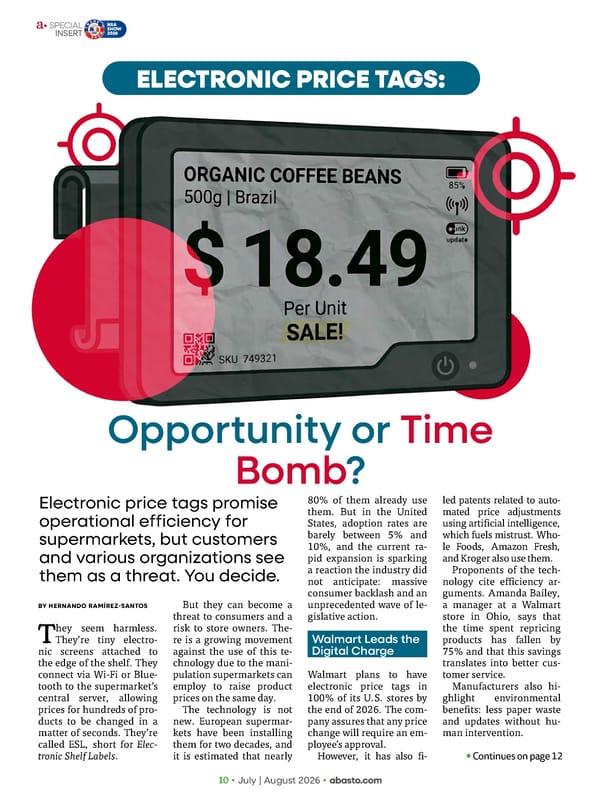
11 • July | August 2026 • abasto.com
12 • July | August 2026 • abasto.com What the Sellers Say The problem lies in what the ESL manufacturers themselves claim in their sales pitches. The Uni- ted Food and Commercial Workers International Union (UFCW) compiled revealing statements from industry executives. Andrew Lutinsky of Pricer, one of the largest ESL manufacturers, puts it bluntly: the labels can “lower the price to maxi- mize sales or, if necessary, raise it to maximize profit margins. All of this can ha- ppen dynamically on the shelf.” Ted Clark of Toshiba Glo- bal Commerce Solutions adds that “retailers are looking for ways to impro- ve their profitability, and with these labels, they can change prices dynamically whenever they want.” The SOLUM Group, ano- ther manufacturer, is even more direct: the biggest advantage of ESLs is “redu- ced labor costs.” Consumers Don’t Trust It The survey is revealing. Sixty-eight percent of con- sumers fear that digital price tags and dynamic pricing will increase the cost of food and essential goods. But the most stri- king figure is another: 67% of U.S. voters support ban- ning this technology and price tracking in super- markets, with cross-party support. Major chains are moving forward with implementa- tion, while consumers— burdened by inflation—do not believe them when they promise not to abuse the technology. This mistrust is we- ll-founded: 72% of respon- dents said they have no confidence that supermar- kets will use the technolo- gy responsibly. A Legislative Wave Is Rising The political reaction came quickly. Congress and the legislatures of 12 states have introduced bills to ban ESLs and price-trac- king in supermarkets. The New York State Se- nate has already taken a historic step: Maryland passed a law banning pri- ce-tracking in supermar- kets, though critics point out that it has significant loopholes. New York, New Jersey, and Illinois are considering similar legis- lation. In the U.S. Congress, Senators Ben Ray Luján (New Mexico) and Jeff Mer- kley (Oregon) are leading the Stop Price Gouging in Grocery Stores Act . Luján warned: “With price hi- kes driven by the trade war, Congress must act to ensure that technology is used to improve the lives of Americans, not to make them overspend at the gro- cery store.” Workers in the Crosshairs Beyond the shopper’s wa- llet, there is another vulne- rable front: employment. The UFCW, which repre- sents more than 800,000 grocery store workers in North America, warns that ESLs directly threaten the jobs of employees who cu- rrently handle price upda- tes and assist customers on the sales floor. Good Technology? ESL advocates argue that the technology can also be used for loyalty discounts, quick promo- tions, and low-inventory alerts, which benefit both the retailer and the consumer. In Norway, the Coop chain reported a 15% increase in customer sa- tisfaction after installing ESLs, thanks to clearer information about pro- ducts and allergies. The problem isn’t how the little screen works. The problem is who controls the algorithm, what criteria are used to change prices, and whe- ther consumers have any real way of knowing this. According to experts, the central issue isn’t the technology itself but the lack of rules governing its use and transparency toward consumers. For now, electronic shelf labels are making their way onto store shelves as the political debate intensifies. • Continuation of page 10 SPECIAL INSERT NSA SHOW 2026
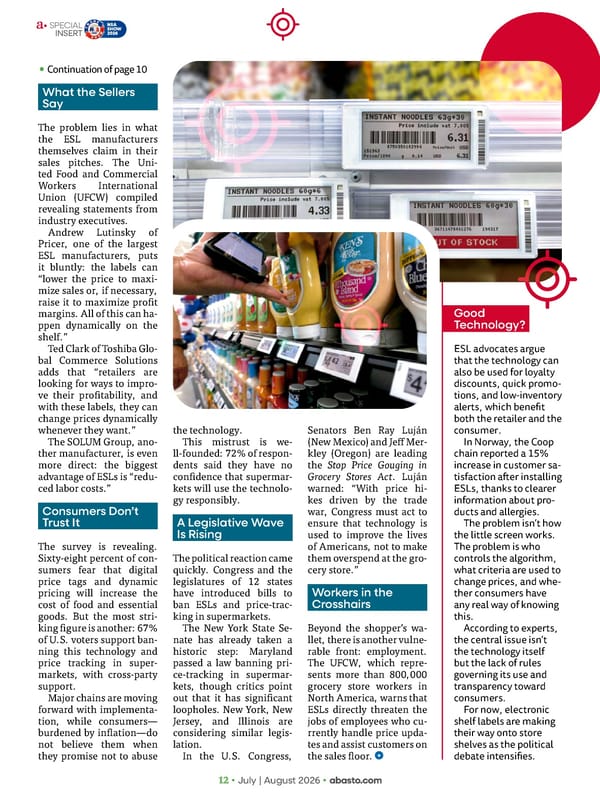
13 • July | August 2026 • abasto.com

14 • July | August 2026 • abasto.com BY ABASTO H ispanic consumers in the United States don’t shop on a whim at the supermarket. They know what they’re looking for, recognize quality, and come back for it. Atún Real arrived with that unders- tanding, and that’s why it’s making headway: backed by Real-Nirsa, Ecuador’s num- ber one brand, and the bu- siness acumen of Clasicorp Consulting, the brand is building a presence on the shelves where these consu- mers shop every week. A Visionary Partnership The strategic partnership behind Atún Real provides key support for the pro- duct’s commercial success. Real-Nirsa contributes cutting-edge technology, production capacity, and decades of experience in tuna processing. Clasicorp Atún Real Makes Its Debut in the U.S. with Its Premium Quality Ecuador’s No. 1 Tuna Brand Strengthens Its Presence on the East Coast Variety for Every Consumer Atún Real offers fillets, chunks, and flaked tuna— packed in water, sunflower oil, and olive oil. The portfo- lio includes traditional cans, flexible pouches, and insti- tutional-sized packages. In the U.S. market, the water- and sunflower oil-packed versions are the most popular, especially in convenient formats geared toward consumers seeking convenience and healthy eating. In addition, the brand has designed modern pac- kaging with a dual focus: it connects with Hispa- nic consumers while also appealing to the Anglo market. The labeling com- plies with all FDA require- ments regarding nutritio- nal information. Expansion Moves Along the East Coast The market entry strate- gy combines direct bu- siness relationships, re- gional partnerships, and a phased, state-by-state rollout. Today, Atún Real is focusing its efforts on Florida and the East Coast, where consumption of La- tino products is showing sustained growth. To drive demand at the Consulting, led by Álva- ro Muñoz and his partner Nelson Eusebio, brings to the table business strate- gy, knowledge of the U.S. market, and a solid distri- bution network. Atún Real arrived with a clear opportunity: the His- panic community in the United States is growing, and with it, the demand for reliable, nutritious pro- ducts with a Latin identity. From the Pacific Ocean to the Can The tuna processed by Re- al-Nirsa comes from the Eastern Pacific Ocean, one of the most productive tuna fishing grounds on the planet. The company works primarily with ye- llowfin and skipjack tuna, harvested using responsible practices that include full traceability and rigorous cold-chain management from the moment of catch. This journey from the ocean to the package is backed by a portfolio of cer- tifications that opens the doors to the most deman- ding markets: Dolphin Safe, MSC, IFS, BASC, and Good Manufacturing Practices, in addition to compliance with FDA regulations and the HACCP system. Opportunity on the Shelf Clasicorp Con- sulting’s message to category buyers is straightforward: Atún Real not only occupies shelf space but also justifies it with actual sales turnover. The brand combines premium quality with a competitive price— two attributes that rarely coexist in the same can. Over the next 12 to 24 months, the company plans to expand its distribu- tion to new states, add additional products to the Real family, and establi- sh itself as a leader in the seafood category for Latino consumers in the United States. point of sale, Clasicorp conducts tastings, special promotions, point-of-pur- chase (POP) materials, di- gital campaigns, and on- boarding programs for new retailers. The goal is clear: to drive product trials, build consu- mer loyalty, and ensure the sales turnover that every category buyer needs to see. Nelson Eusebio and Alvaro Muñoz SPECIAL INSERT NSA SHOW 2026
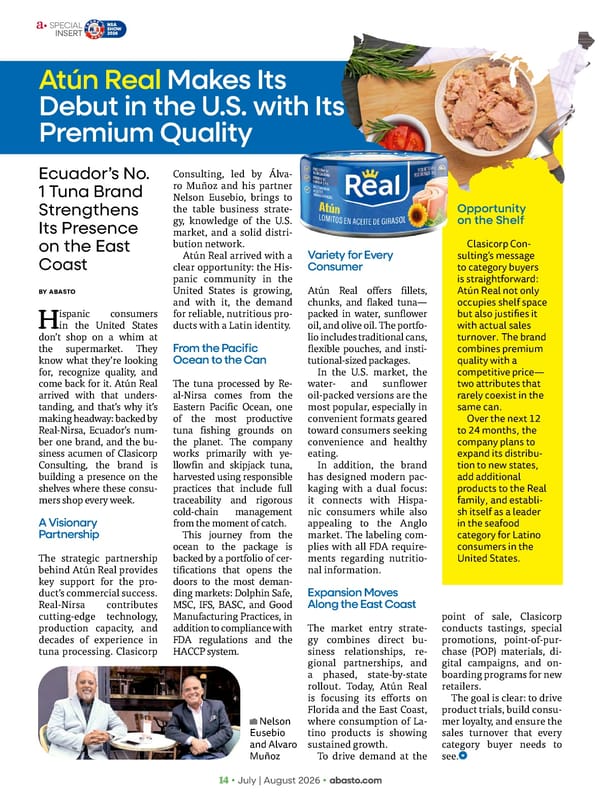
15 • July | August 2026 • abasto.com

16 • July | August 2026 • abasto.com BY ABASTO P rivate brand products, also known as store brands, have become a fix- ture in American homes, as shoppers deepen their trust in them, according to new consumer research released by FMI – The Food Industry Association. The annual Power of Pri- vate Brands 2026: Consu- mer Trends – From Stores to Homes report finds that 92% of U.S. grocery sho- ppers currently have store brand products in their ho- mes and that private brand dollar sales rose 2.8% year-over-year, outpacing national brand growth. Nearly half of shoppers increased private brand purchases over the past year, and 94% of shoppers say they would continue buying store brands even if grocery prices decline. More trust “This year’s consumer re- search makes clear why private brands continue to gather momentum. Con- sumers aren’t just choosing store brands out of habit or necessity; they’re choosing them because they’ve earned the trust of American fami- lies,” said Tom Cosgrove, director of industry relations for FMI. “The food industry has worked hard to build that trust, and food retailers now have the opportunity to ex- pand on it by investing in the areas shoppers tell us matter most – product quality, taste, health and the overall shop- ping experience.” “The data from this year’s report reinforces that sho- ppers have developed ge- nuine appreciation for store brands that goes beyond price. Taste and quality have steadily grown as drivers of purchases, and we’re now increasingly seeing the emer- gence of health as a driver as well, with the majority of sho- ppers reporting being able to find private brand items that satisfy what they’re searching for,” said Steve Markenson, vice president of research & insights for FMI. Key data from the report How common are store brand products in American homes? Nine in 10 American households (92%) currently have store brand products at home, up from 89% last year. Are more Americans buying store brands than they used to? Yes, Ameri- cans are buying more store brands. Nearly half of sho- ppers increased their store brand purchases over the past year, compared to the 31% who increased natio- nal brand purchases. Why do people buy store brands aside from just saving money? Shoppers are increasingly buying store brands because they genui- nely like them. Taste is now cited by 37% of shoppers bu- ying more store brands, up from 26% in 2023, and quali- ty has risen from 30% to 39% over the same period. Do store brands influence where people choose to grocery shop? Yes, store brands influence where people grocery shop. 56% of shoppers say their pri- mary store’s private brand selection is very or extre- mely important to their de- cision to shop there. Which age groups are in- creasing their use of store brands? 59% of Gen Z and 52% of Millennials increased store brand purchases in the past year, compared to 49% of shoppers overall. FMI: Why 90% of Shoppers Choose Private Brands SPECIAL INSERT NSA SHOW 2026
51 • July | August 2026 • abasto.com

52 • July | August 2026 • abasto.com BY RON MARGULIS W alk into a store. Open an app. Scroll a promotion. The shopper does not see channels. They see one brand, one experience and one expectation. The expectation is simple. Make it easy, consistent and relevant. Unified commerce is how you deli- ver on that promise. For Hispanic re- tailers and brands, it is not just about keeping up. It is about leaning into a customer base that is digitally con- nected, culturally driven and highly loyal when you get it right. The problem isn’t the strategy: most retailers understand the idea. The problem is execution. Too many operations still treat stores and digi- tal as separate worlds. Shoppers noti- ce. And they do not like it. Where to Start Start with marketing and mer- chandising. If your weekly ad pro- motes mangos, they better be displa- yed at the front of the store. If a CPG brand funds a digital campaign, that product needs strong shelf presence. Alignment is not complicated, but it does require discipline. Think about the shopper’s journey: they see a promotion on their pho- ne during lunch and walk into your store after work. If the message has changed or the product isn’t there, you’ve lost the momentum. Consis- tency closes the sale. Hispanic shoppers, moreover, res- pond to authenticity: bilingual signa- ge, culturally relevant displays, and localized promotions aren’t just a ni- ce-to-have. They’re essential. The Importance of Connected Systems Technology is where many retailers either accelerate or stagnate. Unified commerce requires that point-of-sa- le, inventory, e-commerce, and lo- yalty platforms communicate in real time. Inventory accuracy is the foun- dation: if the system says a product is in stock but the shelf is empty, trust is broken and nothing else matters. Mobile is especially important. For many Hispanic consumers, the smar- tphone is the primary shopping tool. Apps, mobile coupons, and digital wallets must work flawlessly. The Value of Employees Do not overlook the role of em- ployees. Technology doesn’t replace people—it makes them more effec- tive when they’re well-trained. Store associates must know how online orders work, how promotions are ac- tivated, and how to assist a shopper using their phone in the aisle. Give them tools like handheld devices with real-time inventory access. Give them the authority to solve problems. A well-trained associate can turn a missed item into a saved sale. They can recommend an alternative, lo- cate inventory or even help the cus- tomer place an online order. That is unified commerce in action. A consistent product assortment completes the equation: you can’t promise a seamless experience if your product range falls short. ] Hispanic retail is not uniform. Regional preferences, country of origin, and local demographics influence what sells. Data should guide assortment decisions, but local knowledge should refine them. This is where collaboration with trading partners becomes a competitive advantage. Joint business planning should include shared goals for digital engagement, in-store execution and promotional alignment. Brands can bring shopper insi- ghts, content and funding. Retai- lers can bring real world feedback and operational data. When that collaboration works, the results are tangible: increased visit frequency, larger basket size, and a deeper connection with a customer who values both conve- nience and culture. With Hispanic Consumers, There is No One-Size-Fits- All Solution Unified Commerce Is No Longer Optional for Hispanic Retailers • FOOD INDUSTRY
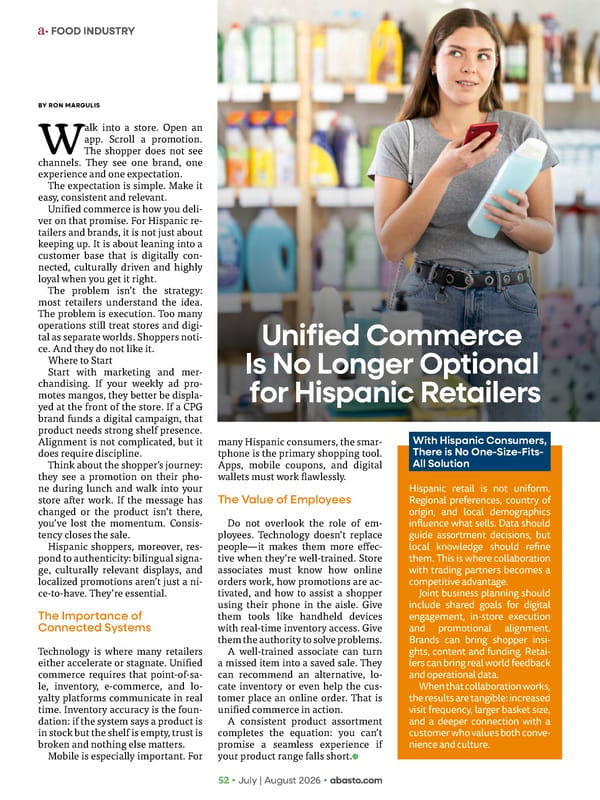
53 • July | August 2026 • abasto.com
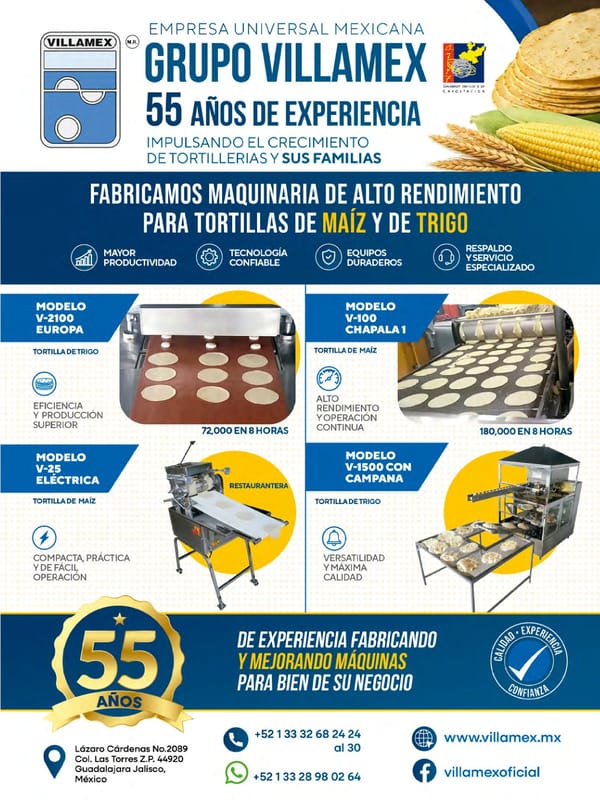
54 • July | August 2026 • abasto.com • FOOD INDUSTRY BY KEN NINOMIYA B ack-to-school time always brings addi- tional competition from mass merchants, club stores, and large grocery chains. The challenge for many independent grocers is how to compete with bi- gger firms that have more advertising resources. Pri- ce may not be the answer. Some benefits exist for in- dependent grocery stores that are not always noticed during the busy holiday sa- les rush. 1. Deep roots in their communities. Parents like to support businesses that support the local schools, youth sports, instructors, and community organizations. Grocers that are part of neighborhood events crea- te better emotional ties with their customers than their much larger rivals. 2. Independents can move more quickly. Larger retailers are gene- rally slow to get permis- sion. Independent opera- tors may quickly develop school-themed displays, community partners- hips, teacher apprecia- tion activities, and local specials that appeal to neighborhood shoppers. 3. Small retailers offer personalized service. The back-to-school season may be a challenging time for families. A shopping Back-to-School Season: The Independent Grocer’s Advantage motional window. Fami- lies are determining whe- re they are going to shop throughout the school year. Retailers who create confidence in August have customers’ devotion for months to come. Some- times huge competitors outspend independent grocers. But independent grocers can out-connect with them often. And in today’s omnichannel commerce, genuine con- nections to communities remain one of the most competitive advantages an independent grocer can have. experience that people re- member long after the sea- son is over can be built by friendly staff, clean stores, easy layouts, and helpful merchandising. A mix value, convenience, and community formula The most effective back- to-school programs mix value, convenience, and community participation. They can collaborate with local schools, sponsor efforts to supply class- rooms, reward teachers, and hold family-friendly events to show their com- mitment to the communi- ty. These efforts may not always lead to immediate sales, but they do build client relationships and long-term commitment. The back-to-school sea- son should be a time to create relationships and not just a short-term pro-
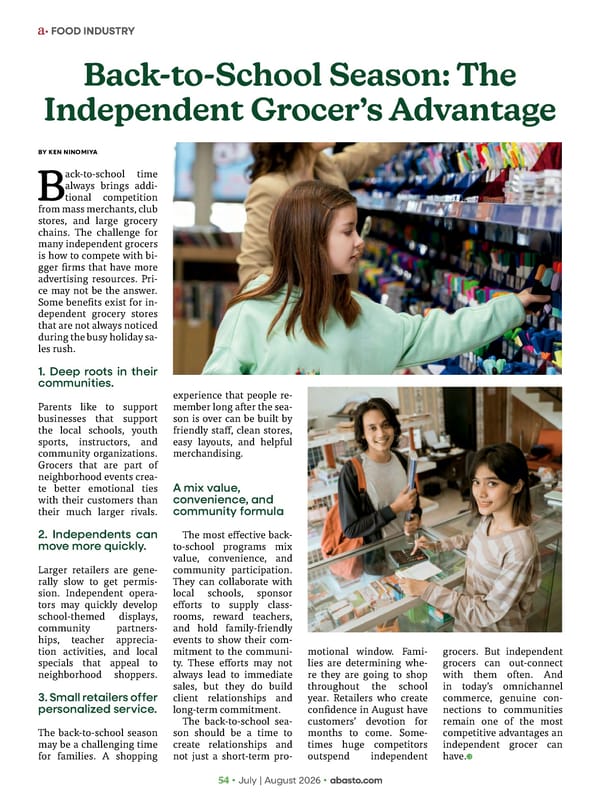
55 • July | August 2026 • abasto.com

56 • July | August 2026 • abasto.com BY GRACE AGOSTINO F o r Hispanic consumers, food is never just food. It’s memory. It’s identity. It’s family. It’s the smell of something familiar, the sound of a kitchen, the voice of someone who reminds you of home. That’s exactly why audio is one of the most powerful—and underutilized—tools for Hispanic food brands today. While many marketers focus on visual platforms, they often overlook a simple tru- th: audio is where culture lives. It’s in the music, the language, the humor, the rhythm of conversation. It’s in the trusted voices people invite into their daily routines—mor- ning shows, midday segments, drive-time personalities who feel more like friends than media. For Hispanic audiences, audio isn’t passi- ve. It’s personal. It travels with them—at home while coo- king, in the car during school drop-offs, at work, in-store. That constant presence crea- tes something most platforms struggle to deliver at scale: familiarity, frequency, and trust. And that matters deeply for food brands. Because in categories like sweets and snac- ks—where decisions are often emotional, impulsive, and rooted in habit—brands aren’t just competing for attention. They’re competing for memory. A beautifully designed package might catch the eye. But it’s repeated exposure and cultural resonance that drive someone to reach for your product again and again. Audio sits right at the center of that loop. It meets consumers in real-life moments that align naturally with consumption behavior: Morning audio aligns with breakfast rou- tines and coffee rituals Afternoon programming connects with cravings and quick snack decisions Evening listening often ties to family time, shared meals, and indulgence These aren’t abstract “impressions.” The- se are contextual moments where messa- ging can feel relevant instead of disruptive. But context alone isn’t enough. The real di- How Hispanic Food Brands Win Through Audio Storytelling Culture Sells fferentiator is who delivers the message. In Hispanic media, personalities matter. On-air talent, DJs, and creators are not just voices—they are trusted influencers within their communities. Their recommenda- tions carry weight because they are built on years of connection, consistency, and cultu- ral understanding. When a trusted voice shares a personal story about a product—how it reminds them of home, how their kids love it, how it shows up in their daily life—that message lands di- fferently. It feels real. And that authenticity is what drives trial. The smartest brands aren’t treating audio as a standalone channel. They’re integrating it into a broader ecosystem—connecting on-air messaging with in-store activations, social content, and influencer partnerships to create a seamless consumer journey. Because ultimately, growth in this space isn’t about choosing between culture and commerce. It’s about understanding that one drives the other. For Hispanic food brands, the opportunity isn’t just to be seen on the shelf—it’s to be re- membered, talked about, and chosen. And that starts with showing up in the places where culture is lived every day. Because in this market, culture doesn’t just shape prefe- rences. Culture sells. Grace Agostino is SVP of Sales & Corporate Communications at Nueva Network, driving growth through culturally relevant audio, media, and marketing solutions. • FOOD INDUSTRY
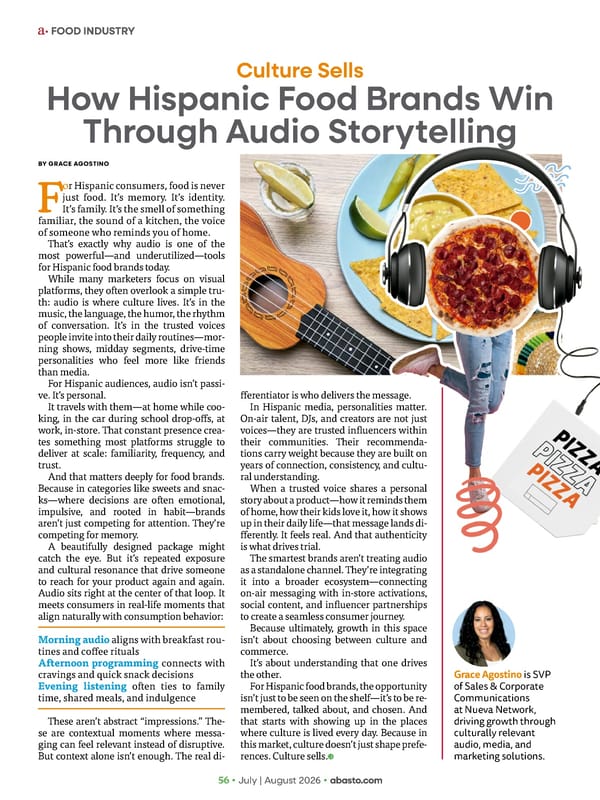
57 • July | August 2026 • abasto.com
58 • July | August 2026 • abasto.com THE WORLD CUP TAKES CENTER STAGE AT EXPO ANTAD 2026 BY VIOLETA MONTES DE OCA E xpo Guadalajara hosted the 43rd edition of the Expo ANTAD from May 19 to 21, 2026 in Guadalajara, Mexico. At the venue, Mikel Arriola, pre- sident of the Mexican Football Federation, delivered the keynote address ahead of the trade show’s official inauguration. The main topic: World Cup. “We are 24 days away from the largest event in human history in terms of magni- tude,” Arriola said, referring to the 2026 World Cup. Soccer, he continued, is the most popu- lar sport on Earth, and North America is the most integrated and wealthiest region in the world. Mexico records 100 million soccer fans, while the United States has 60 million. However, when a person attends a match in Los Angeles, the stands are dominated by a Mexican population. The Hispanic population in the United States represents the fifth-largest Gross Domestic Product (GDP) in the world, Arriola highlighted. Furthermore, he no- ted that the growth rate of this GDP is the third fastest globally, and the income of Hispanics there has increased by nearly 40%. “I believe one of the best ways to look at soccer is from a consumer perspective, because you realize it is the most consu- med and popular sport in the world. We are going to have the biggest World Cup in human history,” he mentioned. There will be 62% more matches than in Qatar 2022, featuring 16 stadiums across three countries. AT THE EXHIBITION HALL 1. Alejandro de la Hoz, Goya Foods team. 2. Ana Luisa Pérez, EDT-VPA Incaparina. 3. David García, Megalimentos. 4. Sandra Cortés, INNERCIA. 5. Ma. Elena Fernández and Alberto Coro- nado, La Sabrozita. 6. Marco Arguijo, El Gran Chaparral. TOUR THE SHOW 2 4 5 3 1 6 • Continues on page 60 • TRADE SHOWS
59 • July | August 2026 • abasto.com
60 • July | August 2026 • abasto.com • INDUSTRIA ALIMENTOS Inside Expo ANTAD 2026 Diego Cosío, executive president of the Na- tional Association of Self-Service and De- partment Stores (ANTAD), shared that this edition featured more than 50,000 repre- sented brands, as well as over 2,500 buyers and representation from 70 countries. “We exceeded our goals by over 10% in the number of participating companies, by 7% in the number of visitors, and saw a 12% growth in generated revenue becau- se Mexico is trending,” said Manuel Álva- rez, general coordinator of Expo ANTAD, in an interview with Abasto Media during the third day of the trade show. Russia, Korea, and Indonesia were three new countries showcasing products du- ring Expo ANTAD 2026. Jalisco, where Guadalajara is located, ranks fifth nationwide in total export value and is the leader among Mexico’s non-border states, highlighted Pablo Le- mus, governor of Jalisco, during the inau- guration of Expo ANTAD 2026. AT THE EXHIBITION HALL 7. Iván Ahumada, Minsa. 8. Armando Gómez Ibarra, Alfonso Már- quez, and Víctor Ortega, Novamex. 9. Federico Wong, SANE Foods. 10. Francisco Menéndez, Rodrigo Rodrí- guez, and Francisco José Menéndez, Mesoamérica. 11. Gustavo Blanco, Mazuma. 12. Ma. Isabel Mendoza and Gustavo Jai- me, Pepito USA. 7 10 11 12 9 8 • Continues on page 62 • Continuation of page 58
61 • July | August 2026 • abasto.com
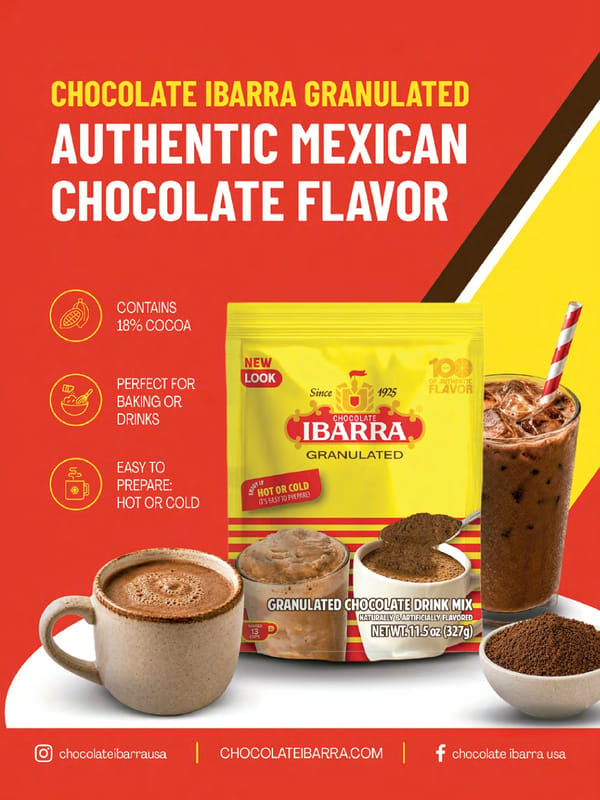
62 • July | August 2026 • abasto.com Save the Date: Expo ANTAD 2027 Expo ANTAD has solidified its position as one of the industry’s most important bu- siness gatherings, setting the pace for the global retail event calendar. “Expo ANTAD has become a global ben- chmark, so other organizers call us and ask when we plan to host the event so they don’t clash with ours,” Álvarez noted. Given this situation, the organizing committee confirmed an adjustment to its dates to maintain its international re- levance. “We are going to shift the dates again, but always within the parameters of the second quarter; we will be holding the event between April and May,” Álva- rez announced, specifying that the ideal projected window is between the last week of April and the first week of May. Looking ahead to next year’s edition, the organization is already preparing a re- newed commercial offering aimed at key niches within the consumer market. “We have an interesting turnout co- ming from other, more specialized sectors within grocery and edibles,” the general coordinator anticipated, detailing that next year will place a major focus on speci- fic categories such as dairy, cold cuts, and sweets. AT THE EXHIBITION HALL 13. Georgina Macias, Geommag 14. Aura Gálvez and Dionisio Martínez, YaEsta. 15. Ilse González, Multimexican and Mul- tiglobal. 16. Richard Harrington and Essy Lechon, Vilore. 17. Francisco López, Melissa Mendoza, and Steve Sande, La Moderna. 18. Luis Alfonso García, Salsa Huichol. 19. Víctor Padilla, Padilla ISM. 20. Gustavo Blanco, Amarumayu. 13 14 17 20 19 18 16 15 • Continuation of page 60 • TRADE SHOWS
63 • July | August 2026 • abasto.com
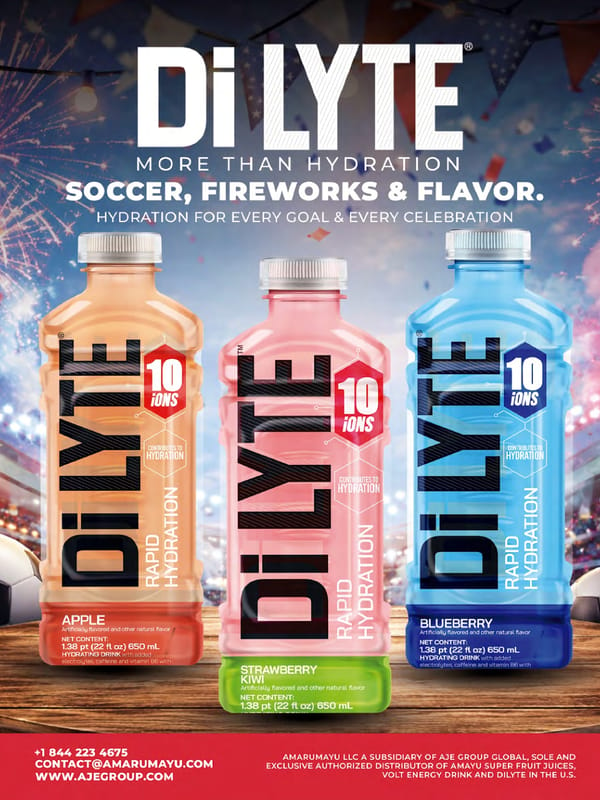
64 • July | August 2026 • abasto.com SWEETS & SNACKS EXPO 2026 LAS VEGAS SWEETENED THE CONFECTIONERY INDUSTRY BY HERNANDO RAMÍREZ-SANTOS T he Sweets & Snacks Expo 2026 made history in Las Vegas, drawing 17,500 attendees and more than 1,000 exhibitors from 90 countries. The National Confectioners Association (NCA) hosted the industry’s premier event across 275,000 square feet of show floor. Bold fla- vors, breakthrough products, and high-va- lue networking defined every session. A Historic First for the Show The Sweets & Snacks Expo took Las Vegas by storm for the very first time. During a conversation with Abasto and another media outlets, Christopher Gindlesperger, Executive Vice President of Public Affairs and Communications for the NCA, called the move “groundbreaking.” The show had spent nearly 30 years building its community in Chicago before relocating to Indianapolis. Now, Las Vegas signals an ambitious new chapter. NCA President and CEO John Downs doubled down on the significance of the shift. He said the move created a unique opportunity to showcase bold innovation and momentum driving the confectionery and snack industries. Las Vegas, he noted, matched the energy, color, and ambition the show deserved. EN LOS PASILLOS DE LA EXPO 1. El equipo de Winnuts. 2. Christian Angulo, Zumba Pica. 3. Karina González y Esteban Cuéllar de Manzela. 4. Nelson Pinzón, Mexilink. 5. Armando Peña, Safari Group. 6. Gastón González, Canel’s USA. 7. Elvis Presley, amenizando el piso del evento. 8. Oswaldo Castellanos, Baruc Navarro, HCNA. 9. Mike Gilroy, Mars. 2 3 5 7 4 6 8 9 1 • TRADE SHOWS • Continues on page 66
65 • July | August 2026 • abasto.com
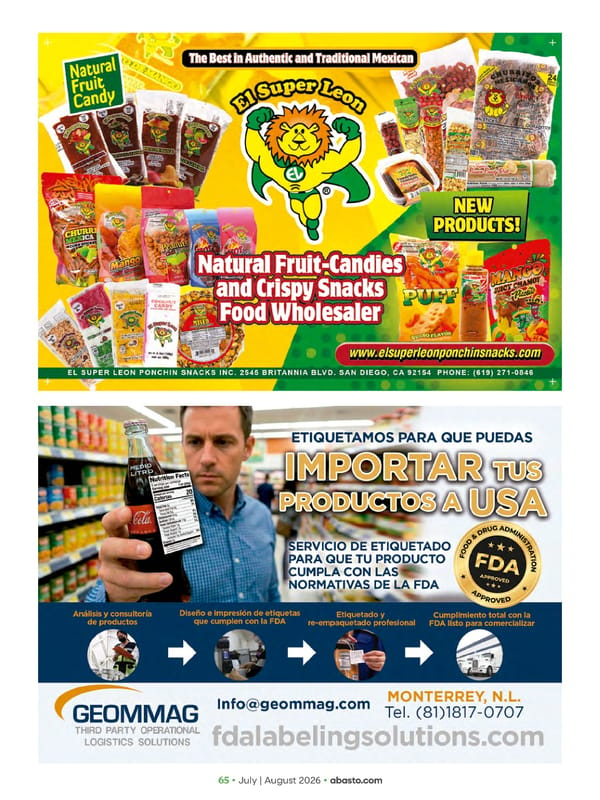
66 • July | August 2026 • abasto.com 1,000 Exhibitors, One Roof The show floor brought the entire con- fectionery ecosystem together under one roof. Manufacturers, buyers, suppliers, and distributors converged to share ideas and discover new products. In an interview with Abasto Media on the exhibition floor of the Sweets and Snacks show, Carly Schildhaus, Senior Di- rector of Public Affairs and Communica- tions for the NCA, described the experien- ce as exceptional. “Hundreds of thousands of types of pro- ducts” filled the aisles, Schildhaus noted. Classic favorites sat alongside cutting-ed- ge innovations. International brands and Latino companies also seized the platform to expand their U.S. market reach. Bold, adventurous flavor profiles do- minated the show floor. Sweet-and-spicy combinations drew heavy attention from attendees. Crunchy-and-chewy texture pairings also emerged as a standout trend. Brands clearly aimed to meet Gen Z and millennial consumers where their tastes lead them. Meanwhile, Gindlesperger highlighted education as a key differentiator for the show. Innovation, networking, and lear- ning all converge in one place, he said, and that combination proves difficult to repli- cate anywhere else. Vegas Energy, Indy Roots The NCA operates on a three-year rota- tion cycle. The show returns to Indianapo- lis in 2027 and 2028 before heading back to Las Vegas in 2029. The structure gives the Expo flexibility to grow while hono- ring its Midwest roots. Schildhaus confirmed the model reflects the show’s strategy to keep expanding its global reach and attendee base each cycle. The Sweets & Snacks Expo 2026 proved that the candy industry thrives on bold moves, on the show floor and off it. EN LOS PASILLOS DE LA EXPO 10. Liliana Rosales, Samuel Senda, Iván Bugarín, Giovany Hernández, Chomis Gomis 11. Marco Andrés Pacheco, Guillermo Montiel, Arco. 12. Grupo Prisma 13. Robert Rodríguez, Dulce Cortina, Elio González, Mexsnax. 14. Colorido del piso de la expo. 15. Ubaldo De La Torre, Fernando Hernández, CBI International 16. León Couturier, El Super Leon. 17. Luis Alejandro Sandoval, Eduardo Nava, Jared Urbaneja, Norjal. 18. Dulces Haribo. 19.Lidia Pineda, Piher Group. 10 11 12 13 14 15 17 16 18 19 • TRADE SHOWS • Continuation of page 64
67 • July | August 2026 • abasto.com
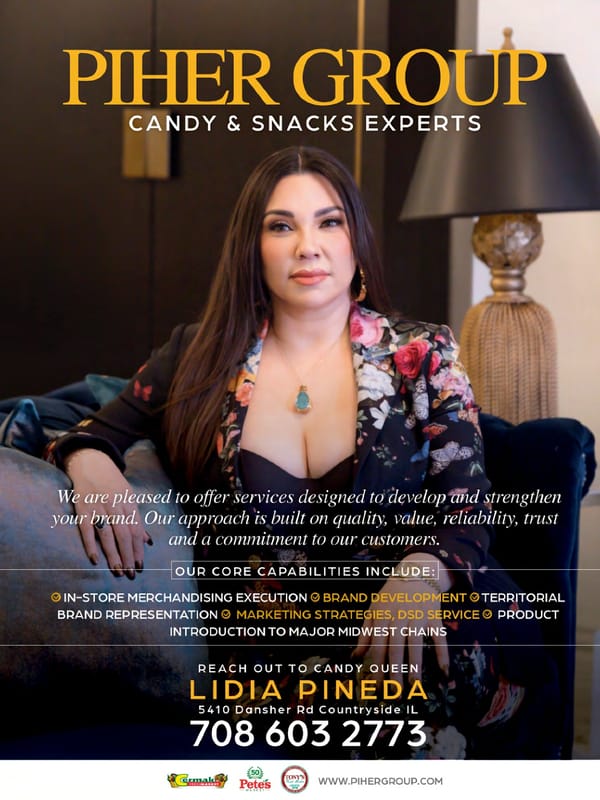
68 • July | August 2026 • abasto.com CUERVITO MORADO TOOK THE WORLD CUP WITH ITS SUMMER SHOW BY ABASTO H ispanic food distributor Cuervi- to Morado held its 2026 Summer Show in Winston-Salem, North Ca- rolina, with resounding success, bringing together hundreds of enthusiastic custo- mers and suppliers. On Thursday, June 4, the company transfor- med its Whitaker Park facility into a vibrant commercial hub, where World Cup fever set the tone for every transaction and encounter. A Hispanic Food Distributor with a World Cup Spirit The organizing team decorated the exhibition floor with soccer-themed decorations and flags of the countries participating in the Nor- th American World Cup, immersing attendees in a festive and inspiring atmosphere. In this way, the company connected the world’s most popular sport with the com- mercial dynamism that distinguishes each edition of this fair, creating an atmosphere that transcended the merely transactional. Dan Calhoun, one of the three founding brothers of Cuervito Morado, summed up the spirit of the event: “We’re excited to share the enthusiasm that summer has just begun. Welcome to the summer fair.” Calhoun emphasized the family-orien- ted nature of the business, noting that the loyalty of customers and business partners reflects the path that God and collective effort have laid out for the company. AT THE HALLWAYS OF THE SHOW 1. Rafael Riera, Goya Foods. 2. Welcome to the Little Purple Raven Show. 3. Chifles. 4. Doing business on the exhibition floor. 5. Gamesa. 6. Tampico. 7. HarinaPan. 8. Lucy Velásquez, Miguel Villarreal, Otto Nudding. 1 3 4 5 7 8 6 2 • TRADE SHOWS • Continues on page 70
69 • July | August 2026 • abasto.com

70 • July | August 2026 • abasto.com World-Class Facilities Support Growth In June 2025, Cuervito Morado opened its new nearly 900,000-square-foot head- quarters and logistics center in Whitaker Park, solidifying its position as a regional distribution powerhouse. From this modern complex, the com- pany serves more than 2,000 stores and food service outlets across ten states in the eastern U.S., from Delaware to Alabama, with next-day delivery. Under the motto “freshness and exce- llence guaranteed,” the company has for- ged lasting relationships with producers in Mexico, Central America, and the sou- thern United States. Business Relationships that Become Bonds of Trust Rick Calabro, general manager, expressed his satisfaction at seeing how business re- lationships evolve into genuine personal bonds: “It gives me great satisfaction to see how they are growing stronger.” Calabro also emphasized that soccer and food serve as powerful unifying for- ces: “Beyond any country or language, food brings us together, and soccer brings us together as well.” Lucy Velázquez, CEO of G&G Marketing, confirms this philosophy: she has been co- llaborating with the Cuervito Morado for 24 years and describes the relationship as part of a family that works together. Velázquez presented 12 companies at the show across categories as diverse as grains, flours, snacks, beverages, candies, and cookies, taking advantage of the sea- son to launch innovative strategies. Innovation and New Products Lead the Business Agenda Manolo Artigas, CEO of Life Marketing, thanked Cuervito Morado for keeping this meeting space alive, even though buyers face challenging economic conditions in today’s market. For his part, Numael Acosta, sales ma- nager at Vilore Foods, capitalized on the show’s enthusiasm to introduce the Totis brand with a brand-new subcategory wi- thin the snack segment: plantain chips. This fourth edition of the show at Cuer- vito Morado’s new facilities confirms that the fair serves as a business accelerator: manufacturers and retailers use it to set trends for the next business cycle. Cuervito Morado, Driving Force of the Hispanic Channel in the Eastern U.S. The low minimum order and fast delivery times position the Hispanic food distribu- tor as the ideal strategic partner for small retailers seeking competitiveness without sacrificing cash flow. Furthermore, its coverage of ten states turns every Cuervito Morado Show into a microcosm of the cultural and gastronomic diversity that defines the contemporary His- panic consumer in North America. With the World Cup as a backdrop and a strong business community at the fore- front, Cuervito Morado’s 2026 Summer Show confirmed that the Hispanic food industry continues to score goals. AT THE HALLWAYS OF THE SHOW 9. Dan Calhoun, CEO of Cuervito Morado. 10. Antonio Ríos, Raúl Dávila, Juan Carlos Aponte, Novamex. 11. Maseca. 12. Padilla Imports, Sales and Marketing. 13. Market 5201. 14. The CBI International team. 15. Malher. 16. Charras. 17. Rick Calabro, el Cuervito Morado. 18. Raymond Pagán, Susuky Zambrano, Mo Jafaari, Nestle USA. 9 11 13 14 15 16 17 18 12 10 • TRADE SHOWS • Continuation of page 68
71 • July | August 2026 • abasto.com
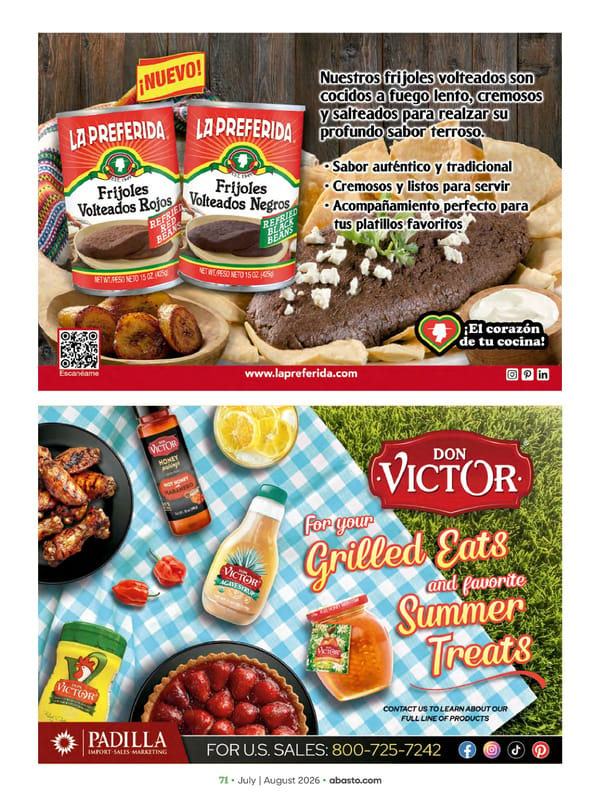
72 • July | August 2026 • abasto.com BY VIOLETA MONTES DE OCA T he Texas International Produce As- sociation (TIPA) had record-brea- king attendance for the 2026 Viva Fresh Expo. Now in its 11th year, the event welcomed 2,872 attendees, including 380 retail and foodservice buyers, and featu- red 199 exhibitors, marking the largest turnout in the show’s history. Since its inaugural event in Austin in 2015, Viva Fresh has grown into a premier regional trade show connecting the pro- duce industry across North America. The 2026 edition continued that trajectory, delivering a dynamic mix of networking, education, and business development opportunities. “This year’s record attendance reflects the continued momentum and impor- tance of Viva Fresh as a key platform for the fresh produce supply chain,” said Bret Erickson, executive vice president at Little Bear Produce and current Viva Fresh chairman. “From meaningful bu- yer-supplier connections to high-quali- ty educational programming, the event continues to evolve to meet the needs of the industry.” VIVA FRESH 2026 SETS NEW ATTENDANCE RECORD AT THE HALLWAYS 1. Dante Galeazzi, TIPA president. 2. RCF Distributors. 3. EXP Group. 4. Spring Valley. 5. Idaho Potato Comission. 6. Fresco Produce. 1 2 3 4 5 6 • Continues on page 74 • TRADE SHOWS
73 • July | August 2026 • abasto.com
74 • July | August 2026 • abasto.com Viva Fresh 2026 Activities The week’s activities included expanded networking opportunities such as the Viva Fresh Open across two golf courses at the TPC San Antonio, as well as the Second Annual Viva Fresh Pickleball Tournament and the first ever Viva Fresh Wine Tasting. These events offer attendees multiple ways to connect outside the exhibit hall. Signature programs such as the In Bloom Women’s Event, the EDGE student pro- gram, and the Y-TIPA Young Professionals mixer highlighted the association’s on- going commitment to leadership develop- ment and industry engagement across all career stages. The educational lineup featured a ran- ge of sessions addressing current topical industry issues reflecting on challenges and opportunities, including a session on Consumomics of Fresh Produce led by fu- turist economist Richard Kottmeyer of Fu- tureBridge, along with Sabrina DeLay. At- tendees also heard from keynote speaker Hunter Pinke, whose message of “no more bad days” and mindset shift resonated strongly with participants and set the tone for the weekend. Exhibition Floor The Saturday expo brought together 199 exhibiting companies showcasing fresh produce, innovations, and services to a highly engaged audience of buyers and industry professionals and offered unique engagement opportunities in the booths and on the show floor. With its strongest attendance to date, Viva Fresh 2026 reinforces its role as a must-attend event for the produce indus- try and underscores the continued grow- th and vitality of the Texas and Southwest produce sectors. Save the date The Viva Fresh Expo 2027 will be on April 8-10, at the JW Marriott Internatio- nal San Antonio Hill Country. AT THE HALLWAYS 7.Cabe Fruit. 8. Little Bear Produce. 9. SL Produce. 10. Sweet Seasons. 11. National Mango Board. 12.Bebo Produce. 7 9 11 12 10 8 • Continuation of page 72 • TRADE SHOWS
75 • July | August 2026 • abasto.com
76 • July | August 2026 • abasto.com 4TH LATIN CONSUMER SUMMIT THE NEW LATIN COXNSUMER REDEFINES REGIONAL RETAIL FROM THE EXHIBITION HALLWAYS 1. Athina Kanioura of PepsiCo and Dan Calhoun, CEO of Cuervito Morado. 2. Isaac Mizrahi, CEO of Alma. 3. Dan Calhoun and Luis Antonio Monckeberg, CEO of Grupo Ohla. 4. Panel discussion: “Leading the New Era of Grow- th in Latin America.” • TRADE SHOWS • Continues on page 78 More than 600 executives gathered in Miami to discuss the future of the Hispanic market BY ABASTO M iami was the epicenter of Latin American retail. Over two inten- se days at Florida International University, leaders of global brands redefi- ned the rules of the game. The 4th Latin Consumer Summit brought together more than 600 executives. They traveled from the United States and Latin America with one certainty: the Hispanic consumer is changing everything. The Star of the Show: The Latin Consumer The data is compelling. The Hispanic market is growing and establishing itself as an econo- mic and cultural engine in North America. The panel “Meet the New Latin Consu- mer” explored this transformation. Álvaro Cárdenas of Diageo and Felipe González, CEO of Nestlé Colombia, analyzed evol- ving purchasing habits. Likewise, Gretel Lanner of Edgewell highli- ghted the importance of hyper-personaliza- tion. Brands that fail to adapt quickly will lose relevance with this demanding consumer. AI, Data, and the Point of Sale Technology is no longer optional. Jason Gol- dberg of Publicis Groupe put it bluntly: arti- ficial intelligence and digital platforms are rewriting the relationship between brands and shoppers. For his part, Andy Murray, founder of Saatchi X, reinforced that message. “Com- panies must build people-centered strate- gies,” he told the audience. Athina Kanioura of PepsiCo added a strate- gic perspective. The region is growing rapidly and demands profound organizational trans- formations to respond to this dynamism. 1 4 2 3
77 • July | August 2026 • abasto.com

78 • July | August 2026 • abasto.com AT THE HALLWAYS 5. Panel discussion: “Success Stories and Hard Lessons.” 6. Jason Goldberg, CCO, Publicist Groupe. 7. Dan Calhoun with Summit attendees. 8. Bernardo Santana, CEO of Iberia Foods, speaking at a panel discussion. 9. Grace Hernández and Arturo Molina, Coin City Bonding. 10. Alvaro Luque, CEO of Avocados From Mexico. • Continuation of page 76 From Latin America to the U.S. Market The panel “From LatAm to the U.S.” revea- led concrete opportunities. Sebastián Me- jía of Juan Valdez shared key lessons lear- ned about expanding northward. Dan Calhoun, CEO of the Hispanic food distributor Cuertivo Morado, and Joaquín Vilajuana rounded out this analysis. The Hispanic consumer in the United States offers a strategic gateway for Latin Ameri- can brands with a global vision. Sports as a Commercial Platform A new trend captured the retail sector’s attention. The panel “Game On: From Sta- dium to Store” demonstrated that sports powerfully connect brands with commu- nities. Carlos Quintero of Mastercard and Pa- blo Cavallaro of Adidas Mexico explained how to integrate entertainment, experien- ces, and marketing into a single strategy. Pedro Garza of Club América provided the sports industry’s perspective. Transformation and Leadership Francisco Irarrázaval, CEO of Falabella, hosted an exclusive private breakfast. He shared how the group strengthened its di- gital operations and customer experience amid a volatile environment. Juan Guaidó delivered the closing re- marks on politics. He analyzed the re- gion’s institutional challenges and their direct impact on investor confidence. A Community Growing Together Antonio Monckeberg, CEO of Grupo Ohla, summed up the spirit of the event: “Con- sumers are changing at an enormous pace. This forces companies to constantly rethink how they innovate and create value.” “What we saw at this year’s event was a regional community that is increasingly collaborative, more global, and more awa- re of the opportunities that exist for Latin America and the Hispanic market in the United States,” added Monckeberg. The Latin Consumer Summit is already planning its next edition. For the food re- tail sector, the message is clear: adapt or be left behind. 5 6 9 10 7 8 • TRADE SHOWS
79 • July | August 2026 • abasto.com
80 • July | August 2026 • abasto.com • FLAVOR FOCUS POR DOREEN COLONDRES lacocinanomuerde.com Garlic, the Soul of Our Kitchens What you’ll need: · 1/2 cup extra-virgin olive oil · 16 medium shrimp, cleaned, deveined, and with tails removed · 6–8 cloves of garlic, thinly sliced · 1 dried chili pepper, peperoncino, chile piquín, or 1 whole chile de árbol · 1 tablespoon fresh parsley (or cilantro) · Salt to taste · 2 tablespoons white wine, sherry, or brandy Here’s what you need to do: · In a skillet or clay pot over medium heat, add the garlic and the whole chili pepper and cook until the garlic is golden brown, about 3–4 minutes, sti- rring constantly so it doesn’t burn. · Turn up the heat slightly, add the shrimp, wine, salt, and pepper, and cook for three minutes, tur- ning them once, until they turn pink. · If it gets too hot, lower the heat so the garlic doesn’t burn. · Remove from heat, add the parsley (or cilantro), and serve. Serve over bread, tostones, or rice. Enjoy your meal! Doreen is an author, chef, wine educator, creator of lacocinanomuerde.com and founder of vitishouse. com. Follow her on social media @doreencolondres Garlic Shrimp burning. If you’re making garlic oil, cook it slowly over low heat: let it sweat and soften. If it browns slightly, it’ll be perfect for dipping bread. And with that same oil, you can start almost any recipe, like this one: A lthough I’ve never seen a festival in its honor, Gar- lic Day is celebrated every year in April. My dad would probably organize one without a second thought, and the truth is, he deserves it. Because garlic isn’t just an ingredient—it’s a tradition. It’s the starting point for almost everything we cook at home. In our Latin American kitchens, garlic lives in sofrito, in rice, in meats, in beans, and even in fish and seafood. It’s in that first aroma that wafts from the skillet, signaling that something good is on the way. And if we cross the At- lantic, in Spain, garlic isn’t optional... It’s the law. But beyond the romanticism, there’s something impor- tant to understand, garlic starts working before it even hits the heat. From home remedies to miracle capsules, garlic has taken center stage even in nail care and overall health, as it’s credited with antimicrobial and anti-inflammatory properties. Back in the kitchen, buy it fresh. Look for firm cloves with intact skin. Fresh garlic doesn’t shout—it whispers. And take good care of it: keep it away from moisture, in a dark, well-ventilated place. The refrigerator, while prac- tical, isn’t always its best friend. The true power of garlic lies not only in what it does for the body, but in what it brings to the table: flavor and me- mories that linger. So, to celebrate garlic, I invite you to try something sim- pler: heat a skillet, add a little olive oil, and let the gar- lic work its magic. The rest, almost always, takes care of itself. Because let’s be honest: a sauce or dip, rice, soup, stew, shrimp, or a good mofongo wouldn’t be the same wi- thout it. If the garlic will be part of a sofrito, chop it finely and cook it over low heat, letting it release its aroma without
81 • July | August 2026 • abasto.com

82 • July | August 2026 • abasto.com Anúnciate aquí: (336) 483-5892 • sales@abasto.com Marketplace NATURAL CHARCOAL/ FIREWOOD FOR GRILLING Private label available Call today! Excellent promotion. (956) 683-0453 100% MEXICAN DAIRY PRODUCTS With all quality certifications. Call today! The best deals. (956) 683-0453 ALOE VERA DRINKS Mango, pineapple, aloe, guava, strawberry, coconut, etc. We are looking for distributors. Call today! (908) 313-4861 LATIN PRODUCTS Find products from your country. The best deals. Call today! (949) 456-2697 MEXICAN SEASONINGS Chorizo, chipotle, carne asada. Call us today! The best deals. (800) 621-5422 SALT WITH SEASONING Seasoning for tacos, fine spices. The best prices! (404) 766-5334 FROZEN COVERINGS AND FILLINGS FOR DESSERTS Vanilla, chocolate, confectionery coverings. Call today! (800) 590-2575 VARIETY OF VELADORAS Religious, esoteric, tumblers, plain. Call today! Excellent promotion. (954) 627-4653 100% MEXICAN SWEETS Tamarind and watermelon with chili. We are looking for distributors! +52 55 55 02 5625 PREMIUM BANANA CHIPS Lemon chili, green sauce Great deals! (281) 657-5702 MEXICAN SAUCES AND SNACKS Black sauce, spicy sauce, habanero sauce, tortillas, nacho-style chips. We are looking for distributors! (210) 907-9415 CANDIED SPICY SWEETS Tamarind flavor. The best deals! (773) 847- 4333 SMOKED CHOP Excellent Mexican product, the best quality. We are looking for distributors. Call today! +52 378 121 43 61 MEXICAN SPICE S Tree chili, peanuts, Japanese chili. Excellent sale prices! (336) 495-5000 MEXICAN SWEETS AND SNACKS Tamarind burritos, churritos, fried snacks, etc. The best deals! Call today! (619) 271-0846 ENERGY DRINKS Blueberry, guarana, and red berries. Call us today! (800) 835 6190 Mexican Snacks Original and green salsa tortilla chips, palanqueta mix, pork rinds, salt and lemon corn chips. (832) 630-8494 CORN TORTILLAS Jalapeño flavor with beans and cheese. Cheese-flavored corn chips. (817)751-4675 Marketplace
83 • July | August 2026 • abasto.com