
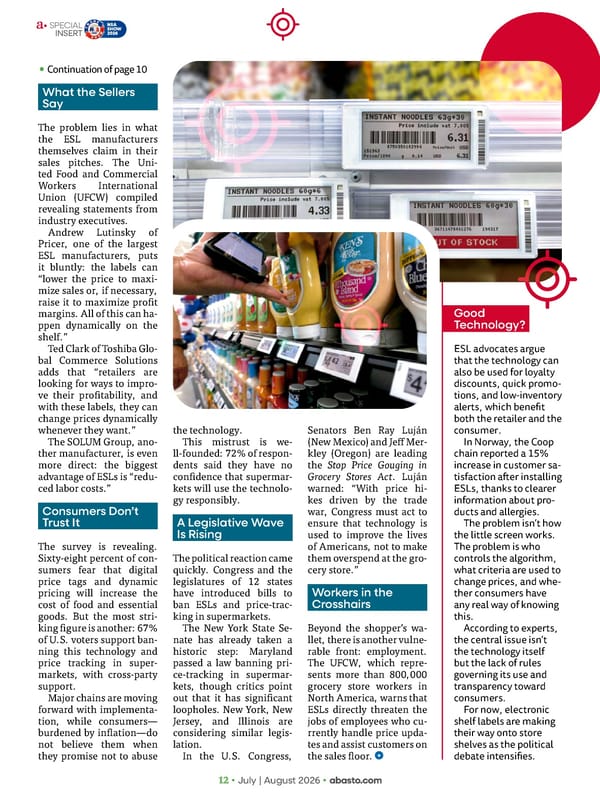
12 • July | August 2026 • abasto.com What the Sellers Say The problem lies in what the ESL manufacturers themselves claim in their sales pitches. The Uni- ted Food and Commercial Workers International Union (UFCW) compiled revealing statements from industry executives. Andrew Lutinsky of Pricer, one of the largest ESL manufacturers, puts it bluntly: the labels can “lower the price to maxi- mize sales or, if necessary, raise it to maximize profit margins. All of this can ha- ppen dynamically on the shelf.” Ted Clark of Toshiba Glo- bal Commerce Solutions adds that “retailers are looking for ways to impro- ve their profitability, and with these labels, they can change prices dynamically whenever they want.” The SOLUM Group, ano- ther manufacturer, is even more direct: the biggest advantage of ESLs is “redu- ced labor costs.” Consumers Don’t Trust It The survey is revealing. Sixty-eight percent of con- sumers fear that digital price tags and dynamic pricing will increase the cost of food and essential goods. But the most stri- king figure is another: 67% of U.S. voters support ban- ning this technology and price tracking in super- markets, with cross-party support. Major chains are moving forward with implementa- tion, while consumers— burdened by inflation—do not believe them when they promise not to abuse the technology. This mistrust is we- ll-founded: 72% of respon- dents said they have no confidence that supermar- kets will use the technolo- gy responsibly. A Legislative Wave Is Rising The political reaction came quickly. Congress and the legislatures of 12 states have introduced bills to ban ESLs and price-trac- king in supermarkets. The New York State Se- nate has already taken a historic step: Maryland passed a law banning pri- ce-tracking in supermar- kets, though critics point out that it has significant loopholes. New York, New Jersey, and Illinois are considering similar legis- lation. In the U.S. Congress, Senators Ben Ray Luján (New Mexico) and Jeff Mer- kley (Oregon) are leading the Stop Price Gouging in Grocery Stores Act . Luján warned: “With price hi- kes driven by the trade war, Congress must act to ensure that technology is used to improve the lives of Americans, not to make them overspend at the gro- cery store.” Workers in the Crosshairs Beyond the shopper’s wa- llet, there is another vulne- rable front: employment. The UFCW, which repre- sents more than 800,000 grocery store workers in North America, warns that ESLs directly threaten the jobs of employees who cu- rrently handle price upda- tes and assist customers on the sales floor. Good Technology? ESL advocates argue that the technology can also be used for loyalty discounts, quick promo- tions, and low-inventory alerts, which benefit both the retailer and the consumer. In Norway, the Coop chain reported a 15% increase in customer sa- tisfaction after installing ESLs, thanks to clearer information about pro- ducts and allergies. The problem isn’t how the little screen works. The problem is who controls the algorithm, what criteria are used to change prices, and whe- ther consumers have any real way of knowing this. According to experts, the central issue isn’t the technology itself but the lack of rules governing its use and transparency toward consumers. For now, electronic shelf labels are making their way onto store shelves as the political debate intensifies. • Continuation of page 10 SPECIAL INSERT NSA SHOW 2026
 Abasto Magazine - July/August 2026 english Page 61 Page 63