
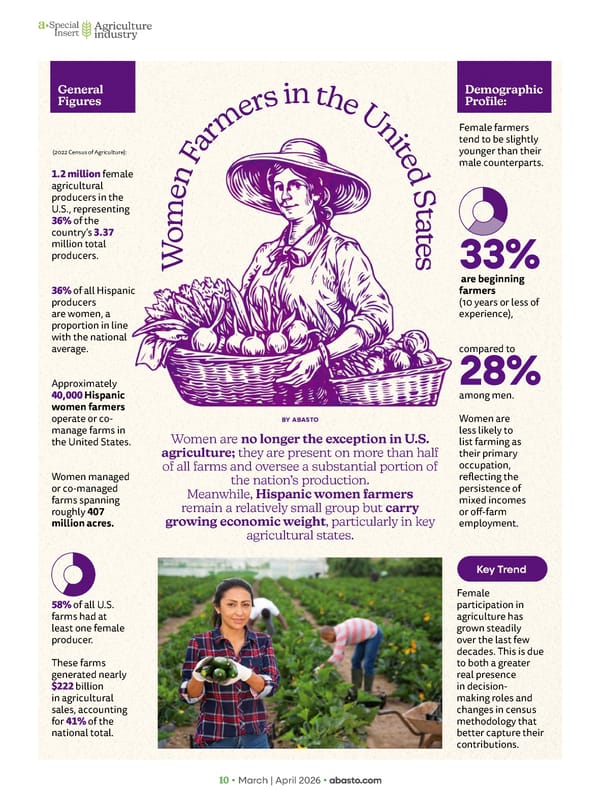
10 • March | April 2026 • abasto.com Special Insert Agriculture industry Female farmers tend to be slightly younger than their male counterparts. 33% are beginning farmers (10 years or less of experience), compared to 28% among men. Women are less likely to list farming as their primary occupation, reflecting the persistence of mixed incomes or off-farm employment. Wo m e n F a r m e r s i n t h e U n i t e d S t ates BY ABASTO Women are no longer the exception in U.S. agriculture; they are present on more than half of all farms and oversee a substantial portion of the nation’s production. Meanwhile, Hispanic women farmers remain a relatively small group but carry growing economic weight , particularly in key agricultural states. Female participation in agriculture has grown steadily over the last few decades. This is due to both a greater real presence in decision- making roles and changes in census methodology that better capture their contributions. (2022 Census of Agriculture): 1.2 million female agricultural producers in the U.S., representing 36% of the country’s 3.37 million total producers. 36% of all Hispanic producers are women, a proportion in line with the national average. Approximately 40,000 Hispanic women farmers operate or co- manage farms in the United States. Women managed or co-managed farms spanning roughly 407 million acres. 58% of all U.S. farms had at least one female producer. These farms generated nearly $222 billion in agricultural sales, accounting for 41% of the national total. Key Trend Demographic Profile: General Figures
 Abasto Magazine March / April 2026 ENGLISH Page 59 Page 61