Abasto Magazine March / April 2026 ENGLISH
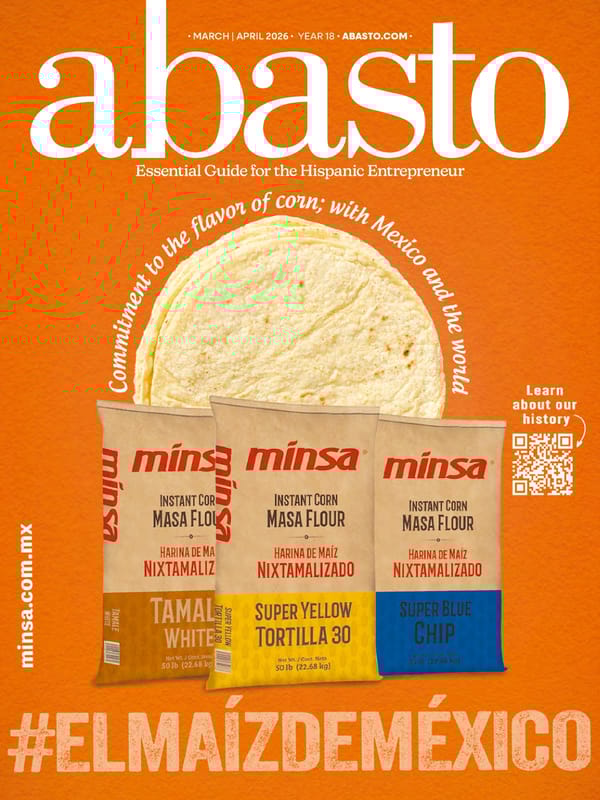
This issue of Abasto magazine highlights Mexican corn products, emphasizing their cultural and culinary significance.
• MARCH | APRIL 2026 • YEAR 18 • ABASTO.COM • Essential Guide for the Hispanic Entrepreneur
3 • March | April 2026 • abasto.com

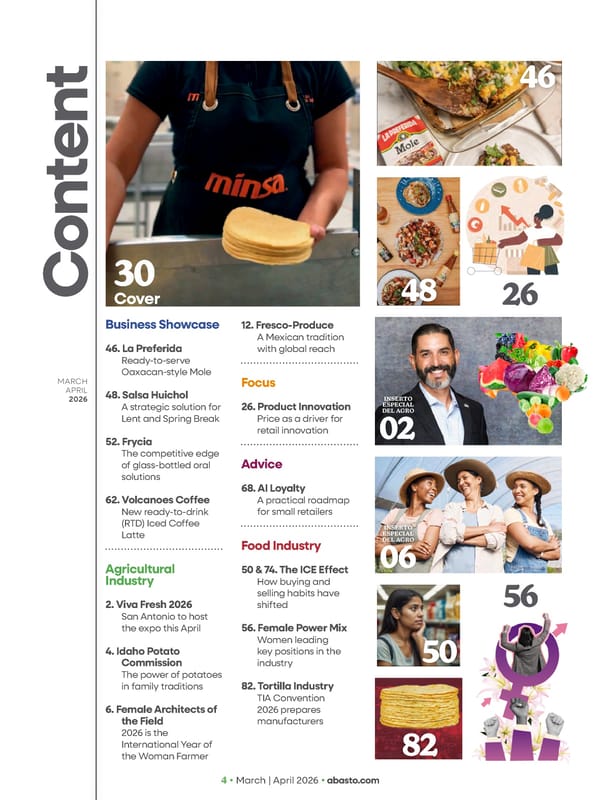
4 • March | April 2026 • abasto.com Content MARCH APRIL 2026 Business Showcase 46. La Preferida Ready-to-serve Oaxacan-style Mole 48. Salsa Huichol A strategic solution for Lent and Spring Break 52. Frycia The competitive edge of glass-bottled oral solutions 62. Volcanoes Coffee New ready-to-drink (RTD) Iced Coffee Latte Agricultural Industry 2. Viva Fresh 2026 San Antonio to host the expo this April 4. Idaho Potato Commission The power of potatoes in family traditions 6. Female Architects of the Field 2026 is the International Year of the Woman Farmer 12. Fresco-Produce A Mexican tradition with global reach Focus 26. Product Innovation Price as a driver for retail innovation Advice 68. AI Loyalty A practical roadmap for small retailers Food Industry 50 & 74. The ICE Effect How buying and selling habits have shifted 56. Female Power Mix Women leading key positions in the industry 82. Tortilla Industry TIA Convention 2026 prepares manufacturers Cover 30 06 02 56 50 82 48 26 46 INSERTO ESPECIAL DEL AGRO INSERTO ESPECIAL DEL AGRO
5 • March | April 2026 • abasto.com
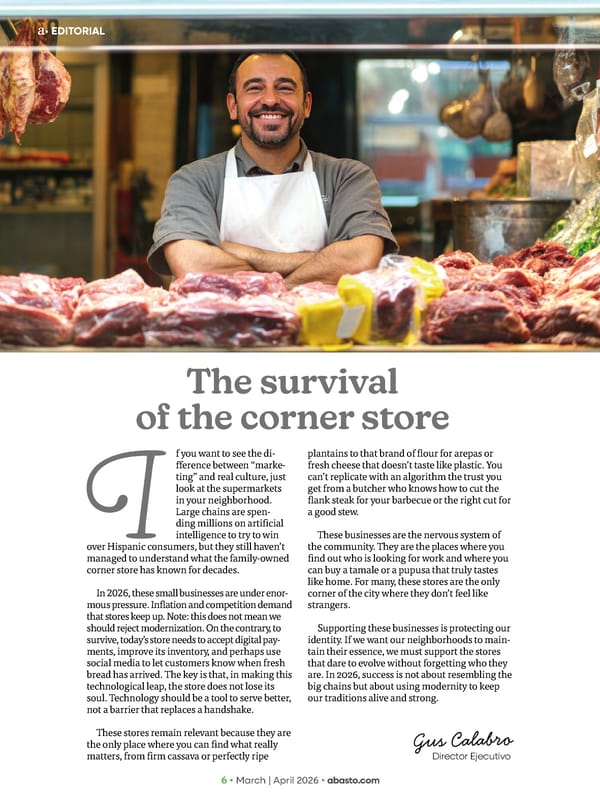
6 • March | April 2026 • abasto.com The survival of the corner store I f you want to see the di- fference between “marke- ting” and real culture, just look at the supermarkets in your neighborhood. Large chains are spen- ding millions on artificial intelligence to try to win over Hispanic consumers, but they still haven’t managed to understand what the family-owned corner store has known for decades. In 2026, these small businesses are under enor- mous pressure. Inflation and competition demand that stores keep up. Note: this does not mean we should reject modernization. On the contrary, to survive, today’s store needs to accept digital pay- ments, improve its inventory, and perhaps use social media to let customers know when fresh bread has arrived. The key is that, in making this technological leap, the store does not lose its soul. Technology should be a tool to serve better, not a barrier that replaces a handshake. These stores remain relevant because they are the only place where you can find what really matters, from firm cassava or perfectly ripe plantains to that brand of flour for arepas or fresh cheese that doesn’t taste like plastic. You can’t replicate with an algorithm the trust you get from a butcher who knows how to cut the flank steak for your barbecue or the right cut for a good stew. These businesses are the nervous system of the community. They are the places where you find out who is looking for work and where you can buy a tamale or a pupusa that truly tastes like home. For many, these stores are the only corner of the city where they don’t feel like strangers. Supporting these businesses is protecting our identity. If we want our neighborhoods to main- tain their essence, we must support the stores that dare to evolve without forgetting who they are. In 2026, success is not about resembling the big chains but about using modernity to keep our traditions alive and strong. Director Ejecutivo • EDITORIAL
7 • March | April 2026 • abasto.com

8 • March | April 2026 • abasto.com Collaborators abastomedia abastomagazine abasto abasto Abasto es una revista bimestral de circulación nacional publicada por Hispanic Marketing Consultants, Inc. P.O. Box 20577 Wins- ton-Salem, NC 27101. Todos los derechos reservados. Prohibida la reproducción parcial o total de su contenido sin previa autori- zación del Editor. Abasto investiga la seriedad de sus anunciantes, pero no se hace responsable del contenido de las ofertas. Las opiniones expresadas por los autores y contribuyentes que colaboran en esta revista no son necesariamente compartidas por los editores o representantes de HMC (Hispanic Marketing Consultants) Abasto Media. • Ana María Triana Psychologist & Business Consultant. She is Marketing Director of AnaBella Dried Food. • Ramón Portilla Founder HumanX Insights. Visionary leader in customer insights. Passionate about CX. Innovator in Insights technology • Julio Ibáñez Retail Executive, International. CEO of Aurora Grocery Group and President of the Hispanic Retail Chamber of Commerce. • Diana Leza Sheehan Founder of PDG Insights with over 25 years of experience, she helps brands and retailers make strategic decisions using data. • Doreen Colondres. Latina chef, tireless traveler, graduate and certified in gastronomy and wines, and owner of the Vitis House school. • Ken Ninomiya Omnichannel marketing and e-commerce ex- pert. Award-winning marketing professional, professor, author, and strategist. • Ricardo Gaitán Branding specialist. Master in Marketing Mana- gement Universidad San Plablo. Author of the book: “101 useful branding tips” • Ron Margulis Director de RAM Communications, LLC. He is a journa- list specializing in the food industry. Gerente General / General Manager Gustavo Calabro gcalabro@abasto.com 336.724.9718 x.204 Diseño Gráfico / Graphic Design Orlando Rivera orlando.rivera@abasto.com 336.724.9718 Departamento Editorial / Editorial Department Hernando Ramírez-Santos hramirezsantos@abasto.com 336.724.9718 x.201 Violeta Montes de Oca vmontesdeoca@abasto.com 336.724.9718 x.203 Cuentas Nacionales / National Accounts Eliana Lankerd elankerd@abasto.com 336.724.9718 x.202 Ventas México-Latam / Sales Representative LATAM Marcela Chaves dianac@abasto.com 336.724.9718 x.206 Xochitl Oliva xoliva@abasto.com 713.363.0385 Juan Pablo Madero jpmadero@abasto.com 52.1.333.167. 8502 Administración & Eventos / Administration & Events Fernanda P. Walker fernanda.pineros@abasto.com 336.724.9718 x.213 Redes Sociales / Social Media Danna Guevara dannag@abasto.com Publicidad / Advertising advertising@abasto.com 336.486.2424 Suscripciones / Subscriptions info@abasto.com • Mary Coppola Heslep Creative Director at Ten Acre Marketing. She was Vice President of Marketing at the United Fresh Produce Association.
BY ABASTO atura’s, the leading nec- tar brand in Honduras, is expanding its presence in the United States with the launch of Natura’s Orange, an orange nectar with natural pulp. This product is designed to meet the preferences of Hispanic consumers seeking a refreshing, nutritious be- verage. Sustained Growth in the Market Natura’s has maintained an average growth rate of over 20% in the last five years, consolidating its position in the beverage market. This launch reinforces its expansion strategy in the US, where the brand has been present for over a decade, win- ning over palates with its hi- gh-quality products. Exclusive Exclusive Launch in the U.S. Launch in the U.S. Natura’s Orange with Natural Pulp: Freshness, Flavor, and Quality in Every Sip Benefits of Natura’s Orange This new beverage stands out for its natural composition and health benefits. It contains natural orange pulp, enriched with vitamin C, and does not require refrigeration, ma- king it practical for any occasion. In addition, it improves digestion and is sweetened with cane sugar, giving it a smooth, sweet taste. Aimed at a Demanding Audience Natura’s Orange is designed for con- sumers who prioritize their health and enjoy natural juices. It is ideal for breakfast or as a snack at home, school, or work. Its flavor and freshness make it an excellent choice for those looking for high-quality orange juice. Availability and Packaging Starting in March, Natura’s orange nectar with natural pulp will launch its third and newest packaging op- tion: Natura’s 450 mL can. This new size complements the 1000 ml and 500 ml T-Top packaging, expan- ding Natura’s Pulpa’s reach through its solid distribution network in the Hispanic and Central American mar- kets in the United States. A Safe Bet for Distributors and Supermarkets The orange juice market continues to grow in the US, as does the Hispanic population. Natura’s, a nostalgic brand with a strong connection to this audien- ce, guarantees high turnover at points of sale. Thanks to its winning formula and unmatched flavor, Natura’s Orange is poised to be an excellent addition to the country’s orange juice portfolio. 10 • March | April 2026 • abasto.com

11 • March | April 2026 • abasto.com

12 • March | April 2026 • abasto.com Starter ALDI to open 180 stores by 2026 The discount chain is committed to growth. It plans to have nearly 2,800 stores by the end of 2026, bringing it closer to its goal of operating 3,200 stores in the United States by 2028. Kroger: Six food trends Kroger’s team of food experts offers a forecast of what customers will be looking for in 2026. Cultured dairy Protein + fiber synergy One-bite snacks and mini-meals Citrus takes center stage Restaurant-style home cooking Asian-inspired fusions Entrecomillas Our new Nuestra Familia Supermarket reflects how we are reinventing the shopping experience, making it faster and easier for families who are always on the go, while still offering the authentic products and traditions that connect communities,” said Jay Mahabir, vice president of Retail Operations at SpartanNash, about his first small-format Nuestra Familia Supermarket in Omaha, Nebraska. ALDI celebrates its 50th anniversary this year, in which it will open more than 180 stores in 31 states It will invest $9 billion through 2028 to expand its operations and build new distribution centers in Flo- rida, Arizona, and Colorado Supermarket ranking According to dunnhumby’s Retailer Preference Index (RPI), consumers are increasingly focusing their decisions on savings in the face of rising essential costs.
13 • March | April 2026 • abasto.com
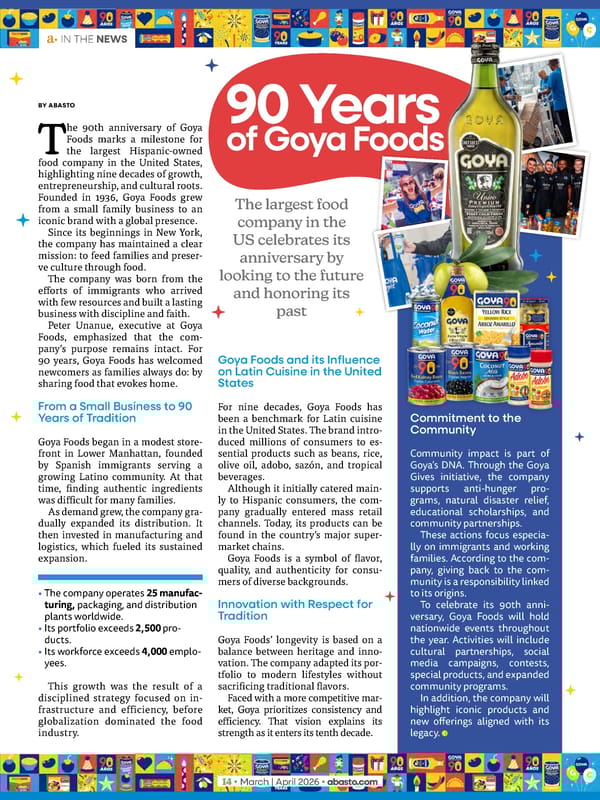
14 • March | April 2026 • abasto.com 90 Years of Goya Foods BY ABASTO T he 90th anniversary of Goya Foods marks a milestone for the largest Hispanic-owned food company in the United States, highlighting nine decades of growth, entrepreneurship, and cultural roots. Founded in 1936, Goya Foods grew from a small family business to an iconic brand with a global presence. Since its beginnings in New York, the company has maintained a clear mission: to feed families and preser- ve culture through food. The company was born from the efforts of immigrants who arrived with few resources and built a lasting business with discipline and faith. Peter Unanue, executive at Goya Foods, emphasized that the com- pany’s purpose remains intact. For 90 years, Goya Foods has welcomed newcomers as families always do: by sharing food that evokes home. From a Small Business to 90 Years of Tradition Goya Foods began in a modest store- front in Lower Manhattan, founded by Spanish immigrants serving a growing Latino community. At that time, finding authentic ingredients was difficult for many families. As demand grew, the company gra- dually expanded its distribution. It then invested in manufacturing and logistics, which fueled its sustained expansion. • The company operates 25 manufac- turing, packaging, and distribution plants worldwide. • Its portfolio exceeds 2,500 pro- ducts. • Its workforce exceeds 4,000 emplo- yees. This growth was the result of a disciplined strategy focused on in- frastructure and efficiency, before globalization dominated the food industry. The largest food company in the US celebrates its anniversary by looking to the future and honoring its past Goya Foods and its Influence on Latin Cuisine in the United States For nine decades, Goya Foods has been a benchmark for Latin cuisine in the United States. The brand intro- duced millions of consumers to es- sential products such as beans, rice, olive oil, adobo, sazón, and tropical beverages. Although it initially catered main- ly to Hispanic consumers, the com- pany gradually entered mass retail channels. Today, its products can be found in the country’s major super- market chains. Goya Foods is a symbol of flavor, quality, and authenticity for consu- mers of diverse backgrounds. Innovation with Respect for Tradition Goya Foods’ longevity is based on a balance between heritage and inno- vation. The company adapted its por- tfolio to modern lifestyles without sacrificing traditional flavors. Faced with a more competitive mar- ket, Goya prioritizes consistency and efficiency. That vision explains its strength as it enters its tenth decade. Commitment to the Community Community impact is part of Goya’s DNA. Through the Goya Gives initiative, the company supports anti-hunger pro- grams, natural disaster relief, educational scholarships, and community partnerships. These actions focus especia- lly on immigrants and working families. According to the com- pany, giving back to the com- munity is a responsibility linked to its origins. To celebrate its 90th anni- versary, Goya Foods will hold nationwide events throughout the year. Activities will include cultural partnerships, social media campaigns, contests, special products, and expanded community programs. In addition, the company will highlight iconic products and new offerings aligned with its legacy. • IN THE NEWS
15 • March | April 2026 • abasto.com
16 • March | April 2026 • abasto.com BY HERNANDO RAMÍREZ-SANTOS C alifornia has begun enforcing a statewi- de mandate requi- ring folic acid fortification of corn masa flour and wet corn masa products sold within its borders, a move aimed at reducing preven- table birth defects. The requirement took effect Jan. 1, 2026, un- der Assembly Bill 1830. The law compels manufac- turers to add folic acid to qualifying products distri- buted in the state. Gov. Ga- vin Newsom signed the le- gislation on Sept. 28, 2024, after sustained advocacy from medical and public health organizations. Addressing a Gap in Federal Nutrition Policy In 1998, federal regulations required grain products such as bread, pasta, and rice to be enriched with folic acid, but excluded nixtamalized corn flour and wet dough. This led to communities that con- Corn flour must be fortified with folic acid New mandate in California A new law has come into effect requiring manufacturers who distribute corn flour in the state to fortify it with folic acid. sume mainly corn-based foods having lower intakes of folic acid, which is es- sential for preventing neu- ral tube defects such as spi- na bifida and anencephaly. Maternal health experts agree that fortifying sta- ple foods is more effective than relying on individual supplements, especially since many pregnancies occur unplanned. The law seeks to close this structu- ral gap by including foods consumed daily. Fortification Standards Now in Effect Starting January 1, 2026, all nixtamalized corn flour manufactured or sold in California must contain 0.7 milligrams of folic acid per pound. Wet dough products may be enriched up to 0.4 milligrams per pound. The standards allow for flexibility in manufactu- ring without compromi- sing public health. The law also establishes labeling requirements: manufacturers must decla- re the presence of folic acid on the nutrition label and specify whether the pro- duct is nixtamalized corn flour or wet dough. This ensures transparency and consistency with existing nutrition information. Health Equity Assemblyman Dr. Joaquín Arambula, who authored the bill, framed folic acid fortification as a health equity measure grounded in public health data. When Newsom signed the legislation, Arambu- la said the law addresses disparities that place some communities at higher risk for preventable birth defects. Studies show Latino communities experience higher rates of neural tube defects, a trend researcher partially attribute to lower folic acid intake from com- monly consumed foods. Backing From Medical and Advocacy Groups The American College of Obstetricians and Gyne- cologists District IX and the March of Dimes spon- sored the legislation. Both organizations have long supported expanding folic acid fortification beyond wheat-based products. With the law now in effect, manufacturers dis- tributing corn masa flour in California must comply with fortification and labe- ling requirements. Retai- lers must ensure fortified options remain available when selling non-fortified products. Exemptions for Small Producers and Retailers • Artisanal food ope- rations and certain processing facilities may manufacture or sell corn flour without enriching it with folic acid. • Grocery stores may also offer unenri- ched products. • The law explicitly ex- cludes snack foods. • IN THE NEWS
17 • March | April 2026 • abasto.com
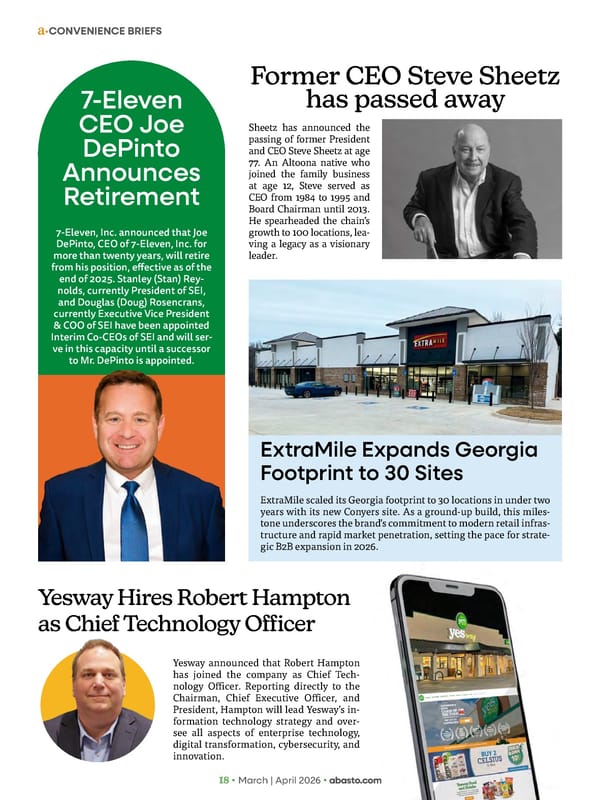
18 • March | April 2026 • abasto.com 7-Eleven CEO Joe DePinto Announces Retirement 7-Eleven, Inc. announced that Joe DePinto, CEO of 7-Eleven, Inc. for more than twenty years, will retire from his position, effective as of the end of 2025. Stanley (Stan) Rey- nolds, currently President of SEI, and Douglas (Doug) Rosencrans, currently Executive Vice President & COO of SEI have been appointed Interim Co-CEOs of SEI and will ser- ve in this capacity until a successor to Mr. DePinto is appointed. Yesway Hires Robert Hampton as Chief Technology Officer Former CEO Steve Sheetz has passed away ExtraMile Expands Georgia Footprint to 30 Sites ExtraMile scaled its Georgia footprint to 30 locations in under two years with its new Conyers site. As a ground-up build, this miles- tone underscores the brand’s commitment to modern retail infras- tructure and rapid market penetration, setting the pace for strate- gic B2B expansion in 2026. Sheetz has announced the passing of former President and CEO Steve Sheetz at age 77. An Altoona native who joined the family business at age 12, Steve served as CEO from 1984 to 1995 and Board Chairman until 2013. He spearheaded the chain’s growth to 100 locations, lea- ving a legacy as a visionary leader. Yesway announced that Robert Hampton has joined the company as Chief Tech- nology Officer. Reporting directly to the Chairman, Chief Executive Officer, and President, Hampton will lead Yesway’s in- formation technology strategy and over- see all aspects of enterprise technology, digital transformation, cybersecurity, and innovation. • CONVENIENCE BRIEFS
19 • March | April 2026 • abasto.com

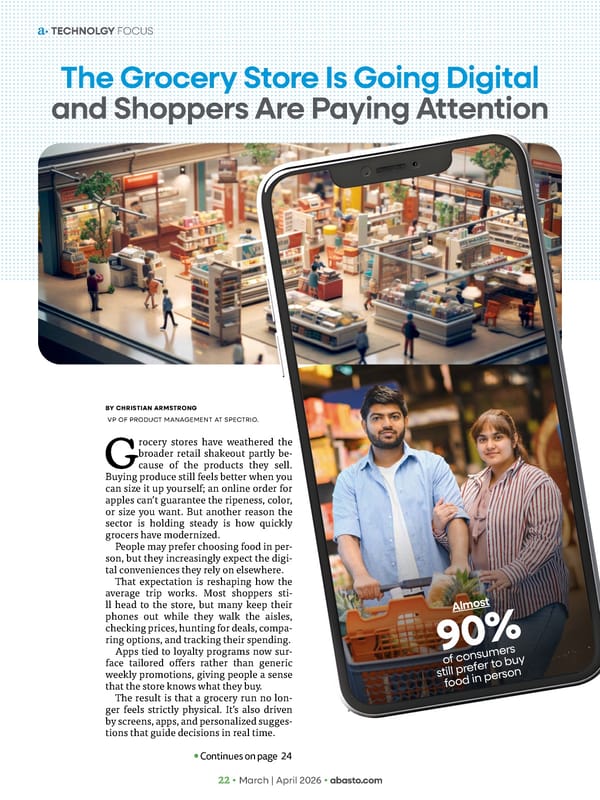
22 • March | April 2026 • abasto.com BY CHRISTIAN ARMSTRONG VP OF PRODUCT MANAGEMENT AT SPECTRIO. G rocery stores have weathered the broader retail shakeout partly be- cause of the products they sell. Buying produce still feels better when you can size it up yourself; an online order for apples can’t guarantee the ripeness, color, or size you want. But another reason the sector is holding steady is how quickly grocers have modernized. People may prefer choosing food in per- son, but they increasingly expect the digi- tal conveniences they rely on elsewhere. That expectation is reshaping how the average trip works. Most shoppers sti- ll head to the store, but many keep their phones out while they walk the aisles, checking prices, hunting for deals, compa- ring options, and tracking their spending. Apps tied to loyalty programs now sur- face tailored offers rather than generic weekly promotions, giving people a sense that the store knows what they buy. The result is that a grocery run no lon- ger feels strictly physical. It’s also driven by screens, apps, and personalized sugges- tions that guide decisions in real time. The Grocery Store Is Going Digital and Shoppers Are Paying Attention Almost 90% of consumers still prefer to buy food in person • Continues on page 24 • TECHNOLGY FOCUS
23 • March | April 2026 • abasto.com
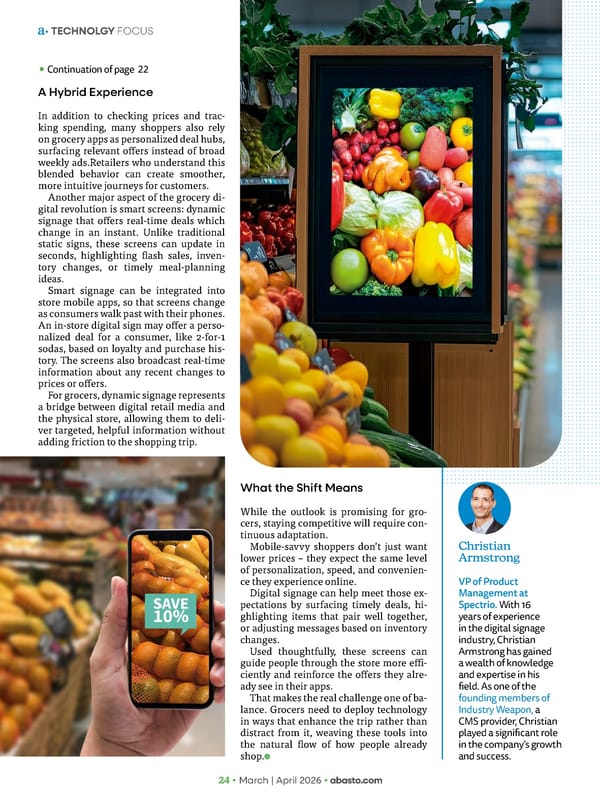
24 • March | April 2026 • abasto.com A Hybrid Experience In addition to checking prices and trac- king spending, many shoppers also rely on grocery apps as personalized deal hubs, surfacing relevant offers instead of broad weekly ads.Retailers who understand this blended behavior can create smoother, more intuitive journeys for customers. Another major aspect of the grocery di- gital revolution is smart screens: dynamic signage that offers real-time deals which change in an instant. Unlike traditional static signs, these screens can update in seconds, highlighting flash sales, inven- tory changes, or timely meal-planning ideas. Smart signage can be integrated into store mobile apps, so that screens change as consumers walk past with their phones. An in-store digital sign may offer a perso- nalized deal for a consumer, like 2-for-1 sodas, based on loyalty and purchase his- tory. The screens also broadcast real-time information about any recent changes to prices or offers. For grocers, dynamic signage represents a bridge between digital retail media and the physical store, allowing them to deli- ver targeted, helpful information without adding friction to the shopping trip. Christian Armstrong VP of Product Management at Spectrio. With 16 years of experience in the digital signage industry, Christian Armstrong has gained a wealth of knowledge and expertise in his field. As one of the founding members of Industry Weapon, a CMS provider, Christian played a significant role in the company’s growth and success. What the Shift Means While the outlook is promising for gro- cers, staying competitive will require con- tinuous adaptation. Mobile-savvy shoppers don’t just want lower prices – they expect the same level of personalization, speed, and convenien- ce they experience online. Digital signage can help meet those ex- pectations by surfacing timely deals, hi- ghlighting items that pair well together, or adjusting messages based on inventory changes. Used thoughtfully, these screens can guide people through the store more effi- ciently and reinforce the offers they alre- ady see in their apps. That makes the real challenge one of ba- lance. Grocers need to deploy technology in ways that enhance the trip rather than distract from it, weaving these tools into the natural flow of how people already shop. • Continuation of page 22 • TECHNOLGY FOCUS
25 • March | April 2026 • abasto.com

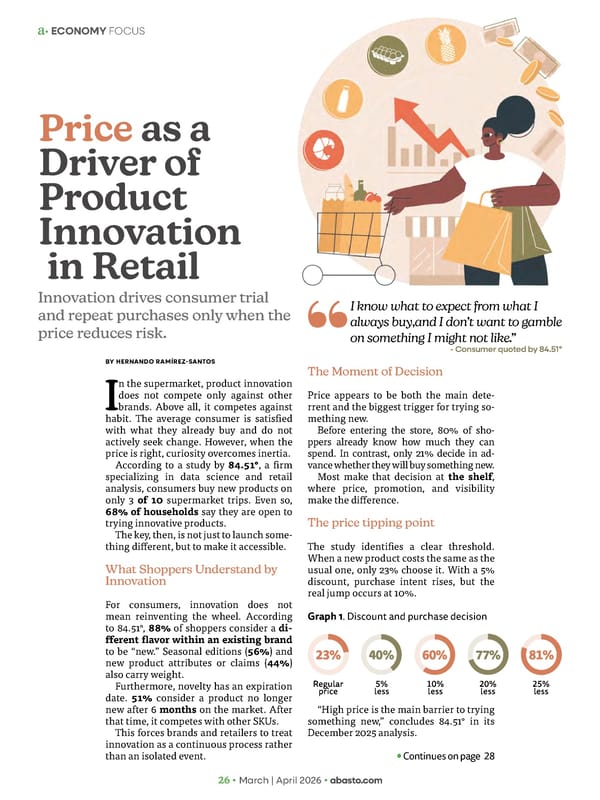
26 • March | April 2026 • abasto.com • ECONOMY FOCUS Innovation drives consumer trial and repeat purchases only when the price reduces risk. Price as a Driver of Product Innovation in Retail BY HERNANDO RAMÍREZ-SANTOS I n the supermarket, product innovation does not compete only against other brands. Above all, it competes against habit. The average consumer is satisfied with what they already buy and do not actively seek change. However, when the price is right, curiosity overcomes inertia. According to a study by 84.51° , a firm specializing in data science and retail analysis, consumers buy new products on only 3 of 10 supermarket trips. Even so, 68% of households say they are open to trying innovative products. The key, then, is not just to launch some- thing different, but to make it accessible. What Shoppers Understand by Innovation For consumers, innovation does not mean reinventing the wheel. According to 84.51°, 88% of shoppers consider a di- fferent flavor within an existing brand to be “new.” Seasonal editions ( 56% ) and new product attributes or claims ( 44% ) also carry weight. Furthermore, novelty has an expiration date. 51% consider a product no longer new after 6 months on the market. After that time, it competes with other SKUs. This forces brands and retailers to treat innovation as a continuous process rather than an isolated event. The Moment of Decision Price appears to be both the main dete- rrent and the biggest trigger for trying so- mething new. Before entering the store, 80% of sho- ppers already know how much they can spend. In contrast, only 21% decide in ad- vance whether they will buy something new. Most make that decision at the shelf , where price, promotion, and visibility make the difference. The price tipping point The study identifies a clear threshold. When a new product costs the same as the usual one, only 23% choose it. With a 5% discount, purchase intent rises, but the real jump occurs at 10%. Graph 1 . Discount and purchase decision I know what to expect from what I always buy,and I don’t want to gamble on something I might not like.” - Consumer quoted by 84.51° “High price is the main barrier to trying something new,” concludes 84.51° in its December 2025 analysis. Regular price 5% less 10% less 20% less 25% less 23% 40% 60% 77% 81% • Continues on page 28
27 • March | April 2026 • abasto.com

• ECONOMY FOCUS Coupons. 2 Free samples. 3 Discounts. Where innovation does work Not all categories react the same way. Snacks, beverages, and sweets lead in both visibility and willingness to try. In contrast, fresh foods such as meat, seafood, and agricultural products gene- rate interest but require more incentives to make it into the shopping cart. The message is clear: perc eived risk va- ries by category, and prices must be adjus- ted accordingly. Snacks Beverages Desserts and sweets Frozen meals 61% 61% 59% 55% Graph 2. Categories with the highest trial of innovation Innovators Are Worth More Price, Visibility, and Trust When consumers want to know more about a new product, they first look at the packaging or turn to word of mouth. That’s why, in addition to price, factors such as clear benefits, perceived quality, and the backing of a well-known brand ca- rry weight. “They’re more expensive, and I don’t want to waste money if my family doesn’t like them,” explained another study participant. In this context, digital coupons, in-sto- re promotions, and strategic locations— headers, seasonal areas, and special dis- plays—become economic tools rather than just commercial ones. Innovation with Clear Numbers The final message is straightforward. Pro- duct innovation encourages new purcha- sing habits, but only when it reduces the consumer’s financial risk. Without the ri- ght price, the novelty is looked at, discus- sed, and left on the shelf. As 84.51° concludes, the innovation that wins is not the most eye-catching, but the one that demonstrates value from the first purchase. 28 • March | April 2026 • abasto.com Main factors that encourage people to buy new products at the supermarket. 1 Households that buy innovations not only try more. They spend more and visit the store more often. According to transactional data from 84.51°: • They buy 12 units per trip , compared to 4 for those who do not try innovation. • They spend $49 per visit , compared to $15. • They visit the store 14 times per quarter , compa- red to 4 visits per quarter. • Well-executed innovation does not cannibalize sa- les: it increases customer value. • Continuation of page 26
29 • March | April 2026 • abasto.com
INNOVATIVE AND HEALTHIER PRODUCTS Minsa’s processes are characterized by the use of the most advan- ced technology and hi- gh-quality standards. Minsa is a company that offers innovative, func- tional, and value-ad- ded products and is always at the forefront of providing exceptio- nal nutritional quality. Innovation does not always mean creating so- mething new; rather, it means adapting the exis- ting portfolio to market needs. Adjustments in spe- cifications, presentations, and strategies by product segment and market allow us to respond more pre- cisely to a diverse and de- manding consumer base. 60 warehouses in Mexico. 2 warehouses in the Uni- ted States. Distribution Network MINSA’S GLOBAL PRESENCE Minsa has a presence throughout Mexico with five production plants stra- tegically located in areas of high corn production and high tortilla consumption: Guadalajara, Tlalnepantla, Mochis, Jáltipan, and Ra- mos Arizpe, with a com- bined installed capacity of more than 700,000 tons per year. Minsa distributes its pro- ducts worldwide: the Uni- ted States, Canada, Central and South America, Euro- pe, and Asia. MINSA, THE STANDARD IN NIXTAMALIZED FLOUR With more than 76 years of experience, Minsa offers innovation, certified quality, and a solid global presence. Quality and tradition ARTICLE PROVIDED BY MINSA M INSA is a proudly Mexican company and a leader and pioneer in the production, distribution, and sale of nixtamalized corn flour in Mexico and the US, with over 76 years of experience in the sector. Our corn flours are used to make tortillas, tortilla chips, tamales, tostadas, snacks, extruded products, and many other corn derivatives. We use 100% premium corn kernels for human consumption, of the highest quality standards. We use white, yellow, and blue corn in non-GMO and organic varieties. Our products come in 1.8-pound, 4-pound, and 20-pound packages for the retail channel, and 50-pound bags and 2,000-pound totes for the foodser- vice and industrial markets. 30 • March | April2026 • abasto.com • OUR COVER
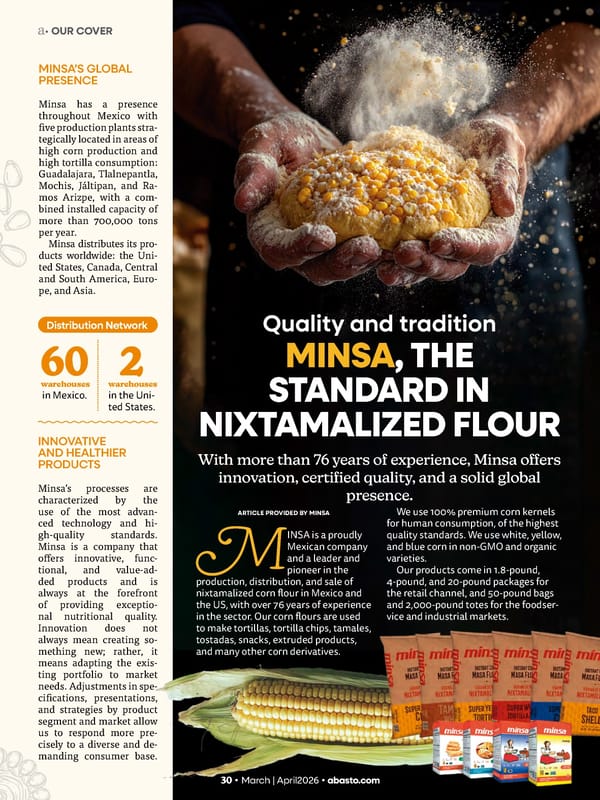
Minsa has focused on innovation with the de- velopment of products that adapt to increasin- gly demanding consumer demand and new market trends, including more than 50 specialized pro- ducts for finished product applications such as tor- tillas, snacks, and appeti- zers. Our products adapt to and guide the market for healthy products, such as gluten-free, non-GMO, or- ganic, whole-grain, and Kosher-certified flours, fortified with vitamins and minerals in accordance with FDA standards, and now fortified with folic acid for certain US mar- kets. CERTIFIED QUALITY AND SAFETY In addition, we offer our customers certainty and confidence in our pro- duction and management processes and guaran- tee the quality and con- sistency of our products. To this end, Minsa’s plants are certified under the FSSC 22000 (Food Safety System Certification) scheme, inter- nationally recognized by the Global Food Safety Initiative (GFSI) for food safety. The certification applies to the entire supply chain, from production to packaging. EXTENSIVE MARKET KNOWLEDGE Currently, the corn flour export market to the US is no longer explained solely by volume or quantity. It is essential to understand a more informed, more de- manding consumer with clear expectations regar- ding quality, origin, perfor- mance, and consistency. Beyond volume, their be- havior reflects customer confidence, stability in su- pply to meet ever-growing demand, and recognition of the product’s value. Based on the experience of the Mexican industry, sus- taining exports on a daily basis requires more than just production capacity: it requires planning, in- ventory control, logistical coordination, conserva- tion and preservation, and a clear long-term vision. When these elements align, the market responds with stable prices and a stronger, more stable commercial relationship. Our approach as a business group is clear: in a highly competitive market, origin matters; it is an added va- lue. U.S. consumers recog- nize and value authenticity when it is accompanied by quality, consistency, and compliance. Our company is sustainable and committed to the environment. Our team is our most important asset, which is why Minsa cares about and directs team actions aimed at social de- velopment, based on supporting nutrition, promoting culture, and preserving the environment. We implement various actions to recycle resources such as paper, car- dboard, wood, and plastic. We optimize water and energy consumption in our plants. Committed Company VISIT US AT THE TIA ANNUAL CONVENTION Minsa recognizes the importance of par- ticipating in the TIA (Tortilla Industry As- sociation) Annual Con- vention, which today is the world’s largest natural gathering for tortilla manufactu- rers. It is the place where suppliers of raw materials, machi- nery, and inputs con- verge with producers. It will present its pro- duct portfolio, service offering, customized solutions, innovative products, sales and te- chnical support team, and the backing of more than 76 years of experience to the mar- ket and customers. 31 • March | April 2026 • abasto.com
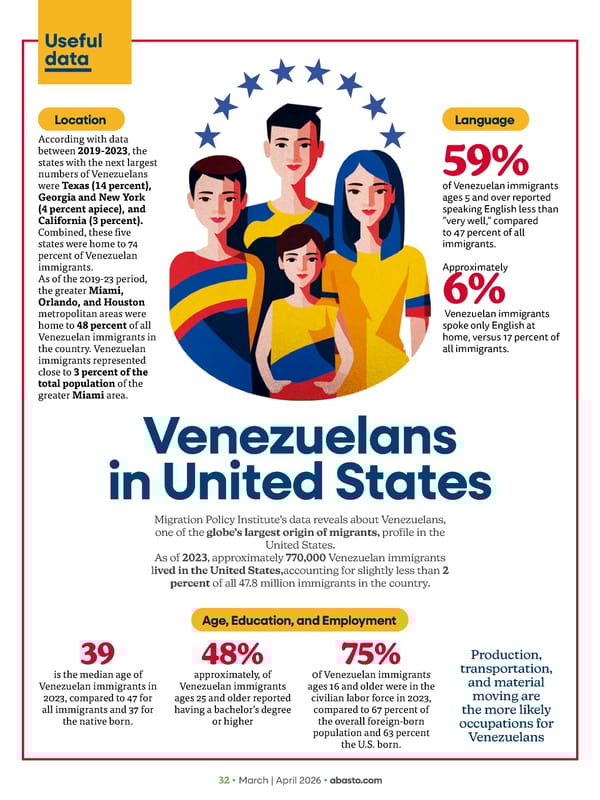
32 • March | April 2026 • abasto.com Venezuelans in United States Migration Policy Institute’s data reveals about Venezuelans, one of the globe’s largest origin of migrants, profile in the United States. As of 2023 , approximately 770,000 Venezuelan immigrants l ived in the United States, accounting for slightly less than 2 percent of all 47.8 million immigrants in the country. Location Language According with data between 2019-2023 , the states with the next largest numbers of Venezuelans were Texas (14 percent), Georgia and New York (4 percent apiece), and California (3 percent). Combined, these five states were home to 74 percent of Venezuelan immigrants. As of the 2019-23 period, the greater Miami, Orlando, and Houston metropolitan areas were home to 48 percent of all Venezuelan immigrants in the country. Venezuelan immigrants represented close to 3 percent of the total population of the greater Miami area. 59% of Venezuelan immigrants ages 5 and over reported speaking English less than “very well,” compared to 47 percent of all immigrants. Approximately 6% Venezuelan immigrants spoke only English at home, versus 17 percent of all immigrants. Age, Education, and Employment 39 is the median age of Venezuelan immigrants in 2023, compared to 47 for all immigrants and 37 for the native born. 48% approximately, of Venezuelan immigrants ages 25 and older reported having a bachelor’s degree or higher 75% 0f Venezuelan immigrants ages 16 and older were in the civilian labor force in 2023, compared to 67 percent of the overall foreign-born population and 63 percent the U.S. born. Production, transportation, and material moving are the more likely occupations for Venezuelans Useful data
33 • March | April 2026 • abasto.com
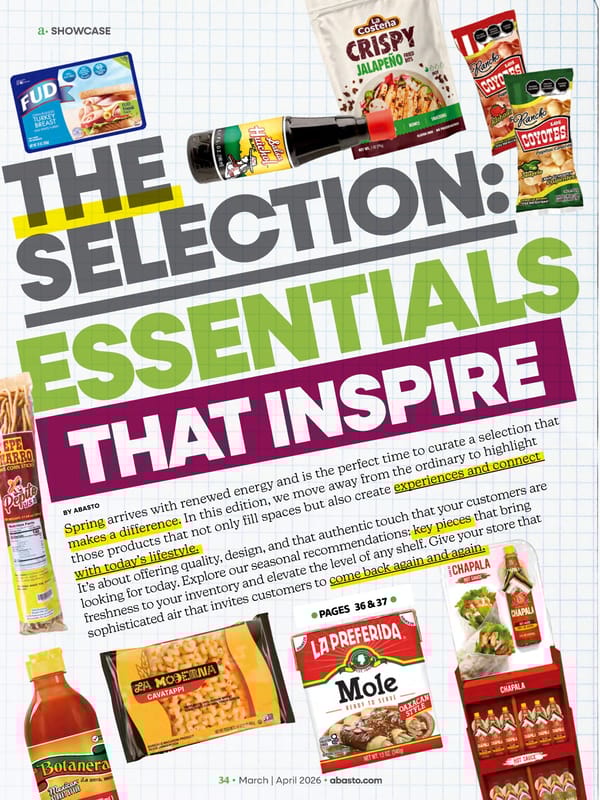
SELECTION: THE ESSENTIALS THAT INSPIRE BY ABASTO Spring arrives with renewed energy and is the perfect time to curate a selection that makes a difference. In this edition, we move away from the ordinary to highlight those products that not only fill spaces but also create experiences and connect with today’s lifestyle. It’s about offering quality, design, and that authentic touch that your customers are looking for today. Explore our seasonal recommendations: key pieces that bring freshness to your inventory and elevate the level of any shelf. Give your store that sophisticated air that invites customers to come back again and again. 34 • March | April 2026 • abasto.com • PAGES 36 & 37 • • SHOWCASE
35 • March | April 2026 • abasto.com
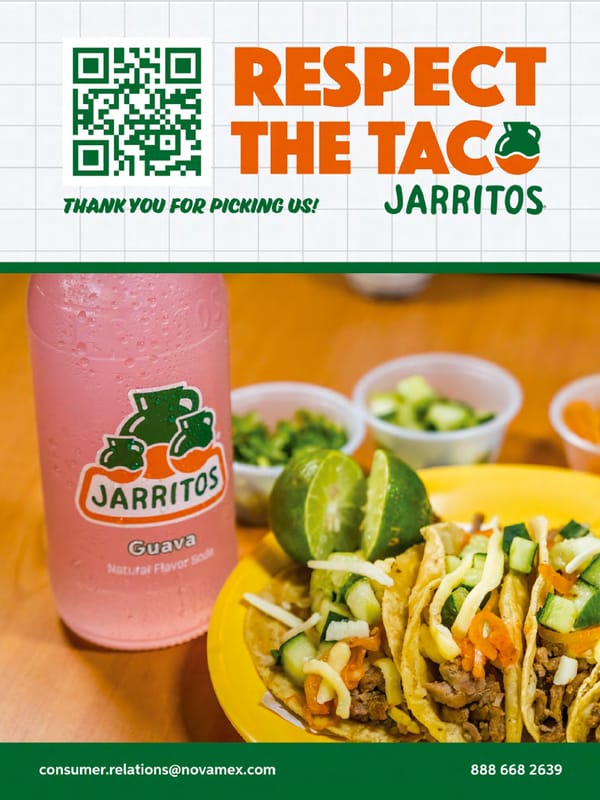
PEPITO USA The flavor revolution is here! Introducing the new Pepe Charro Long Corn Sticks from Pepito USA. Crispy, delicious, and perfect for sharing at your gatherings or enjoying that special craving of the day. Don’t miss out on trying the snack everyone has been waiting for. pepito.global sales@pepito.global OAXACA -STYLE MOLE MADE BY CHEFS The intense flavor of Oaxaca-style mole, made with a rich blend of chilies, spices, seeds, nuts, and a touch of chocolate. This authentic sauce offers a smoky, earthy flavor with sweet undertones that brings gourmet tradition right to your kitchen. 1-800-621-5422 sales@lapreferida.com LENT FLAVOR Enjoy authentic Mexican pasta, perfect for your Lenten dishes. Quality, tradition, and flavor that bring families together in the United States. lamodernausa.com 817 -506- 3535 DON’T BE AFRAID... TOSS IN NEGRA HUICHOL Salsa Huichol Negra has a unique flavor, ideal for new consumers of hot sauces. It is an ideal accompaniment for aguachiles, ceviches, pizzas, popcorn, etc. It has a profile that enhances the flavor and seasons your favorite dishes. Follow us and tag us on our social media. #SalsaHuichol. #OuterSpiceFlavor #SalsaHuicholHotSauce. Salsa Huichol Hot Sauce ESSENTIALS THAT INSPIRE 36 • March | April 2026 • abasto.com • SHOWCASE
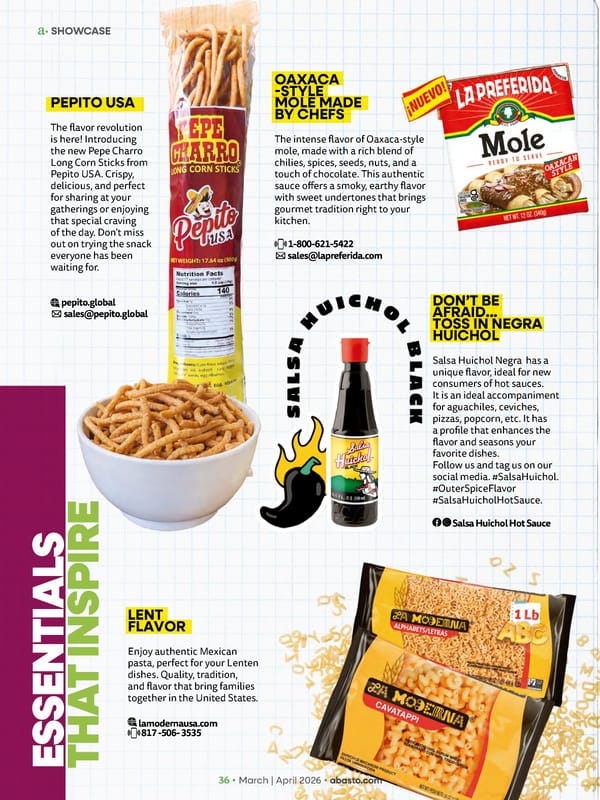
SALSA LA BOTANERA Made with 100% natural chiles and no artificial colors. It is the reliable choice for any host, ideal for snacks such as potatoes, pork rinds, corn, and popcorn. It offers a balanced flavor and authentic Mexican street style that everyone can enjoy in their favorite everyday dishes. mega-foods.com (972) 482-7708 LAKE CHAPALA The 5oz salsa display comes with three authentic flavors: Árbol, Red Habanero, and Poblano & Habanero. Practical and ready to display and sell. sanefoods.com.mx federico.wong@sane.com.mx SIGMA FUD This season, no algorithm cooks like grandma. With FUD, relive the flavors that bring the family together, inspire delicious recipes full of love, and transform every meal into an unforgettable memory to share today and always around the table. Bar-S Foods – A Sigma Company. fudusa.com 1-800-699-4115 37 • March | April 2026 • abasto.com CRISPY JALAPEÑOS New! More than 70% of households consume this category, seeking novelty and authentic flavor. Ideal for toppings and as a snack. Include them on your shelves. vilore.com sales@vilore.com (210) 509-9496 ADD COYOTES TO YOUR LENT AND SPRING BREAK For your gatherings and events this Lent and Spring Break, Botanas Rancho Los Coyotes are your best option. Add the authentic flavor of the most Mexican snack to all your moments and occasions with Botanas Rancho Los Coyotes. We are looking for distributors. (210) 500-5412. #LaBotanaMasMexicana loscoyotes.mx Botanas Rancho Los Coyotes
POR RICARDO GAITÁN BRAND ANALYST T he answer to the question that heads this analysis could be: never! 2025 was etched into the collective memory due to the im- pact of the tariffs implemented du- ring President Trump’s second term. These measures not only affected the usual flow of imports and exports but also altered the dynamics of the rules-based international order that had guaranteed the stability of the global economy for 80 years. The Origin of Economic Cooperation The global order that emerged after World War II was based on the Bretton Woods system, a model designed to provide financial stability and promo- te free trade. This scheme made the do- llar the international reference curren- cy, facilitating economic transactions among countries and strengthening global financial integration. Its pillars were the General Agree- ment on Tariffs and Trade (GATT) established in 1947. The measure promoted negotiations between How Can We Forget 2025? World leaders seek alternatives to preserve the balance and competitiveness of global trade. countries to lower trade barriers and reduce tariffs, with the support of key financial institutions such as the In- ternational Monetary Fund (IMF) for exchange rate stability and the World Bank for reconstruction. In this way, economic cooperation was promoted to avoid protectio- nism. These foundations laid in the mid-20th century consolidated the “golden age” of capitalism and eco- nomic growth, mainly in the Western Hemisphere. Spirit of Dialogue However, the beginning of 2026 brought renewed global hope: the Davos Forum, held January 19-23 in Switzerland, under the slogan “A Spi- rit of Dialogue.” This event focused on rebuilding trust and global coope- ration in response to recent profound geopolitical changes. The debate sparked by the United States’ unilateral decisions highligh- ted international concern about the scale of their effects. In this context of tension and uncertainty, streng- thening dialogue and international cooperation becomes essential to address shared economic challenges. In Search of Global Balance The renewed hope embodied by the Davos Forum reflected precisely the 38 • March | April 2026 • abasto.com importance of rebuilding trust and promoting joint solutions to the re- percussions of unilateral policies, re- affirming the value of collaboration in restoring global balance. In short, Davos established itself as the appropriate forum for world leaders to meet and discuss viable al- ternatives to preserve global balance and competitiveness. This meeting took place amid an international situation marked by high tension and so-called “market turmoil,” the result of recent profound geopolitical and economic changes. Trump’s Protectionism The MAGA initiative, promo- ted by President Trump under the slogan “Make America Great Again,” prioritizes pro- tecting U.S. interests and see- ks to regain its supremacy as a world power. This approach, far from conso- lidating its leadership in the in- ternational context, has raised questions about its position and credibility, especially in li- ght of the effects of unilateral measures such as tariffs and the breakdown of the Bretton Woods system. • ADVICE
39 • March | April 2026 • abasto.com
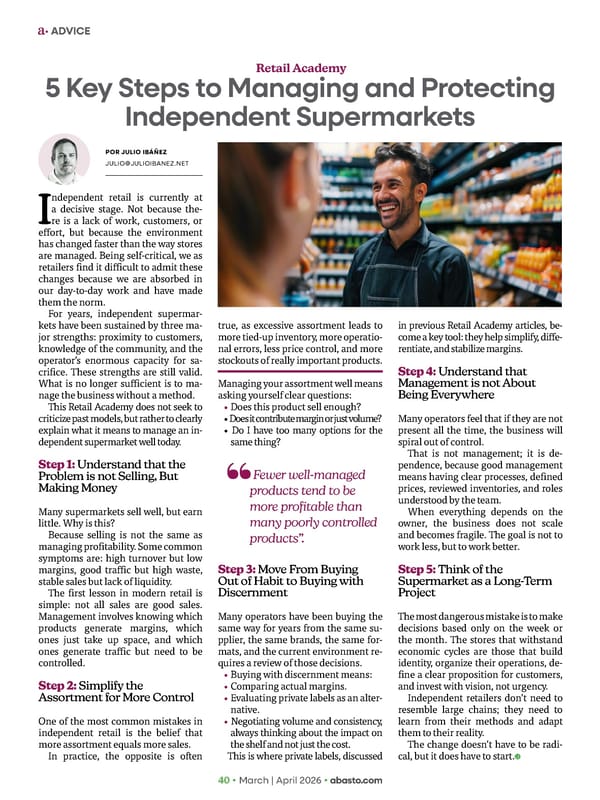
40 • March | April 2026 • abasto.com POR JULIO IBÁÑEZ JULIO@JULIOIBANEZ.NET I ndependent retail is currently at a decisive stage. Not because the- re is a lack of work, customers, or effort, but because the environment has changed faster than the way stores are managed. Being self-critical, we as retailers find it difficult to admit these changes because we are absorbed in our day-to-day work and have made them the norm. For years, independent supermar- kets have been sustained by three ma- jor strengths: proximity to customers, knowledge of the community, and the operator’s enormous capacity for sa- crifice. These strengths are still valid. What is no longer sufficient is to ma- nage the business without a method. This Retail Academy does not seek to criticize past models, but rather to clearly explain what it means to manage an in- dependent supermarket well today. Step 1: Understand that the Problem is not Selling, But Making Money Many supermarkets sell well, but earn little. Why is this? Because selling is not the same as managing profitability. Some common symptoms are: high turnover but low margins, good traffic but high waste, stable sales but lack of liquidity. The first lesson in modern retail is simple: not all sales are good sales. Management involves knowing which products generate margins, which ones just take up space, and which ones generate traffic but need to be controlled. Step 2: Simplify the Assortment for More Control One of the most common mistakes in independent retail is the belief that more assortment equals more sales. In practice, the opposite is often 5 Key Steps to Managing and Protecting Independent Supermarkets Retail Academy true, as excessive assortment leads to more tied-up inventory, more operatio- nal errors, less price control, and more stockouts of really important products. Managing your assortment well means asking yourself clear questions: • Does this product sell enough? • Does it contribute margin or just volume? • Do I have too many options for the same thing? Fewer well-managed products tend to be more profitable than many poorly controlled products”. Step 3: Move From Buying Out of Habit to Buying with Discernment Many operators have been buying the same way for years from the same su- pplier, the same brands, the same for- mats, and the current environment re- quires a review of those decisions. • Buying with discernment means: • Comparing actual margins. • Evaluating private labels as an alter- native. • Negotiating volume and consistency, always thinking about the impact on the shelf and not just the cost. This is where private labels, discussed in previous Retail Academy articles, be- come a key tool: they help simplify, diffe- rentiate, and stabilize margins. Step 4: Understand that Management is not About Being Everywhere Many operators feel that if they are not present all the time, the business will spiral out of control. That is not management; it is de- pendence, because good management means having clear processes, defined prices, reviewed inventories, and roles understood by the team. When everything depends on the owner, the business does not scale and becomes fragile. The goal is not to work less, but to work better. Step 5: Think of the Supermarket as a Long-Term Project The most dangerous mistake is to make decisions based only on the week or the month. The stores that withstand economic cycles are those that build identity, organize their operations, de- fine a clear proposition for customers, and invest with vision, not urgency. Independent retailers don’t need to resemble large chains; they need to learn from their methods and adapt them to their reality. The change doesn’t have to be radi- cal, but it does have to start. • ADVICE
41 • March | April 2026 • abasto.com
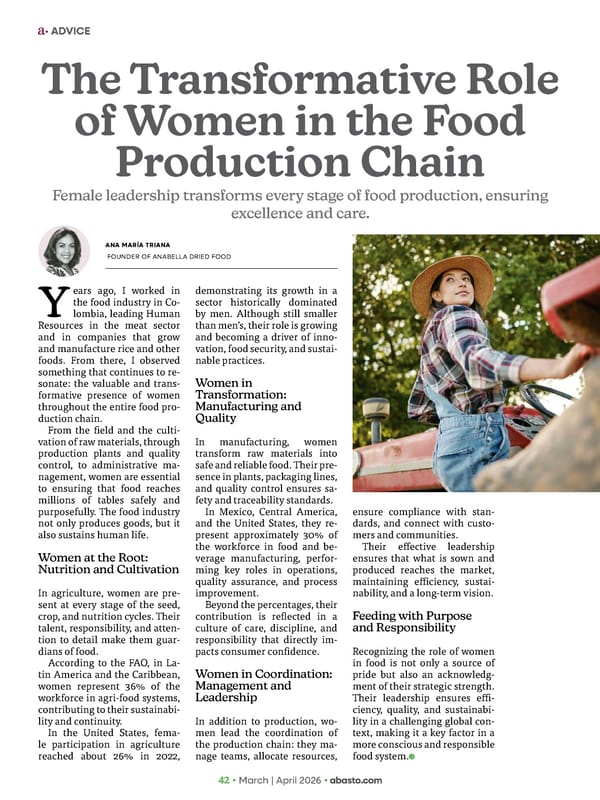
42 • March | April 2026 • abasto.com ANA MARÍA TRIANA FOUNDER OF ANABELLA DRIED FOOD The Transformative Role of Women in the Food Production Chain Y ears ago, I worked in the food industry in Co- lombia, leading Human Resources in the meat sector and in companies that grow and manufacture rice and other foods. From there, I observed something that continues to re- sonate: the valuable and trans- formative presence of women throughout the entire food pro- duction chain. From the field and the culti- vation of raw materials, through production plants and quality control, to administrative ma- nagement, women are essential to ensuring that food reaches millions of tables safely and purposefully. The food industry not only produces goods, but it also sustains human life. Women at the Root: Nutrition and Cultivation In agriculture, women are pre- sent at every stage of the seed, crop, and nutrition cycles. Their talent, responsibility, and atten- tion to detail make them guar- dians of food. According to the FAO, in La- tin America and the Caribbean, women represent 36% of the workforce in agri-food systems, contributing to their sustainabi- lity and continuity. In the United States, fema- le participation in agriculture reached about 26% in 2022, demonstrating its growth in a sector historically dominated by men. Although still smaller than men’s, their role is growing and becoming a driver of inno- vation, food security, and sustai- nable practices. Women in Transformation: Manufacturing and Quality In manufacturing, women transform raw materials into safe and reliable food. Their pre- sence in plants, packaging lines, and quality control ensures sa- fety and traceability standards. In Mexico, Central America, and the United States, they re- present approximately 30% of the workforce in food and be- verage manufacturing, perfor- ming key roles in operations, quality assurance, and process improvement. Beyond the percentages, their contribution is reflected in a culture of care, discipline, and responsibility that directly im- pacts consumer confidence. Women in Coordination: Management and Leadership In addition to production, wo- men lead the coordination of the production chain: they ma- nage teams, allocate resources, ensure compliance with stan- dards, and connect with custo- mers and communities. Their effective leadership ensures that what is sown and produced reaches the market, maintaining efficiency, sustai- nability, and a long-term vision. Feeding with Purpose and Responsibility Recognizing the role of women in food is not only a source of pride but also an acknowledg- ment of their strategic strength. Their leadership ensures effi- ciency, quality, and sustainabi- lity in a challenging global con- text, making it a key factor in a more conscious and responsible food system. Female leadership transforms every stage of food production, ensuring excellence and care. • ADVICE
43 • March | April 2026 • abasto.com
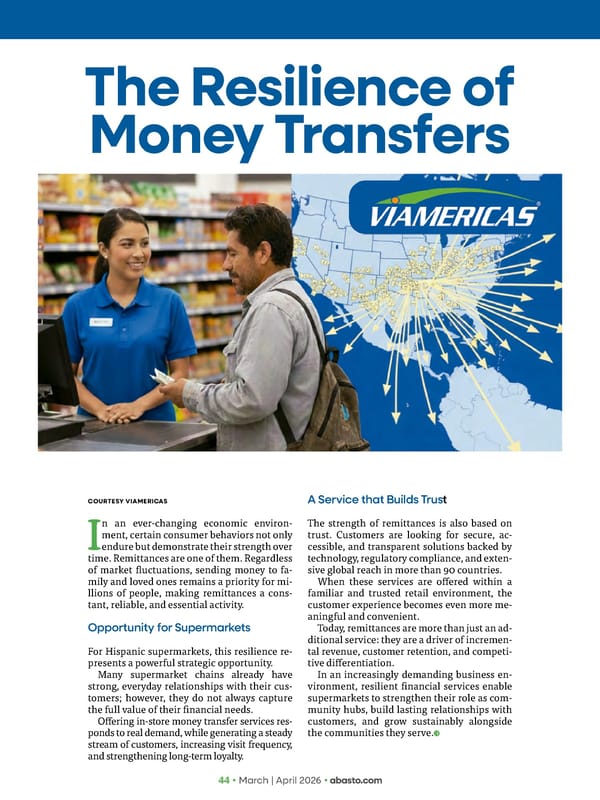
44 • March | April 2026 • abasto.com • BUENOS NEGOCIOS COURTESY VIAMERICAS I n an ever-changing economic environ- ment, certain consumer behaviors not only endure but demonstrate their strength over time. Remittances are one of them. Regardless of market fluctuations, sending money to fa- mily and loved ones remains a priority for mi- llions of people, making remittances a cons- tant, reliable, and essential activity. Opportunity for Supermarkets For Hispanic supermarkets, this resilience re- presents a powerful strategic opportunity. Many supermarket chains already have strong, everyday relationships with their cus- tomers; however, they do not always capture the full value of their financial needs. Offering in-store money transfer services res- ponds to real demand, while generating a steady stream of customers, increasing visit frequency, and strengthening long-term loyalty. A Service that Builds Trust The strength of remittances is also based on trust. Customers are looking for secure, ac- cessible, and transparent solutions backed by technology, regulatory compliance, and exten- sive global reach in more than 90 countries. When these services are offered within a familiar and trusted retail environment, the customer experience becomes even more me- aningful and convenient. Today, remittances are more than just an ad- ditional service: they are a driver of incremen- tal revenue, customer retention, and competi- tive differentiation. In an increasingly demanding business en- vironment, resilient financial services enable supermarkets to strengthen their role as com- munity hubs, build lasting relationships with customers, and grow sustainably alongside the communities they serve. The Resilience of Money Transfers
45 • March | April 2026 • abasto.com
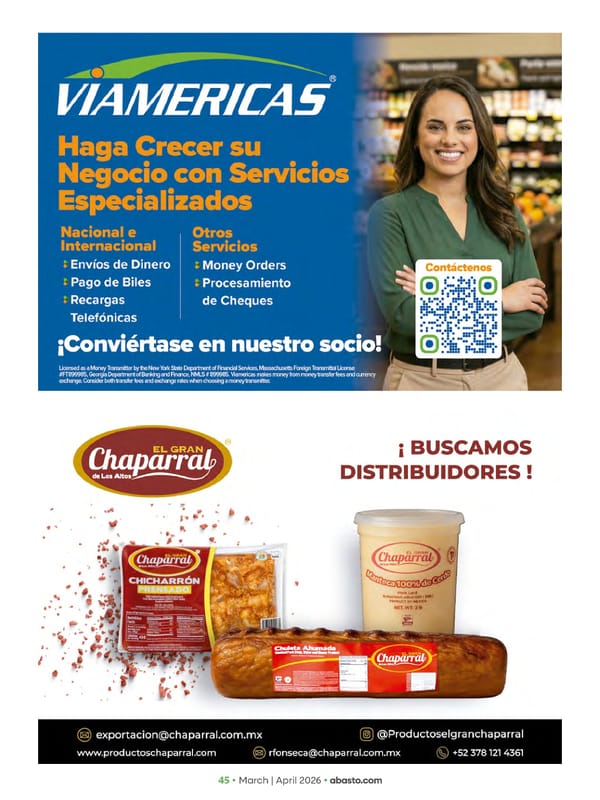
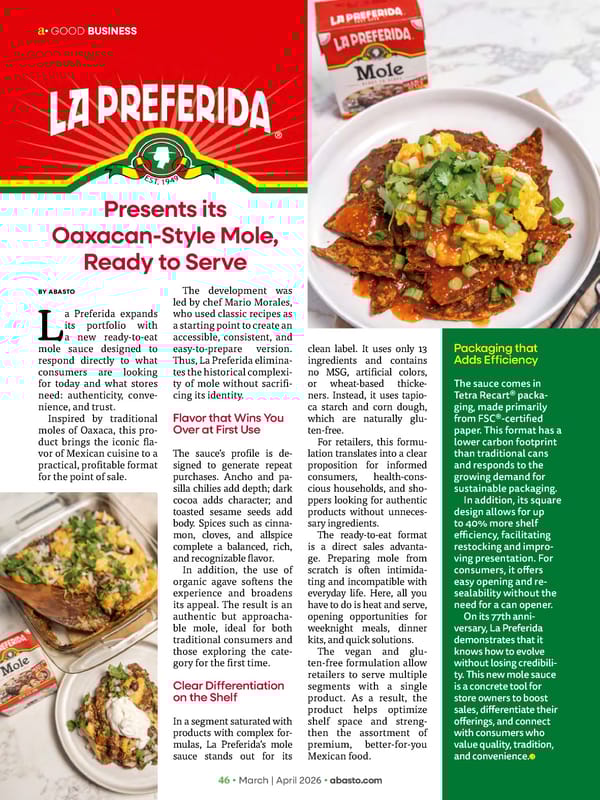
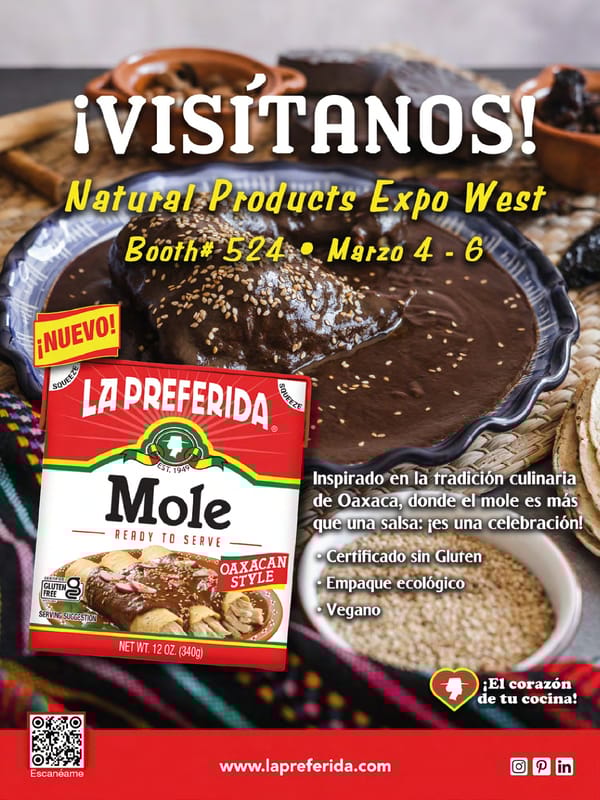
46 • March | April 2026 • abasto.com Presents its Oaxacan-Style Mole, Ready to Serve BY ABASTO L a Preferida expands its portfolio with a new ready-to-eat mole sauce designed to respond directly to what consumers are looking for today and what stores need: authenticity, conve- nience, and trust. Inspired by traditional moles of Oaxaca, this pro- duct brings the iconic fla- vor of Mexican cuisine to a practical, profitable format for the point of sale. The development was led by chef Mario Morales, who used classic recipes as a starting point to create an accessible, consistent, and easy-to-prepare version. Thus, La Preferida elimina- tes the historical complexi- ty of mole without sacrifi- cing its identity. Flavor that Wins You Over at First Use The sauce’s profile is de- signed to generate repeat purchases. Ancho and pa- silla chilies add depth; dark cocoa adds character; and toasted sesame seeds add body. Spices such as cinna- mon, cloves, and allspice complete a balanced, rich, and recognizable flavor. In addition, the use of organic agave softens the experience and broadens its appeal. The result is an authentic but approacha- ble mole, ideal for both traditional consumers and those exploring the cate- gory for the first time. Clear Differentiation on the Shelf In a segment saturated with products with complex for- mulas, La Preferida’s mole sauce stands out for its clean label. It uses only 13 ingredients and contains no MSG, artificial colors, or wheat-based thicke- ners. Instead, it uses tapio- ca starch and corn dough, which are naturally glu- ten-free. For retailers, this formu- lation translates into a clear proposition for informed consumers, health-cons- cious households, and sho- ppers looking for authentic products without unneces- sary ingredients. The ready-to-eat format is a direct sales advanta- ge. Preparing mole from scratch is often intimida- ting and incompatible with everyday life. Here, all you have to do is heat and serve, opening opportunities for weeknight meals, dinner kits, and quick solutions. The vegan and glu- ten-free formulation allow retailers to serve multiple segments with a single product. As a result, the product helps optimize shelf space and streng- then the assortment of premium, better-for-you Mexican food. Packaging that Adds Efficiency The sauce comes in Tetra Recart® packa- ging, made primarily from FSC®-certified paper. This format has a lower carbon footprint than traditional cans and responds to the growing demand for sustainable packaging. In addition, its square design allows for up to 40% more shelf efficiency, facilitating restocking and impro- ving presentation. For consumers, it offers easy opening and re- sealability without the need for a can opener. On its 77th anni- versary, La Preferida demonstrates that it knows how to evolve without losing credibili- ty. This new mole sauce is a concrete tool for store owners to boost sales, differentiate their offerings, and connect with consumers who value quality, tradition, and convenience. • GOOD BUSINESS
47 • March | April 2026 • abasto.com
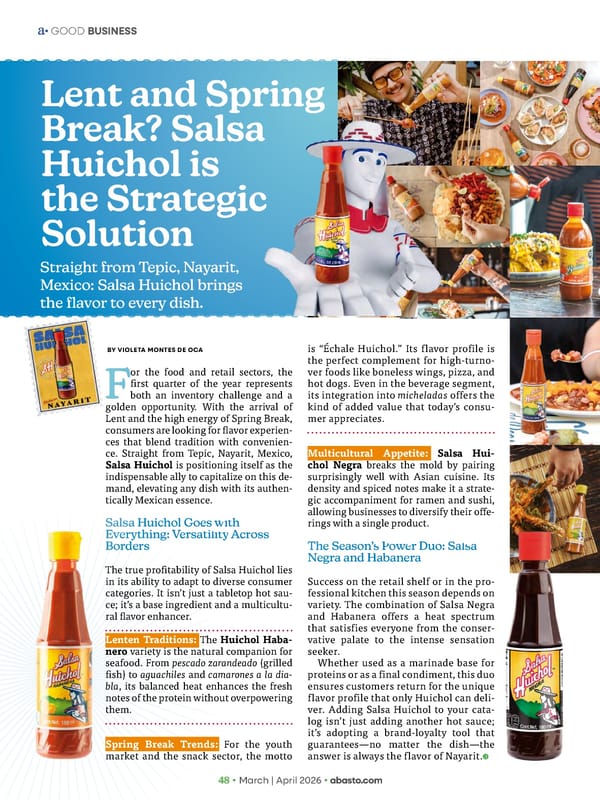
48 • March | April 2026 • abasto.com BY VIOLETA MONTES DE OCA F or the food and retail sectors, the first quarter of the year represents both an inventory challenge and a golden opportunity. With the arrival of Lent and the high energy of Spring Break, consumers are looking for flavor experien- ces that blend tradition with convenien- ce. Straight from Tepic, Nayarit, Mexico, Salsa Huichol is positioning itself as the indispensable ally to capitalize on this de- mand, elevating any dish with its authen- tically Mexican essence. Salsa Huichol Goes with Everything: Versatility Across Borders The true profitability of Salsa Huichol lies in its ability to adapt to diverse consumer categories. It isn’t just a tabletop hot sau- ce; it’s a base ingredient and a multicultu- ral flavor enhancer. Lenten Traditions: The Huichol Haba- nero variety is the natural companion for seafood. From pescado zarandeado (grilled fish) to aguachiles and camarones a la dia- bla , its balanced heat enhances the fresh notes of the protein without overpowering them. Spring Break Trends: For the youth market and the snack sector, the motto Lent and Spring Break? Salsa Huichol is the Strategic Solution Straight from Tepic, Nayarit, Mexico: Salsa Huichol brings the flavor to every dish. is “Échale Huichol.” Its flavor profile is the perfect complement for high-turno- ver foods like boneless wings, pizza, and hot dogs. Even in the beverage segment, its integration into micheladas offers the kind of added value that today’s consu- mer appreciates. Multicultural Appetite: Salsa Hui- chol Negra breaks the mold by pairing surprisingly well with Asian cuisine. Its density and spiced notes make it a strate- gic accompaniment for ramen and sushi, allowing businesses to diversify their offe- rings with a single product. The Season’s Power Duo: Salsa Negra and Habanera Success on the retail shelf or in the pro- fessional kitchen this season depends on variety. The combination of Salsa Negra and Habanera offers a heat spectrum that satisfies everyone from the conser- vative palate to the intense sensation seeker. Whether used as a marinade base for proteins or as a final condiment, this duo ensures customers return for the unique flavor profile that only Huichol can deli- ver. Adding Salsa Huichol to your cata- log isn’t just adding another hot sauce; it’s adopting a brand-loyalty tool that guarantees—no matter the dish—the answer is always the flavor of Nayarit. • GOOD BUSINESS
49 • March | April 2026 • abasto.com
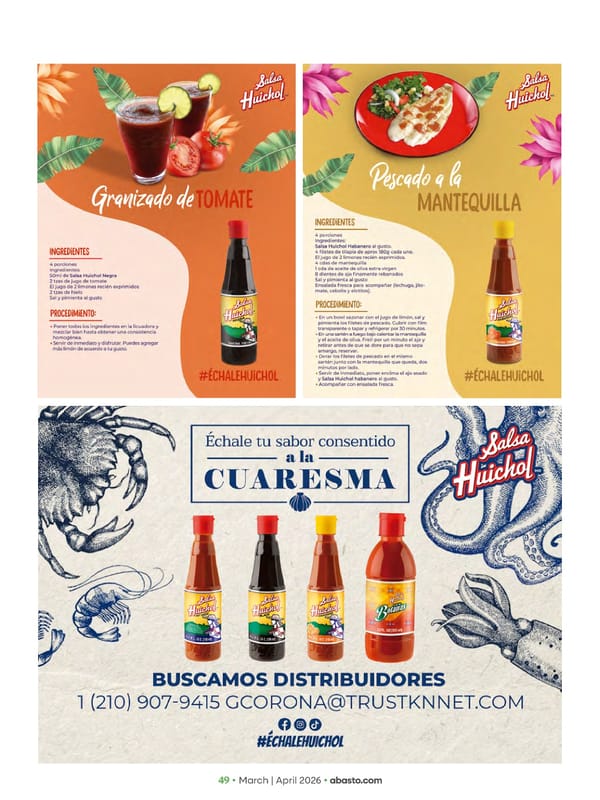
50 • March | April 2026 • abasto.com POR DIANA LEZA DIANA@PDGINSIGHTS.COM Enforcement Concerns Reshape Latino Retail How Immigration Enforcement is Reshaping Latino Shoping Behavior N ew data from the December 2025 US Diverse Consumer Pulse Study reveals that im- migration enforcement is profoundly influencing retail behavior. Beyond actual enforcement, the perception of activity is enough to shift how, where, and when people shop. Perception vs. Reality Awareness of enforcement is nearly universal, but many consumers belie- ve activity is happening in their own backyards. While 59% of the General Population believes enforcement is occurring locally, that number jumps to 69% for Latino consumers and 76% for Spanish-dominant La- tinos . This perception triggers an emotional calculation of risk during routine grocery runs. Shifting Patterns Enforcement anxiety is a mains- tream retail issue. Approximately 60% of Latino consumers and 61% of Black consumers report that enforcement concerns have altered their shopping patterns. To mitigate risk, shoppers are: • Increasing online shopping and de- livery reliance. • Avoiding stores where raids were ru- mored. • Bulk-buying to reduce trip frequency. • Choosing specific days or times to shop to avoid authorities. The Safety Gap Safety is the primary driver for these changes. While 25% of the General Population cites safety as their main concern, this rises to 39% among Spanish-dominant Latinos . Addi- tionally, 21% of Latino consumers change their behavior to protect fa- mily members, and 16% do so spe- cifically to avoid discrimination or unwelcoming environments. For these shoppers, retail is no longer just transactional; it is a matter of vulnerability. A Roadmap for Retailers Latino shoppers represent a hi- gh-growth segment, and retailers must proactively build trust to main- tain loyalty. Here are practical steps retailers can take: 1 Improve Communication: Be clear, consistent, and multilingual when communicating store safety practices and community support. 2 Increase Cultural Competence: Hiring bilingual staff or offering cultural training builds trust and ea- ses customer anxiety. 3 Offer More Flexibility: Enhan- ce curbside pickup, delivery, and offpeak shopping opportunities. 4 Visibly Support the Communi- ty: Partner with trusted commu- nity organizations, share resources, and show solidarity with immigrant families. Why it Matters As a high-growth segment, Latino consumers are vital to U.S. retail. However, immigration enforce- ment anxiety is driving shoppers to shift online, reduce trip fre- quency, or choose stores percei- ved as safer. This isn’t just a policy debate; it’s a lived experience cau- sing universal behavioral shifts. Retailers who overlook these anxieties risk steady, long-term declines. Conversely, those who prioritize empathy, transparen- cy, and cultural competence will build lasting trust. To secu- re growth, stores must provide a safe, welcoming environment that recognizes the emotional reality of their shoppers. • ADVICE
AGRICULTURE SPECIAL INSERT The Elite of Produce VIVA FRESH 2026 EXCLUSIVE SPECIAL An exclusive look at the companies that are transforming the agricultural industry at the Viva Fresh Show
2 • March | April 2026 • abasto.com Viva Fresh 2026: Driving Purposeful Connection Across the Tex-Mex Corridor Championing the Future through the International Year of the Woman Farmer BY VIOLETA MONTES DE OCA A s the fresh produce indus- try converges for Viva Fresh 2026, the atmosphere is de- fined by more than just trade—it is defined by a “North Star” of connec- tion with purpose . According to Dante Galeazzi, President and CEO of the Texas International Produce As- sociation (TIPA), this year’s expo acts as a vital catalyst for smarter collabo- ration during an era of unpreceden- ted complexity. Viva Fresh 2026 will be at JW Ma- rriott San Antonio Hill Country Re- sort & Spa, on April 16-18. “As our industry navigates more complexity than ever—from trade and labor to technology and con- sumer expectations—the need for intentional, high-value connections has never been greater,” says Ga- leazzi. By focusing on the Tex-Mex corridor, Viva Fresh 2026 aims to strengthen supply chains and drive economic growth that resonates na- tionwide. Navigating the Cross-Border Evolution Central to this year’s mission is the evolution of the Texas-Mexico trade relationship. Recognizing that the- se two regions are “inseparable,” the expo has doubled down on educa- tion regarding cross-border logistics and regulatory shifts. By bringing customs brokers, logistics providers, and importers into direct dialogue with growers and buyers, Viva Fresh creates a trusted space to align expec- tations and adapt to the rapid pace of change. Advocacy and the Road Ahead Looking toward the next 24 months, Galeazzi identifies the “pace of chan- ge” as the industry’s greatest disrup- tor. Whether facing shifts in trade policy or labor dynamics, TIPA’s goal remains focused on modernizing ad- vocacy. When it comes to federal policy, Galeazzi’s message for independent grocers and wholesalers is clear: the industry needs clarity, consistency, and collaboration . By urging poli- cymakers to recognize the unique realities of perishable products, Viva Fresh 2026 stands as a unified front, ensuring that the backbone of the food supply chain remains stable, efficient, and inclusive for years to come. Empowering Leadership: The Year of the Woman Farmer A cornerstone of the 2026 program is the celebration of the International Year of the Woman Farmer. For Ga- leazzi, the message to the industry is urgent: women are not merely parti- cipants; they are the innovators and decision-makers essential to agricul- ture’s survival. However, TIPA is moving beyond symbolic recognition toward concre- te action. Through In Bloom , TIPA’s dedicated initiative, the association is fostering mentorship, sponsorship, and intentional pathways into exe- cutive roles and board service. “Real progress happens when companies intentionally invest in women’s grow- th and ensure they have a seat—and a voice—at the tables where decisions are made,” Galeazzi notes. Special Insert Agriculture industry

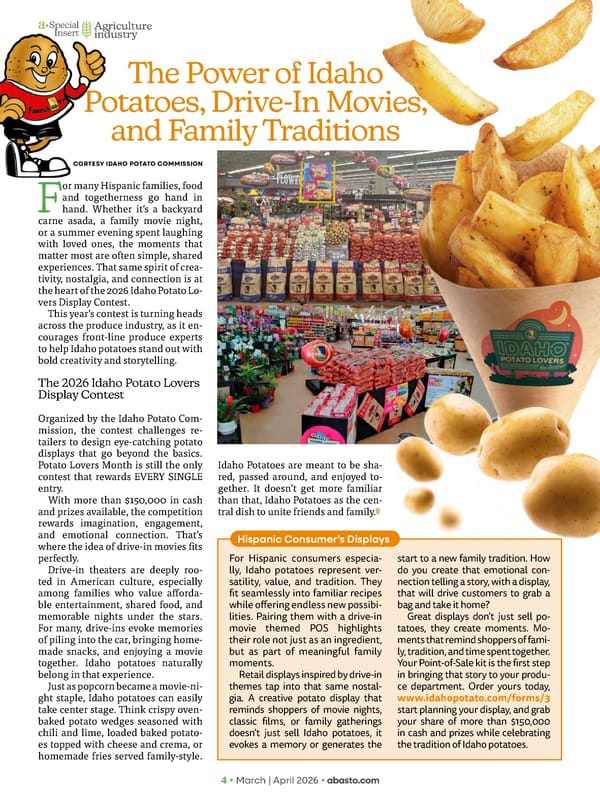
4 • March | April 2026 • abasto.com CORTESY IDAHO POTATO COMMISSION F or many Hispanic families, food and togetherness go hand in hand. Whether it’s a backyard carne asada, a family movie night, or a summer evening spent laughing with loved ones, the moments that matter most are often simple, shared experiences. That same spirit of crea- tivity, nostalgia, and connection is at the heart of the 2026 Idaho Potato Lo- vers Display Contest. This year’s contest is turning heads across the produce industry, as it en- courages front-line produce experts to help Idaho potatoes stand out with bold creativity and storytelling. The 2026 Idaho Potato Lovers Display Contest Organized by the Idaho Potato Com- mission, the contest challenges re- tailers to design eye-catching potato displays that go beyond the basics. Potato Lovers Month is still the only contest that rewards EVERY SINGLE entry. With more than $150,000 in cash and prizes available, the competition rewards imagination, engagement, and emotional connection. That’s where the idea of drive-in movies fits perfectly. Drive-in theaters are deeply roo- ted in American culture, especially among families who value afforda- ble entertainment, shared food, and memorable nights under the stars. For many, drive-ins evoke memories of piling into the car, bringing home- made snacks, and enjoying a movie together. Idaho potatoes naturally belong in that experience. Just as popcorn became a movie-ni- ght staple, Idaho potatoes can easily take center stage. Think crispy oven- baked potato wedges seasoned with chili and lime, loaded baked potato- es topped with cheese and crema, or homemade fries served family-style. The Power of Idaho Potatoes, Drive-In Movies, and Family Traditions Idaho Potatoes are meant to be sha- red, passed around, and enjoyed to- gether. It doesn’t get more familiar than that, Idaho Potatoes as the cen- tral dish to unite friends and family. For Hispanic consumers especia- lly, Idaho potatoes represent ver- satility, value, and tradition. They fit seamlessly into familiar recipes while offering endless new possibi- lities. Pairing them with a drive-in movie themed POS highlights their role not just as an ingredient, but as part of meaningful family moments. Retail displays inspired by drive-in themes tap into that same nostal- gia. A creative potato display that reminds shoppers of movie nights, classic films, or family gatherings doesn’t just sell Idaho potatoes, it evokes a memory or generates the start to a new family tradition. How do you create that emotional con- nection telling a story, with a display, that will drive customers to grab a bag and take it home? Great displays don’t just sell po- tatoes, they create moments. Mo- ments that remind shoppers of fami- ly, tradition, and time spent together. Your Point-of-Sale kit is the first step in bringing that story to your produ- ce department. Order yours today, www.idahopotato.com/forms/3 start planning your display, and grab your share of more than $150,000 in cash and prizes while celebrating the tradition of Idaho potatoes. Hispanic Consumer’s Displays Special Insert Agriculture industry

6 • March | April 2026 • abasto.com BY VIOLETA MONTES DE OCA 2026 marks a historic milestone: the United Nations has declared it the International Year of the Woman Farmer. This formal recog- nition celebrates those who, with steady hands and strategic vision, sustain global food security. Today, women are not just participants—they are desig- ning the future of the supply chain. Architects of the Fields: Leading the International Year of the Woman Farmer Ivonne Lugo: The Engine of Human Evolution For Ivonne Lugo , PR and Marketing Manager at SL Produce , leadership is not about gender, but about vision and execution. With five years in the sector—which she describes as “multiplied by ten” due to its inten- sity—Ivonne maintains that women are the engine of agricultural evolu- tion. Her approach brings a deeply human perspective, connecting the dots between technology, sustainabi- lity, and the human factor. At SL Pro- duce, Ivonne celebrates a structure where key roles, from recruitment to agribusiness management, are led by women. For her, the industry’s trans- formation occurs through the per- fect balance of masculine experien- ce and feminine intuition. “We are detectives by nature,” she explains, referring to the feminine ability to read the consumer. Her message to professional mothers is powerful: a career in agriculture doesn’t divide them—it multiplies them. Between business strategies and bedtime sto- ries, the sector’s resilience is built. Marina Bernal: Cultivating Tomorrow’s Talent As CFO of Sweet Seasons , Marina Bernal sees 2026 as the validation of talent at all levels of the sector. Marina argues that for the industry to be com- petitive and sustainable, it must leve- rage 100% of its human capital, from logistics to C-suite leadership. The pro- fessionalization of the sector has acted as a magnet, attracting a new genera- tion of women who see “produce” as a viable, high-impact career path. Ma- rina maintains that equity and merit strengthen decision-making, creating organizations that are more robust against market fluctuations. When clear female role models exist, a do- mino effect is created, inspiring others to replicate those achievements. Her financial focus does not ignore the human element; on the contrary, she affirms that the best practices emerge from a diverse exchange of ideas. Her closing message summarizes the es- sence of this international year: “Nou- rishing the world begins by cultivating talent and opportunity within our own industry.” • Continuation of page 8 Special Insert Agriculture industry
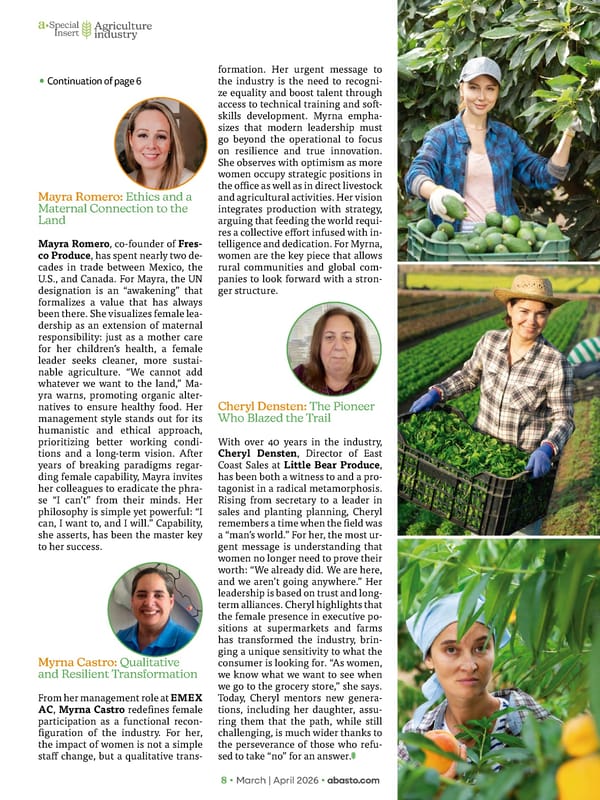
8 • March | April 2026 • abasto.com Mayra Romero: Ethics and a Maternal Connection to the Land Mayra Romero , co-founder of Fres- co Produce , has spent nearly two de- cades in trade between Mexico, the U.S., and Canada. For Mayra, the UN designation is an “awakening” that formalizes a value that has always been there. She visualizes female lea- dership as an extension of maternal responsibility: just as a mother care for her children’s health, a female leader seeks cleaner, more sustai- nable agriculture. “We cannot add whatever we want to the land,” Ma- yra warns, promoting organic alter- natives to ensure healthy food. Her management style stands out for its humanistic and ethical approach, prioritizing better working condi- tions and a long-term vision. After years of breaking paradigms regar- ding female capability, Mayra invites her colleagues to eradicate the phra- se “I can’t” from their minds. Her philosophy is simple yet powerful: “I can, I want to, and I will.” Capability, she asserts, has been the master key to her success. Myrna Castro: Qualitative and Resilient Transformation From her management role at EMEX AC , Myrna Castro redefines female participation as a functional recon- figuration of the industry. For her, the impact of women is not a simple staff change, but a qualitative trans- formation. Her urgent message to the industry is the need to recogni- ze equality and boost talent through access to technical training and soft- skills development. Myrna empha- sizes that modern leadership must go beyond the operational to focus on resilience and true innovation. She observes with optimism as more women occupy strategic positions in the office as well as in direct livestock and agricultural activities. Her vision integrates production with strategy, arguing that feeding the world requi- res a collective effort infused with in- telligence and dedication. For Myrna, women are the key piece that allows rural communities and global com- panies to look forward with a stron- ger structure. Cheryl Densten: The Pioneer Who Blazed the Trail With over 40 years in the industry, Cheryl Densten , Director of East Coast Sales at Little Bear Produce , has been both a witness to and a pro- tagonist in a radical metamorphosis. Rising from secretary to a leader in sales and planting planning, Cheryl remembers a time when the field was a “man’s world.” For her, the most ur- gent message is understanding that women no longer need to prove their worth: “We already did. We are here, and we aren’t going anywhere.” Her leadership is based on trust and long- term alliances. Cheryl highlights that the female presence in executive po- sitions at supermarkets and farms has transformed the industry, brin- ging a unique sensitivity to what the consumer is looking for. “As women, we know what we want to see when we go to the grocery store,” she says. Today, Cheryl mentors new genera- tions, including her daughter, assu- ring them that the path, while still challenging, is much wider thanks to the perseverance of those who refu- sed to take “no” for an answer. • Continuation of page 6 Special Insert Agriculture industry
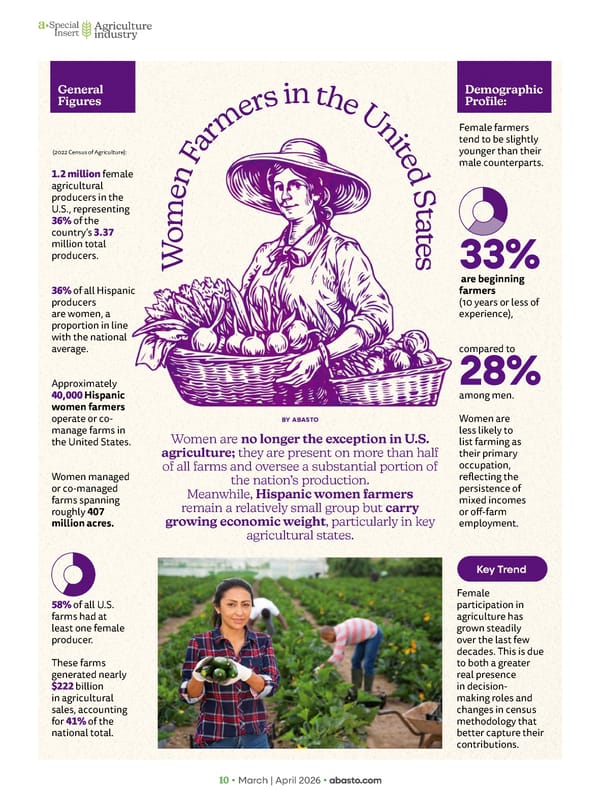
10 • March | April 2026 • abasto.com Special Insert Agriculture industry Female farmers tend to be slightly younger than their male counterparts. 33% are beginning farmers (10 years or less of experience), compared to 28% among men. Women are less likely to list farming as their primary occupation, reflecting the persistence of mixed incomes or off-farm employment. Wo m e n F a r m e r s i n t h e U n i t e d S t ates BY ABASTO Women are no longer the exception in U.S. agriculture; they are present on more than half of all farms and oversee a substantial portion of the nation’s production. Meanwhile, Hispanic women farmers remain a relatively small group but carry growing economic weight , particularly in key agricultural states. Female participation in agriculture has grown steadily over the last few decades. This is due to both a greater real presence in decision- making roles and changes in census methodology that better capture their contributions. (2022 Census of Agriculture): 1.2 million female agricultural producers in the U.S., representing 36% of the country’s 3.37 million total producers. 36% of all Hispanic producers are women, a proportion in line with the national average. Approximately 40,000 Hispanic women farmers operate or co- manage farms in the United States. Women managed or co-managed farms spanning roughly 407 million acres. 58% of all U.S. farms had at least one female producer. These farms generated nearly $222 billion in agricultural sales, accounting for 41% of the national total. Key Trend Demographic Profile: General Figures
11 • March | April 2026 • abasto.com
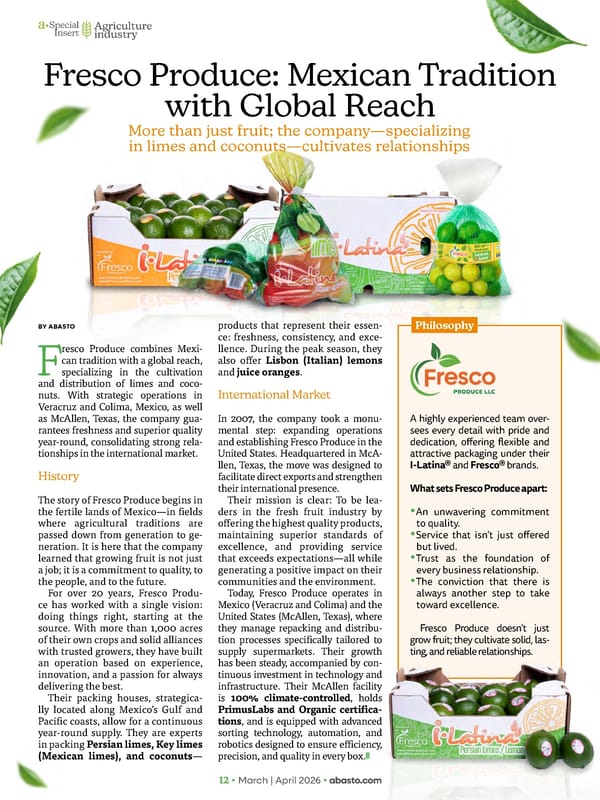
12 • March | April 2026 • abasto.com BY ABASTO F resco Produce combines Mexi- can tradition with a global reach, specializing in the cultivation and distribution of limes and coco- nuts. With strategic operations in Veracruz and Colima, Mexico, as well as McAllen, Texas, the company gua- rantees freshness and superior quality year-round, consolidating strong rela- tionships in the international market. History The story of Fresco Produce begins in the fertile lands of Mexico—in fields where agricultural traditions are passed down from generation to ge- neration. It is here that the company learned that growing fruit is not just a job; it is a commitment to quality, to the people, and to the future. For over 20 years, Fresco Produ- ce has worked with a single vision: doing things right, starting at the source. With more than 1,000 acres of their own crops and solid alliances with trusted growers, they have built an operation based on experience, innovation, and a passion for always delivering the best. Their packing houses, strategica- lly located along Mexico’s Gulf and Pacific coasts, allow for a continuous year-round supply. They are experts in packing Persian limes, Key limes (Mexican limes), and coconuts — Fresco Produce: Mexican Tradition with Global Reach More than just fruit; the company—specializing in limes and coconuts—cultivates relationships A highly experienced team over- sees every detail with pride and dedication, offering flexible and attractive packaging under their I-Latina® and Fresco® brands. What sets Fresco Produce apart: • An unwavering commitment to quality. • Service that isn’t just offered but lived. • Trust as the foundation of every business relationship. • The conviction that there is always another step to take toward excellence. Fresco Produce doesn’t just grow fruit; they cultivate solid, las- ting, and reliable relationships. Philosophy products that represent their essen- ce: freshness, consistency, and exce- llence. During the peak season, they also offer Lisbon (Italian) lemons and juice oranges . International Market In 2007, the company took a monu- mental step: expanding operations and establishing Fresco Produce in the United States. Headquartered in McA- llen, Texas, the move was designed to facilitate direct exports and strengthen their international presence. Their mission is clear: To be lea- ders in the fresh fruit industry by offering the highest quality products, maintaining superior standards of excellence, and providing service that exceeds expectations—all while generating a positive impact on their communities and the environment. Today, Fresco Produce operates in Mexico (Veracruz and Colima) and the United States (McAllen, Texas), where they manage repacking and distribu- tion processes specifically tailored to supply supermarkets. Their growth has been steady, accompanied by con- tinuous investment in technology and infrastructure. Their McAllen facility is 100% climate-controlled , holds PrimusLabs and Organic certifica- tions , and is equipped with advanced sorting technology, automation, and robotics designed to ensure efficiency, precision, and quality in every box. Special Insert Agriculture industry
13 • March | April 2026 • abasto.com
14 • March | April 2026 • abasto.com Growth will be driven primarily by prices rather than volume increases BY ABASTO S ales of fresh produce will maintain steady but limited growth through 2026, accor- ding to Circana’s latest forecast. Specifically, the firm projects an increase of close to 2% annually in dollar sales. However, volume is expected to remain virtually flat, reflecting price pressure and more cautious consumers. At the same time, inflation con- tinues to influence purchasing decisions within the department. Therefore, growth will depend more on prices than on increased consumption. A Consumer-Driven Approach Circana bases its projections on its Future of Produce report, which integrates macroeconomic in- dicators, point-of-sale data, and in-depth consumer analysis. Un- like traditional supply-focused models, this approach prioritizes demand and buyer behavior. In addition, the report includes three-year projections on sales, volu- me, and prices for fresh fruits, fresh vegetables, and more than 30 specific categories. It also incorporates consu- mer survey results through an inte- ractive digital platform. Together, these data seek to help producers, distributors, brands, and retailers identify concrete opportunities for growth. Innovation, Key to Growth Despite consumer interest in heal- thier eating, Circana identifies un- tapped potential in the category. “Despite favorable winds from U.S. consumer interest in natural, fresh, and healthy eating, the sales forecast is modest, and volume is surprisingly flat through 2026,” said Jonna Parker, vice president of Fresh Foods at Circana. According to Parker, the slow erosion of volume growth over the next three years is seen as unta- pped potential, pointing to what could happen if fresh fruits and vegetables continue on their cu- rrent trajectory of focusing sole- ly on providing abundant supply without deeply understanding to- day’s consumers. Looking ahead, Circana recom- mends strengthening the value message to attract price-sensitive consumers. It also highlights the importance of investing in meal solutions, pre-cut products, and ready-to-eat options. Without a clear investment in de- mand generation, the industry risks settling for modest results in a mar- ket with room for innovation. Although the overall picture shows stability, performan- ce will vary by segment. For example, fresh fruit is expected to outperform the department average, driven by demand for snack options and interest in tropical varieties. In contrast, fresh vegetables face a more challenging environment. Circana points to an ur- gent need for innovation in convenient formats, greater investment in marketing, and a clear value strategy to com- pete with packaged foods. Fruits Advance; Vegetables Face Challenges Circana Sees Moderate Growth in Fresh Produce As the category evolves, brands that innovate around convenience, health, and affordability will lead the next wave of growth.” Jonna Parker | VP of Fresh Foods, Circana. Special Insert Agriculture industry
15 • March | April 2026 • abasto.com
16 • March | April 2026 • abasto.com IFPA destaca las frutas y verduras en nuevas Guías Alimentarias de EE. UU. BY ABASTO I FPA Highlights Fruits and Vege- tables in New U.S. Dietary Guide- lines The 2025–2030 Dietary Guidelines emphasize whole foods and the con- sumption of fruits and vegetables. By Abasto The International Fresh Produce Association (IFPA) welcomed the re- lease of the 2025–2030 Dietary Gui- delines for Americans (DGA), which underscore the importance of fruits and vegetables in a healthy diet. The new Dietary Guidelines re- commend that Americans consume a variety of colorful, nutrient-rich products throughout the day, with a diet focused on “real whole foods.” “Scientific evidence consistent- ly shows that fruits and vegetables should make up the majority of what people eat,” said Mollie Van Lieu, IFPA’s vice president of nutrition and health. “The Administration’s focus on whole foods is an opportunity to increase fruit and vegetable con- sumption, as they are the most nu- trient-dense foods available.” For a 2,000-calorie daily plan, the guidelines suggest three servings of vegetables and two servings of fruit, distinguishing between naturally occurring sugars in fruits and added sugars. IFPA also appreciated the guideli- nes’ focus on reducing added sugars and highly processed foods, which often replace healthier options such as fruits and vegetables. Today’s Dietary Guidelines reinforce the critical role that fruits and vegetables play in overall health.” -Mollie Van Lieu IFPA Vice President of Nutrition and Health. Impact on Federal Nutrition Programs Van Lieu noted that the Dietary Gui- delines are a framework for nume- rous federal nutrition programs. IFPA is committed to continuing to work to ensure that a wide variety Las Guías Alimentarias 2025–2030 enfatizan los alimentos enteros y el consumo de frutas y verduras of fruits and vegetables are availa- ble in these programs and that the 2025–2030 Guidelines drive signifi- cant increases in fruit and vegetable consumption for all consumers. The Dietary Guidelines influen- ce key federal programs, including school breakfasts and lunches, the WIC food package, military food pro- grams, and other nutrition initiati- ves. IFPA’s Involvement in the Develop- ment of the Guidelines IFPA was actively involved in the development of the guidelines, sub- mitting written comments, provi- ding oral testimony, and nominating members to the Dietary Guidelines Advisory Committee. The association continues to advo- cate for access to fruits and vegeta- bles in federal nutrition programs. 2025–2030 Dietary Guidelines for Americans Published by the U.S. Depart- ment of Health and Human Ser- vices and the U.S. Department of Agriculture. Emphasize “whole real foods” as the basis of healthy eating. Recommend three servings of ve- getables and two servings of fruit per day for a 2,000-calorie diet. They distinguish between natu- rally occurring sugars in fruits and added sugars. They encourage reducing highly processed foods and added sugars. They guide federal nutrition pro- grams, including school menus, WIC, and military food services. Vegetables and fruits Whole grains Proteins, dairy products, and healthy fats Special Insert Agriculture industry
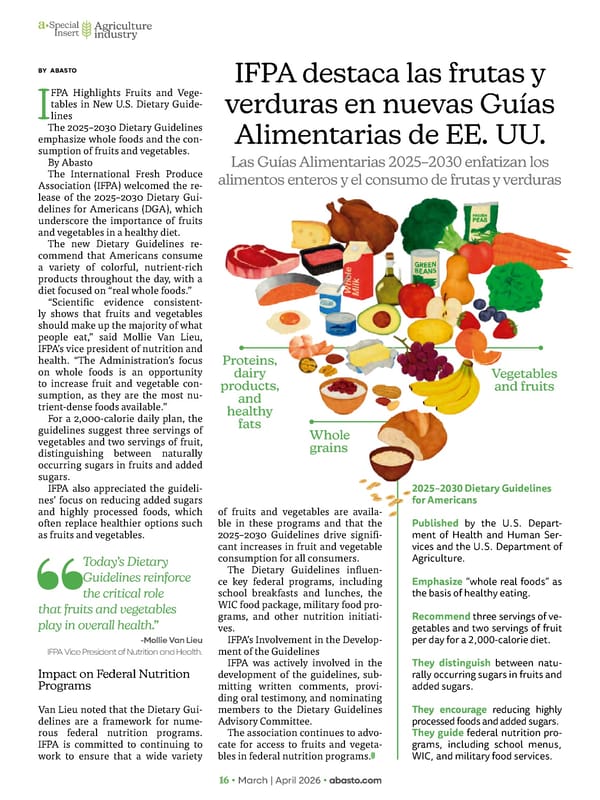
17 • March | April 2026 • abasto.com
18 • March | April 2026 • abasto.com Suplemento especial Industria agrícola BY HERNANDO RAMÍREZ-SANTOS T he impact of tariffs on farmers is influencing key decisions for the 2026 agricultural season, according to warnings from produ- cers and industry leaders during a national press conference held via videoconference. Rising costs, volatile export mar- kets, and the lack of a predictable tra- de policy are forcing many farmers to postpone investments and reduce risks. The meeting, organized by Tariffs Cost US, brought together farmers from Iowa, Montana, and Kansas, who agreed that tariff uncertainty began in April 2025 and continues without a clear solution. Since then, the Trump adminis- tration has imposed tariffs of 10% to 50% on almost all imports. The ave- rage tariff rate now exceeds 16.8%, the highest level since 1935, at a cri- tical time for agricultural planning. Low Prices and Rising Costs Aaron Lehman, a fifth-generation far- mer in Iowa and president of the Iowa Farmers Union, said the impact of tari- ffs on farmers is reflected every day in the field. Data from Iowa State University shows that corn is selling 44 cents be- low the cost of production. Soybeans are trading $1.30 below the same threshold. In practice, farmers lose money on every bushel they produce. In practical terms, farmers are seeing a loss on every bushel produced In addition, Lehman warned that tariffs are eroding trade relations- hips built over the years. Foreign bu- yers have opted for suppliers in South America, and many have not retur- ned to the U.S. market. “The damage doesn’t end in a single season,” he said. “It affects farmers for years.” We are seeing lower prices for what we produce and higher costs for the inputs we need to purchase”. Aaron Lehman President of the Iowa Farmers Union. The Impact of Tariffs Slows Down Crop Planning for 2026 • Continues on page 20 Special Insert Agriculture industry
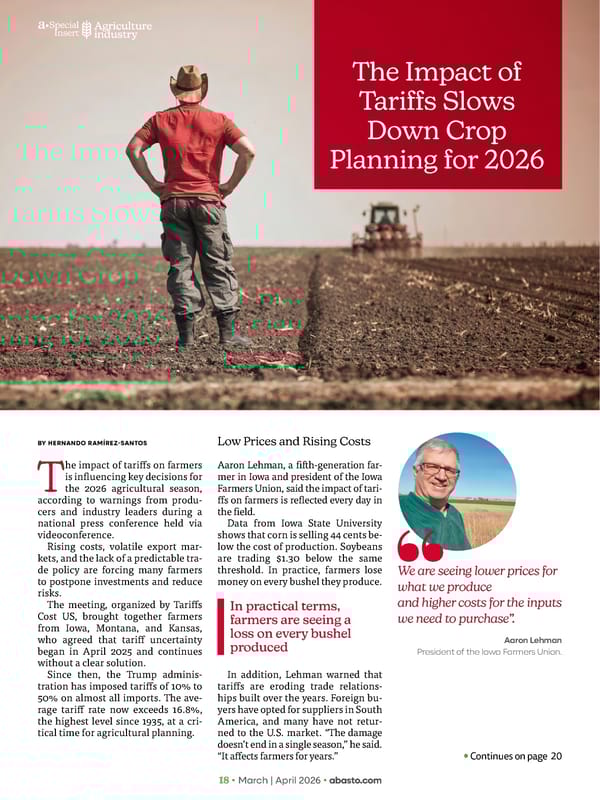
19 • March | April 2026 • abasto.com
20 • March | April 2026 • abasto.com Tariffs are tools, not toys. Without stability, planning for 2026 will become increasingly difficult.” Nick Levendofsky executive director of the Kansas Farmers Union. Call for Stable Trade Policy While farmers recognize the need to correct unfair trade practices, they insisted that blanket tariffs do not solve problems such as dumping, currency manipulation, or unequal labor standards. They called on Congress to take a greater role in trade policy and to adopt clear rules that enable confident planning. Expansion Plans on Hold in Montana In Montana, rancher Ben Peterson explained that the impact of tariffs on farmers has made risk manage- ment nearly impossible. His diversi- fied operation, which includes lives- tock, grains, and forage, depends on global markets even when he sells locally. Production costs continue to rise. A respiratory vaccine for calves went from costing $3.50 to about $6 in just over a year. The price of farm equi- pment remains high, and parts are scarcer and more expensive. Given this outlook, Peterson decided to put expansion plans on hold, delay machinery purchases, and postpone infrastructure improvements. “When you plan for a season, you commit capital months or years in advance,” he said. “Now the risk is too high.” The Impact of Tariffs on Farmers and Exports Nick Levendofsky, executive director of the Kansas Farmers Union, no- ted that tariffs hit export-dependent crops the hardest. Kansas depends on international markets for products such as wheat, soybeans, and sorghum. When ta- riffs trigger trade retaliation, prices fall, and contracts become more un- certain. Economists project that opera- ting costs could increase by 4% for corn and 6% for soybeans by 2026, above the USDA’s most recent es- timates. Fertilizers, chemicals, re- pairs, and fuel continue to become more expensive. Sorghum is a clear example. Its pri- ce fell below $3 per bushel, and some grain elevators are already warning that they may not accept the crop next season. “Farmers don’t set prices; we ac- cept them,” Levendofsky said. “Hi- gher food prices do not mean higher incomes for farmers.” Effects on Farm Communities Participants warned that the impact goes beyond the farm. Uncertainty slows machinery purchases, affects local manufacturers and suppliers, and makes it difficult to bring new generations into family farms. Lehman explained that farmers are forced to focus on survival, put- ting innovation and long-term plan- ning on the back burner. “We can handle low markets,” he said. “What we can’t handle is cons- tant unpredictability.” • Continuation of page 18 Special Insert Agriculture industry
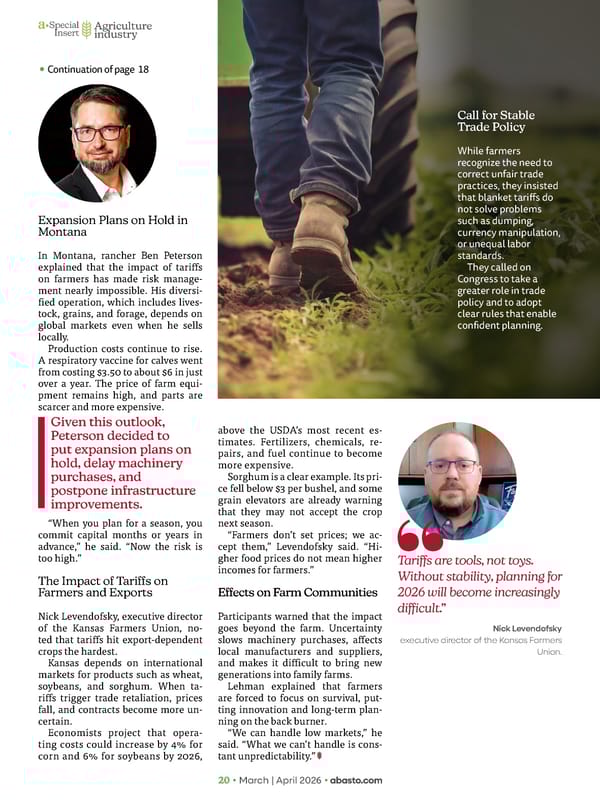
21 • March | April 2026 • abasto.com
22 • March | April 2026 • abasto.com SWIPE 2026: Driving the Future of Fresh Produce in the U.S. AT THE EXHIBITION HALL 1. Idaho Potatoe Commission. 2. SL Produce. 3. SEEDED. 4. GreenPoint Distributing. 5. National Mango Board. 6. RCF Mango. 7. Raquel Espinoza. 8. Malena Produce. 9. Cutting Ribbon. 10. Marengo Foods. PARA MÁS INFO 1 2 3 4 5 6 The speakers emphasized that the fu- ture competitiveness of the retail sec- tor will depend on the ability to adapt to the unpredictable. Other Key Sessions Included: AI in Grocery: Easing Shrink and Other Common Challen- ges: Experts and retailers discussed how AI is a key tool for combating food waste (shrink), optimizing the su- pply chain, and reducing ri- sing operating costs. BY DANNA GUEVARA T he third edition of the Sou- thwest International Produce Expo, SWIPE 2026, organized by The Fresh Produce Association of the Americas (FPAA), established it- self as a strategic space for the fresh produce industry. The event, held January 22-24 in Tucson, Arizona, offered a compre- hensive platform for networking, education, and business, highligh- ting the region’s crucial role in su- pplying fresh produce to the United States. Networking and High-Level Connections The event kicked off on January 22 with the SWIPE Desert Golf Classic Tournament, co-hosted by the FPAA and the FPFC. This tournament not only promoted the sport, but also served as the first meeting point for industry leaders to establish links be- fore the official opening of the fair. The opening day culminated with the Southwest Social Produce Party at the JW Marriott Starr Pass Resort & Spa. In a business-like atmosphe- re, attendees enjoyed an evening de- signed to strengthen business and personal relationships. Education: Technology and Resilience in the Supply Chain On Friday, January 23, the focus shif- ted to innovation. Educational panels highlighted how new technologies are transforming the supply chain from origin to end consumer. In the panel “Black Swan Event: Preparing for the Unpredictable,” industry experts such as Rob Billow of Charlie’s Produce, Kevin Carter of Associated Wholesale Grocers, Noe- lle Neary of Wakefern, and Kristi No- vak of H-E-B discussed the urgency of adopting emerging technologies. Special Insert Agriculture industry
23 • March | April 2026 • abasto.com 7 Duties & Tariffs: How Retail is Navigating the Impact of an Unstable Supply Chain: This section discusses the impact of the Trump admi- nistration’s trade policies and new tariff agreements. Retailers shared strategies to mitigate supply chain tur- bulence and protect both the profitability of their operations and consumer loyalty. A Vibrant and Global Exhibition Floor The SWIPE 2026 exhibition hall fea- tured more than 67 booths, beco- ming an epicenter of color, aroma, and negotiation. The fair attracted prominent leaders and featured a strong international presence, with representatives from Mexico, Peru, Honduras, and other countries. “We have a wide variety of import companies that are joining the Fresh Produce Association family and are now part of this event,” said Raquel Espinoza, Chairwoman of Produce House, in an interview with Abasto Media. 9 9 10 8 SWIPE 2027 Following the success of this third edition, which reaffirmed the vitality of the fresh produce community, the industry is already looking ahead to next year. The 2027 edition of SWIPE will take place from January 14 to 16, promising to remain the meeting point for innovation and agricultural trade in the United States.
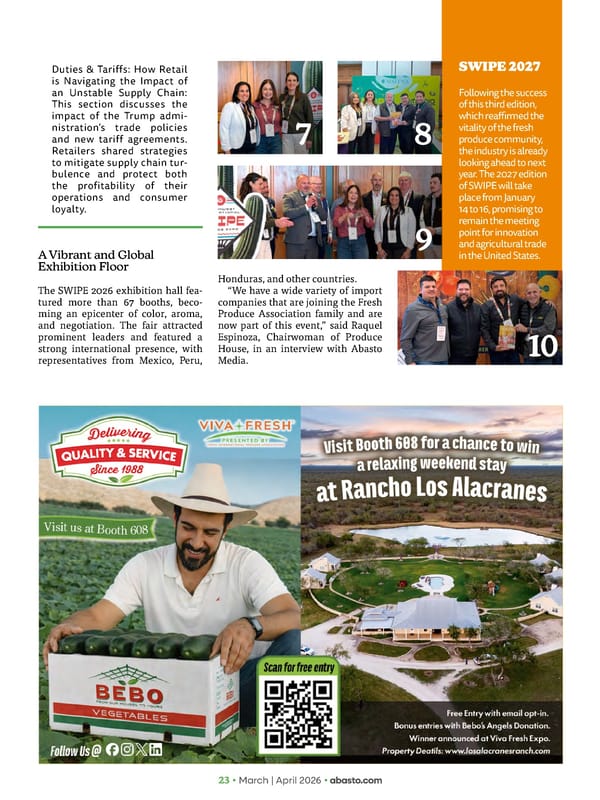
24 • March | April 2026 • abasto.com S ince 1987, every March has been designated National Women’s History Month, a period dedica- ted to honoring the contributions of women in the history of the United States. Reinforcing this important month of education and celebration, the UN has designated 2026 as the In- ternational Year of Women Farmers (IYWF 2026). Given the public recognition of wo- men in agriculture worldwide, there is a sense of urgency to capitalize on the visibility of their contributions. I see it more as a steady rhythm that is worth repeating. The role of women in the global agricultural industry is critical for providing perspectives and ideas that are simply missing when they are absent. Over the past decade, I have wit- nessed and participated in an effort to elevate women to executive posi- tions, bringing dynamic solutions to business challenges from the highest levels to advance our industry. Wo- men who empower other women are now more vocal about their inten- tions, as are men who champion the value that all genders bring to pro- blem-solving and offering solutions. Here are some ways to celebrate and support this month—and all year long. • Dialogue The positions women hold in the fresh produce industry are varied and found at all levels of organiza- tions. The idea of “traditional male roles” is beginning to disappear, as modern positions are gender-neu- tral. “Diversity” is not a bad word. The boom in DEI (Diversity, Equity, and Inclusion) programs may have passed, but the practice of incorpora- ting diverse opinions, perspectives, and life experiences remains a pro- ven way to achieve better results. • Mentoring Successful mentoring helps mini- mize feelings of isolation among women and increases their confi- dence and commitment to work. In the fresh produce industry, there are many opportunities to pair mentors with mentees, either formally or informally. The power of mentoring is not always about years of experience, im- parting wisdom, or influencing the next generation. It can, and should, be a mutually beneficial exchange of ideas and dialogue from all angles. • Leadership I compare leadership to athletics. Both require a mix of DNA and training to be at the top. It is true that you can be born with leadership skills, but leaders also need to cultivate, focus, and practice leadership discipline to maintain the authority and respect that the position demands. Just as an athlete may have natural talent, training is necessary to maintain the ability to compete at the highest level. This year, seek out the stories of the leaders who are shaping the future of the fresh produce industry as a thri- ving global sector. Chances are, one of them is sitting right next to you. Find the expanded version of this column at abasto.com. Women’s History Month POR: MARY HESLEP TEN ACRE MARKETING Special Insert Agriculture industry
51 • March | April 2026 • abasto.com
A market leader in Guatemala with 80+ years of experience and certified products. The Competitive Edge of Laboratorios Frycia’s Glass- Bottled Oral Rehydration Salts 00 • Marzo | Abril 2026 • abasto.com More Than Just Hydration: 52 • Marzo | Abril 2026 • abasto.com A Brand with Proven Backing By utilizing certi- fied raw materials and clinically proven solutions, Frycia is setting a new standard for trust and efficacy for both commer- cial partners and patients across the region. Their oral rehydration products are backed by Good Manufac- turing Practices (GMP) certifications and FDA approval— essential require- ments for conque- ring the competitive U.S. market.. BY VIOLETA MONTES DE OCA L aboratorios Frycia is a strategic powerhouse in the pharmaceutical industry, projecting its operational excellence toward the global oral rehydra- tion solutions market—a sector currently in an unprecedented phase of expansion. As the market leader in Guatemala, Frycia brings over 80 years of industry expertise to the table. According to an October 2025 analysis by Market Research Future, the global ORS industry is projected to grow from $6.137 billion in 2025 to $9.56 billion by 2035. In this promising landscape, North Ameri- ca stands as the epicenter, accounting for approximately 30% of the global market. Furthermore, a study by Transparency Market Research revealed that the liquid dosage segment dominated the global market as recently as 2021. In the United States, Latinos are hi- gh-volume consumers of oral rehydration salts, as these beverages are a staple for re- covery after intense workdays, illness, or seasonal weather changes. This category represents significant growth potential for retailers in key markets such as Cali- fornia, New York, Florida, Texas, Chicago, and Washington, D.C. Oral Rehydration Salts in Glass Packaging Laboratorios Frycia is capitalizing on this category’s growth through a differentia- ted product line. This includes Orasol— oral rehydration salts in glass bottles that offer 3-to-1 efficiency compared to other brands—and Levusol, a glucose-free for- mula specifically designed for diabetic patients. Orasol and Levusol offer two distinct fla- vor advantages: Despite the necessary sodium content, the flavor profiles effectively mask any saltiness. The glass bottle packaging ensures su- perior taste, product quality, and health safety. • GOOD BUSINESS
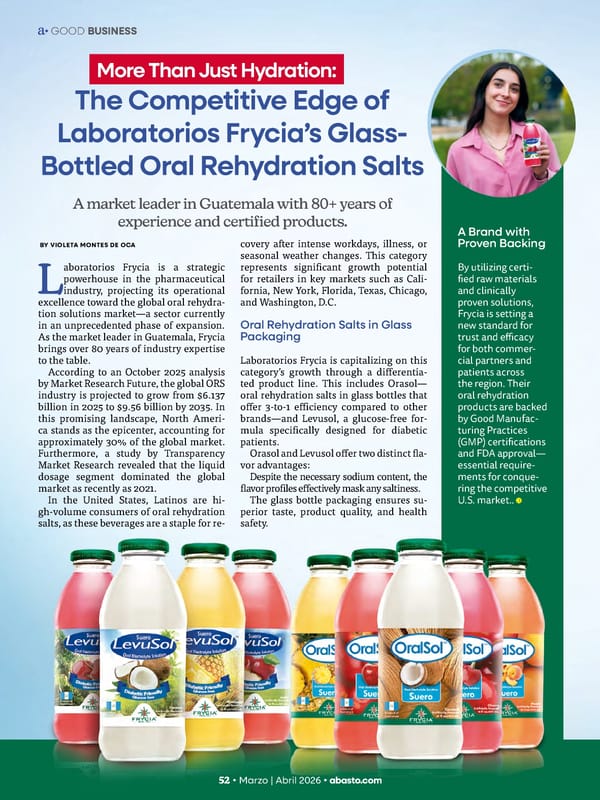
53 • March | April 2026 • abasto.com

54 • March | April 2026 • abasto.com BY ABASTO T he story of Lidia Pineda— known as the “Candy Queen” of the U.S. Midwest—did not begin with massive resour- ces or a rigid corporate structure. Today, however, she stands as a revitalized and successful entrepreneur in total com- mand of her craft. She is a powerhouse in the candy and snack industry, mastering everything from product development and distribution to negotiation, logistics, margins, and profitability. Her Story Lidia Pineda’s journey in the candy and snack industry began 20 years ago with something very tangible: a single pallet of mazapán and Paleta Payaso marsh- mallow pops. Originally from Los Mochis, Sinaloa, Mexico—a city defined by com- merce and a strong work ethic—Lidia was raised in a family shaped by a powerful matriarchy. Growing up watching her rela- tives work from dawn until dusk instilled in her a foundation of responsibility and constant drive. She studied Public Accounting with a specialty in Finance at Tecnológico de Monterrey, one of Mexico’s most pres- tigious universities, but she knew from the start that her true calling was in sales. From her very first move, she understood that success in this market isn’t just about moving volume; it’s about agility, stra- tegic vision, and the ability to identify opportunities where others only see pro- ducts. What began as a small operation transformed into a career dedicated to understanding trends, optimizing supply chains, and, above all, building high-va- lue relationships. Today, that experience allows her to offer a unique perspective on the sector, combining grassroots operatio- nal knowledge with a modern, disruptive business vision. Starting from Scratch For over 20 years, Lidia grew within the industry, gaining deep knowledge of every link in the business chain. For years, that growth was supported by a personal and business partnership that allowed for ex- pansion and consolidation. However, over time, that chapter came to an end. LIDIA PINEDA IS THE Candy Queen HER JOURNEY BEGAN 20 YEARS AGO WITH A SINGLE PALLET OF MAZAPÁN; TODAY, SHE IS REDEFINING THE WAY BUSINESS IS DONE. • GOOD BUSINESS
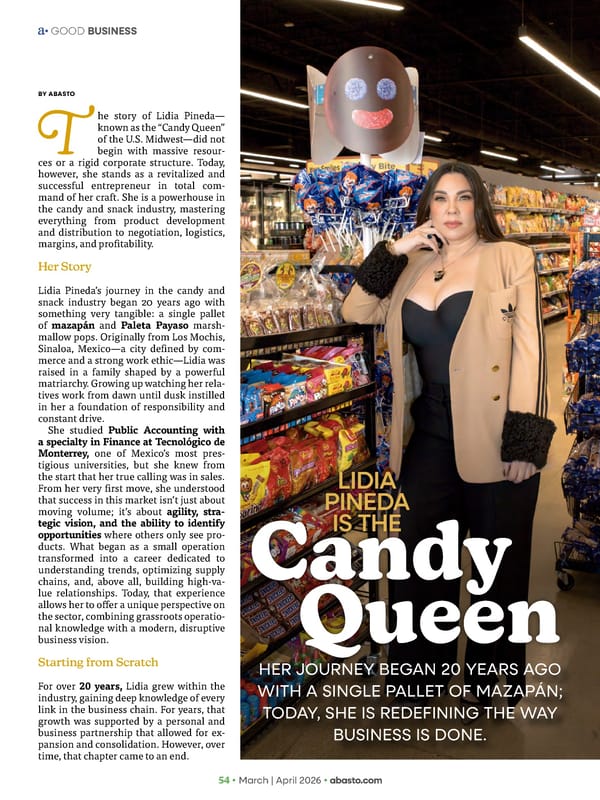
A divorce marked the close of both a per- sonal and professional cycle , leaving Lidia to face one of the most complex challenges an entrepreneur can endure: starting over from scratch. This wasn’t just an emotional fresh start; it was a deeply strategic reboot. She returned to knocking on doors and rein- troducing herself to clients, suppliers, and collaborators. This process allowed her to rebuild her path with a renewed vision and a strengthened professional focus. Today, she works with allies who profoundly un- derstand the industry—from l ogistics and distribution to point-of-sale execution — while always respecting the importance of informed decision-making. These alliances are not based on forced exclusivity or de- pendency, but on complementing strengths to build real value. PIHER Group Less than a year ago, Lidia launched PI- HER Group (the name is a combination of her two surnames, Pineda and Hernán- dez). Through this venture, she has disco- vered a new way of doing business—one that is more conscious, flexible, and alig- ned with long-term growth. Currently, she has the power to choose what to sell, how to sell it, and who to partner with, maintai- ning total control over risk, structure, and the direction of the company. In this industry, when a woman is ab- sent, the operation feels it. Lidia deeply recognizes and appreciates the value and dedication of every woman on her team. She has a profound understanding of risk, turnover, profitability, and sustai- nable growth. Throughout her career, being a Latina woman has never been a limitation; on the contrary, it is a strate- gic advantage. She knows the consumer intimately, understands the sales chan- nels, and knows how to move products backed by solid financial criteria. “After more than two decades in the industry, reinventing myself isn’t just an option—it’s a necessity to lead in a constantly evolving market,” Lidia mentioned in an exclusive interview with Abasto Media. Nothing we achieve is sustainable without the team. I have moved forward surrounded by strong women—in the office, in daily operations, and out in the field. These are women who execute, sell, stock, run demos, solve problems, and sustain our sales every single day. Lidia Pineda 55 • Marzo | Abril 2026 • abasto.com REACH OUT TO LIDIA
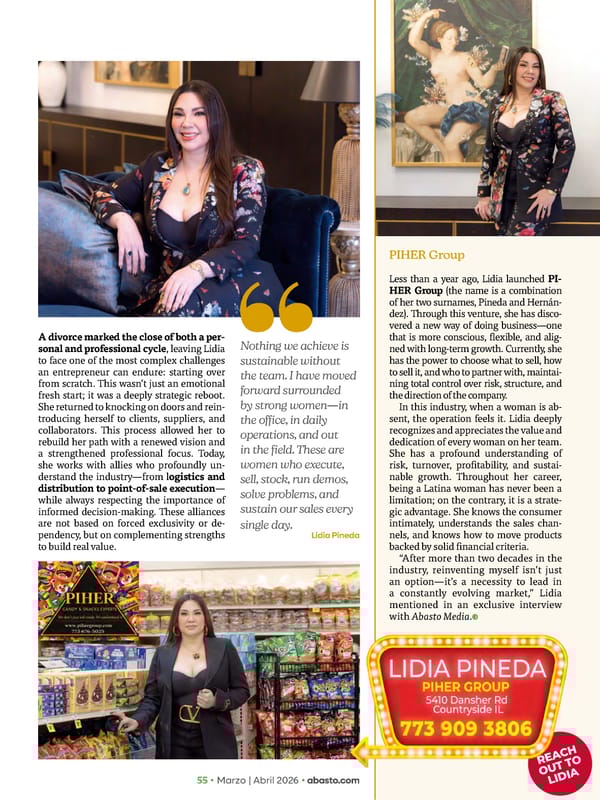
56 • March | April 2026 • abasto.com BY VIOLETA MONTES DE OCA T o conquer the dynamic U.S. food and beverage market, a good product isn’t enough; it requires a strategic “Power Mix” that masters every facet of the business. In this special March edition, Abasto Media brings together the insights of five exceptional leaders who are re- defining the rules of the game: LOGISTICS AND INTERNATIONALIZATION SYLVIA MENÉNDEZ , Internatio- nal Business Manager at Yaesta , represents the evolution of legacy into global professionalization. The daughter of the creator of the iconic Tortrix in Guatemala, Sylvia began her journey selling snacks from her garage; today, she is an engineer and strategist driving products across borders. Her approach to the B2B market is clear: talent opens doors, but only standardization and regula- tory compliance (FDA) allow you to stay inside. For Sylvia, the “nos- talgia” market has matured into a high-quality cultural experience that competes with global brands. Her leadership, built on the faith and consistency she learned from her mother, prioritizes data-driven THE FEMALE “POWER MIX” IN FOOD AND BEVERAGE decision-making and traceability systems over mere intuition. Hea- ding into 2026, Menéndez defines the industry through adaptability. She maintains that true success isn’t just “arriving” in the U.S., but achieving shelf rotation through purposeful discipline and a deep respect for cultural identity. Scaling isn’t about losing your essence; it’s about learning to reproduce it with consistency.” Sylvia Menéndez Women leading in marketing, logistics, and trade associations share their stories, strategies, and secrets to success • FOOD INDUSTRY
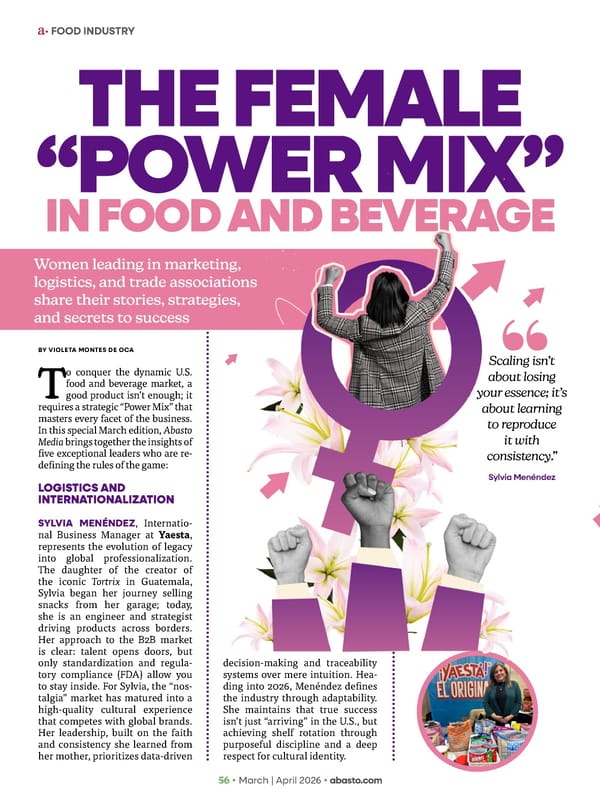
57 • March | April 2026 • abasto.com FOOD INDUSTRY • Letty González Sandra Cortés Georgina Macías Yamilet Rivas MARKETING AND RETAIL STRATEGY LETTY GONZÁLEZ, CEO of Con- zeptos Marketing , is a leading figure in retail marketing with over two decades of experience. Alongside her partner and sister, Paty González, she has built an agency that transforms commer- cial goals into consistent execution strategies. For Letty, a food brand’s success on the shelf depends on storytelling that is clear and credi- ble: while first-generation immi- grants connect through memory and nostalgia, bicultural Gen Z looks for identity and current rele- vance. With a 2026 vision centered on adaptability, González argues that the Hispanic market, though diverse, is easy to navigate through active listening. Her competitive advantage lies in proprietary te- chnology: an exclusive Conzeptos app that allows clients to monitor activations in real-time, providing total operational transparency. Her advice for Latina entrepreneurs is blunt: to play in the big leagues of retail, you must change how you operate, professionalize your pro- cesses, and, crucially, learn to dele- gate to sustain growth. STRATEGIC AND LOGISTIC FOCUS GEORGINA MACÍAS , CEO and Founder of Geommag , has spent 22 years leading logistics and 3PL (Third-Party Logistics) services between Mexico and the United States. Her story is one of perse- verance and breaking paradigms; supported from the start by her mother, Georgina transformed her entrepreneurial dream into a pillar of the international supply chain. For her, the key for a Hispanic brand to scale in U.S. retail is diffe- rentiation: “The market is vast, but a clear value proposition and strict adherence to certifications (such as Non-GMO or Organic) are what allow you to compete globally wi- thout losing your cultural essen- ce.” Looking toward 2026, Macías promotes the adoption of AI and automation as critical tools for agi- lity amidst logistical fluctuations, though she maintains that an en- trepreneur’s “instinct and heart” is a signature that no technology can replicate. Georgina is a firm voi- ce in demystifying the size of the Hispanic market, noting that its $2 trillion in consumption positions it as an economic giant. Her ingre- dient for success? Collaboration: establishing strategic partnerships that provide the necessary support for solid growth. EXECUTION AND POINT- OF-SALE SANDRA CORTÉS is the CEO of Innercia , a firm with over 25 years of experience in Latin America and a robust expansion into the U.S. market. A specialist in the design and production of retail displays, her goal is to transform the point- of-sale into a real sales engine. For Sandra, the great challenge for Hispanic brands in the U.S. is not just distribution, but shelf rota- tion: “Many fail by saturating the shelf with volume without commu- nicating the benefits and attributes that differentiate the product.” Her vision for the bicultural ecosystem focuses on innovation and adapta- bility. She maintains that the His- panic consumer is savvy and mo- ves beyond the “nostalgia market”; therefore, the key to success lies in impeccable execution that seduces the shopper through creativity and market knowledge gained from 25 years of working with Latino brands. Inspired by her mother’s discipline, Sandra leads with or- ganization and teamwork, convin- ced that to stand out in an “ocean of brands,” it is vital to connect emotionally through Well-Thou- ght-Out Design at the last meter of the sale. ASSOCIATION LEADERSHIP AND ACCESS TO CAPITAL YAMILET RIVAS , Founder and President of the U.S. Women’s Chamber of Commerce , serves as a strategic bridge for Latina entre- preneurs within the U.S. corporate ecosystem. Under her philosophy of “agility and action,” Rivas ar- gues that scaling to the retail big leagues requires leaving “opera- tional loneliness” behind and su- rrounding oneself with consultants and experts. As a trade leader, she emphasizes that Woman-Owned Small Business (WOSB/MWBE) certifications are master keys to accessing exclusive contracts and closing capital gaps through key alliances, such as her partnership with SALCHAM to strengthen the food and beverage sector. Looking ahead to 2026, Yamilet defines the industry through the concept of the “niche,” warning that today “every company is, in essence, a tech company” and must rely on data intelligence to compete. For her, breaking the myth of Hispanic market homogeneity is fundamen- tal to capturing real opportunities. Inspired by the early support of her Aunt Noris, Rivas promotes a vi- sion where institutional structure and specialized knowledge trans- form individual effort into scalable, sustainable success.

58 • March | April 2026 • abasto.com BY RON MARGULIS N on-Hispanic shoppers are already curious about His- panic foods and the retailers who win more of their weekly basket make that curiosity feel easy, safe and fun to act on in-store and online. The goal is not to “Americanize” the experience, but to remove fric- tion while keeping the store’s cultu- ral soul intact in a market where the U.S. ethnic foods category alone is projected to more than double from about 33.7 billion dollars in 2025 to 68.9 billion dollars by 2035, accor- ding to Future Market Insights. Start in the Store: Experience and Wayfinding Non-Hispanic shoppers often arrive at any ethnic retailer on a mission for one or two items they already know. For Hispanic stress, it’s often for items like tortillas, salsa or a specific hot sauce. They usually will leave after gathering these few “safe” products, even though retail data shows these Winning the Mainstream Basket How Hispanic Grocers Can Capture More Spend from Non-Hispanic Shoppers same categories drive incremental basket growth across demographics. To grow share of spend, the store must invite them to wander the aisles by: Using bilingual but plain-language signage that clearly explains depart- ments, service counters and key ca- tegories with simple descriptors like “Fresh tortillas made daily” or “Quick weeknight meals,” reflecting Nielse- nIQ research that nearly half of U.S. adults say they would shop more at a retailer offering a wider selection of multicultural products. Placing easy “bridge” items at the entrance and power aisles, perhaps chips and salsa, aguas frescas, plan- tain snacks or frozen meals, so new visitors see familiar use occasions for Hispanic products, mirroring how mainstream retailers are expanding multicultural sets to match demand. Investing in front-of-house gree- ters who can answer “what do I make with this?” in English, clean, bright lighting and conventional shelf la- youts that feel familiar to non-Hispa- nic shoppers while still highlighting specialty service counters. One practical example is to create a “Tuesday Taco Night” endcap with shells, tortillas, seasoned meats, prepared pico de gallo, shredded lettuce and beverages positioned near the front so even a first-time visitor can build a full meal solu- tion in one stop. Merchandising that Demystifies Multicultural consumers are alre- ady influencing everything from chip flavors to fresh ingredients, and non-Hispanic households are em- bracing global flavors for “variety, authenticity and adventure” in every- day meals. Hispanic banners can lean into that curiosity with clearer mer- chandising stories. Integrate key Hispanic categories beyond a single “ethnic” aisle by cross-merchandising tortillas, salsas and cheeses with mainstream meat, dairy and snacks to show how they fit into everyday meals. • Continues on page 60 • FOOD INDUSTRY
59 • March | April 2026 • abasto.com
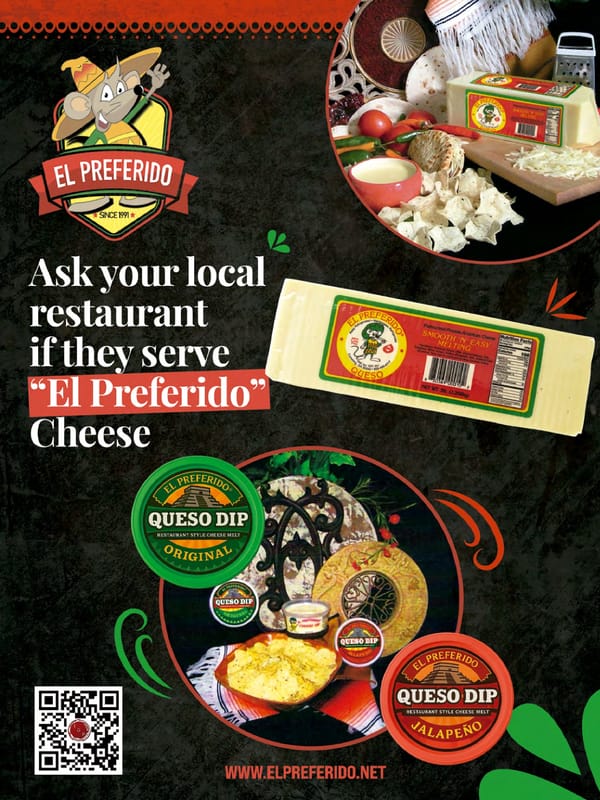
60 • March | April 2026 • abasto.com Use shelf talkers and recipe cards (“3-ingredient guacamole,” “Sheet- pan fajitas”) to translate unfamiliar ingredients into meal ideas, not just product attributes, tapping into the fact that multicultural shoppers, who spend 21% of their annual food do- llars on fresh according to Nielsen IQ, are shaping broader cooking norms. Highlight private label lines that cue authenticity and value, similar to how several traditional grocery chains are launching Hispanic-inspi- red private label or regional specialty banners and using store brands to fill multicultural assortment gaps. Think of your assortment in terms of “on-ramps.” Offer products and brands that look familiar (chips, ma- rinades, frozen entrées) but introdu- ce authentic flavors as part of a com- plete basket to raise total trip value. Promotions and Pricing that Signal Everyday Value Non-Hispanic shoppers will not shift more of their total grocery budget to a Hispanic banner unless the price/ value equation feels predictable and repeatable, especially as many con- sumers are willing to pay a premium for global-flavor items but still watch overall trip spend. Retailers Should Consider: Positioning Hispanic staples like tortillas and salsas, which over-in- dex with non-Hispanic shoppers, as EDLP or frequently promoted items to anchor a perception of value while maintaining category growth. Using simple, bilingual promotio- nal language (“Family meal deal”) tied to common U.S. occasions like game day, school lunches and gri- lling season, so the deals feel intuiti- ve across cultures. Transparent, easy-to-understand pricing also helps non-Hispanic hou- seholds treat the store as a primary shop, not just an occasional destina- tion for special ingredients. Social Media as the Bridge Social platforms are where food trends travel fastest and multicul- tural foods are often at the center of that momentum as ethnic and spe- cialty products move from niche to mainstream. Demand for ethnic food in the U.S. overall is projected to grow at roughly 7.4% annually through 2035, reports Future Market Insights, underscoring the importance of digi- tal discovery. Using Instagram, TikTok and Face- book to share short, subtitled videos that show “how to use” hero items and highlight weekly meal bundles is an easy way to start. Partnering with His- panic and non-Hispanic local creators is a good next step. Finally, making digital offers easy to redeem in-store reinforces the connection between on- line inspiration and physical shelves. As multicultural consumers conti- nue to outspend non-Hispanic White households on fresh, non-Hispanic shoppers are following their lead into global foods, creating a tremen- dous opportunity. Hispanic food retailers can capture a larger share of that growing food wallet through cultural credibility and frictionless, familiar shopping experiences on the floor, on the shelf, in the ad and in the social media feed. In-Store Events and “Retailtainment” Experiential retail is a proven growth engine for special- ty and multicultural grocers, which are increasingly seen as a mainstream format rather than a novelty as shoppers seek wellness and global flavors. Hosting tasting events and cooking demos, tying events to widely recognized cultural and sports moments and using loyalty apps to reward volume shoppers are sure ways to gain share of wallet. • Continuation of page 58 • FOOD INDUSTRY
61 • March | April 2026 • abasto.com

62 • March | April 2026 • abasto.com Conquering palates with its Vanilla and Mocha flavors, the new cold coffee brand 5 Volcanoes Coffee offers convenience, taste, and an excellent price for the modern consumer. BY ABASTO 5 Volcanoes Coffee makes its grand entrance in the United States in 2026 with a premium ready-to-drink (RTD) coffee that pro- mises to win over consumers. It comes in two flavors: Mocha and Vanilla, with reduced-fat milk and 12-ounce servings. This launch combines flavor, quality, and con- venience, offering supermarkets an opportunity to showcase their shel- ves and attract customers seeking ready-to-go beverages. Development Aligned with Consumer Trends The product responds to growing trends in the category, such as a pre- ference for coffee to go, lighter milk formulas, and the natural energy of coffee. Flavor profiles and packaging de- sign were validated with consumers, who highlighted the taste, ease of consumption, and shelf appeal. The latter point is key for retailers loo- king to drive trial and repurchase. Opportunity for Distributors and Retailers 5 Volcanoes Coffee offers distri- butors and retailers a market-ready brand with a focused portfolio that facilitates distribution and point-of- sale management. It has plans for national expansion in supermar- kets, self-service stores, and conve- nience channels. 5 VOLCANOES COFFEE A New Iced Coffee Latte is Here, Ready to Drink! Growth in the RTD Coffee Market With the ready- to-drink coffee category expanding, driven by changes in consumption habits and demand outside traditional coffee shops, 5 Volcanoes Coffee represents an attractive opportunity for retailers looking to strengthen their assortment with a validated, competitive, and scalable brand. Learn more at www.5-volcanoes.com • FOOD INDUSTRY
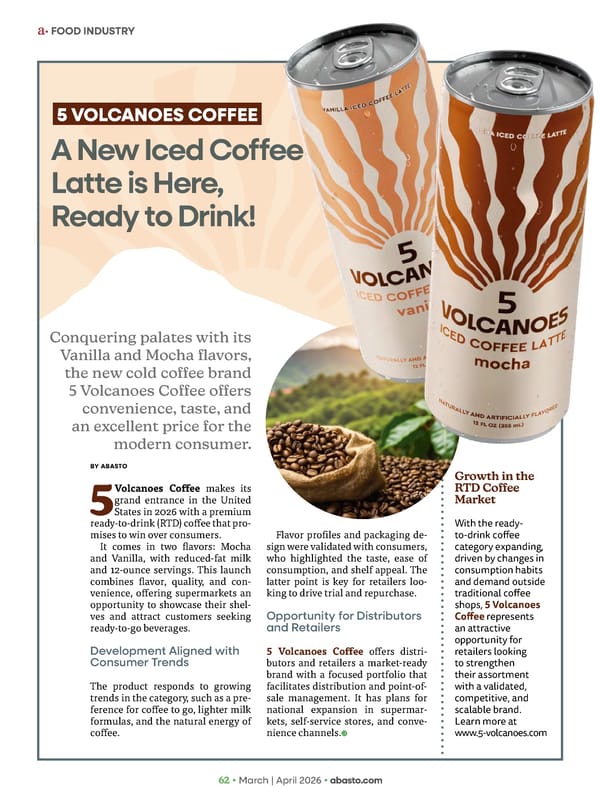
63 • March | April 2026 • abasto.com

64 • March | April 2026 • abasto.com Strategies that Will Shape Food Retail in 2026 Alison Schilling analyzes trends, challenges, and opportunities for supermarkets. BY HERNANDO RAMÍREZ-SANTOS T he food retail sector is un- dergoing a period of re- definition marked by de- mographic changes, inflationary pressures, new value demands, and the expansion of global flavors in the American diet. In this context, Abasto spoke with Alison Schilling, managing director and partner in the Consu- mer division at L.E.K. Consulting, to analyze the most effective stra- tegies that supermarkets should adopt, as well as the trends that will influence customer service, product offerings, and growth in the coming years. L.E.K. Consulting is a strategic consulting firm, as its name sug- gests. They support their clients in areas such as growth, store ex- pansion, white space analysis, ope- rations optimization, commercial excellence, and more. They also help retailers analyze where it is most productive to invest space and how to reach new consumers, whether through acquisitions or improvements in offerings. Consumer Trends in 2025–2026 Abasto: What consumer trends are redefining the market? Schilling: U.S. consumers are de- manding more flavors and variety. Exposure to Mexican, Cuban, Puerto Rican, and other cuisines has expan- ded from foodservice to retail. This is driving increased product offe- rings and growth in the Hispanic ais- le, even in traditional supermarkets. Expectations About Value and Experience Abasto: How have consumer ex- pectations regarding value chan- ged? Schilling: Inflationary pressure has not let up. This has reinforced an “hourglass economy” behavior: demand is growing for both pre- mium products and value options. Consumers are looking for compe- titive prices, which is driving club stores, discount stores, and private labels. The average shopper feels pressure and is migrating to more economical alternatives. • Continues on page 66 • FOOD INDUSTRY
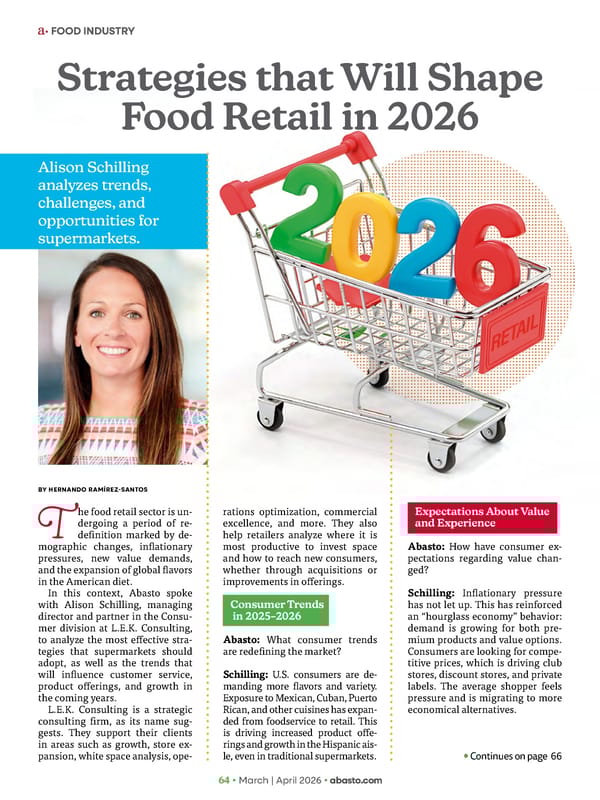
65 • March | April 2026 • abasto.com

66 • March | April 2026 • abasto.com Strategic Initiatives Abasto: What approaches do you recommend for defining priorities? Schilling: We think of strategy as a funnel. You have to evaluate whe- ther the opportunity is large enough and whether it aligns with the bu- siness’s capabilities. Anything that doesn’t fit well should be discarded without fear. Anything that meets both criteria becomes a priority. Balancing the Immediate with Transformation Abasto: How do you handle the urgent without losing sight of the long term? Schilling: You need balance. You have to resolve the immediate to have room to maneuver, but without compromising future relevance. Ta- riffs will continue to create uncer- tainty, so keeping your eye on the next five years ahead will be key. Competition Between E-commerce and Direct-to- Consumer Sales Abasto: How are retail leaders res- ponding to digital advances? Schilling: Brands that sell food di- rectly to consumers are still small. The big challenge is e-commerce. In the U.S., click-and-collect pre- dominates over fast delivery. Retai- lers must optimize pickup, in-store flows, and operational efficiency to meet promised times. Growth Opportunities Abasto: Where are the biggest opportunities in the next five years? Schilling: In mastering value, adjusting assortment to actual demand, strengthening the peri- phery—which continues to grow— and creating differentiation throu- gh incremental traffic. Precise alignment between the planogram and the consumer will be decisive. The Impact of Artificial Intelligence Abasto: Does L.E.K. also advise on the use of AI? Schilling: Yes. We analyze the “AI delta”: where the company is today and what opportunities it has to improve processes, logistics, pic- king, or dat. Emerging Behaviors Abasto: What habits should ma- nufacturers and retailers watch for in 2026? Schilling: First, have a portfolio that meets value needs and cul- tural preferences. Second- and third-generation Hispanics shop across multiple channels: they vi- sit independent stores as well as Walmart, Kroger, and H-E-B. In addition, Hispanic-focused private labels will continue to grow. Inde- pendent stores continue to stand out for their depth and unique as- sortment, including products im- possible to find in large chains. Assessing Your Role in the Market Abasto: How should retailers as- sess their current position? Schilling: By knowing their con- sumer. A retailer’s assortment in the South cannot be the same as one in the Midwest. One or two tor- tillas are not enough; you need va- rieties that cover value, local, and “better for you,” as well as a clear and accessible display. What Sets Those Who Adapt Successfully Apart Abasto: What sets retailers who manage to transform themselves apart? Schilling: Commitment. It’s not enough to try one or two Hispanic SKUs. It requires depth, assort- ment, merchandising support, and, where appropriate, commu- nication in Spanish. We also see Hispanic chains such as Vallarta adopting more comprehensive models—bakery, prepared foods— to attract a wider audience. • Continuation of page 64 • FOOD INDUSTRY
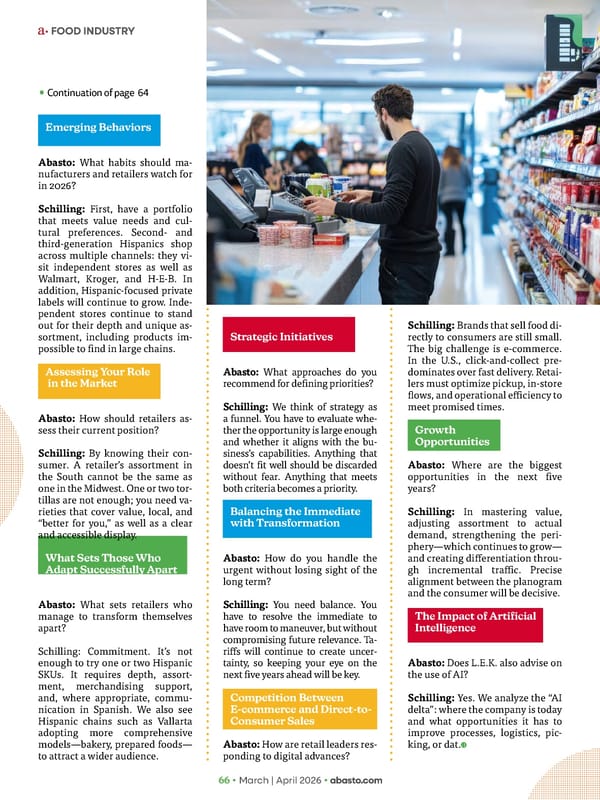
67 • March | April 2026 • abasto.com
68 • March | April 2026 • abasto.com I ndependent grocery stores have small staff, tight budgets, and a lot of compe- tition from national chains and big-box stores. The fact that they are close to the customer gives them an edge. They have strong local relationships, the trust of the community, and the speed to act quickly. When paired with the right low-cost AI tools, these strengths can be turned into a strong strategy for engaging shoppers across all channels. Here is a useful framework for small grocery stores that is based on three im- portant steps and three simple AI tools. 1 Communicate with local shoppers in a clear and consistent way. What to do: Consumers should know ri- ght away what makes your store unique, whether it is the local goods, the service, the cultural relevance, or the ease of ac- cess. That message needs to be the same on shop signs, emails, social media, and online listings. ChatGPT is an AI tool that is easy to use. and makes it easy for grocery stores to quickly make store messages, weekly ads, social posts, shelf talkers, and event ads. Teams do not have to start with nothing every week because they can reuse and improve messages in minutes. This saves time and keeps them up to date. 2 Produce professional-looking images that are easy to use without a design team What to do: When you are food shop- A Practical AI- Powered Shopper Engagement Plan ping, images are especially important. Promotions that stand out, clear signs, and branding digital content all help to in- crease conversions and basket sizes. Inde- pendents have difficulty with this because they do not have creators on staff. Grocers can use Canva to make profes- sional images for shop signs, weekly deals, loyalty programs, digital coupons, and social media. With AI-powered templates and resizing tools, it is simple to use the same ad on more than one channel. 3 Capture First-Party Data and Stay Connected After Checkout What to do: Independent grocers often lose engagement at checkout. To keep customers coming back, you need to stay connected with them with deals, remin- ders, and news about what is going on in the area. Grocery stores can get emails from cus- tomers using QR codes, reward programs, or digital receipts, and then Mailchimp can send personalized emails automati- cally. With AI-driven send-time optimi- zation and segmentation, shops can send the right message to shoppers at the right time without having to do it by hand. Artificial intelligence as a tool for independent retailers POR KEN NINOMIYA MARKETING OMNICANAL • FOOD INDUSTRY Independent grocery stores can compete without spending a lot of money on enterprise systems. By focusing on: • Clear messages for locals • Clear visual performance every time • Ongoing communication with shoppers Conclusión
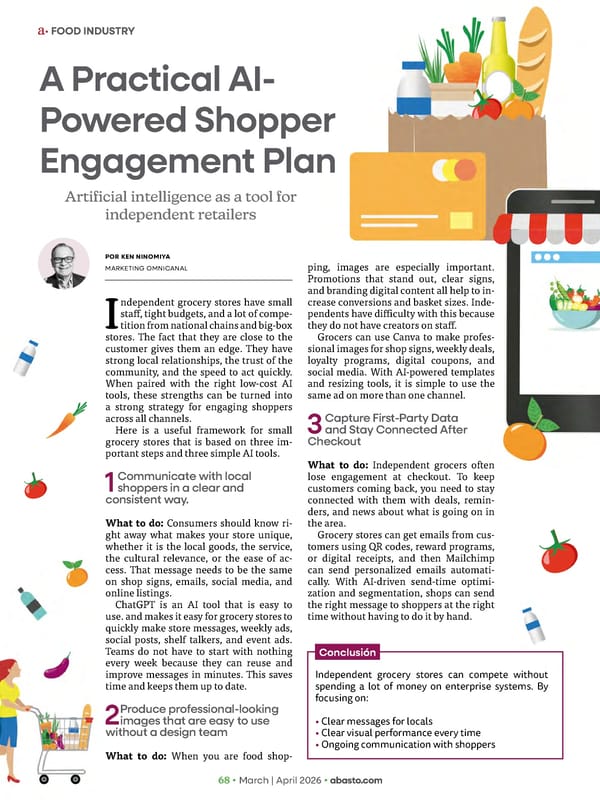
69 • March | April 2026 • abasto.com
70 • March | April 2026 • abasto.com A Warm Welcome for Vallarta Supermarkets in Arizona BY HERNANDO RAMÍREZ-SANTOS V allarta Supermar- kets, with more than 40 years of his- tory in California, opened its first supermarket in Glen- dale, Arizona, on January 14. The 49,000-square-foot store located at 59th Ave- nue and Camelback Road celebrated its opening with music, dancing, and gifts for the first customers. The arrival marks the begin- ning of a broader expan- sion in Arizona. César González, COO and owner of the Glendale store, said that touring the community and talking to residents was key to deci- ding to open outside of Ca- lifornia. “We saw that the- re was a real opportunity to serve this community and bring an authentic shop- ping experience,” he said. Glendale welcomed the Hispanic supermarket chain, which drew a large influx of customers. Political and Cultural Support It brings unique products, jobs, and a real boost to our local economy.” Jerry P. Weiers | Mayor of Glendale. Councilman Lupe Conchas, whose district includes the new store, welcomed the opening before the crowd: “We are not just celebrating a supermarket, we are cele- brating a cultural space for the Latino community in Glendale,” he said during the ceremony. In addition to local jobs, Vallarta donated $7,500 to local organizations and schools as part of the festi- vities, reinforcing its com- munity focus. • Continues on page 72 • FOOD INDUSTRY
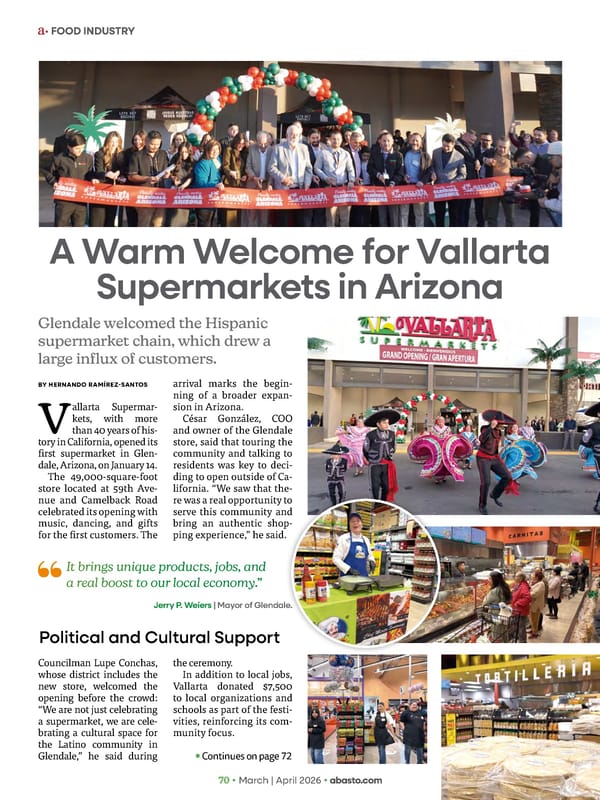
71 • March | April 2026 • abasto.com
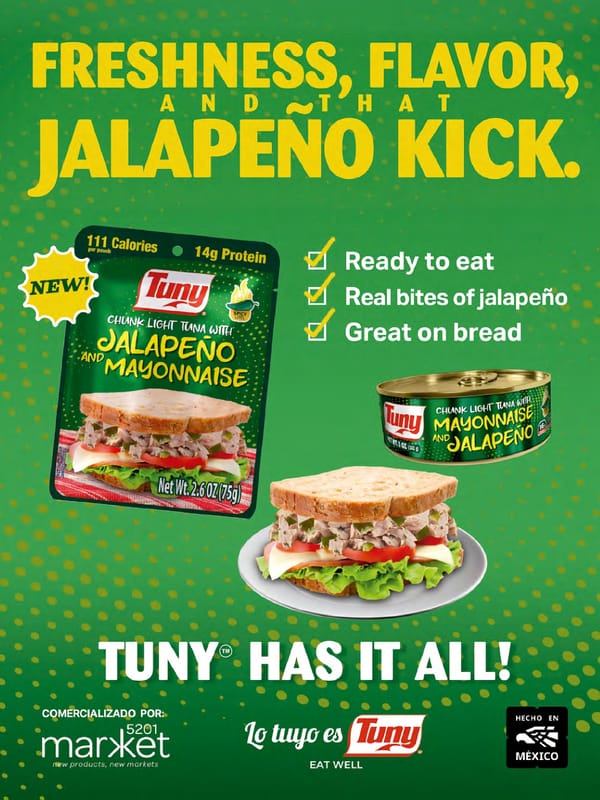
72 • March | April 2026 • abasto.com Voices of Enthusiastic Customers Visitors who arrived be- fore dawn described the opening as something they had been waiting for their entire lives. Berenice Gue- rrero and Neri López, nati- ves of Jalisco, got up early to visit the store and do their shopping. “It’s very good, it has good prices and, above all, very good quality. We are very grateful for the treat- ment we received; they are very friendly and for everything they shared with us,” said Guerrero. “What I liked the most is the price of beans, I grabbed two packages be- cause I put beans in all my meals,” said López. Looking Ahead With plans for 10–15 more stores in Arizo- na, Vallarta is commi- tted to growth while preserving its family tradition and unique cultural offerings. This is more than just an opening; it’s the beginning of a new chapter for Vallarta Lizette Gómez | Marketing director for Vallarta Supermarkets 72 • March | April 2026 • abasto.com • Continuation of page 70 • FOOD INDUSTRY
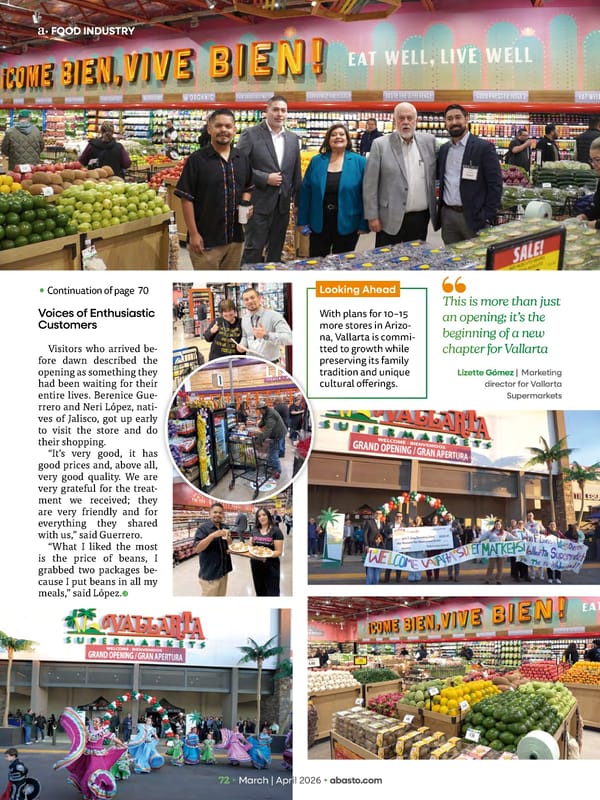
73 • March | April 2026 • abasto.com

74 • March | April 2026 • abasto.com 5 Concrete Actions to Serve Your Customers When They Need You Most A couple of months ago, I saw a YouTu- be report that concerned me about an issue I already had hard data on. In this story, Rosa María, an employee of more than 10 years at a store in the shop- ping district of Huntington Park, California, talked about the loss of visitors, entire fami- lies, who used to enjoy the mall as they had been doing. “Before,” she says nostalgically, “the aisles were filled with voices, entire families, people who came to shop and say hello. Now, many still shop, but they don’t come as often. You can tell.” Rosa María isn’t talking about politics or statistics. She’s talking about absences . The kind we’ve seen in other cities. Her story is not unique. In different markets across the United States, Hispanic communities have begun to reorga- nize the way they shop, seeking to reduce their presence in public places and avoid uncomfortable situations associated with immigration operations by the Department of Home- land Security and ICE. This change is already visible in retail. A recent Reuters re- port documents how merchants in areas with high Hispanic populations have seen a clear drop in physical store traffic, as some customers choose to shop online or reduce their visits. Data from Kantar and 2025 cited in the same analysis in- dicate that visits by Hispanic shoppers to large stores fell by nearly 15% year-on-year between April and June, compared to much smaller declines in other groups. For Hispanic supermarkets, this is a key moment to re- think not only their community role but also how to stren- gthen their relationships with customers and serve them in the best possible way. Here are five simple, realistic, and actionable ideas for res- ponding from a customer service and experience perspective. 1. Implement or Relaunch a Basic Loyalty Program Don’t put it off any longer. Now is the time to identify your customers individually and start communicating with them in a more intimate and personalized way. Implementing simple loyalty programs will allow you to identify repeat customers, understand changes in purcha- sing habits, and, above all, maintain a direct channel of com- munication. As physical visits decline, knowing who your customers are and how to contact them becomes critical. 2. Listen to Your Customers Now Through Short, Anonymous Surveys. From a couple of questions such as “What did you like about your experience in our store today?” or “What could we do POR RAMÓN PORTILLA HUMANX INSIGHTS today to give you better service?”, listening to your custo- mers will open up a tremendous opportunity to adjust your merchandise, in-store experience, prices, and even help you decide how to serve them better. Don’t forget that the simple act of asking questions reinforces trust and closeness. 3. Partnerships With Home Delivery Services. The same Reuters analysis highlights that businesses with little digital presence have been hit hardest by the change , while those offering remote purchasing op- tions have mitigated some of the impact. Partnering with delivery platforms lets you continue serving customers who now prioritize convenience and discretion without large initial investments. Platforms such as DoorDash and Uber Eats are already available. There may even be local options in your community. 4. “Community Service” Counter. When was the last time you adjusted or rethought your customer service area? This space in your store can be a valuable resource for your customers, offering useful in- formation such as referrals to local legal services, trans- lation support or basic documentation, and transporta- tion or delivery options. It’s not about solving everything, but about guiding and accompanying , reinforcing the store’s role as an ally when your customers need you most. 5. The Atmosphere of Your Store as a Haven of Peace Through Empathetic Communication. In times of uncertainty, not communicating also com- municates . Simple, human visual messages within the point of sale reinforce emotional security and a sense of belonging, without encouraging greater exposure. Have you considered adding more human images in the store, such as at the checkout or butchery areas? How • FOOD INDUSTRY
75 • March | April 2026 • abasto.com about a large photo of your employees welcoming your customers? Your store has enormous potential to “make your customers feel better.” Examples of effective messages: “Thank you for trusting us. We are here to serve you, today and always.” “This store exists for and because of our community.” “We are proud to serve our families, in good times and in difficult times.” These messages are not political: they are gestures of gratitude and recognition toward those who continue to trust the store. Final Thoughts Despite these changes in shopping habits, Hispanic pur- chasing power continues to grow and is projected to reach nearly $2.8 trillion by 2026. The challenge is not a lack of demand, but understan- ding how the community’s needs are changing. Today, Hispanic retailers have the opportunity to de- monstrate that they understand their customers beyond the transaction. Stores that know how to listen, adapt, and communicate with empathy will not only protect their businesses but also strengthen lasting bonds. Because, in the end, communities don’t just remember prices. They remember who was there when they needed it most.
76 • March | April 2026 • abasto.com • FOOD INDUSTRY Happy Homecoming BY HERNANDO RAMÍREZ-SANTOS O n January 14, Northgate González Market opened its new store in La Mirada, California, marking a sym- bolic return to the community where the González family’s history in the United States began. The store’s opening reinfor- ces the chain’s presence in Southern Cali- fornia and its commitment to serving au- thentic, fresh Mexican food. Located at 12721 Valley View Blvd., the 29,800-square-foot store stands in a city deeply connected to the founding family’s origins. As such, the opening represents both a commercial expansion and a perso- nal moment steeped in meaning. “For our family, La Mirada will always hold a special place in our hearts,” said Oscar Gonza- lez, co-president of Northgate Gonzalez Mar- ket. “It was our first home, and opening a store here is a moment of pride for all of us.” A Visual Tribute to Family History From its conception, Northgate González Market La Mirada reflects the company’s roots and values. In that spirit, the store features a custom mural titled From Our Roots to Home, created by local artist Aly- sia Ponce. The work visually narrates the González family’s journey from Jalostotitlán, Jalisco, to California. During the grand opening, the company held a special reception attended by local officials. At the event, Northgate announ- ced a donation of more than $20,000 to lo- cal schools, underscoring its commitment to community development. “La Mirada is proud to welcome Nor- thgate Market and the González family’s investment in our city,” said John Lewis, District 1 Councilman. Northgate González Market La Mirada also has a direct economic impact. The store employs 244 people and offers new job opportunities in a modern space desig- ned to serve a high volume of customers. Northgate González Market Opens Store in La Mirada Northgate Market is not only a great place to shop but also a community partner.” John Lewis District 1 Councilman.
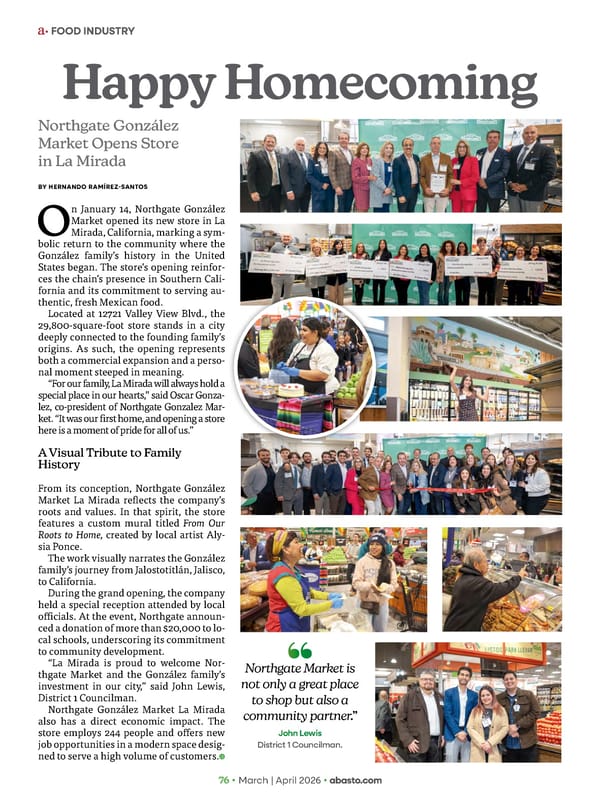
77 • March | April 2026 • abasto.com

78 • March | April 2026 • abasto.com BY ABASTO T he National Super- market Association formally welcomed its new president and board of directors elected for the 2026–2027 term. The cere- mony was held on January 29, marking the beginning of a new era of leadership focused on representation, collaboration, and sustaina- ble growth for independent supermarkets. Formal Beginning of New Leadership Beyond the protocol of the official swearing-in ceremony, the event sym- bolized the beginning of a new strategic cycle. The as- sociation of independent Hispanic grocers seeks to reinforce its mission of “Shaping Tomorrow” whi- le addressing the current challenges facing the su- permarket industry. The National Supermarket Association’s board of di- rectors will serve for a two- year term, covering 2026 and 2027. The new team combines operational ex- perience, business leader- ship, and deep knowledge of independent retail. Anthony Peña assumed the position of national president. From that po- sition, he will lead the organization in a context marked by inflationary pressures, regulatory changes, and transforma- tions in consumer habits. Frank Félix Zapata serves as vice president, and Jorge Guillén serves as secretary general. Pedro Goico is the association’s treasurer. The board is completed by directors José “JD” Azco- na, Iván Bueno, Anthony Es- pinal, Jason Ferreira, Arturo Payamps, Frank Pimentel, and Ángel Rafael Núñez. Together, the group will define strategic priorities, develop trade association policies, and support mem- ber programs. The National Supermar- ket Association has indica- ted that this board will be responsible for strengthe- ning the voice of the inde- pendent sector and expan- ding the services it offers to its members on the East Coast. The NSA Swears in Its New Board of Directors for 2026–2027 Trade Association Advocacy and Direct Support The National Supermarket Association actively repre- sents its members in the public and private sectors. The organization defends its members’ interests on key issues, including labor regulations, food assistan- ce programs, public safety, operating costs, and su- pply chain stability. In addition, the asso- ciation promotes training initiatives, networking opportunities, and stra- tegic alliances with su- ppliers. These actions enable independent super- markets to remain compe- titive and continue to play an essential role in their communities. In an environment mar- ked by retail consolidation, e-commerce growth, and margin pressure, the NSA emphasizes the importan- ce of strong, unified repre- sentation. NSA History Founded in 1989 by Hispanic entrepre- neurs, the National Supermarket Asso- ciation has establi- shed itself as one of the leading organi- zations representing independent super- market owners in the United States. Its reach spans New York, other East Coast cities, the Mid-Atlantic region, and Florida. Over the past two decades, the association has seen steady growth in both its members- hip and institutional influence. Currently, it repre- sents approximately 600 supermarkets. The majority of its members are of His- panic descent and operate stores that serve communities of color, many of which are located in urban areas with limited access to major retail chains. ANTHONY PEÑA PTE NSA ANTHONY PEÑA PTE NSA Anthony Peña, new president of the NSA. Swearing-in of the NSA Board of Director • FOOD INDUSTRY
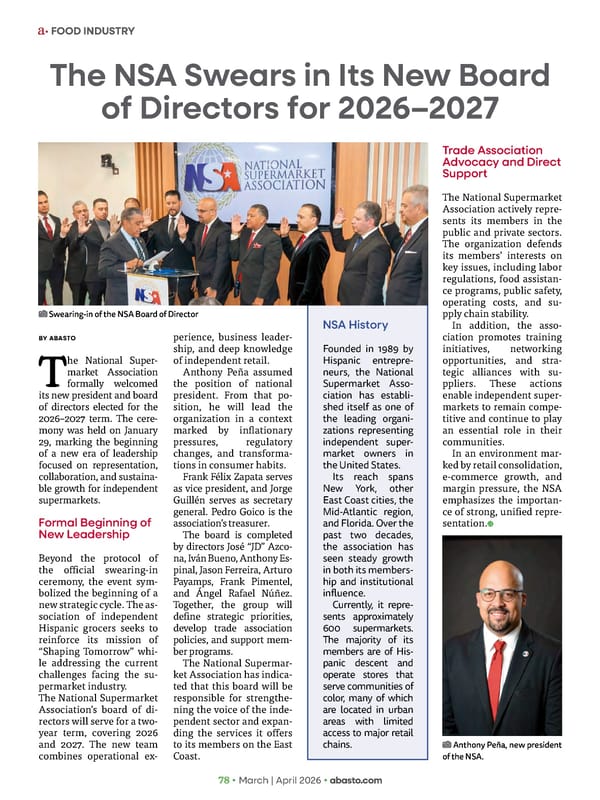
79 • March | April 2026 • abasto.com

80 • March | April 2026 • abasto.com The Retail Learning Institute, which provides training and professional development for the retail industry, has developed department-specific guides. These resources include re- commended sanitation and maintenance tasks to be performed daily, weekly, monthly, and beyond. These checklists are practical and engaging, designed to remind staff of the critical tasks necessary for the safe and efficient operation of their departments. Clip this list for your store and find this document— along with others available in both English and Spanish—on the Retail Learning Institute website. FOR MORE INFO Ways to Save Energy • FOOD INDUSTRY
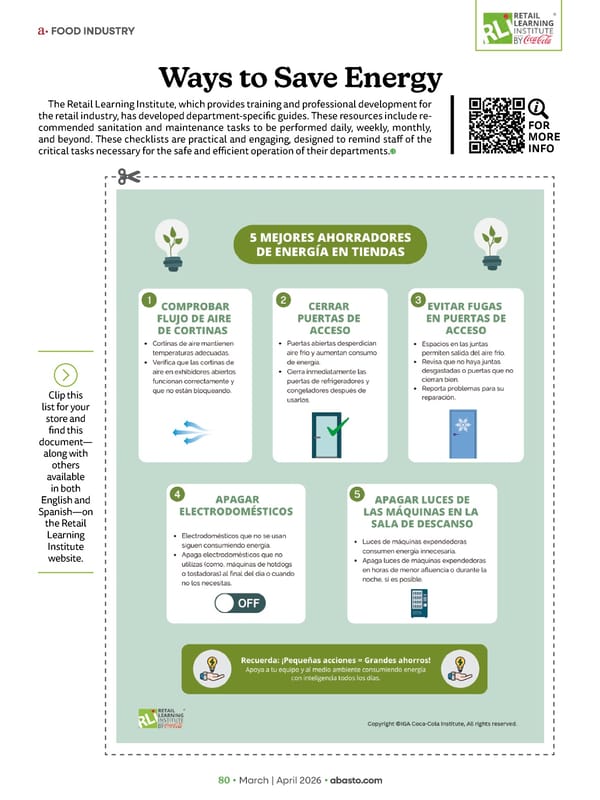
81 • March | April 2026 • abasto.com
82 • March | April 2026 • abasto.com The TIA 2026 convention prepares manufacturers for regulatory, health, and trend-related issues BY ABASTO T ortillas are part of the food and cultural fabric of the Uni- ted States. Their consumption has expanded beyond the traditional. The Tortilla Industry Association (TIA) will bring together manufac- turers, suppliers, and experts in Las Vegas on April 24 and 25. Its goal is to equip the industry to address regula- tory changes, consumer trends, inno- vation, and operational challenges. The U.S. tortilla market has shown solid growth in recent years. This progress is driven by everyday con- sumption and expansion in retail and food services. Projections estimate that the mar- ket will exceed $13.7 billion by 2025. The compound annual growth rate (CAGR) is projected to exceed 5% through 2035. This growth is suppor- ted by consumer preference for ver- satile, natural, and convenient foods. Both corn and flour tortillas do- minate sales. In addition, premium and healthy categories have gained traction. High-fiber, low-carb, or glu- ten-free options appeal to consumers concerned about nutrition and clear labeling. A Market Evolving with Health Trends and Regulation The regulatory environment direct- ly influences the industry. Starting January 1, 2026, California requires folic acid fortification of corn flour used to make tortillas. This measure seeks to reduce birth defects in vulnerable communities. Compliance with labeling and for- tification standards poses logistical and communication challenges. For this reason, one of the modules of the 2026 convention focuses on how to correctly label products as “healthy.” In addition, the demand for clear labeling on packaging is the focus of technical and regulatory debates. This reflects the need for transparen- cy to maintain consumer confidence. Technical and Operational Issues on the TIA Agenda The educational program also ad- dresses equipment maintenance and operational practices. These are cri- tical in a sector where efficiency and food safety determine production margins. Product innovation includes ses- sions on frying oils, enzymes for low-carbohydrate options, and fat reduction. Manufacturers seek to balance heal- th, texture, and product shelf life. There will also be a workshop on sca- ling micro-production operations for medium-sized companies, addressing common problems during growth. Market Outlook and Future The tortilla market continues to grow, with a focus on health, convenience, and sustainabili- ty. The global sector is estima- ted to reach $80 billion by 2035, led by North America. The 2026 TIA Annual Conven- tion provides a key space to share best practices, adapt to regulatory changes, and conso- lidate an iconic product of Ame- rican food culture. Beyond the Product: Safety and Social Responsibility The session “Ways to Protect Your Employees in the Event of an ICE Raid” addresses the legal and physical safety of workers. This demonstrates that operational stability re- quires preparation for unex- pected situations. Trends and Education in the Tortilla Industry Growth, Challenges, and Learning at TIA 2026 • FOOD INDUSTRY
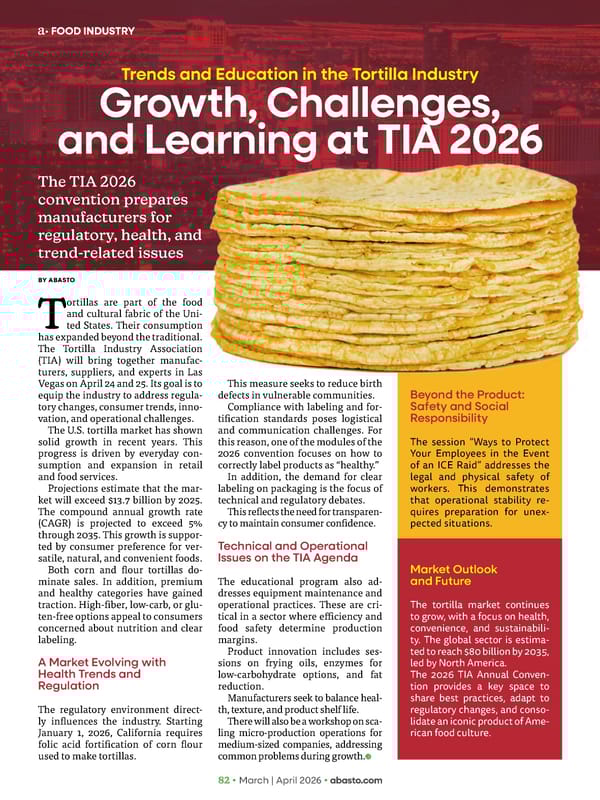
83 • March | April 2026 • abasto.com

84 • March | April 2026 • abasto.com 4 The NGA Show 2026 Dispatch: The Future of Hispanic Retail BY RON MARGULIS A s independent grocers gathered last week for the National Grocers Association (NGA) 2026 Annual Meeting in Las Vegas, a recurring theme of cultural connection is the new frontier of grocery growth that resonated across ses- sions. For Hispanic retail operators, the in- sights shared on technology adoption, su- pply resilience and shopper engagement during the Show offered a clear roadmap for competitive strength in the year ahead. Technology Innovation Forum During the Technology Innovation Forum, speakers from leading retailers and vendors emphasized that the next phase of omnichannel success will de- pend on “merchandising with meaning.” Hispanic grocers, who are almost always deeply embedded in their communities, are uniquely positioned to lead this shift by blending digital tools with authentici- ty. AI-driven demand forecasting, in-sto- re digitalization and real-time inventory visibility were showcased as ways to keep high-demand categories like fresh produ- ce and cultural staples both stocked and profitable. FOR MORE INFO AT THE HALLWAYS OF THE NGA SHOW 1. Idaho Potato Commission, Matt Zapczynski, Mark Daniels, Patrick Mills y Ross Johnson. 2. MexSnax , Jesús Camacho. 3. Teloloapan Supermarket. 4. Equipo Arteagas Food Center. 5. YaEsta, Dionisio Martínez, José René Menéndez y Lucía Figueroa. 6. Pepito USA, Gustavo Jaime Ornelas, Armando Medina, Isabel Mendoza, Ingrid Yoseff y Alejan- dro Cárdenas. 3 6 1 2 5 • Continues on page 86 • FOOD INDUSTRY
85 • March | April 2026 • abasto.com
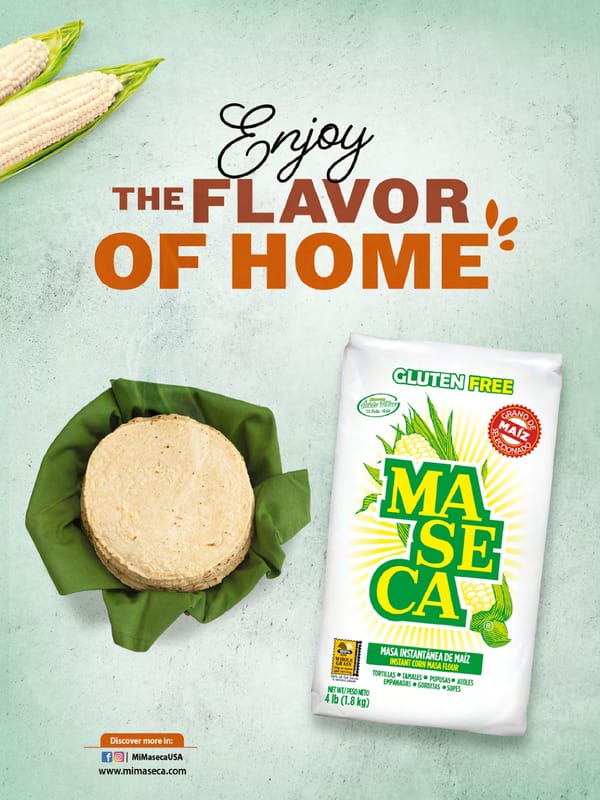
86 • March | April 2026 • abasto.com Educational Sessions at NGA Show 2026 Educational sessions also underscored supplier diversity and localized assort- ment planning as growth levers for 2026. Speakers from NGA Show and Salient noted that Hispanic consumer spending continues to outpace overall U.S. grocery growth, especially in bilingual-market corridors across Texas, Florida and the Southwest. To serve these shoppers effec- tively, grocers are being encouraged to use advanced retail data tools to track cultural buying cycles and to deepen partnerships with Hispanic-owned CPG brands. Sustainability and workforce deve- lopment also took center stage. Seve- ral panels highlighted family-owned Hispanic retailers making strides in energy-efficient refrigeration and em- ployee training aligned with commu- nity values, validating the strategy that operational modernization can go hand-in-hand with cultural integrity. As NGA President Greg Ferrara summari- zed in his closing remarks, “Independent grocers thrive when they reflect the com- munities they serve. Technology and tra- dition are no longer opposing forces — they’re partners in local growth.” For Hispanic retailers, that message sig- nals a year of strong opportunity. Accor- ding to speakers at the NGA Show 2026, it will be one driven by community connec- tion, smarter technology investments and a continued emphasis on heritage-cente- red retailing innovation. Save the date THE NGA SHOW 2027 Date: January 31–February 2 Location: MGM Grand Conference Center, Las Vegas, Nevada AT THE HALLWAYS OF THE NGA SHOW 7.Sigma Team, Silvana Arzeno. 8. Rica, Jaime Pina Sweeney, Genaro Pérez y Brau- lio José Brache. 9. Supermercados Talpa, Louis Cárdenas, Carlos Torrellas, David Herrera, Alejandra Cárdenas y Francisco Chiquillo. 10. Todos Supermarkets, Carlos Castro. 11. Ricky Joy. 12. Equipo Arteagas Food Center. 7 8 12 11 9 10 • Continuation of page 84 • FOOD INDUSTRY
87 • March | April 2026 • abasto.com 10

88 • March | April 2026 • abasto.com P oor olives someti- mes bear the brunt of culinary injus- tice: we always see them as an accompaniment to wine, beer, or charcuterie boards... but we forget that they are much more than that. They are a powerhou- se of flavor, history, and health that deserve to shi- ne in the pot, the oven, and even the mortar. In Puerto Rico, we add them without a second thought to picadillo, bean stews, meat stews, and chicken stews. With each spoonful, that salty, deep flavor changes the entire balance of the dish. The same is true in the rest of the world: the Mediterra- nean loves them in salads and on toast; and countries like Peru incorporate them into creams, tapenades, and pastes, especially black olives, as part of their deli- cious fusion with Spanish and Italian cuisine. Green or Black, Not All Taste the Same Good quality green or black olives are not only di- fferentiated by color. Some offer freshness, bitterness, sweetness, and some are meatier than others, per- fect for salads, pastas, or simply on toast with a dri- zzle of extra virgin olive oil. Among the most com- mon (good quality) varie- ties are the following: • Kalamata (Greece): in- tense, fruity, and with a natural sweetness that you’ll love. Ideal for sa- lads, artisan bread, or focaccia. • Cerignola (Italy): large, meaty, and mild, perfect for appetizers or stuffed with anchovies, cheese, or peppers. • Castelvetrano (Sicily): one of the sweetest in the world. Its buttery texture makes it irresistible for pasta, pizza, or simply on its own. Why Do Some Olives Taste So Sour? Not all olives are cured the same way. The cheapest ones usually go through chemical processes, which leave a sour and flat taste. On the other hand, good quality olives are slowly cured in natural brine, developing sweet, fruity nuances and a meatier tex- ture. So choose the ones that taste like fruit, not vi- negar. Uses That Will Inspire You Add them to stews, pies, pasta, and all kinds of sa- lads. But don’t forget that if you grind them in a mortar until you get a paste, they’ll be a hit on toast. And of course, they’re great in rice dishes and baked fish. They are a little nutritio- BY DOREEN COLONDRES lacocinanomuerde.com Ingredients: • 1/2 cup heirloom or tricolor quinoa, cooked. • 2 medium tomatoes (heirloom cherry or pear-shaped). • 1 cucumber, cut into small cubes. • 1 green bell pepper, cut into small cubes. • 1/2 medium red onion, finely chopped. • 8-10 Kalamata olives, quartered. • 2 tablespoons Italian parsley (or more to taste). • 1 tablespoon dried oregano. • 3 tablespoons extra virgin olive oil. • Juice of 1 lemon. • Dash of wine vinegar (1 tablespoon). • 2 ounces feta cheese. • 1 clove garlic, finely chopped (optional). Greek Quinoa Salad with Kalamata Olives nal treasure. They are full of good fats, antioxidants, and vitamin E. They are also low in carbohydrates and a natural source of healthy energy. A few a day are enough to add flavor, texture, and well-being, re- minding us that simple can also be extraordinary. What You Need to Do: Chop and mix all the in- gredients, gently combi- ning with the quinoa at the end. Add the oil, le- mon juice, vinegar, salt, pepper, mix and serve or refrigerate to enjoy cold and allow the flavors to blend. Doreen Colondres is an author, chef, food and wine spokesperson, crea- tor of lacocinanomuerde. com and founder of viti- shouse.com. Follow her at @doreencolondres Olives: From Snacks to the Pot • FLAVOR FOCUS
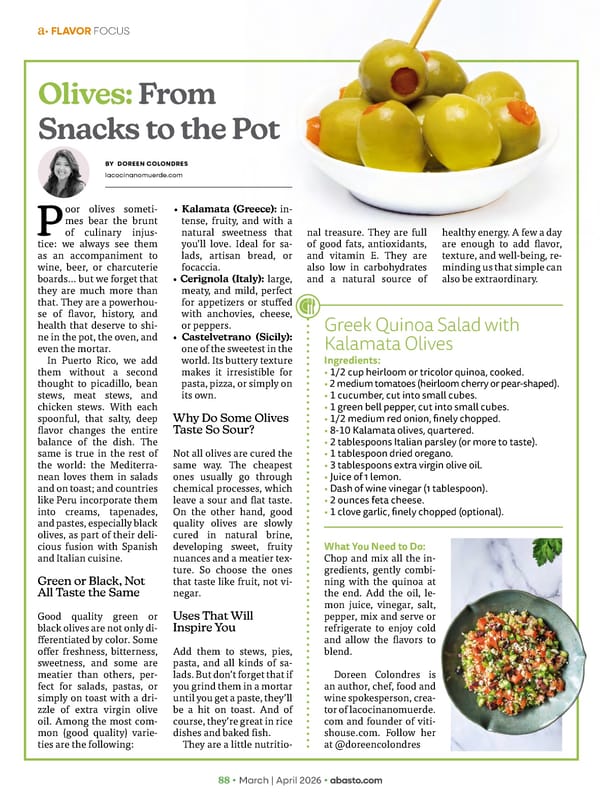
89 • March | April 2026 • abasto.com
90 • March | April 2026 • abasto.com Advertise here: (336) 483-5892 • sales@abasto.com NATURAL CHARCOAL/ FIREWOOD FOR GRILLING Private label available Call today! Excellent promotion. (956) 683-0453 100% MEXICAN DAIRY PRODUCTS With all quality certifications. Call today! The best deals. (956) 683-0453 ALOE VERA DRINKS Mango, pineapple, aloe, guava, strawberry, coconut, etc. We are looking for distributors. Call today! (908) 313-4861 LATIN PRODUCTS Find products from your country. The best deals. Call today! (949) 456-2697 MEXICAN SEASONINGS Chorizo, chipotle, carne asada. Call us today! The best deals. (800) 621-5422 SALT WITH SEASONING Seasoning for tacos, fine spices. The best prices! (404) 766-5334 FROZEN COVERINGS AND FILLINGS FOR DESSERTS Vanilla, chocolate, confectionery coverings. Call today! (800) 590-2575 VARIETY OF VELADORAS Religious, esoteric, tumblers, plain. Call today! Excellent promotion. (954) 627-4653 100% MEXICAN SWEETS Tamarind and watermelon with chili. We are looking for distributors! +52 55 55 02 5625 PREMIUM BANANA CHIPS Lemon chili, green sauce Great deals! (281) 657-5702 MEXICAN SAUCES AND SNACKS Black sauce, spicy sauce, habanero sauce, tortillas, nacho-style chips. We are looking for distributors! (210) 907-9415 CANDIED SPICY SWEETS Tamarind flavor. The best deals! (773) 847- 4333 SMOKED CHOP Excellent Mexican product, the best quality. We are looking for distributors. Call today! +52 378 121 43 61 MEXICAN SPICE S Tree chili, peanuts, Japanese chili. Excellent sale prices! (336) 495-5000 MEXICAN SWEETS AND SNACKS Tamarind burritos, churritos, fried snacks, etc. The best deals! Call today! (619) 271-0846 ENERGY DRINKS Blueberry, guarana, and red berries. Call us today! (800) 835 6190 Mexican Snacks Original and green salsa tortilla chips, palanqueta mix, pork rinds, salt and lemon corn chips. (832) 630-8494 CORN TORTILLAS Jalapeño flavor with beans and cheese. Cheese-flavored corn chips. (817)751-4675 Marketplace
91 • March | April 2026 • abasto.com

92 • March | April 2026 • abasto.com • INDUSTRIA ALIMENTOS