
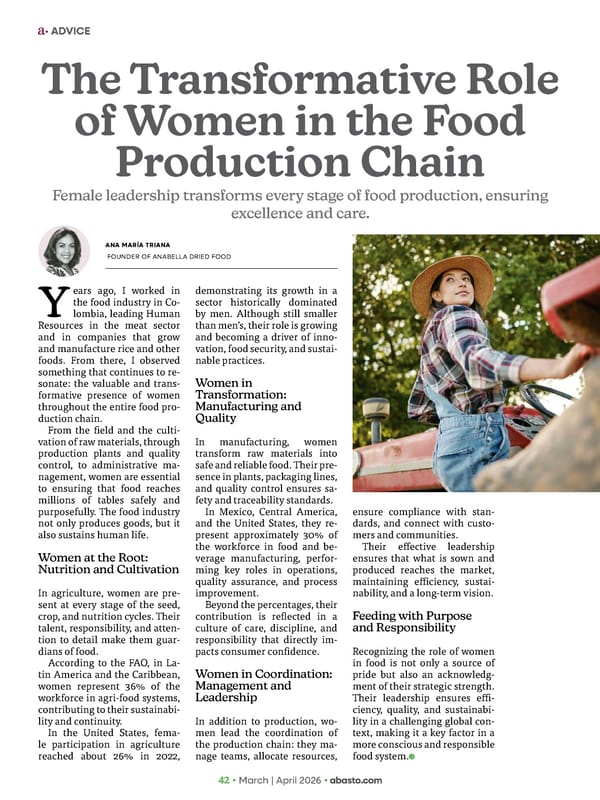
42 • March | April 2026 • abasto.com ANA MARÍA TRIANA FOUNDER OF ANABELLA DRIED FOOD The Transformative Role of Women in the Food Production Chain Y ears ago, I worked in the food industry in Co- lombia, leading Human Resources in the meat sector and in companies that grow and manufacture rice and other foods. From there, I observed something that continues to re- sonate: the valuable and trans- formative presence of women throughout the entire food pro- duction chain. From the field and the culti- vation of raw materials, through production plants and quality control, to administrative ma- nagement, women are essential to ensuring that food reaches millions of tables safely and purposefully. The food industry not only produces goods, but it also sustains human life. Women at the Root: Nutrition and Cultivation In agriculture, women are pre- sent at every stage of the seed, crop, and nutrition cycles. Their talent, responsibility, and atten- tion to detail make them guar- dians of food. According to the FAO, in La- tin America and the Caribbean, women represent 36% of the workforce in agri-food systems, contributing to their sustainabi- lity and continuity. In the United States, fema- le participation in agriculture reached about 26% in 2022, demonstrating its growth in a sector historically dominated by men. Although still smaller than men’s, their role is growing and becoming a driver of inno- vation, food security, and sustai- nable practices. Women in Transformation: Manufacturing and Quality In manufacturing, women transform raw materials into safe and reliable food. Their pre- sence in plants, packaging lines, and quality control ensures sa- fety and traceability standards. In Mexico, Central America, and the United States, they re- present approximately 30% of the workforce in food and be- verage manufacturing, perfor- ming key roles in operations, quality assurance, and process improvement. Beyond the percentages, their contribution is reflected in a culture of care, discipline, and responsibility that directly im- pacts consumer confidence. Women in Coordination: Management and Leadership In addition to production, wo- men lead the coordination of the production chain: they ma- nage teams, allocate resources, ensure compliance with stan- dards, and connect with custo- mers and communities. Their effective leadership ensures that what is sown and produced reaches the market, maintaining efficiency, sustai- nability, and a long-term vision. Feeding with Purpose and Responsibility Recognizing the role of women in food is not only a source of pride but also an acknowledg- ment of their strategic strength. Their leadership ensures effi- ciency, quality, and sustainabi- lity in a challenging global con- text, making it a key factor in a more conscious and responsible food system. Female leadership transforms every stage of food production, ensuring excellence and care. • ADVICE
 Abasto Magazine March / April 2026 ENGLISH Page 41 Page 43