
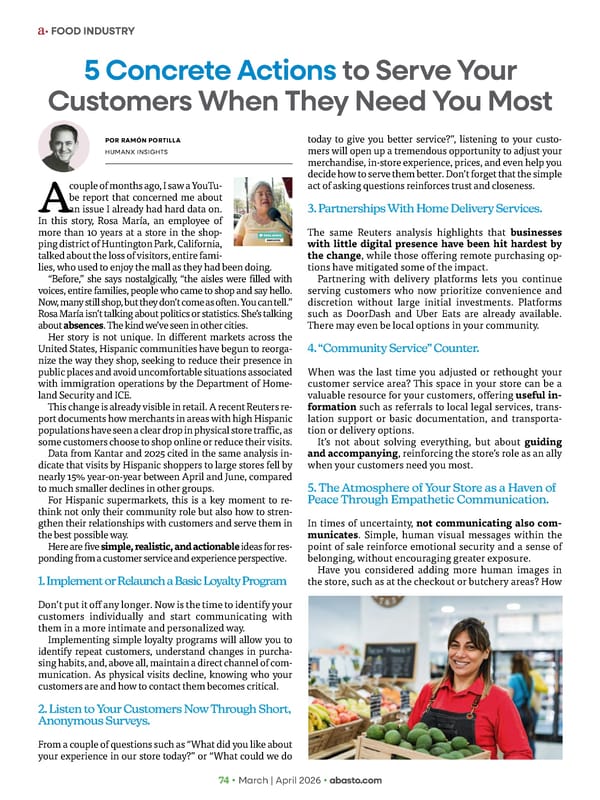
74 • March | April 2026 • abasto.com 5 Concrete Actions to Serve Your Customers When They Need You Most A couple of months ago, I saw a YouTu- be report that concerned me about an issue I already had hard data on. In this story, Rosa María, an employee of more than 10 years at a store in the shop- ping district of Huntington Park, California, talked about the loss of visitors, entire fami- lies, who used to enjoy the mall as they had been doing. “Before,” she says nostalgically, “the aisles were filled with voices, entire families, people who came to shop and say hello. Now, many still shop, but they don’t come as often. You can tell.” Rosa María isn’t talking about politics or statistics. She’s talking about absences . The kind we’ve seen in other cities. Her story is not unique. In different markets across the United States, Hispanic communities have begun to reorga- nize the way they shop, seeking to reduce their presence in public places and avoid uncomfortable situations associated with immigration operations by the Department of Home- land Security and ICE. This change is already visible in retail. A recent Reuters re- port documents how merchants in areas with high Hispanic populations have seen a clear drop in physical store traffic, as some customers choose to shop online or reduce their visits. Data from Kantar and 2025 cited in the same analysis in- dicate that visits by Hispanic shoppers to large stores fell by nearly 15% year-on-year between April and June, compared to much smaller declines in other groups. For Hispanic supermarkets, this is a key moment to re- think not only their community role but also how to stren- gthen their relationships with customers and serve them in the best possible way. Here are five simple, realistic, and actionable ideas for res- ponding from a customer service and experience perspective. 1. Implement or Relaunch a Basic Loyalty Program Don’t put it off any longer. Now is the time to identify your customers individually and start communicating with them in a more intimate and personalized way. Implementing simple loyalty programs will allow you to identify repeat customers, understand changes in purcha- sing habits, and, above all, maintain a direct channel of com- munication. As physical visits decline, knowing who your customers are and how to contact them becomes critical. 2. Listen to Your Customers Now Through Short, Anonymous Surveys. From a couple of questions such as “What did you like about your experience in our store today?” or “What could we do POR RAMÓN PORTILLA HUMANX INSIGHTS today to give you better service?”, listening to your custo- mers will open up a tremendous opportunity to adjust your merchandise, in-store experience, prices, and even help you decide how to serve them better. Don’t forget that the simple act of asking questions reinforces trust and closeness. 3. Partnerships With Home Delivery Services. The same Reuters analysis highlights that businesses with little digital presence have been hit hardest by the change , while those offering remote purchasing op- tions have mitigated some of the impact. Partnering with delivery platforms lets you continue serving customers who now prioritize convenience and discretion without large initial investments. Platforms such as DoorDash and Uber Eats are already available. There may even be local options in your community. 4. “Community Service” Counter. When was the last time you adjusted or rethought your customer service area? This space in your store can be a valuable resource for your customers, offering useful in- formation such as referrals to local legal services, trans- lation support or basic documentation, and transporta- tion or delivery options. It’s not about solving everything, but about guiding and accompanying , reinforcing the store’s role as an ally when your customers need you most. 5. The Atmosphere of Your Store as a Haven of Peace Through Empathetic Communication. In times of uncertainty, not communicating also com- municates . Simple, human visual messages within the point of sale reinforce emotional security and a sense of belonging, without encouraging greater exposure. Have you considered adding more human images in the store, such as at the checkout or butchery areas? How • FOOD INDUSTRY
 Abasto Magazine March / April 2026 ENGLISH Page 97 Page 99