
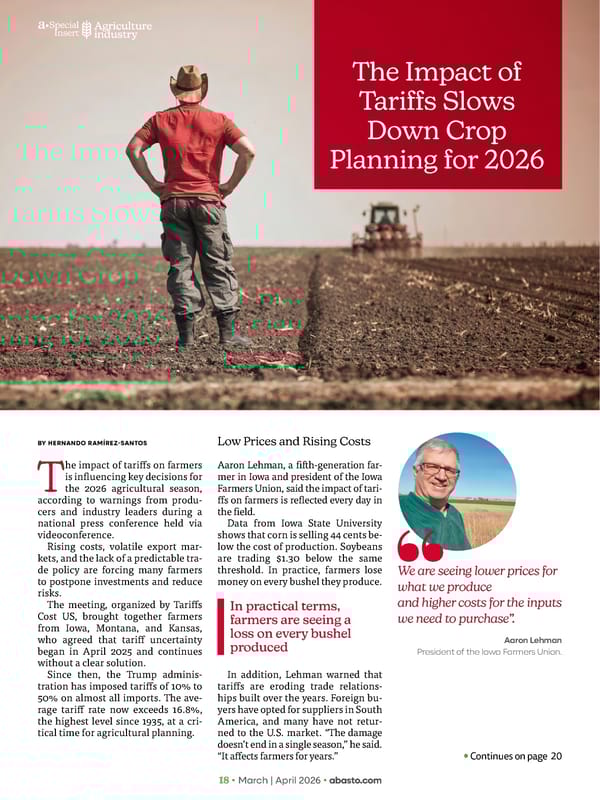
18 • March | April 2026 • abasto.com Suplemento especial Industria agrícola BY HERNANDO RAMÍREZ-SANTOS T he impact of tariffs on farmers is influencing key decisions for the 2026 agricultural season, according to warnings from produ- cers and industry leaders during a national press conference held via videoconference. Rising costs, volatile export mar- kets, and the lack of a predictable tra- de policy are forcing many farmers to postpone investments and reduce risks. The meeting, organized by Tariffs Cost US, brought together farmers from Iowa, Montana, and Kansas, who agreed that tariff uncertainty began in April 2025 and continues without a clear solution. Since then, the Trump adminis- tration has imposed tariffs of 10% to 50% on almost all imports. The ave- rage tariff rate now exceeds 16.8%, the highest level since 1935, at a cri- tical time for agricultural planning. Low Prices and Rising Costs Aaron Lehman, a fifth-generation far- mer in Iowa and president of the Iowa Farmers Union, said the impact of tari- ffs on farmers is reflected every day in the field. Data from Iowa State University shows that corn is selling 44 cents be- low the cost of production. Soybeans are trading $1.30 below the same threshold. In practice, farmers lose money on every bushel they produce. In practical terms, farmers are seeing a loss on every bushel produced In addition, Lehman warned that tariffs are eroding trade relations- hips built over the years. Foreign bu- yers have opted for suppliers in South America, and many have not retur- ned to the U.S. market. “The damage doesn’t end in a single season,” he said. “It affects farmers for years.” We are seeing lower prices for what we produce and higher costs for the inputs we need to purchase”. Aaron Lehman President of the Iowa Farmers Union. The Impact of Tariffs Slows Down Crop Planning for 2026 • Continues on page 20 Special Insert Agriculture industry
 Abasto Magazine March / April 2026 ENGLISH Page 67 Page 69