
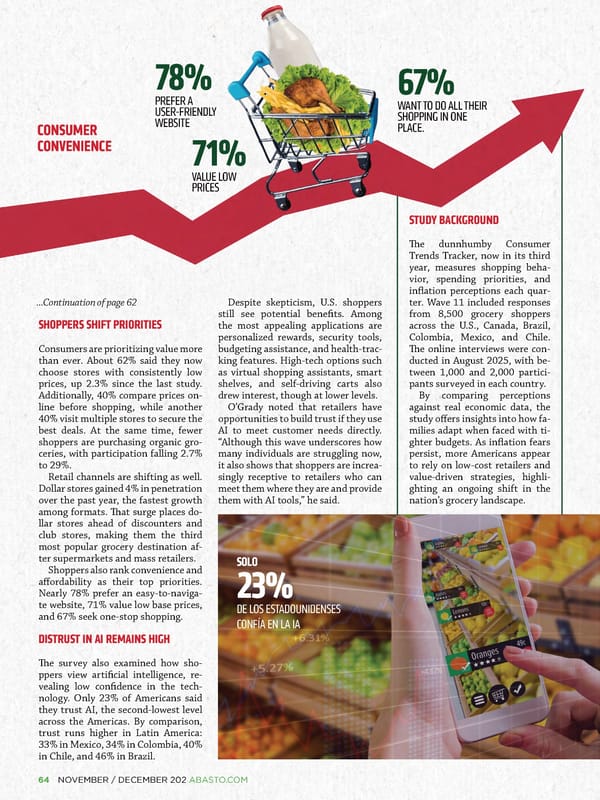
Despite skepticism, U.S. shoppers still see potential benefts. Among the most appealing applications are personalized rewards, security tools, budgeting assistance, and health-trac- king features. High-tech options such as virtual shopping assistants, smart shelves, and self-driving carts also drew interest, though at lower levels. O’Grady noted that retailers have opportunities to build trust if they use AI to meet customer needs directly. “Although this wave underscores how many individuals are struggling now, it also shows that shoppers are increa- singly receptive to retailers who can meet them where they are and provide them with AI tools,” he said. CONSUMER CONVENIENCE SHOPPERS SHIFT PRIORITIES Consumers are prioritizing value more than ever. About 62% said they now choose stores with consistently low prices, up 2.3% since the last study. Additionally, 40% compare prices on- line before shopping, while another 40% visit multiple stores to secure the best deals. At the same time, fewer shoppers are purchasing organic gro- ceries, with participation falling 2.7% to 29%. Retail channels are shifting as well. Dollar stores gained 4% in penetration over the past year, the fastest growth among formats. Tat surge places do- llar stores ahead of discounters and club stores, making them the third most popular grocery destination af- ter supermarkets and mass retailers. Shoppers also rank convenience and afordability as their top priorities. Nearly 78% prefer an easy-to-naviga- te website, 71% value low base prices, and 67% seek one-stop shopping. DISTRUST IN AI REMAINS HIGH Te survey also examined how sho- ppers view artifcial intelligence, re- vealing low confdence in the tech- nology. Only 23% of Americans said they trust AI, the second-lowest level across the Americas. By comparison, trust runs higher in Latin America: 33% in Mexico, 34% in Colombia, 40% in Chile, and 46% in Brazil. 78% PREFER A USER-FRIENDLY WEBSITE 71% VALUE LOW PRICES 67% WANT TO DO ALL THEIR SHOPPING IN ONE PLACE. STUDY BACKGROUND Te dunnhumby Consumer Trends Tracker, now in its third year, measures shopping beha- vior, spending priorities, and infation perceptions each quar- ter. Wave 11 included responses from 8,500 grocery shoppers across the U.S., Canada, Brazil, Colombia, Mexico, and Chile. Te online interviews were con- ducted in August 2025, with be- tween 1,000 and 2,000 partici- pants surveyed in each country. By comparing perceptions against real economic data, the study ofers insights into how fa- milies adapt when faced with ti- ghter budgets. As infation fears persist, more Americans appear to rely on low-cost retailers and value-driven strategies, highli- ghting an ongoing shift in the nation’s grocery landscape. ...Continuation of page 62 SOLO 23% DE LOS ESTADOUNIDENSES CONFÍA EN LA IA 64�NOVEMBER / DECEMBER 202 ABASTO.COM
 Abasto Magazine November/December 2025 ENGLISH Page 63 Page 65