
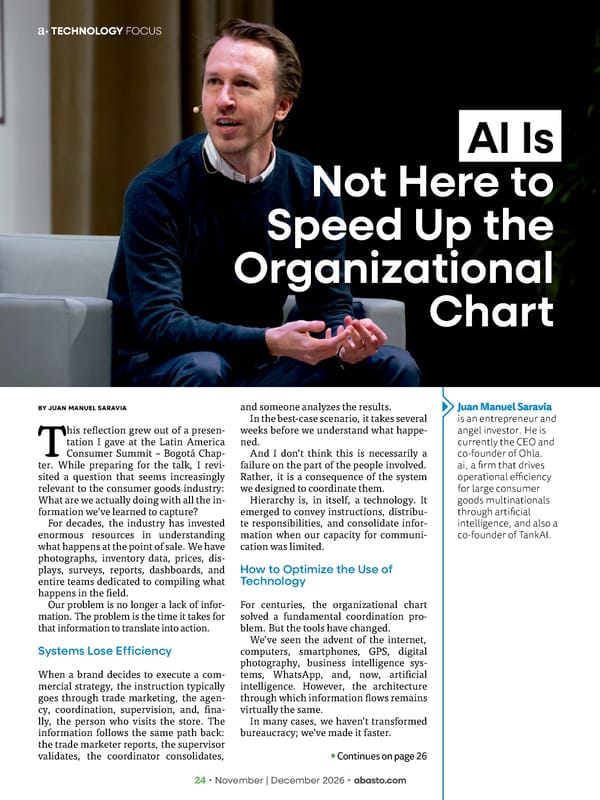
24 • November / December 2026• abasto.com BY JUAN MANUEL SARAVIA T his reflection grew out of a presen- tation I gave at the Latin America Consumer Summit – Bogotá Chap- ter. While preparing for the talk, I revi- sited a question that seems increasingly relevant to the consumer goods industry: What are we actually doing with all the in- formation we’ve learned to capture? For decades, the industry has invested enormous resources in understanding what happens at the point of sale. We have photographs, inventory data, prices, dis- plays, surveys, reports, dashboards, and entire teams dedicated to compiling what happens in the field. Our problem is no longer a lack of infor- mation. The problem is the time it takes for that information to translate into action. Systems Lose Efficiency When a brand decides to execute a com- mercial strategy, the instruction typically goes through trade marketing, the agen- cy, coordination, supervision, and, fina- lly, the person who visits the store. The information follows the same path back: the trade marketer reports, the supervisor validates, the coordinator consolidates, AI Is Not Here to Speed Up the Organizational Chart and someone analyzes the results. In the best-case scenario, it takes several weeks before we understand what happe- ned. And I don’t think this is necessarily a failure on the part of the people involved. Rather, it is a consequence of the system we designed to coordinate them. Hierarchy is, in itself, a technology. It emerged to convey instructions, distribu- te responsibilities, and consolidate infor- mation when our capacity for communi- cation was limited. How to Optimize the Use of Technology For centuries, the organizational chart solved a fundamental coordination pro- blem. But the tools have changed. We’ve seen the advent of the internet, computers, smartphones, GPS, digital photography, business intelligence sys- tems, WhatsApp, and, now, artificial intelligence. However, the architecture through which information flows remains virtually the same. In many cases, we haven’t transformed bureaucracy; we’ve made it faster. Juan Manuel Saravia is an entrepreneur and angel investor. He is currently the CEO and co-founder of Ohla. ai, a firm that drives operational efficiency for large consumer goods multinationals through artificial intelligence, and also a co-founder of TankAI. • Continues on page 26 • TECHNOLOGY FOCUS
 Abasto Magazine November | December 2026 ENGLISH Page 23 Page 25