Abasto Magazine November | December 2026 ENGLISH
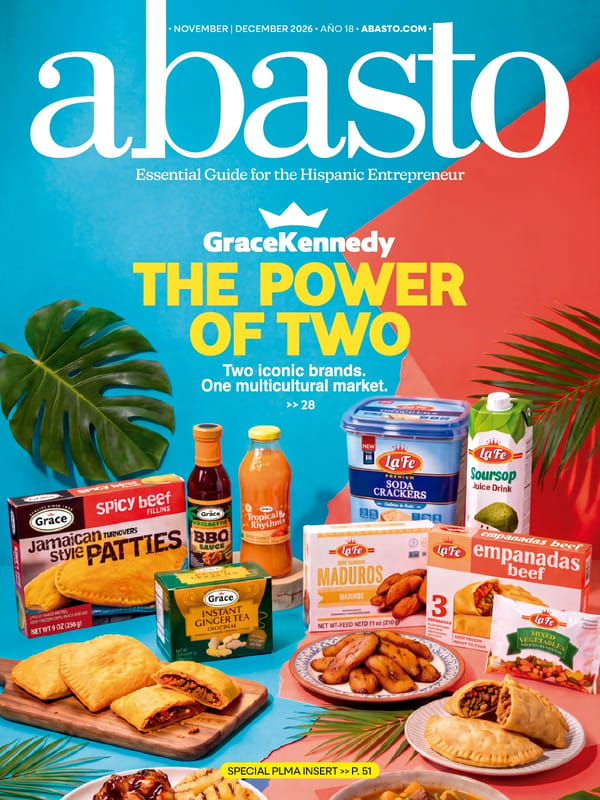
This issue of Abasto magazine highlights the collaboration between GraceKennedy and La Fe, showcasing a range of multicultural food products for Hispanic entrepreneurs.
>> 28 Essential Guide for the Hispanic Entrepreneur • NOVEMBER / DECEMBER 2026 • AÑO 18 • ABASTO.COM • SPECIAL PLMA INSERT >> P. 51
3• November / December 2026• abasto.com
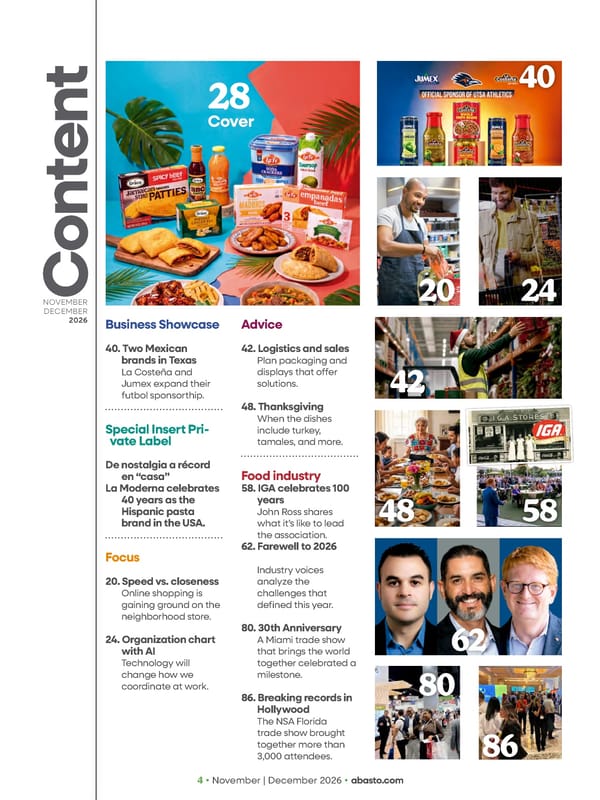
40 28 Cover Content 20 24 NOVEMBER DECEMBER 2026 Business Showcase Advice 40. Two Mexican 42. Logistics and sales brands in Texas Plan packaging and La Costeña and displays that offer Jumex expand their solutions. 42 futbol sponsorthip. 48. Thanksgiving When the dishes Special Insert Pri- include turkey, vate Label tamales, and more. De nostalgia a récord en “casa” Food industry La Moderna celebrates 58. IGA celebrates 100 40 years as the years Hispanic pasta John Ross shares 48 58 brand in the USA. what it’s like to lead the association. 62. Farewell to 2026 Focus Industry voices 20. Speed vs. closeness analyze the Online shopping is challenges that gaining ground on the defined this year. neighborhood store. 80. 30th Anniversary 24. Organization chart A Miami trade show 62 | with AI | that brings the world | | Technology will | together celebrated a | | change how we | milestone. | | coordinate at work. | 80 | | 86. Breaking records in | | Hollywood | | The NSA Florida trade show brought together more than | 86 | 3,000 attendees. 4• November / December 2026• abasto.com
5• November / December 2026• abasto.com
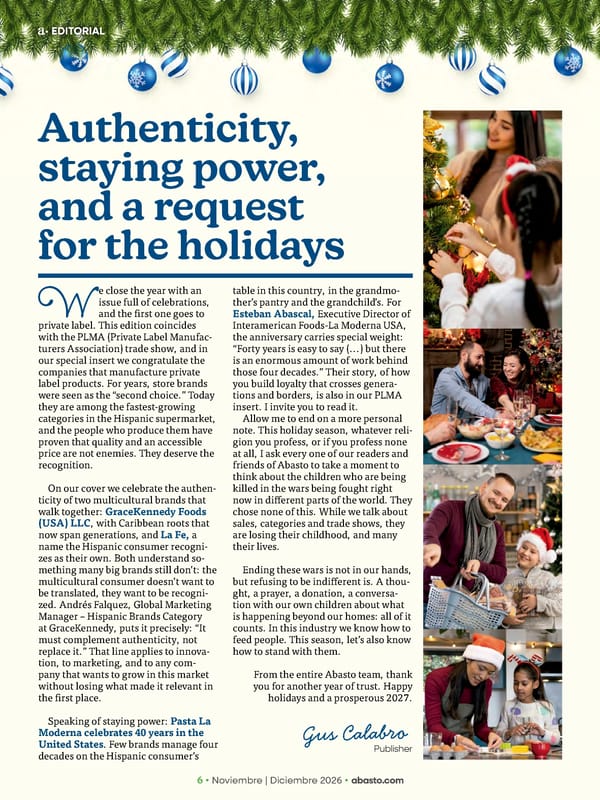
• EDITORIAL Authenticity, staying power, and a request for the holidays W e close the year with an issue full of celebrations, and the first one goes to private label. This edition coincides with the PLMA (Private Label Manufac- turers Association) trade show, and in our special insert we congratulate the companies that manufacture private label products. For years, store brands were seen as the “second choice.” Today they are among the fastest-growing categories in the Hispanic supermarket, and the people who produce them have proven that quality and an accessible price are not enemies. They deserve the recognition. On our cover we celebrate the authen- ticity of two multicultural brands that walk together: GraceKennedy Foods (USA) LLC, with Caribbean roots that now span generations, and La Fe, a name the Hispanic consumer recogni- zes as their own. Both understand so- mething many big brands still don’t: the multicultural consumer doesn’t want to be translated, they want to be recogni- zed. Andrés Falquez, Global Marketing Manager – Hispanic Brands Category at GraceKennedy, puts it precisely: “It must complement authenticity, not replace it.” That line applies to innova- tion, to marketing, and to any com- pany that wants to grow in this market without losing what made it relevant in the first place. Speaking of staying power: Pasta La Moderna celebrates 40 years in the United States. Few brands manage four decades on the Hispanic consumer’s table in this country, in the grandmo- ther’s pantry and the grandchild’s. For Esteban Abascal, Executive Director of Interamerican Foods-La Moderna USA, the anniversary carries special weight: “Forty years is easy to say (...) but there is an enormous amount of work behind those four decades.” Their story, of how you build loyalty that crosses genera- tions and borders, is also in our PLMA insert. I invite you to read it. Allow me to end on a more personal note. This holiday season, whatever reli- gion you profess, or if you profess none at all, I ask every one of our readers and friends of Abasto to take a moment to think about the children who are being killed in the wars being fought right now in different parts of the world. They chose none of this. While we talk about sales, categories and trade shows, they are losing their childhood, and many their lives. Ending these wars is not in our hands, but refusing to be indifferent is. A thou- ght, a prayer, a donation, a conversa- tion with our own children about what is happening beyond our homes: all of it counts. In this industry we know how to feed people. This season, let’s also know how to stand with them. From the entire Abasto team, thank you for another year of trust. Happy holidays and a prosperous 2027. Publisher 6• Noviembre / Diciembre 2026 •abasto.com
7• November / December 2026• abasto.com
8• November / December 2026• abasto.com Abasto es una revista bimestral de circulación nacional publicada por Hispanic Marketing Consultants, Inc. P.O. Box 20577 Winston-Salem, NC 27101. Todos los derechos reservados. Prohibida la reproducción parcial o total de su contenido sin previa autorización del Editor. Abasto investiga la seriedad de sus anunciantes, pero no se hace responsable del contenido de las ofer- tas. Las opiniones expresadas por los autores y contribuyentes que colaboran en esta revista no son necesariamente compartidas por los editores o representantes de HMC (Hispanic Marketing Consultants) Abasto Media. Abastomedia abasto Abastomagazine Abastomedia Abasto / Food & Beverage Business News abasto Abastomagazine Abasto / Food & Beverage Business News Publisher Gustavo Calabro gcalabro@abasto.com 336.724.9718 x.204 Diseño Gráfico / Graphic Design Orlando Rivera orlando.rivera@abasto.com 336.724.9718 Departamento Editorial / Editorial Department Hernando Ramírez-Santos hramirezsantos@abasto.com 336.724.9718 x.201 Violeta Montes de Oca vmontesdeoca@abasto.com 336.724.9718 x.203 Cuentas Nacionales / National Accounts Eliana Lankerd elankerd@abasto.com 336.724.9718 x.202 Ventas México-Latam / Sales Representative LATAM Marcela Cháves dianac@abasto.com 336.724.9718 x.206 Xóchitl Oliva xoliva@abasto.com 713.363.0385 Juan Pablo Madero jpmadero@abasto.com 52.1.333.167. 8502 Inteligencia Empresarial / Business Intelligence Luke Ostertag luke.osterag@abasto.com Administración & Eventos / Administration & Events Fernanda P. Walker fernanda.pineros@abasto.com 336.724.9718 x.213 Redes Sociales / Social Media Danna Guevara dannag@abasto.com Publicidad / Advertising advertising@abasto.com / 336.486.2424 Suscripciones / Subscriptions info@abasto.com • Ana María Triana Psychologist & Business Consultant. She is Marketing Director of AnaBella Dried Food. • Ramón Portilla Founder HumanX Insights. Visionary leader in customer insights. Passionate about CX. Innovator in Insights technology • Julio Ibáñez International Retail Executive and Advisor and President of the Hispanic Retail Chamber of Commerce • Diana Leza Sheehan Founder of PDG Insights with over 25 years of experience, she helps brands and retailers make strategic decisions using data. • Doreen Colondres. Latina chef, tireless traveler, graduate and certified in gastronomy and wines, and owner of the Vitis House school. • Ken Ninomiya Omnichannel marketing and e-commerce ex- pert. Award-winning marketing professional, professor, author, and strategist. • Ricardo Gaitán Branding specialist. Master in Marketing Mana- gement Universidad San Plablo. Author of the book: “101 useful branding tips” • Ron Margulis Director de RAM Communications, LLC. He is a journa- list specializing in the food industry. • Mary Coppola Heslep Creative Director at Ten Acre Marketing. She was Vice President of Marketing at the United Fresh Produce Association. Collaborators

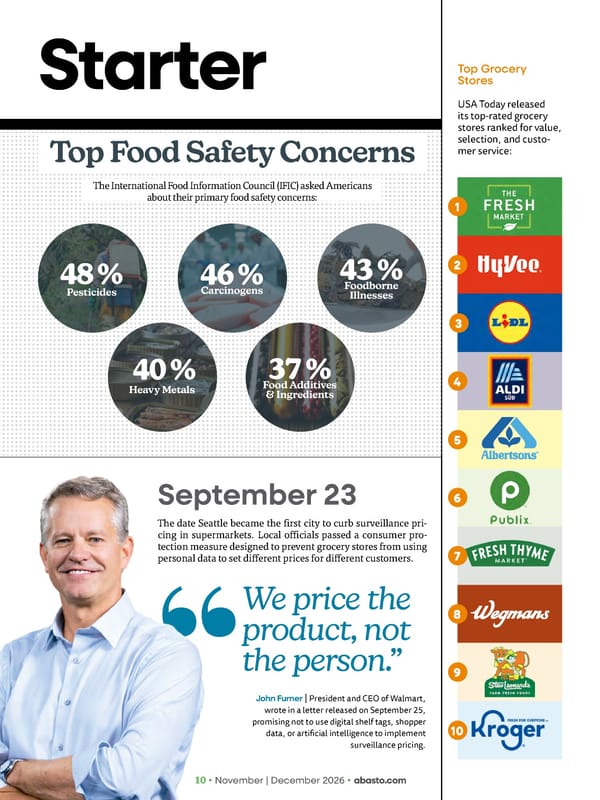
Starter Top Grocery Stores USA Today released its top-rated grocery stores ranked for value, selection, and custo- Top Food Safety Concerns mer service: The International Food Information Council (IFIC) asked Americans about their primary food safety concerns: 1 43 % 2 48 % 46 % Pesticides Carcinogens Foodborne Illnesses 3 40 % 37 % Food Additives 4 | Heavy Metals | & Ingredients | | 5 | | September 23 | 6 | | The date Seattle became the first city to curb surveillance pri- cing in supermarkets. Local officials passed a consumer pro- tection measure designed to prevent grocery stores from using personal data to set different prices for different customers. | 7 | We price the 8 product, not the person.” 9 John Furner / President and CEO of Walmart, wrote in a letter released on September 25, promising not to use digital shelf tags, shopper data, or artificial intelligence to implement 10 surveillance pricing. 10 • November / December 2026• abasto.com
11 • November / December 2026• abasto.com
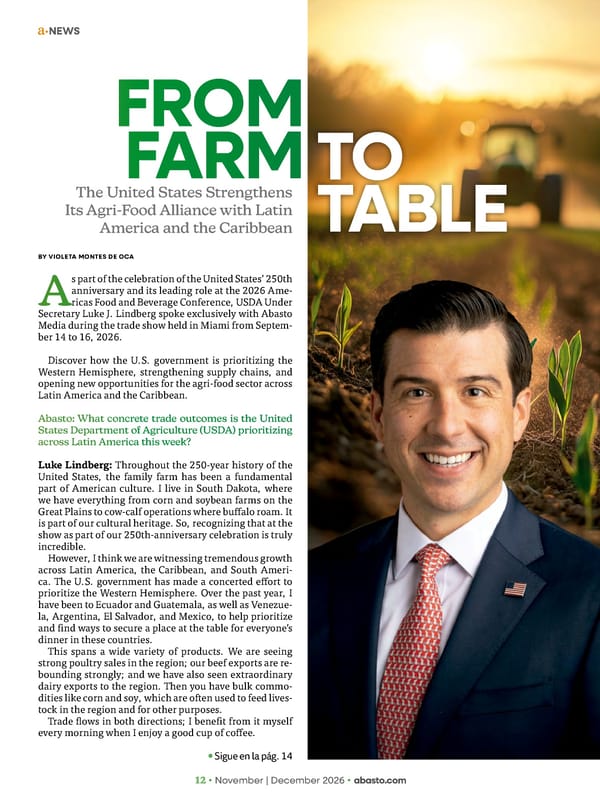
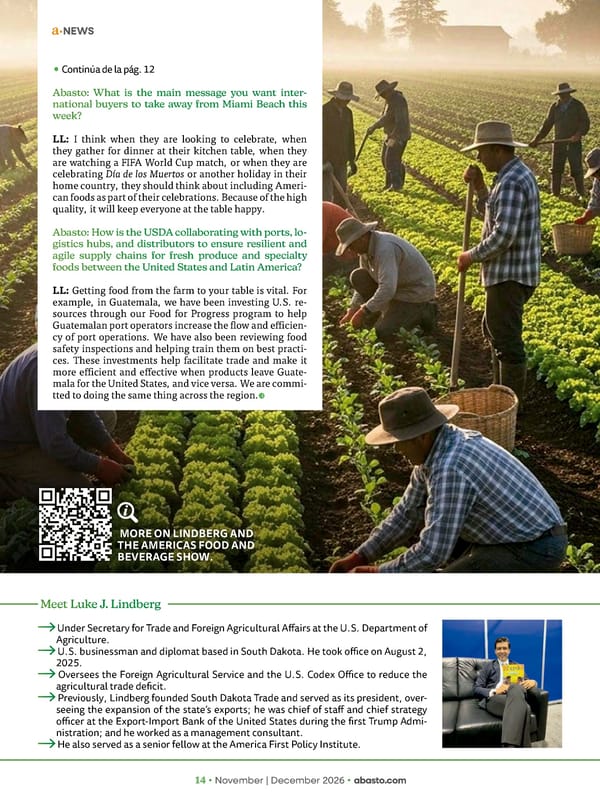
12 • November / December 2026• abasto.com •NEWS BY VIOLETA MONTES DE OCA A s part of the celebration of the United States’ 250th anniversary and its leading role at the 2026 Ame- ricas Food and Beverage Conference, USDA Under Secretary Luke J. Lindberg spoke exclusively with Abasto Media during the trade show held in Miami from Septem- ber 14 to 16, 2026. Discover how the U.S. government is prioritizing the Western Hemisphere, strengthening supply chains, and opening new opportunities for the agri-food sector across Latin America and the Caribbean. Abasto: What concrete trade outcomes is the United States Department of Agriculture (USDA) prioritizing across Latin America this week? Luke Lindberg: Throughout the 250-year history of the United States, the family farm has been a fundamental part of American culture. I live in South Dakota, where we have everything from corn and soybean farms on the Great Plains to cow-calf operations where buffalo roam. It is part of our cultural heritage. So, recognizing that at the show as part of our 250th-anniversary celebration is truly incredible. However, I think we are witnessing tremendous growth across Latin America, the Caribbean, and South Ameri- ca. The U.S. government has made a concerted effort to prioritize the Western Hemisphere. Over the past year, I have been to Ecuador and Guatemala, as well as Venezue- la, Argentina, El Salvador, and Mexico, to help prioritize and find ways to secure a place at the table for everyone’s dinner in these countries. This spans a wide variety of products. We are seeing strong poultry sales in the region; our beef exports are re- bounding strongly; and we have also seen extraordinary dairy exports to the region. Then you have bulk commo- dities like corn and soy, which are often used to feed lives- tock in the region and for other purposes. Trade flows in both directions; I benefit from it myself every morning when I enjoy a good cup of coffee. The United States Strengthens Its Agri-Food Alliance with Latin America and the Caribbean FROM FARM TO TABLE • Sigue en la pág. 14
13 • November / December 2026• abasto.com
14 • November / December 2026• abasto.com •NEWS Abasto: What is the main message you want inter- national buyers to take away from Miami Beach this week? LL: I think when they are looking to celebrate, when they gather for dinner at their kitchen table, when they are watching a FIFA World Cup match, or when they are celebrating Día de los Muertos or another holiday in their home country, they should think about including Ameri- can foods as part of their celebrations. Because of the high quality, it will keep everyone at the table happy. Abasto: How is the USDA collaborating with ports, lo- gistics hubs, and distributors to ensure resilient and agile supply chains for fresh produce and specialty foods between the United States and Latin America? LL: Getting food from the farm to your table is vital. For example, in Guatemala, we have been investing U.S. re- sources through our Food for Progress program to help Guatemalan port operators increase the flow and efficien- cy of port operations. We have also been reviewing food safety inspections and helping train them on best practi- ces. These investments help facilitate trade and make it more efficient and effective when products leave Guate- mala for the United States, and vice versa. We are commi- tted to doing the same thing across the region. Under Secretary for Trade and Foreign Agricultural Affairs at the U.S. Department of Agriculture. U.S. businessman and diplomat based in South Dakota. He took office on August 2, 2025. Oversees the Foreign Agricultural Service and the U.S. Codex Office to reduce the agricultural trade deficit. Previously, Lindberg founded South Dakota Trade and served as its president, over- seeing the expansion of the state’s exports; he was chief of staff and chief strategy officer at the Export-Import Bank of the United States during the first Trump Admi- nistration; and he worked as a management consultant. He also served as a senior fellow at the America First Policy Institute. • Continúa de la pág. 12 Meet Luke J. Lindberg MORE ON LINDBERG AND THE AMERICAS FOOD AND BEVERAGE SHOW.
15 • November / December 2026• abasto.com
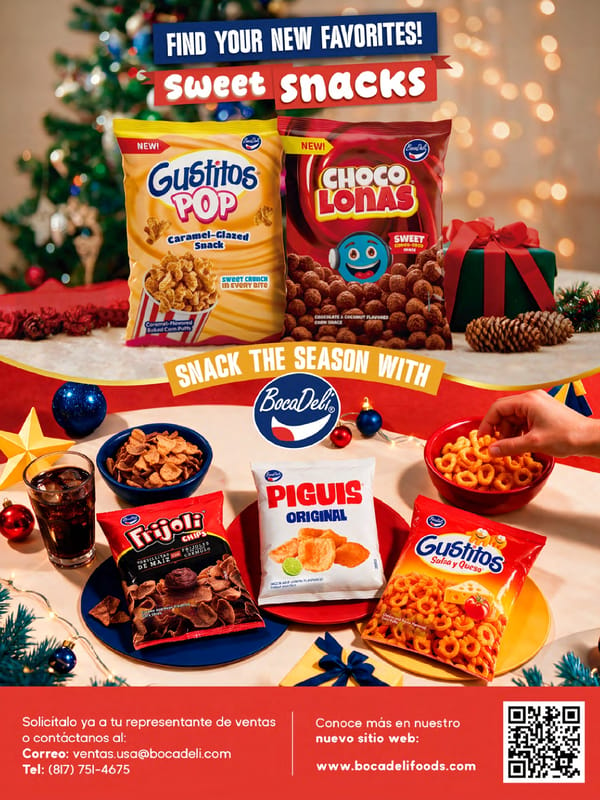
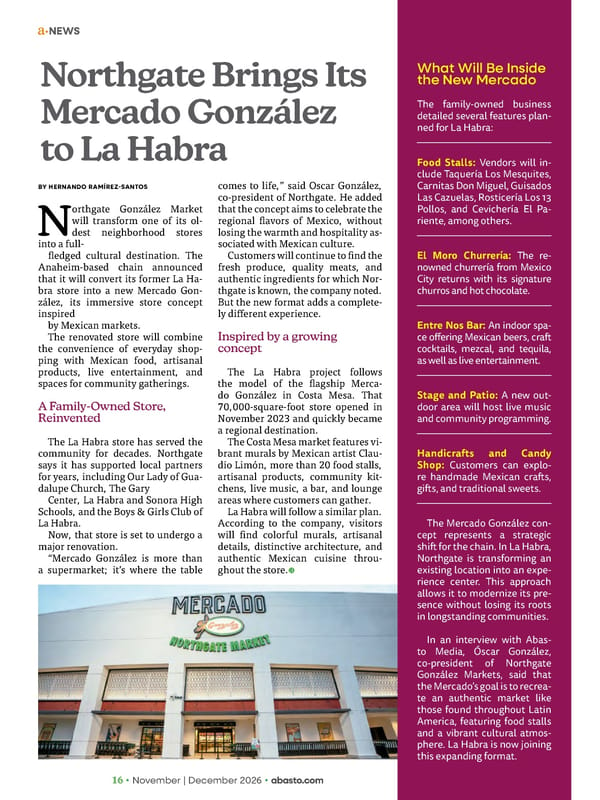
16 • November / December 2026• abasto.com •NEWS BY HERNANDO RAMÍREZ-SANTOS N orthgate González Market will transform one of its ol- dest neighborhood stores into a full- fledged cultural destination. The Anaheim-based chain announced that it will convert its former La Ha- bra store into a new Mercado Gon- zález, its immersive store concept inspired by Mexican markets. The renovated store will combine the convenience of everyday shop- ping with Mexican food, artisanal products, live entertainment, and spaces for community gatherings. A Family-Owned Store, Reinvented The La Habra store has served the community for decades. Northgate says it has supported local partners for years, including Our Lady of Gua- dalupe Church, The Gary Center, La Habra and Sonora High Schools, and the Boys & Girls Club of La Habra. Now, that store is set to undergo a major renovation. “Mercado González is more than a supermarket; it’s where the table comes to life,” said Oscar González, co-president of Northgate. He added that the concept aims to celebrate the regional flavors of Mexico, without losing the warmth and hospitality as- sociated with Mexican culture. Customers will continue to find the fresh produce, quality meats, and authentic ingredients for which Nor- thgate is known, the company noted. But the new format adds a complete- ly different experience. Inspired by a growing concept The La Habra project follows the model of the flagship Merca- do González in Costa Mesa. That 70,000-square-foot store opened in November 2023 and quickly became a regional destination. The Costa Mesa market features vi- brant murals by Mexican artist Clau- dio Limón, more than 20 food stalls, artisanal products, community kit- chens, live music, a bar, and lounge areas where customers can gather. La Habra will follow a similar plan. According to the company, visitors will find colorful murals, artisanal details, distinctive architecture, and authentic Mexican cuisine throu- ghout the store. Northgate Brings Its Mercado González to La Habra What Will Be Inside the New Mercado The family-owned business detailed several features plan- ned for La Habra: Food Stalls: Vendors will in- clude Taquería Los Mesquites, Carnitas Don Miguel, Guisados Las Cazuelas, Rosticería Los 13 Pollos, and Cevichería El Pa- riente, among others. El Moro Churrería: The re- nowned churrería from Mexico City returns with its signature churros and hot chocolate. Entre Nos Bar: An indoor spa- ce offering Mexican beers, craft cocktails, mezcal, and tequila, as well as live entertainment. Stage and Patio: A new out- door area will host live music and community programming. Handicrafts and Candy Shop: Customers can explo- re handmade Mexican crafts, gifts, and traditional sweets. The Mercado González con- cept represents a strategic shift for the chain. In La Habra, Northgate is transforming an existing location into an expe- rience center. This approach allows it to modernize its pre- sence without losing its roots in longstanding communities. In an interview with Abas- to Media, Óscar González, co-president of Northgate González Markets, said that the Mercado’s goal is to recrea- te an authentic market like those found throughout Latin America, featuring food stalls and a vibrant cultural atmos- phere. La Habra is now joining this expanding format.
17 • November / December 2026• abasto.com
18 • November / December 2026• abasto.com

19 • November / December 2026• abasto.com
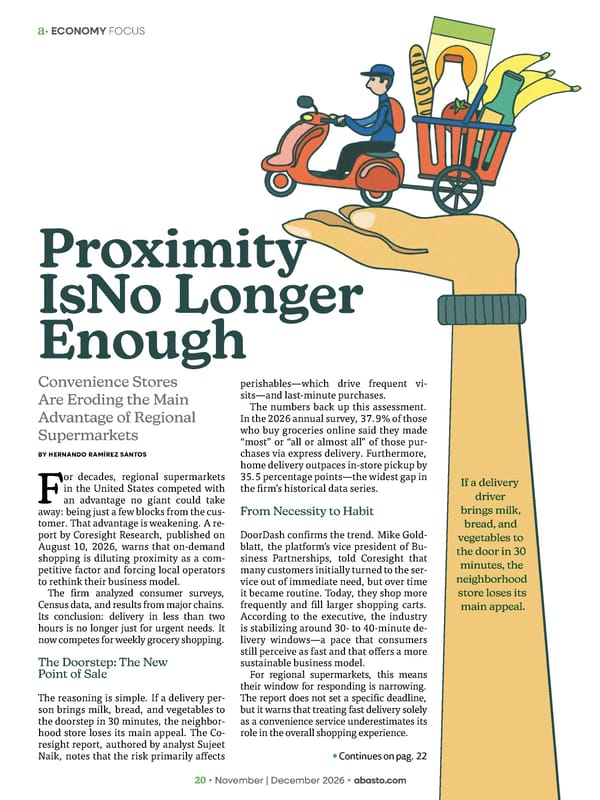
20 • November / December 2026• abasto.com • ECONOMY FOCUS Proximity IsNo Longer Enough Convenience Stores Are Eroding the Main Advantage of Regional Supermarkets BY HERNANDO RAMÍREZ SANTOS F or decades, regional supermarkets in the United States competed with an advantage no giant could take away: being just a few blocks from the cus- tomer. That advantage is weakening. A re- port by Coresight Research, published on August 10, 2026, warns that on-demand shopping is diluting proximity as a com- petitive factor and forcing local operators to rethink their business model. The firm analyzed consumer surveys, Census data, and results from major chains. Its conclusion: delivery in less than two hours is no longer just for urgent needs. It now competes for weekly grocery shopping. The Doorstep: The New Point of Sale The reasoning is simple. If a delivery per- son brings milk, bread, and vegetables to the doorstep in 30 minutes, the neighbor- hood store loses its main appeal. The Co- resight report, authored by analyst Sujeet Naik, notes that the risk primarily affects perishables—which drive frequent vi- sits—and last-minute purchases. The numbers back up this assessment. In the 2026 annual survey, 37.9% of those who buy groceries online said they made “most” or “all or almost all” of those pur- chases via express delivery. Furthermore, home delivery outpaces in-store pickup by 35.5 percentage points—the widest gap in the firm’s historical data series. From Necessity to Habit DoorDash confirms the trend. Mike Gold- blatt, the platform’s vice president of Bu- siness Partnerships, told Coresight that many customers initially turned to the ser- vice out of immediate need, but over time it became routine. Today, they shop more frequently and fill larger shopping carts. According to the executive, the industry is stabilizing around 30- to 40-minute de- livery windows—a pace that consumers still perceive as fast and that offers a more sustainable business model. For regional supermarkets, this means their window for responding is narrowing. The report does not set a specific deadline, but it warns that treating fast delivery solely as a convenience service underestimates its role in the overall shopping experience. If a delivery driver brings milk, bread, and vegetables to the door in 30 minutes, the neighborhood store loses its main appeal. • Continues on pag. 22
21 • November / December 2026• abasto.com
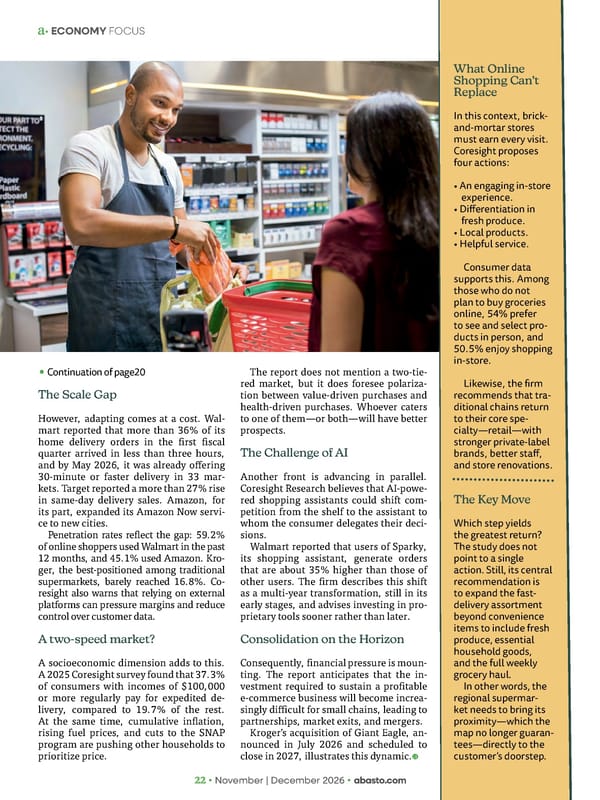
22 • November / December 2026• abasto.com • Continuation of page20 • ECONOMY FOCUS The Scale Gap However, adapting comes at a cost. Wal- mart reported that more than 36% of its home delivery orders in the first fiscal quarter arrived in less than three hours, and by May 2026, it was already offering 30-minute or faster delivery in 33 mar- kets. Target reported a more than 27% rise in same-day delivery sales. Amazon, for its part, expanded its Amazon Now servi- ce to new cities. Penetration rates reflect the gap: 59.2% of online shoppers used Walmart in the past 12 months, and 45.1% used Amazon. Kro- ger, the best-positioned among traditional supermarkets, barely reached 16.8%. Co- resight also warns that relying on external platforms can pressure margins and reduce control over customer data. A two-speed market? A socioeconomic dimension adds to this. A 2025 Coresight survey found that 37.3% of consumers with incomes of $100,000 or more regularly pay for expedited de- livery, compared to 19.7% of the rest. At the same time, cumulative inflation, rising fuel prices, and cuts to the SNAP program are pushing other households to prioritize price. What Online Shopping Can’t Replace In this context, brick- and-mortar stores must earn every visit. Coresight proposes four actions: • An engaging in-store experience. • Differentiation in fresh produce. • Local products. • Helpful service. Consumer data supports this. Among those who do not plan to buy groceries online, 54% prefer to see and select pro- ducts in person, and 50.5% enjoy shopping in-store. Likewise, the firm recommends that tra- ditional chains return to their core spe- cialty—retail—with stronger private-label brands, better staff, and store renovations. The Key Move Which step yields the greatest return? The study does not point to a single action. Still, its central recommendation is to expand the fast- delivery assortment beyond convenience items to include fresh produce, essential household goods, and the full weekly grocery haul. In other words, the regional supermar- ket needs to bring its proximity—which the map no longer guaran- tees—directly to the customer’s doorstep. The report does not mention a two-tie- red market, but it does foresee polariza- tion between value-driven purchases and health-driven purchases. Whoever caters to one of them—or both—will have better prospects. The Challenge of AI Another front is advancing in parallel. Coresight Research believes that AI-powe- red shopping assistants could shift com- petition from the shelf to the assistant to whom the consumer delegates their deci- sions. Walmart reported that users of Sparky, its shopping assistant, generate orders that are about 35% higher than those of other users. The firm describes this shift as a multi-year transformation, still in its early stages, and advises investing in pro- prietary tools sooner rather than later. Consolidation on the Horizon Consequently, financial pressure is moun- ting. The report anticipates that the in- vestment required to sustain a profitable e-commerce business will become increa- singly difficult for small chains, leading to partnerships, market exits, and mergers. Kroger’s acquisition of Giant Eagle, an- nounced in July 2026 and scheduled to close in 2027, illustrates this dynamic.
23 • November / December 2026• abasto.com
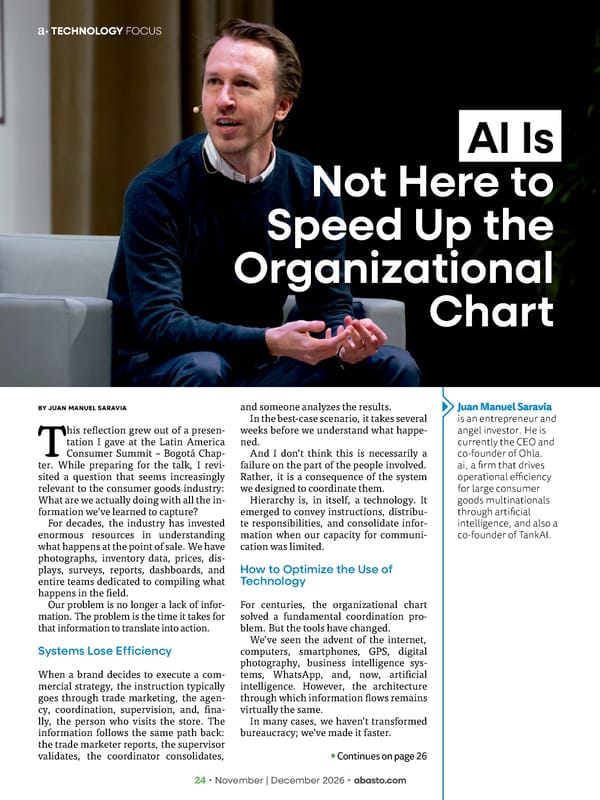
24 • November / December 2026• abasto.com BY JUAN MANUEL SARAVIA T his reflection grew out of a presen- tation I gave at the Latin America Consumer Summit – Bogotá Chap- ter. While preparing for the talk, I revi- sited a question that seems increasingly relevant to the consumer goods industry: What are we actually doing with all the in- formation we’ve learned to capture? For decades, the industry has invested enormous resources in understanding what happens at the point of sale. We have photographs, inventory data, prices, dis- plays, surveys, reports, dashboards, and entire teams dedicated to compiling what happens in the field. Our problem is no longer a lack of infor- mation. The problem is the time it takes for that information to translate into action. Systems Lose Efficiency When a brand decides to execute a com- mercial strategy, the instruction typically goes through trade marketing, the agen- cy, coordination, supervision, and, fina- lly, the person who visits the store. The information follows the same path back: the trade marketer reports, the supervisor validates, the coordinator consolidates, AI Is Not Here to Speed Up the Organizational Chart and someone analyzes the results. In the best-case scenario, it takes several weeks before we understand what happe- ned. And I don’t think this is necessarily a failure on the part of the people involved. Rather, it is a consequence of the system we designed to coordinate them. Hierarchy is, in itself, a technology. It emerged to convey instructions, distribu- te responsibilities, and consolidate infor- mation when our capacity for communi- cation was limited. How to Optimize the Use of Technology For centuries, the organizational chart solved a fundamental coordination pro- blem. But the tools have changed. We’ve seen the advent of the internet, computers, smartphones, GPS, digital photography, business intelligence sys- tems, WhatsApp, and, now, artificial intelligence. However, the architecture through which information flows remains virtually the same. In many cases, we haven’t transformed bureaucracy; we’ve made it faster. Juan Manuel Saravia is an entrepreneur and angel investor. He is currently the CEO and co-founder of Ohla. ai, a firm that drives operational efficiency for large consumer goods multinationals through artificial intelligence, and also a co-founder of TankAI. • Continues on page 26 • TECHNOLOGY FOCUS
25 • November / December 2026• abasto.com
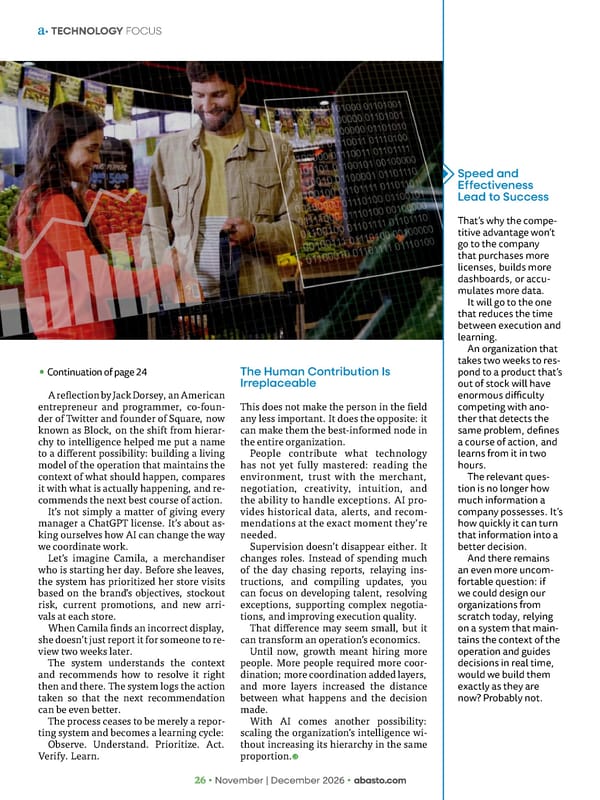
26 • November / December 2026• abasto.com A reflection by Jack Dorsey, an American entrepreneur and programmer, co-foun- der of Twitter and founder of Square, now known as Block, on the shift from hierar- chy to intelligence helped me put a name to a different possibility: building a living model of the operation that maintains the context of what should happen, compares it with what is actually happening, and re- commends the next best course of action. It’s not simply a matter of giving every manager a ChatGPT license. It’s about as- king ourselves how AI can change the way we coordinate work. Let’s imagine Camila, a merchandiser who is starting her day. Before she leaves, the system has prioritized her store visits based on the brand’s objectives, stockout risk, current promotions, and new arri- vals at each store. When Camila finds an incorrect display, she doesn’t just report it for someone to re- view two weeks later. The system understands the context and recommends how to resolve it right then and there. The system logs the action taken so that the next recommendation can be even better. The process ceases to be merely a repor- ting system and becomes a learning cycle: Observe. Understand. Prioritize. Act. Verify. Learn. The Human Contribution Is Irreplaceable This does not make the person in the field any less important. It does the opposite: it can make them the best-informed node in the entire organization. People contribute what technology has not yet fully mastered: reading the environment, trust with the merchant, negotiation, creativity, intuition, and the ability to handle exceptions. AI pro- vides historical data, alerts, and recom- mendations at the exact moment they’re needed. Supervision doesn’t disappear either. It changes roles. Instead of spending much of the day chasing reports, relaying ins- tructions, and compiling updates, you can focus on developing talent, resolving exceptions, supporting complex negotia- tions, and improving execution quality. That difference may seem small, but it can transform an operation’s economics. Until now, growth meant hiring more people. More people required more coor- dination; more coordination added layers, and more layers increased the distance between what happens and the decision made. With AI comes another possibility: scaling the organization’s intelligence wi- thout increasing its hierarchy in the same proportion. Speed and Effectiveness Lead to Success That’s why the compe- titive advantage won’t go to the company that purchases more licenses, builds more dashboards, or accu- mulates more data. It will go to the one that reduces the time between execution and learning. An organization that takes two weeks to res- pond to a product that’s out of stock will have enormous difficulty competing with ano- ther that detects the same problem, defines a course of action, and learns from it in two hours. The relevant ques- tion is no longer how much information a company possesses. It’s how quickly it can turn that information into a better decision. And there remains an even more uncom- fortable question: if we could design our organizations from scratch today, relying on a system that main- tains the context of the operation and guides decisions in real time, would we build them exactly as they are now? Probably not. • Continuation of page 24 • TECHNOLOGY FOCUS
27 • November / December 2026• abasto.com
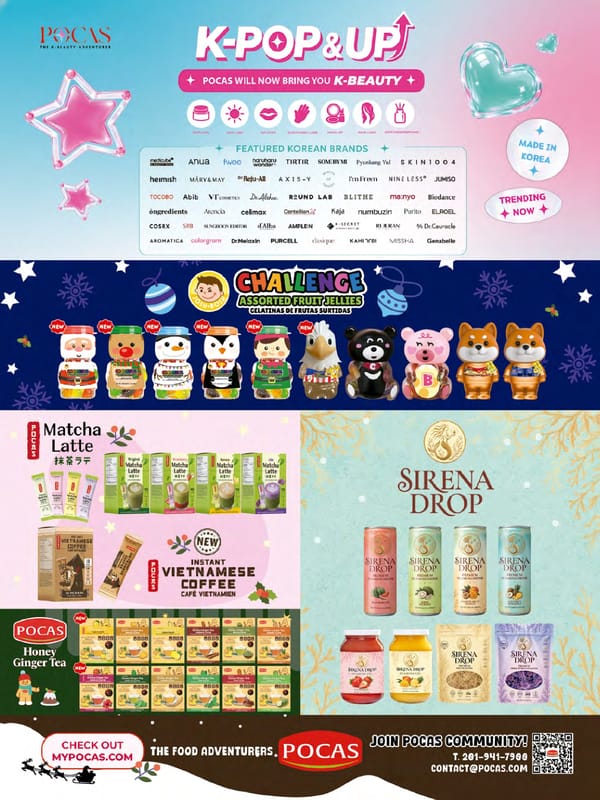
TWO ICONIC BRANDS. ONE MULTICULTURAL AMERICA BY HERNANDO RAMÍREZ-SANTOS O ne brand was born in Ja- maica in 1922. The other has been a staple in His- panic kitchens across the United States for more than half a century. Today, Grace and La Fe sha- re a parent company and a common purpose: to bring authentic flavors to an increasingly diverse consumer base. GraceKennedy Foods (USA) LLC, a subsidiary of the Jamaica-based GraceKennedy Group, acquired La Fe Foods in 2014. Since then, it has added distribution centers in New Jersey, Florida, and Georgia. For the company, “The Power of Two” encapsulates this union. It re- presents the strength of two iconic brands with distinct cultural iden- tities, united by a shared vision of growth in the U.S. multicultural food market. Grace brings its Caribbean herita- ge and distinctive flavors. La Fe, for its part, adds its connection to Hispa- nic households and a broad portfolio of everyday products. Together, they are carving out a space in traditio- nal, multicultural, and mass-market channels. “Our strategy is not to change what makes each brand unique, but to le- verage their individual strengths to build a more relevant, accessible, and competitive portfolio,” said An- drés Falquez, Global Marketing Ma- nager – Hispanic Brands Category at GraceKennedy Foods. AUTHENTICITY AS A COMPETITIVE ADVANTAGE According to Falquez, food connects consumers to their roots and cultural identity. At the same time, younger generations maintain those ties whi- le exploring other cuisines and lifes- tyles. Cultural heritage creates an emo- tional connection and serves as a competitive advantage. That’s why innovation follows a simple rule: “It must complement authenticity, not replace it.” GraceKennedy Foods aims to esta- blish itself as “a trusted and relevant leader in the U.S. multicultural food market.” Andrés Falquez is Global Marketing Manager – Hispanic Brands Category at GraceKennedy Foods. He leads brand strategy, innovation, and business development. He has more than 20 years of experience in Latin America and the United States. He joined GraceKennedy in 2018. 28 • November / December 2026• abasto.com Our multicultural vision is rooted in authenticity. By honoring the heritage of Grace and La Fe and driving innovation, we bring trusted flavors to new generations and create meaningful connections in an ever-evolving market.” Andrés Falquez Grace and La Fe: Two Legacies, One Strategy
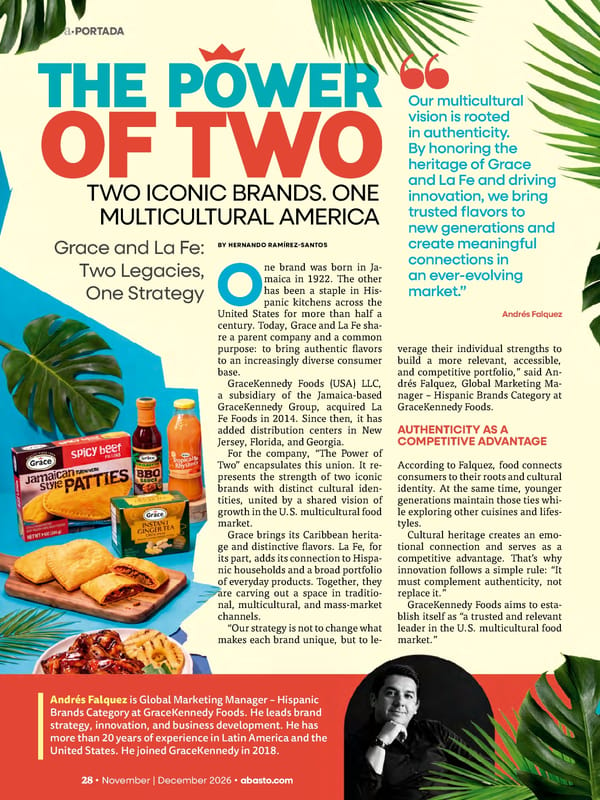
LA FE HISPANIC HERITAGE. EVOLVING CONSUMER. Frozen foods form the foundation of La Fe’s business. Its portfolio inclu- des cassava, plantains, vegetables, and fruit purees, essential ingre- dients in Hispanic family meals. Now, the brand is focusing on con- venience. Empanadas, easy-to-pre- pare meals, and new tropical beve- rages bring those classic flavors into everyday life. “Our goal is to offer meaningful in- novation without losing the flavors, quality, and cultural connection that consumers associate with La Fe,” said Falquez. NEW GENERATIONS Second- and third-generation His- panics maintain their roots but shop and cook differently. Thus, La Fe see- ks to retain its traditional customer base while also attracting young hou- seholds and mainstream consumers. On the business side, La Fe is stren- gthening its distribution in the Nor- theast and in Florida. It is also working with regional chains, independent stores, and major retailers to improve product availability and assortment. GRACE CARIBBEAN ROOTS. GLOBAL RELEVANCE. Grace has built its reputation on au- thenticity, quality, and an unders- tanding of Caribbean cuisine. For generations, its products have been a staple of everyday cooking and fami- ly celebrations. Its jerk seasonings, hot sauces, and coconut milk remain central to that identity. Today, the company spans four strategic categories: frozen foods, seasonings and sauces, beverages, and fish and meats. In addition, brands such as Tropical Rhythms, Zesti, Tas- tee Cheese, and Nurishment round out the Caribbean portfolio. INNOVATING WITHOUT SACRIFICING FLAVOR Grace innovates with three priorities: authenticity, convenience, and rele- vance. In the frozen foods, seafood, and meat categories, it seeks practi- cal formats for Caribbean dishes. In seasonings and sauces, it explores new uses for its signature flavors. “Our goal is to honor the traditions that have made Grace a go-to brand in households,” said Andrea Rey- nolds, Global Marketing Manager – Grace Brand & Caribbean Division Andrea Reynolds is Global Marketing Manager – Grace Brand & Caribbean Division Products at GraceKennedy Foods. She leads the strategy and expansion of Grace and other brands within the group. She has experience with Fortune 500 brands in the Caribbean, Europe, Canada, and the United States. Grace and La Fe aim to retain their traditional customer base while also attracting young households and consumers from the general market. Products at GraceKennedy Foods. For Reynolds, the United States offers a great opportunity, as Carib- bean cuisine is generating increasing interest among diverse consumers. 29 • November / December 2026 • abasto.com
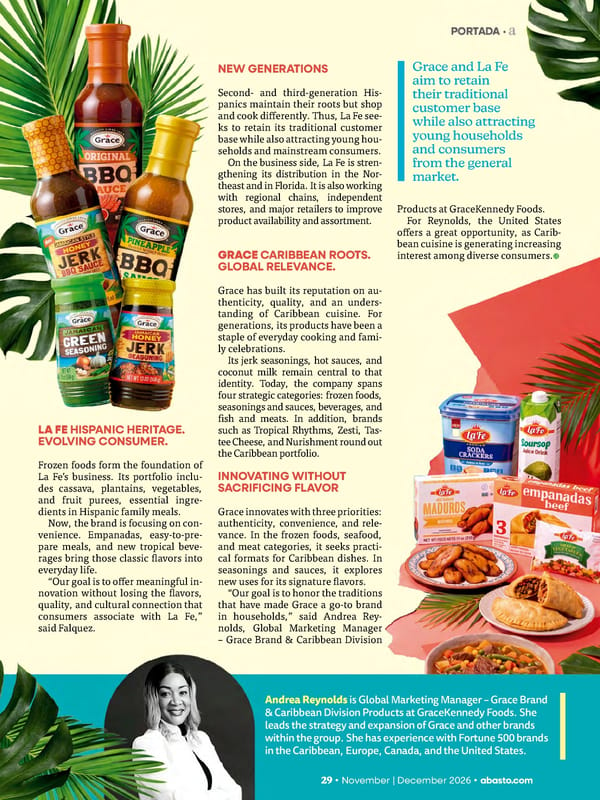
Useful data Beyond bacon Pork, The National Pork Producers Council notes that pork is the most widely consumed meat worldwide. Turkey, The United States Department of Agriculture (USDA) reveals that the United States is the third-largest and global producer and consumer of pork and pork products. USDA National Agricultural Statis- Pumpkin | tics Service data show that as of Sep- tember 1, 2026, U.S. farms had 74.3 million pigs and hogs. | Season | | Of that total, 68.4 million were | | market hogs and 5.87 million were kept for breeding. | The year-end holidays | | Top Producing States: | bring together | | Iowa: | Minnesota: | North | family, friends, and | | 24.7 | 9.30 | Carolina: | traditional dishes to | | million head | million head | 7.60 | celebrate the season. million head Americans consume an average of 53 pounds of pork per person per year. Fun Fact Adult pigs can run up to 11 mph. That equals a 7-minute mile! The main course Dato curioso: Total U.S. pumpkin production reached 1.47 billion pounds. The Kansas Farm Food Connection Turkeys—especially wild notes that roughly 2,500 farms rai- ones—can fly. However, Top Producing States: se turkeys in the U.S., meaning 216 they prefer to run, and most Illinois: California: Indiana: million turkeys are raised each year. roost in tree branches. In 533 162 135 About 46 million of those are con- the 20th century, they nearly million million million sumed on Thanksgiving. went extinct, disappearing pounds pounds pounds Americans consume more than 5 from New England, where billion pounds of turkey each year, the Pilgrims started the In 2025, pumpkin availability was or nearly 16 pounds per person. Thanksgiving tradition. 5.2 pounds per person. Top Producing States: North Minnesota: Indiana: The sweet side Dato curioso: Carolina: 971.5 826 Pumpkin was very 1.1 million million According to the 2022 Census of Agri- likely served at the first billion pounds pounds culture, more than 15,000 farms pro- Thanksgiving dinner in 1621. pounds duced pumpkins for the fresh market. Scientifically, pumpkins are Every U.S. state produces pump- fruits (because they contain It takes between 75 and 80 pounds kins, but five states produced near- seeds), but culinarily, of feed to raise a 38-pound tom (the ly 72% of the 2025 crop, according they are often treated term for a male turkey). to the USDA. as vegetables. 30 • November / December 2026• abasto.com
31 • November / December 2026• abasto.com
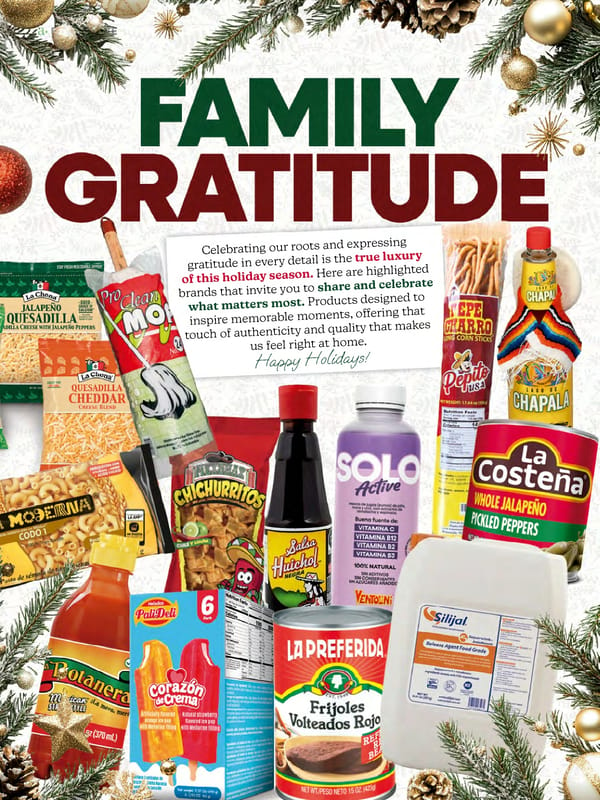
Happy Holidays! Celebrating our roots and expressing gratitude in every detail is the true luxury Here are highlighted of this holiday season. brands that invite you to share and celebrate what matters most. Products designed to inspire memorable moments, offering that touch of authenticity and quality that makes us feel right at home.
33 • November / December 2026• abasto.com
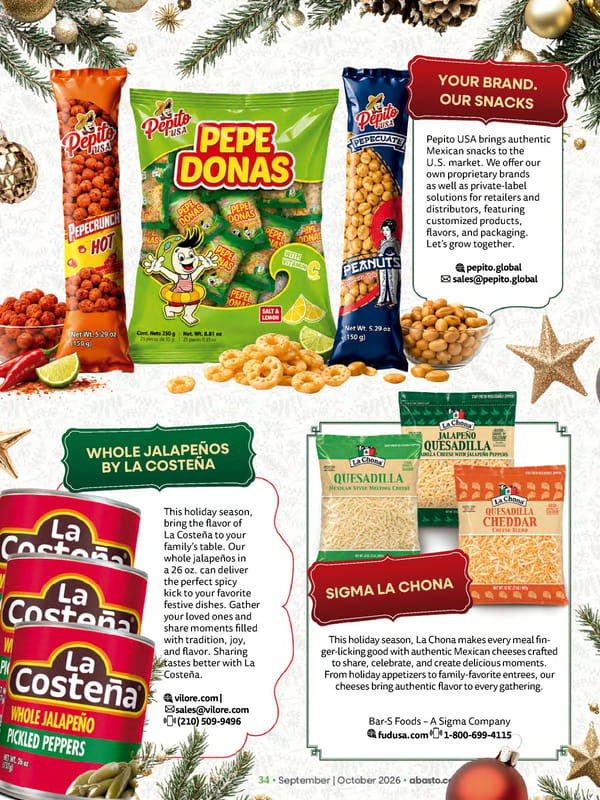
This holiday season, bring the flavor of La Costeña to your family’s table. Our whole jalapeños in a 26 oz. can deliver the perfect spicy kick to your favorite festive dishes. Gather your loved ones and share moments filled with tradition, joy, and flavor. Sharing tastes better with La Costeña. vilore.com / sales@vilore.com (210) 509-9496 Pepito USA brings authentic Mexican snacks to the U.S. market. We offer our own proprietary brands as well as private-label solutions for retailers and distributors, featuring customized products, flavors, and packaging. Let’s grow together. pepito.global sales@pepito.global This holiday season, La Chona makes every meal fin- ger-licking good with authentic Mexican cheeses crafted to share, celebrate, and create delicious moments. From holiday appetizers to family-favorite entrees, our cheeses bring authentic flavor to every gathering. Bar-S Foods – A Sigma Company fudusa.com 1-800-699-4115 WHOLE JALAPEÑOS BY LA COSTEÑA SIGMA LA CHONA YOUR BRAND. OUR SNACKS
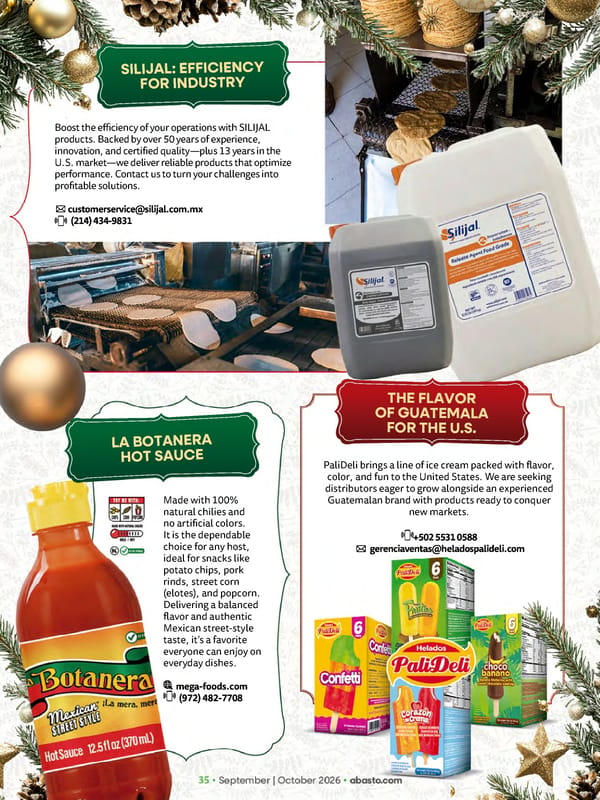
Boost the efficiency of your operations with SILIJAL products. Backed by over 50 years of experience, innovation, and certified quality—plus 13 years in the U.S. market—we deliver reliable products that optimize performance. Contact us to turn your challenges into profitable solutions. customerservice@silijal.com.mx (214) 434-9831 Made with 100% natural chilies and no artificial colors. It is the dependable choice for any host, ideal for snacks like potato chips, pork rinds, street corn (elotes), and popcorn. Delivering a balanced flavor and authentic Mexican street-style taste, it’s a favorite everyone can enjoy on everyday dishes. mega-foods.com (972) 482-7708 PaliDeli brings a line of ice cream packed with flavor, color, and fun to the United States. We are seeking distributors eager to grow alongside an experienced Guatemalan brand with products ready to conquer new markets. +502 5531 0588 gerenciaventas@heladospalideli.com SILIJAL: EFFICIENCY FOR INDUSTRY LA BOTANERA HOT SAUCE THE FLAVOR OF GUATEMALA FOR THE U.S.
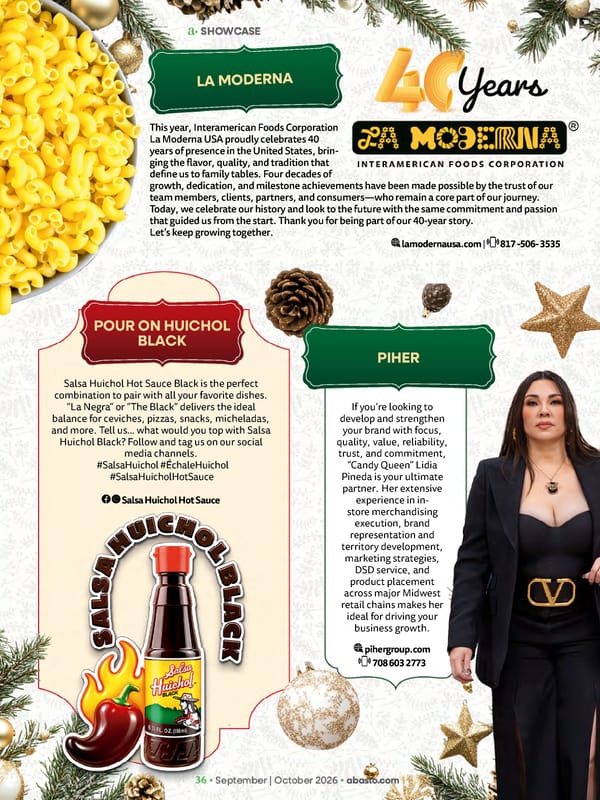
This year, Interamerican Foods Corporation La Moderna USA proudly celebrates 40 years of presence in the United States, brin- ging the flavor, quality, and tradition that define us to family tables. Four decades of growth, dedication, and milestone achievements have been made possible by the trust of our team members, clients, partners, and consumers—who remain a core part of our journey. Today, we celebrate our history and look to the future with the same commitment and passion that guided us from the start. Thank you for being part of our 40-year story. Let’s keep growing together. lamodernausa.com / 817 -506- 3535 POUR ON HUICHOL BLACK LA MODERNA PIHER Salsa Huichol Hot Sauce Black is the perfect combination to pair with all your favorite dishes. “La Negra” or “The Black” delivers the ideal balance for ceviches, pizzas, snacks, micheladas, and more. Tell us… what would you top with Salsa Huichol Black? Follow and tag us on our social media channels. #SalsaHuichol #ÉchaleHuichol #SalsaHuicholHotSauce Salsa Huichol Hot Sauce If you’re looking to develop and strengthen your brand with focus, quality, value, reliability, trust, and commitment, “Candy Queen” Lidia Pineda is your ultimate partner. Her extensive experience in in- store merchandising execution, brand representation and territory development, marketing strategies, DSD service, and product placement across major Midwest retail chains makes her ideal for driving your business growth. pihergroup.com 708 603 2773
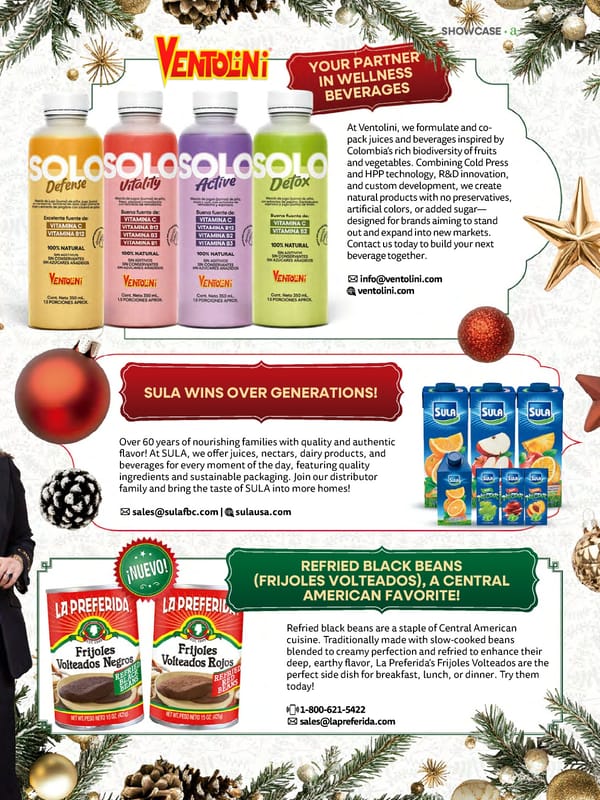
YOUR PARTNER IN WELLNESS BEVERAGES At Ventolini, we formulate and co- pack juices and beverages inspired by Colombia’s rich biodiversity of fruits and vegetables. Combining Cold Press and HPP technology, R&D innovation, and custom development, we create natural products with no preservatives, artificial colors, or added sugar— designed for brands aiming to stand out and expand into new markets. Contact us today to build your next beverage together. info@ventolini.com ventolini.com Over 60 years of nourishing families with quality and authentic flavor! At SULA, we offer juices, nectars, dairy products, and beverages for every moment of the day, featuring quality ingredients and sustainable packaging. Join our distributor family and bring the taste of SULA into more homes! sales@sulafbc.com / sulausa.com SULA WINS OVER GENERATIONS! REFRIED BLACK BEANS (FRIJOLES VOLTEADOS), A CENTRAL AMERICAN FAVORITE! Refried black beans are a staple of Central American cuisine. Traditionally made with slow-cooked beans blended to creamy perfection and refried to enhance their deep, earthy flavor, La Preferida’s Frijoles Volteados are the perfect side dish for breakfast, lunch, or dinner. Try them today! 1-800-621-5422 sales@lapreferida.com
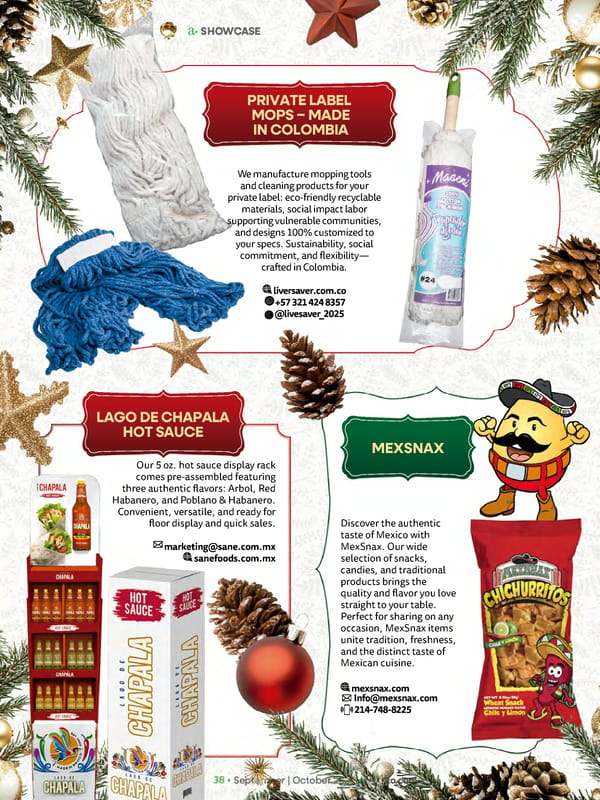
PRIVATE LABEL MOPS – MADE IN COLOMBIA We manufacture mopping tools and cleaning products for your private label: eco-friendly recyclable materials, social impact labor supporting vulnerable communities, and designs 100% customized to your specs. Sustainability, social commitment, and flexibility— crafted in Colombia. liversaver.com.co +57 321 424 8357 @livesaver_2025 Our 5 oz. hot sauce display rack comes pre-assembled featuring three authentic flavors: Arbol, Red Habanero, and Poblano & Habanero. Convenient, versatile, and ready for floor display and quick sales. marketing@sane.com.mx sanefoods.com.mx LAGO DE CHAPALA HOT SAUCE MEXSNAX Discover the authentic taste of Mexico with MexSnax. Our wide selection of snacks, candies, and traditional products brings the quality and flavor you love straight to your table. Perfect for sharing on any occasion, MexSnax items unite tradition, freshness, and the distinct taste of Mexican cuisine. mexsnax.com Info@mexsnax.com 214-748-8225
39 • November / December 2026• abasto.com

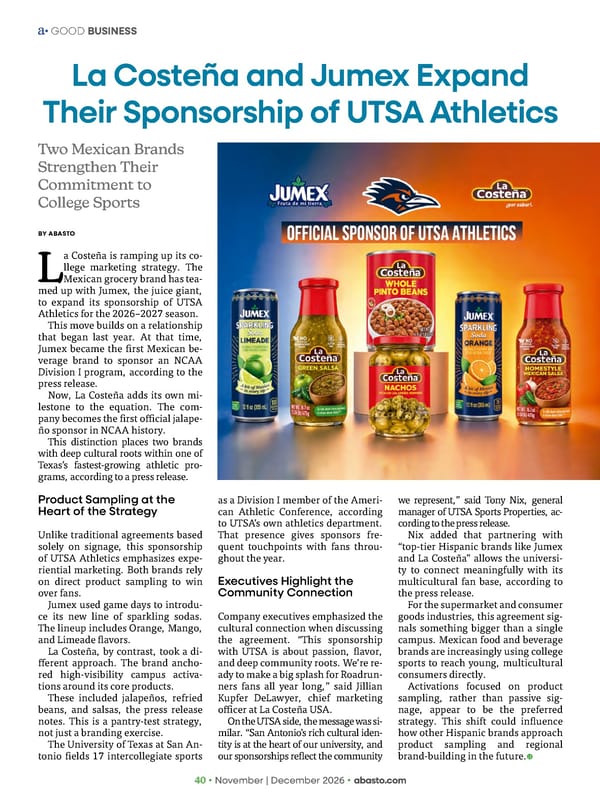
40 • November / December 2026• abasto.com • GOOD BUSINESS La Costeña and Jumex Expand Their Sponsorship of UTSA Athletics BY ABASTO L a Costeña is ramping up its co- llege marketing strategy. The Mexican grocery brand has tea- med up with Jumex, the juice giant, to expand its sponsorship of UTSA Athletics for the 2026–2027 season. This move builds on a relationship that began last year. At that time, Jumex became the first Mexican be- verage brand to sponsor an NCAA Division I program, according to the press release. Now, La Costeña adds its own mi- lestone to the equation. The com- pany becomes the first official jalape- ño sponsor in NCAA history. This distinction places two brands with deep cultural roots within one of Texas’s fastest-growing athletic pro- grams, according to a press release. Product Sampling at the Heart of the Strategy Unlike traditional agreements based solely on signage, this sponsorship of UTSA Athletics emphasizes expe- riential marketing. Both brands rely on direct product sampling to win over fans. Jumex used game days to introdu- ce its new line of sparkling sodas. The lineup includes Orange, Mango, and Limeade flavors. La Costeña, by contrast, took a di- fferent approach. The brand ancho- red high-visibility campus activa- tions around its core products. These included jalapeños, refried beans, and salsas, the press release notes. This is a pantry-test strategy, not just a branding exercise. The University of Texas at San An- tonio fields 17 intercollegiate sports Two Mexican Brands Strengthen Their Commitment to College Sports as a Division I member of the Ameri- can Athletic Conference, according to UTSA’s own athletics department. That presence gives sponsors fre- quent touchpoints with fans throu- ghout the year. Executives Highlight the Community Connection Company executives emphasized the cultural connection when discussing the agreement. “This sponsorship with UTSA is about passion, flavor, and deep community roots. We’re re- ady to make a big splash for Roadrun- ners fans all year long,” said Jillian Kupfer DeLawyer, chief marketing officer at La Costeña USA. On the UTSA side, the message was si- milar. “San Antonio’s rich cultural iden- tity is at the heart of our university, and our sponsorships reflect the community we represent,” said Tony Nix, general manager of UTSA Sports Properties, ac- cording to the press release. Nix added that partnering with “top-tier Hispanic brands like Jumex and La Costeña” allows the universi- ty to connect meaningfully with its multicultural fan base, according to the press release. For the supermarket and consumer goods industries, this agreement sig- nals something bigger than a single campus. Mexican food and beverage brands are increasingly using college sports to reach young, multicultural consumers directly. Activations focused on product sampling, rather than passive sig- nage, appear to be the preferred strategy. This shift could influence how other Hispanic brands approach product sampling and regional brand-building in the future.
41 • November / December 2026• abasto.com
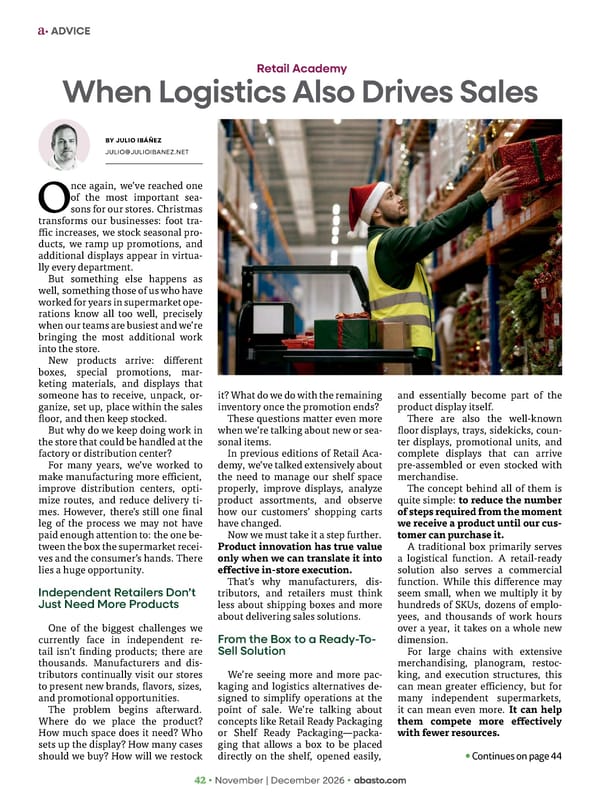
42 • November / December 2026• abasto.com BY JULIO IBÁÑEZ JULIO@JULIOIBANEZ.NET Retail Academy When Logistics Also Drives Sales O nce again, we’ve reached one of the most important sea- sons for our stores. Christmas transforms our businesses: foot tra- ffic increases, we stock seasonal pro- ducts, we ramp up promotions, and additional displays appear in virtua- lly every department. But something else happens as well, something those of us who have worked for years in supermarket ope- rations know all too well, precisely when our teams are busiest and we’re bringing the most additional work into the store. New products arrive: different boxes, special promotions, mar- keting materials, and displays that someone has to receive, unpack, or- ganize, set up, place within the sales floor, and then keep stocked. But why do we keep doing work in the store that could be handled at the factory or distribution center? For many years, we’ve worked to make manufacturing more efficient, improve distribution centers, opti- mize routes, and reduce delivery ti- mes. However, there’s still one final leg of the process we may not have paid enough attention to: the one be- tween the box the supermarket recei- ves and the consumer’s hands. There lies a huge opportunity. Independent Retailers Don’t Just Need More Products One of the biggest challenges we currently face in independent re- tail isn’t finding products; there are thousands. Manufacturers and dis- tributors continually visit our stores to present new brands, flavors, sizes, and promotional opportunities. The problem begins afterward. Where do we place the product? How much space does it need? Who sets up the display? How many cases should we buy? How will we restock it? What do we do with the remaining inventory once the promotion ends? These questions matter even more when we’re talking about new or sea- sonal items. In previous editions of Retail Aca- demy, we’ve talked extensively about the need to manage our shelf space properly, improve displays, analyze product assortments, and observe how our customers’ shopping carts have changed. Now we must take it a step further. Product innovation has true value only when we can translate it into effective in-store execution. That’s why manufacturers, dis- tributors, and retailers must think less about shipping boxes and more about delivering sales solutions. From the Box to a Ready-To- Sell Solution We’re seeing more and more pac- kaging and logistics alternatives de- signed to simplify operations at the point of sale. We’re talking about concepts like Retail Ready Packaging or Shelf Ready Packaging—packa- ging that allows a box to be placed directly on the shelf, opened easily, and essentially become part of the product display itself. There are also the well-known floor displays, trays, sidekicks, coun- ter displays, promotional units, and complete displays that can arrive pre-assembled or even stocked with merchandise. The concept behind all of them is quite simple: to reduce the number of steps required from the moment we receive a product until our cus- tomer can purchase it. A traditional box primarily serves a logistical function. A retail-ready solution also serves a commercial function. While this difference may seem small, when we multiply it by hundreds of SKUs, dozens of emplo- yees, and thousands of work hours over a year, it takes on a whole new dimension. For large chains with extensive merchandising, planogram, restoc- king, and execution structures, this can mean greater efficiency, but for many independent supermarkets, it can mean even more. It can help them compete more effectively with fewer resources. • Continues on page 44 • ADVICE
43 • November / December 2026• abasto.com

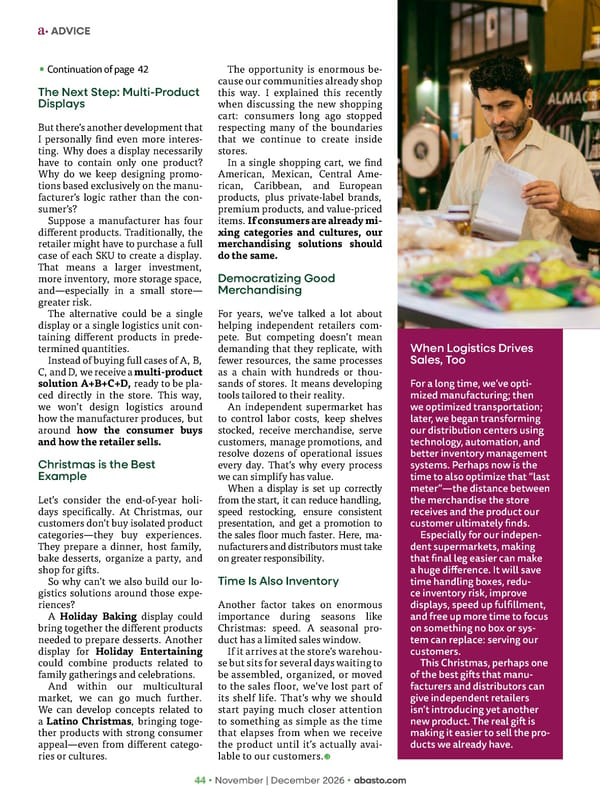
44 • November / December 2026• abasto.com The Next Step: Multi-Product Displays But there’s another development that I personally find even more interes- ting. Why does a display necessarily have to contain only one product? Why do we keep designing promo- tions based exclusively on the manu- facturer’s logic rather than the con- sumer’s? Suppose a manufacturer has four different products. Traditionally, the retailer might have to purchase a full case of each SKU to create a display. That means a larger investment, more inventory, more storage space, and—especially in a small store— greater risk. The alternative could be a single display or a single logistics unit con- taining different products in prede- termined quantities. Instead of buying full cases of A, B, C, and D, we receive a multi-product solution A+B+C+D, ready to be pla- ced directly in the store. This way, we won’t design logistics around how the manufacturer produces, but around how the consumer buys and how the retailer sells. Christmas is the Best Example Let’s consider the end-of-year holi- days specifically. At Christmas, our customers don’t buy isolated product categories—they buy experiences. They prepare a dinner, host family, bake desserts, organize a party, and shop for gifts. So why can’t we also build our lo- gistics solutions around those expe- riences? A Holiday Baking display could bring together the different products needed to prepare desserts. Another display for Holiday Entertaining could combine products related to family gatherings and celebrations. And within our multicultural market, we can go much further. We can develop concepts related to a Latino Christmas, bringing toge- ther products with strong consumer appeal—even from different catego- ries or cultures. The opportunity is enormous be- cause our communities already shop this way. I explained this recently when discussing the new shopping cart: consumers long ago stopped respecting many of the boundaries that we continue to create inside stores. In a single shopping cart, we find American, Mexican, Central Ame- rican, Caribbean, and European products, plus private-label brands, premium products, and value-priced items. If consumers are already mi- xing categories and cultures, our merchandising solutions should do the same. Democratizing Good Merchandising For years, we’ve talked a lot about helping independent retailers com- pete. But competing doesn’t mean demanding that they replicate, with fewer resources, the same processes as a chain with hundreds or thou- sands of stores. It means developing tools tailored to their reality. An independent supermarket has to control labor costs, keep shelves stocked, receive merchandise, serve customers, manage promotions, and resolve dozens of operational issues every day. That’s why every process we can simplify has value. When a display is set up correctly from the start, it can reduce handling, speed restocking, ensure consistent presentation, and get a promotion to the sales floor much faster. Here, ma- nufacturers and distributors must take on greater responsibility. Time Is Also Inventory Another factor takes on enormous importance during seasons like Christmas: speed. A seasonal pro- duct has a limited sales window. If it arrives at the store’s warehou- se but sits for several days waiting to be assembled, organized, or moved to the sales floor, we’ve lost part of its shelf life. That’s why we should start paying much closer attention to something as simple as the time that elapses from when we receive the product until it’s actually avai- lable to our customers. When Logistics Drives Sales, Too For a long time, we’ve opti- mized manufacturing; then we optimized transportation; later, we began transforming our distribution centers using technology, automation, and better inventory management systems. Perhaps now is the time to also optimize that “last meter”—the distance between the merchandise the store receives and the product our customer ultimately finds. Especially for our indepen- dent supermarkets, making that final leg easier can make a huge difference. It will save time handling boxes, redu- ce inventory risk, improve displays, speed up fulfillment, and free up more time to focus on something no box or sys- tem can replace: serving our customers. This Christmas, perhaps one of the best gifts that manu- facturers and distributors can give independent retailers isn’t introducing yet another new product. The real gift is making it easier to sell the pro- ducts we already have. • Continuation of page 42 • ADVICE
45 • November / December 2026• abasto.com

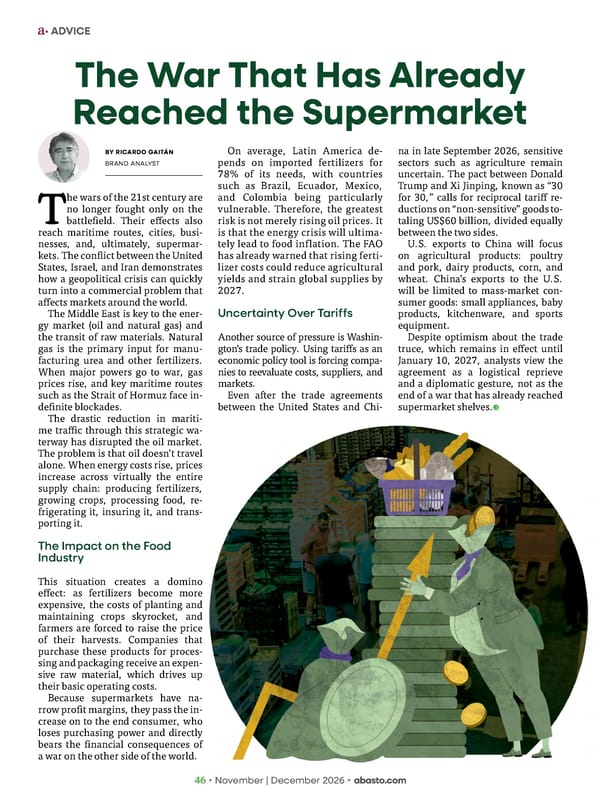
46 • November / December 2026• abasto.com BY RICARDO GAITÁN BRAND ANALYST • ADVICE T he wars of the 21st century are no longer fought only on the battlefield. Their effects also reach maritime routes, cities, busi- nesses, and, ultimately, supermar- kets. The conflict between the United States, Israel, and Iran demonstrates how a geopolitical crisis can quickly turn into a commercial problem that affects markets around the world. The Middle East is key to the ener- gy market (oil and natural gas) and the transit of raw materials. Natural gas is the primary input for manu- facturing urea and other fertilizers. When major powers go to war, gas prices rise, and key maritime routes such as the Strait of Hormuz face in- definite blockades. The drastic reduction in mariti- me traffic through this strategic wa- terway has disrupted the oil market. The problem is that oil doesn’t travel alone. When energy costs rise, prices increase across virtually the entire supply chain: producing fertilizers, growing crops, processing food, re- frigerating it, insuring it, and trans- porting it. The Impact on the Food Industry This situation creates a domino effect: as fertilizers become more expensive, the costs of planting and maintaining crops skyrocket, and farmers are forced to raise the price of their harvests. Companies that purchase these products for proces- sing and packaging receive an expen- sive raw material, which drives up their basic operating costs. Because supermarkets have na- rrow profit margins, they pass the in- crease on to the end consumer, who loses purchasing power and directly bears the financial consequences of a war on the other side of the world. The War That Has Already Reached the Supermarket On average, Latin America de- pends on imported fertilizers for 78% of its needs, with countries such as Brazil, Ecuador, Mexico, and Colombia being particularly vulnerable. Therefore, the greatest risk is not merely rising oil prices. It is that the energy crisis will ultima- tely lead to food inflation. The FAO has already warned that rising ferti- lizer costs could reduce agricultural yields and strain global supplies by 2027. Uncertainty Over Tariffs Another source of pressure is Washin- gton’s trade policy. Using tariffs as an economic policy tool is forcing compa- nies to reevaluate costs, suppliers, and markets. Even after the trade agreements between the United States and Chi- na in late September 2026, sensitive sectors such as agriculture remain uncertain. The pact between Donald Trump and Xi Jinping, known as “30 for 30,” calls for reciprocal tariff re- ductions on “non-sensitive” goods to- taling US$60 billion, divided equally between the two sides. U.S. exports to China will focus on agricultural products: poultry and pork, dairy products, corn, and wheat. China’s exports to the U.S. will be limited to mass-market con- sumer goods: small appliances, baby products, kitchenware, and sports equipment. Despite optimism about the trade truce, which remains in effect until January 10, 2027, analysts view the agreement as a logistical reprieve and a diplomatic gesture, not as the end of a war that has already reached supermarket shelves.
47 • November / December 2026• abasto.com
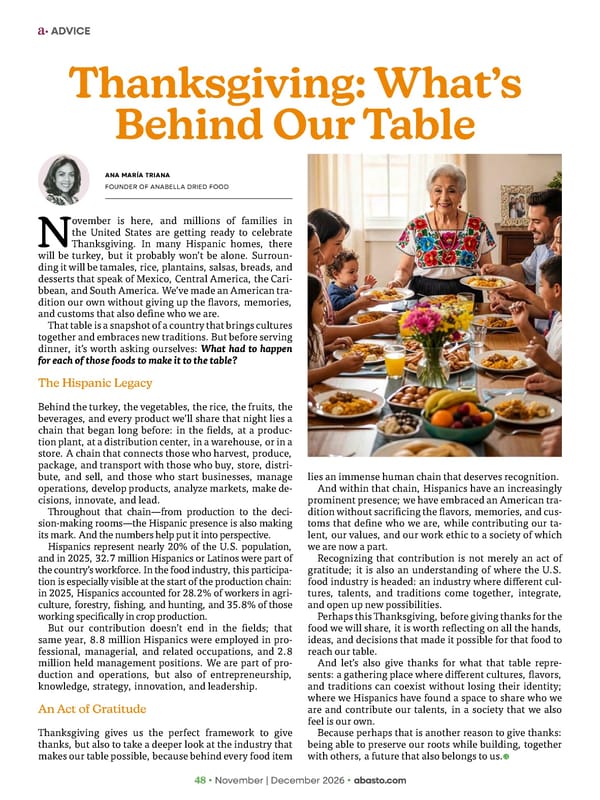
48 • November / December 2026• abasto.com ANA MARÍA TRIANA FOUNDER OF ANABELLA DRIED FOOD • ADVICE N ovember is here, and millions of families in the United States are getting ready to celebrate Thanksgiving. In many Hispanic homes, there will be turkey, but it probably won’t be alone. Surroun- ding it will be tamales, rice, plantains, salsas, breads, and desserts that speak of Mexico, Central America, the Cari- bbean, and South America. We’ve made an American tra- dition our own without giving up the flavors, memories, and customs that also define who we are. That table is a snapshot of a country that brings cultures together and embraces new traditions. But before serving dinner, it’s worth asking ourselves: What had to happen for each of those foods to make it to the table? The Hispanic Legacy Behind the turkey, the vegetables, the rice, the fruits, the beverages, and every product we’ll share that night lies a chain that began long before: in the fields, at a produc- tion plant, at a distribution center, in a warehouse, or in a store. A chain that connects those who harvest, produce, package, and transport with those who buy, store, distri- bute, and sell, and those who start businesses, manage operations, develop products, analyze markets, make de- cisions, innovate, and lead. Throughout that chain—from production to the deci- sion-making rooms—the Hispanic presence is also making its mark. And the numbers help put it into perspective. Hispanics represent nearly 20% of the U.S. population, and in 2025, 32.7 million Hispanics or Latinos were part of the country’s workforce. In the food industry, this participa- tion is especially visible at the start of the production chain: in 2025, Hispanics accounted for 28.2% of workers in agri- culture, forestry, fishing, and hunting, and 35.8% of those working specifically in crop production. But our contribution doesn’t end in the fields; that same year, 8.8 million Hispanics were employed in pro- fessional, managerial, and related occupations, and 2.8 million held management positions. We are part of pro- duction and operations, but also of entrepreneurship, knowledge, strategy, innovation, and leadership. An Act of Gratitude Thanksgiving gives us the perfect framework to give thanks, but also to take a deeper look at the industry that makes our table possible, because behind every food item Thanksgiving: What’s Behind Our Table lies an immense human chain that deserves recognition. And within that chain, Hispanics have an increasingly prominent presence; we have embraced an American tra- dition without sacrificing the flavors, memories, and cus- toms that define who we are, while contributing our ta- lent, our values, and our work ethic to a society of which we are now a part. Recognizing that contribution is not merely an act of gratitude; it is also an understanding of where the U.S. food industry is headed: an industry where different cul- tures, talents, and traditions come together, integrate, and open up new possibilities. Perhaps this Thanksgiving, before giving thanks for the food we will share, it is worth reflecting on all the hands, ideas, and decisions that made it possible for that food to reach our table. And let’s also give thanks for what that table repre- sents: a gathering place where different cultures, flavors, and traditions can coexist without losing their identity; where we Hispanics have found a space to share who we are and contribute our talents, in a society that we also feel is our own. Because perhaps that is another reason to give thanks: being able to preserve our roots while building, together with others, a future that also belongs to us.
49 • November / December 2026• abasto.com
50 • November / December 2026• abasto.com From the Mic to the Kitchen: The New Holiday Influencer Instead of another commercial announ- cing lower prices, show consumers the meal. Share the recipe. Tell the family story behind it. Then show what it cost— and what was saved by choosing private label. Suddenly, value becomes tangible. The idea can travel across platforms. Radio creates mass awareness and invites listeners into the experience. Short-form social video brings the recipe to life. The personality provides familiarity and trust. Retailers can extend the experience with digital recipes, QR codes, shoppable in- gredient lists or even personality-curated holiday collections. For private-label marketers, this is an opportunity to move the conversation be- yond price. A store brand can become part of so- meone’s traditions if marketers give con- sumers a reason to try it first. And during the holidays, food offers the perfect invi- tation. Consumers don’t need another message shouting about what’s on sale. They need ideas, inspiration and ways to celebrate generously while spending wisely. This holiday season, don’t just advertise what’s on the shelf. Give consumers a reason to put it on the table. • ADVICE BY GRACE AGOSTINO SENIOR VICE PRESIDENT (SVP) OF SALES AND CORPORATE COMMUNICATIONS AT NUEVA RED T he battle for the holiday basket doesn’t begin in the aisle. It begins in the consumer’s mind. Long before shoppers walk into a gro- cery store, they’re thinking about what they’ll cook, what traditions they’ll keep and, increasingly, how much it will all cost. That creates a unique opportunity for private-label brands. Value matters, especially when holiday shopping lists get longer. But saving mo- ney doesn’t have to mean sacrificing tra- dition, quality or the joy of putting some- thing special on the table. The marketing challenge is showing consumers that— not simply telling them. Enter the modern radio personality. Today’s DJs and hosts are more than voices behind a microphone. They are influencers with audiences that follow them from broadcast to Instagram, YouTube and other social platforms. That combination offers brands so- mething particularly powerful: mass reach paired with intimacy. Imagine a favorite personality taking listeners into their kitchen through a short vertical video to make the flan their mo- ther served every Christmas, their family’s tamales or the dish that simply has to be on the Nochebuena table. Now make private-label products part of the recipe.
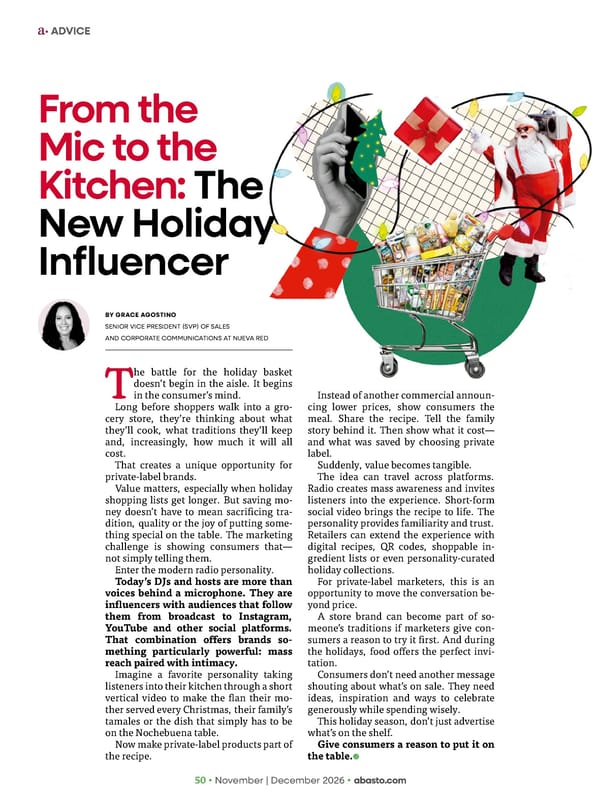
NOVEMBER/ DECEMBER 2026 YEAR 18 • ABASTO.COM SPECIAL PLMA INSERT
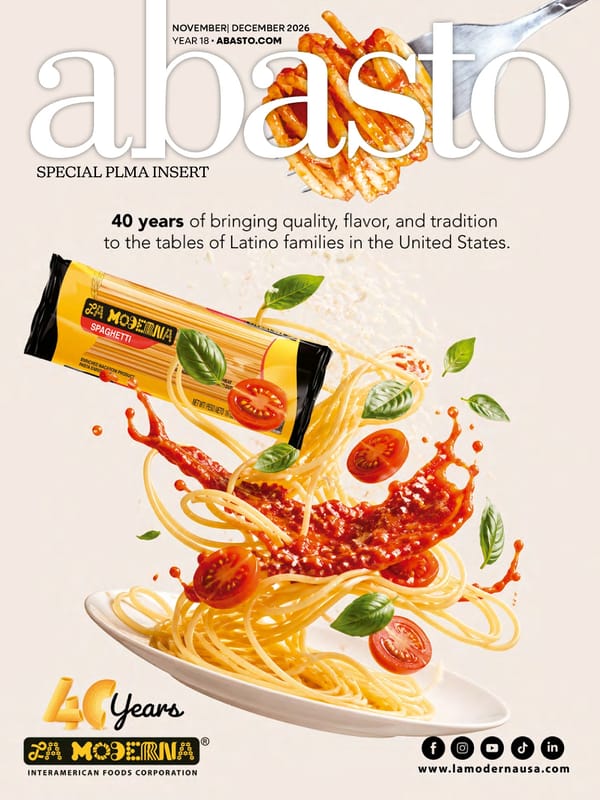
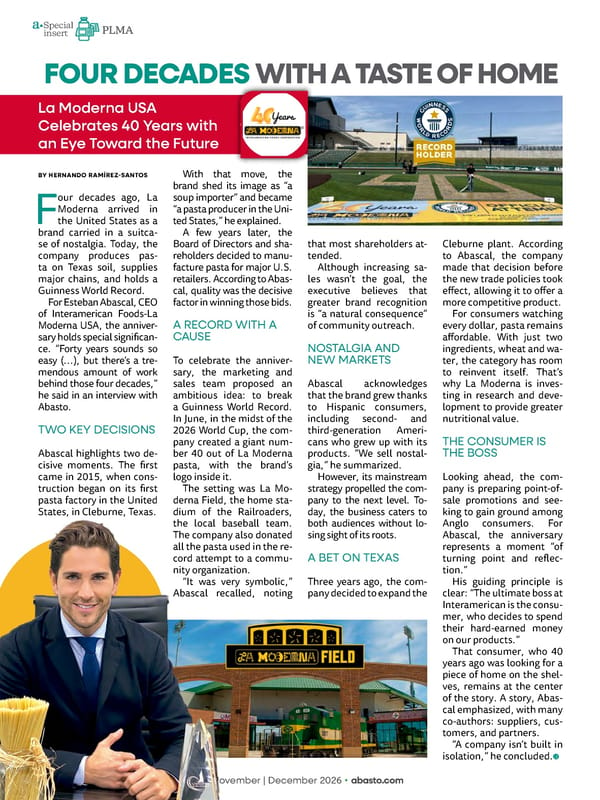
2• November / December 2026• abasto.com Special PLMA insert FOUR DECADES WITH A TASTE OF HOME BY HERNANDO RAMÍREZ-SANTOS F our decades ago, La Moderna arrived in the United States as a brand carried in a suitca- se of nostalgia. Today, the company produces pas- ta on Texas soil, supplies major chains, and holds a Guinness World Record. For Esteban Abascal, CEO of Interamerican Foods-La Moderna USA, the anniver- sary holds special significan- ce. “Forty years sounds so easy (...), but there’s a tre- mendous amount of work behind those four decades,” he said in an interview with Abasto. TWO KEY DECISIONS Abascal highlights two de- cisive moments. The first came in 2015, when cons- truction began on its first pasta factory in the United States, in Cleburne, Texas. With that move, the brand shed its image as “a soup importer” and became “a pasta producer in the Uni- ted States,” he explained. A few years later, the Board of Directors and sha- reholders decided to manu- facture pasta for major U.S. retailers. According to Abas- cal, quality was the decisive factor in winning those bids. A RECORD WITH A CAUSE To celebrate the anniver- sary, the marketing and sales team proposed an ambitious idea: to break a Guinness World Record. In June, in the midst of the 2026 World Cup, the com- pany created a giant num- ber 40 out of La Moderna pasta, with the brand’s logo inside it. The setting was La Mo- derna Field, the home sta- dium of the Railroaders, the local baseball team. The company also donated all the pasta used in the re- cord attempt to a commu- nity organization. “It was very symbolic,” Abascal recalled, noting that most shareholders at- tended. Although increasing sa- les wasn’t the goal, the executive believes that greater brand recognition is “a natural consequence” of community outreach. NOSTALGIA AND NEW MARKETS Abascal acknowledges that the brand grew thanks to Hispanic consumers, including second- and third-generation Ameri- cans who grew up with its products. “We sell nostal- gia,” he summarized. However, its mainstream strategy propelled the com- pany to the next level. To- day, the business caters to both audiences without lo- sing sight of its roots. A BET ON TEXAS Three years ago, the com- pany decided to expand the La Moderna USA Celebrates 40 Years with an Eye Toward the Future Cleburne plant. According to Abascal, the company made that decision before the new trade policies took effect, allowing it to offer a more competitive product. For consumers watching every dollar, pasta remains affordable. With just two ingredients, wheat and wa- ter, the category has room to reinvent itself. That’s why La Moderna is inves- ting in research and deve- lopment to provide greater nutritional value. THE CONSUMER IS THE BOSS Looking ahead, the com- pany is preparing point-of- sale promotions and see- king to gain ground among Anglo consumers. For Abascal, the anniversary represents a moment “of turning point and reflec- tion.” His guiding principle is clear: “The ultimate boss at Interamerican is the consu- mer, who decides to spend their hard-earned money on our products.” That consumer, who 40 years ago was looking for a piece of home on the shel- ves, remains at the center of the story. A story, Abas- cal emphasized, with many co-authors: suppliers, cus- tomers, and partners. “A company isn’t built in isolation,” he concluded.
3• November / December 2026• abasto.com
4• November / December 2026• abasto.com BY HERNANDO RAMÍREZ-SANTOS H ispanic products will take center stage at PLMA’s 2026 Private Label Trade Show in No- vember. Exhibitors from across Latin America are expanding the event’s inter- national reach, according to the Private Label Manufac- turers Association (PLMA). The trade show, themed “Store Brands Marketpla- ce,” will take place Novem- ber 15–17 at the Donald E. Stephens Convention Cen- ter, near Chicago’s O’Hare International Airport. The association also noted that more countries than ever will participate, with se- veral sponsoring multiple pavilions. Buyers will find a wide as- sortment of authentic His- panic foods, beverages, and non-food items. These pro- ducts come from suppliers in the U.S., South America, Asia, Australia, and Europe, the PLMA noted. LATIN AMERICAN EXHIBITORS BRING MORE HISPANIC PRODUCTS Enriketa Beluli, PLMA’s se- nior manager of global pavi- lions, strongly emphasized the region’s momentum. “South American partici- pation seems unstoppable, as it continues to grow every year,” Beluli said. Specifically, companies from Peru, Brazil, Colom- bia, and Chile will exhibit alongside suppliers from Guatemala, Costa Rica, and Mexico. Together, they will bring a mix of food and be- verages, as well as house- HISPANIC PRODUCTS GAIN GROUND AT THE 2026 PLMA TRADE SHOW hold and health products, she added. Beluli also linked this in- terest to a broader commer- cial objective. “This reflects the region’s growing effort to connect with the U.S. market and showcases its diverse range of high-demand Hispanic products,” she said. WHY PRIVATE- LABEL BRANDS ARE EMBRACING INTERNATIONAL FLAVORS The timing is favorable for Hispanic product suppliers. Sales of ethnic and interna- tional foods and beverages are growing across multiple categories in the U.S., ac- cording to the PLMA. This growth spans both conven- tional supermarkets and specialty stores. The association attributes the trend to international travel, television cooking shows, and the proliferation of ethnic restaurants. Demographics also play a major role. The U.S. Hispa- nic population reached 70.1 million as of July 1, 2025, according to the Census Bu- reau. That figure represents 21% of the country’s total population. Private label is also expe- riencing a record-breaking run. Private labels reached all-time highs of 21.3% in dollar share and 23.5% in unit share in 2025, PLMA reported in April. PLMA REPORTS RECORD INTERNATIONAL REACH Beyond Latin America, the 2026 edition will feature pa- vilions from Japan, Abu Dha- bi, and Israel. An Australian Home & Health pavilion and a second delegation from Vietnam will also make their debut. For now, PLMA projects more than 50 country pa- vilions. International su- ppliers will account for approximately half of the exhibitors and will come from more than 60 coun- tries. Beluli also expects more foreign companies to join. “This year marks a new re- cord for PLMA in terms of in- ternational reach and influen- ce in the industry,” he said. Exhibition space has grown by nearly 20% since 2023, he noted, and interna- tional participants account for much of that increase. Other national groups in- clude Italy, France, Spain, the United Kingdom, Den- mark, Poland, Georgia, Turkey, Ukraine, and the Netherlands. Belgium will have two pavilions, while Greece and Canada will each have three. Similarly, China, Sou- th Korea, Thailand, and Vietnam will send several delegations. Australia will be present in both halls: Food & Beverage and Home & Health. Additionally, the World of Private Label pavilion will bring together hundreds of individual exhibitors under one roof. Special PLMA insert
5• November / December 2026• abasto.com
6• November / December 2026• abasto.com especialInserto PLMA The supermarket chain and SPINS predict a focus on fiber, protein, and global flavors. BY ABASTO THE 2027 SHOPPING CART FRESH THYME ANTICIPATES plexity to their lives.” The specialist added that the list reflects an infor- med and intentional con- sumer base. This customer seeks a shopping basket that is innovative, practi- cal, and aligned with their long-term health goals. NUTRITION WITH A PURPOSE Three of the trends revolve around nutritional densi- ty. The first, “Fiber First,” places fiber at the center of innovation. According to the report, consumers no longer associate fiber solely with digestive heal- th. They now link it to sa- tiety, balanced nutrition, and overall well-being. As a result, the company anticipates more breads, cereals, snacks, and be- verages that highlight this nutrient. As examples, it cites the prebiotic soda Oli- pop and Hero seed bread. This interest aligns with independent data. A sur- vey published by the Inter- national Food Information Council (IFIC) in February 2026 revealed a significant gap: Two-thirds of Ameri- cans consume too little fi- ber or are unaware of how much they consume. Furthermore, “More in Every Bite” caters to those seeking greater nutritional value in small portions. The retailer attributes this demand to busy schedu- les, changing eating ha- bits, and the popularity of GLP-1 medications. In this regard, a November 2025 KFF survey indicated that 12% of adults in the coun- try take one of these drugs. In addition, 18% said they had used them at some point. Meanwhile, “The Brain Food Era” reflects the in- terest in cognitive health. According to the study, brands will incorporate omega-3s, antioxidants, functional mushrooms, and creatine into more everyday items. • Sigue en la pág. 8 Special PLMA insert F resh Thyme Market is already outlining what U.S. consumers will want in 2027. The Midwes- tern supermarket chain released its annual “Top 10 Trends” report, which it developed in collabo- ration with SPINS, a firm specializing in packaged consumer goods data. The report predicts the flavors, ingredients, and wellness priorities that will hit store shelves over the next year. Taken together, the pre- dictions paint a picture of a shopper who demands more from every product. They want fiber, protein, and essential nutrients. However, they also seek enjoyment, convenience, and variety. “Grocery shoppers are redefining wellness on their own terms,” said Ce- cily Martínez, a registered dietitian at Fresh Thyme Market, in a press release. “People want fresh, orga- nic, and healthier foods that offer meaningful be- nefits without adding com-
7• November / December 2026• abasto.com Minsa

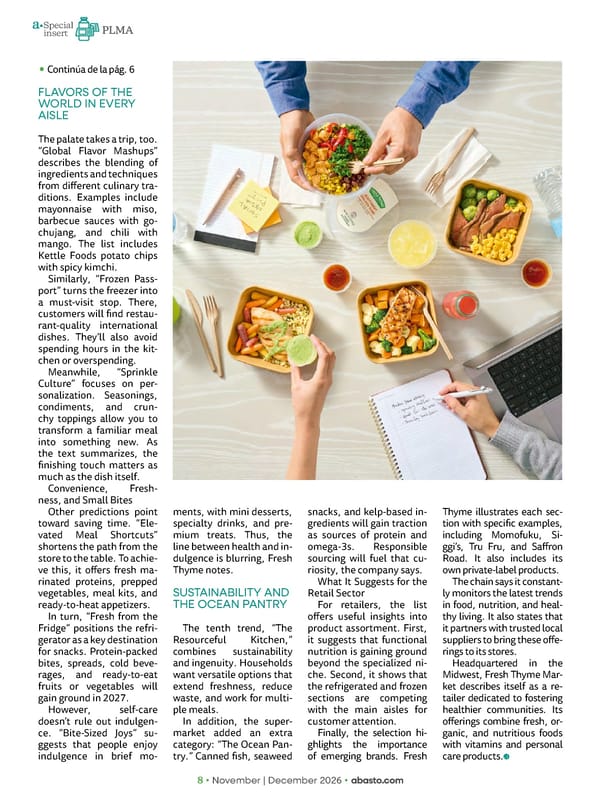
8• November / December 2026• abasto.com FLAVORS OF THE WORLD IN EVERY AISLE The palate takes a trip, too. “Global Flavor Mashups” describes the blending of ingredients and techniques from different culinary tra- ditions. Examples include mayonnaise with miso, barbecue sauces with go- chujang, and chili with mango. The list includes Kettle Foods potato chips with spicy kimchi. Similarly, “Frozen Pass- port” turns the freezer into a must-visit stop. There, customers will find restau- rant-quality international dishes. They’ll also avoid spending hours in the kit- chen or overspending. Meanwhile, “Sprinkle Culture” focuses on per- sonalization. Seasonings, condiments, and crun- chy toppings allow you to transform a familiar meal into something new. As the text summarizes, the finishing touch matters as much as the dish itself. Convenience, Fresh- ness, and Small Bites Other predictions point toward saving time. “Ele- vated Meal Shortcuts” shortens the path from the store to the table. To achie- ve this, it offers fresh ma- rinated proteins, prepped vegetables, meal kits, and ready-to-heat appetizers. In turn, “Fresh from the Fridge” positions the refri- gerator as a key destination for snacks. Protein-packed bites, spreads, cold beve- rages, and ready-to-eat fruits or vegetables will gain ground in 2027. However, self-care doesn’t rule out indulgen- ce. “Bite-Sized Joys” su- ggests that people enjoy indulgence in brief mo- ments, with mini desserts, specialty drinks, and pre- mium treats. Thus, the line between health and in- dulgence is blurring, Fresh Thyme notes. SUSTAINABILITY AND THE OCEAN PANTRY The tenth trend, “The Resourceful Kitchen,” combines sustainability and ingenuity. Households want versatile options that extend freshness, reduce waste, and work for multi- ple meals. In addition, the super- market added an extra category: “The Ocean Pan- try.” Canned fish, seaweed snacks, and kelp-based in- gredients will gain traction as sources of protein and omega-3s. Responsible sourcing will fuel that cu- riosity, the company says. What It Suggests for the Retail Sector For retailers, the list offers useful insights into product assortment. First, it suggests that functional nutrition is gaining ground beyond the specialized ni- che. Second, it shows that the refrigerated and frozen sections are competing with the main aisles for customer attention. Finally, the selection hi- ghlights the importance of emerging brands. Fresh Thyme illustrates each sec- tion with specific examples, including Momofuku, Si- ggi’s, Tru Fru, and Saffron Road. It also includes its own private-label products. The chain says it constant- ly monitors the latest trends in food, nutrition, and heal- thy living. It also states that it partners with trusted local suppliers to bring these offe- rings to its stores. Headquartered in the Midwest, Fresh Thyme Mar- ket describes itself as a re- tailer dedicated to fostering healthier communities. Its offerings combine fresh, or- ganic, and nutritious foods with vitamins and personal care products. • Continúa de la pág. 6 Special PLMA insert
9• November / December 2026• abasto.com
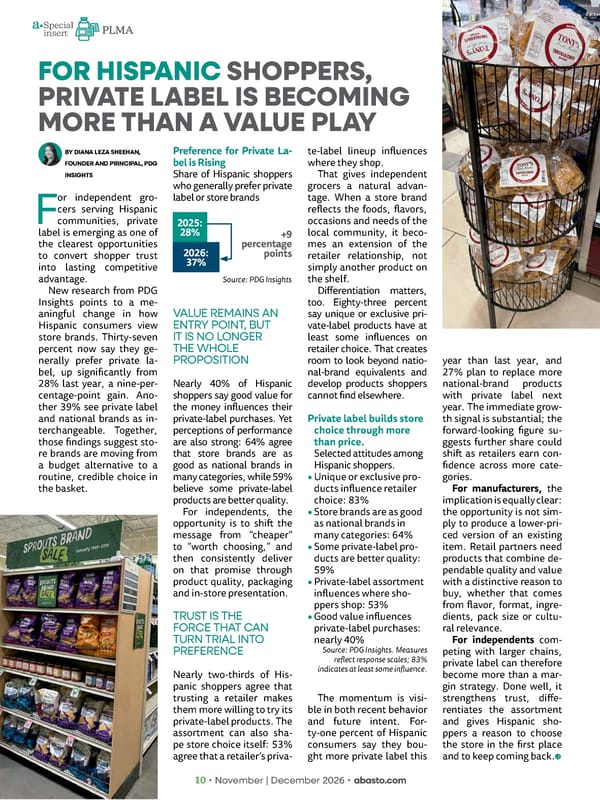
10 • November / December 2026• abasto.com Special PLMA insert FOR HISPANIC SHOPPERS, PRIVATE LABEL IS BECOMING MORE THAN A VALUE PLAY BY DIANA LEZA SHEEHAN, FOUNDER AND PRINCIPAL, PDG INSIGHTS F or independent gro- cers serving Hispanic communities, private label is emerging as one of the clearest opportunities to convert shopper trust into lasting competitive advantage. New research from PDG Insights points to a me- aningful change in how Hispanic consumers view store brands. Thirty-seven percent now say they ge- nerally prefer private la- bel, up significantly from 28% last year, a nine-per- centage-point gain. Ano- ther 39% see private label and national brands as in- terchangeable. Together, those findings suggest sto- re brands are moving from a budget alternative to a routine, credible choice in the basket. Preference for Private La- bel is Rising Share of Hispanic shoppers who generally prefer private label or store brands Source: PDG Insights 2025: 28% 2026: 37% +9 percentage points VALUE REMAINS AN ENTRY POINT, BUT IT IS NO LONGER THE WHOLE PROPOSITION Nearly 40% of Hispanic shoppers say good value for the money influences their private-label purchases. Yet perceptions of performance are also strong: 64% agree that store brands are as good as national brands in many categories, while 59% believe some private-label products are better quality. For independents, the opportunity is to shift the message from “cheaper” to “worth choosing,” and then consistently deliver on that promise through product quality, packaging and in-store presentation. TRUST IS THE FORCE THAT CAN TURN TRIAL INTO PREFERENCE Nearly two-thirds of His- panic shoppers agree that trusting a retailer makes them more willing to try its private-label products. The assortment can also sha- pe store choice itself: 53% agree that a retailer’s priva- te-label lineup influences where they shop. That gives independent grocers a natural advan- tage. When a store brand reflects the foods, flavors, occasions and needs of the local community, it beco- mes an extension of the retailer relationship, not simply another product on the shelf. Differentiation matters, too. Eighty-three percent say unique or exclusive pri- vate-label products have at least some influences on retailer choice. That creates room to look beyond natio- nal-brand equivalents and develop products shoppers cannot find elsewhere. Private label builds store choice through more than price. Selected attitudes among Hispanic shoppers. • Unique or exclusive pro- ducts influence retailer choice: 83% • Store brands are as good as national brands in many categories: 64% • Some private-label pro- ducts are better quality: 59% • Private-label assortment influences where sho- ppers shop: 53% • Good value influences private-label purchases: nearly 40% Source: PDG Insights. Measures reflect response scales; 83% indicates at least some influence. The momentum is visi- ble in both recent behavior and future intent. For- ty-one percent of Hispanic consumers say they bou- ght more private label this year than last year, and 27% plan to replace more national-brand products with private label next year. The immediate grow- th signal is substantial; the forward-looking figure su- ggests further share could shift as retailers earn con- fidence across more cate- gories. For manufacturers, the implication is equally clear: the opportunity is not sim- ply to produce a lower-pri- ced version of an existing item. Retail partners need products that combine de- pendable quality and value with a distinctive reason to buy, whether that comes from flavor, format, ingre- dients, pack size or cultu- ral relevance. For independents com- peting with larger chains, private label can therefore become more than a mar- gin strategy. Done well, it strengthens trust, diffe- rentiates the assortment and gives Hispanic sho- ppers a reason to choose the store in the first place and to keep coming back.
11 • November / December 2026• abasto.com
12 • November / December 2026• abasto.com Special PLMA insert FIVE COUNTRIES, ONE QUESTION: HOW CAN WE BECOME BETTER RETAILERS BY 2027? come to work? In a supermarket, em- ployees aren’t just behind the customer experience. They are part of the expe- rience. Task for 2027: better tra- in, listen to, and recognize our teams. It’s not enough to get them to show up. Let’s make it worthwhile; our store managers bear the greatest responsibility. CHILE: OUR PHYSICAL STORE IS NOW THE PREMIER RETAIL MEDIA PLATFORM Chile is at the forefront of retail media in Latin Ame- rica. Its sophistication is impressive, but, as in the United States, it seems we’re looking too much at screens and not enough at our aisles. A study by dunnhumby found that in-store displays were the most influential retail media format among U.S. consumers, surpas- sing online ads and perso- nalized recommendations. For Hispanic supermar- kets, this is a huge oppor- tunity. Brands want to reach our consumers. We already have them in our aisles, making decisions. Goal for 2027: Explore how screens, tastings, di- gital signage, promotions, and experiences can bring the store to life and allow brands to influence and measure conversion. PERU: PROTECT WITHOUT INTIMIDATING In Peru, I spoke at the launch of the country’s first major shrinkage study. The global statistic on in-store losses is alarming: $4 trillion. Technology is advancing in hardware, analytics, and applied artificial inte- lligence. But the challen- ge I posed to the Peruvian industry was: how does the honest customer feel when faced with all that technology? We can protect mer- chandise so much that we end up telling the custo- mer, “I don’t trust you.” Task for 2027: Invest in better control systems, but evaluate them on two criteria: how much they reduce our losses and how much they contribute to a safe, pleasant experience. Let’s protect inventory without making custo- mers feel watched or lo- sing trust. We toured Carrefour in Madrid with Spanish retail experts and retail executives from Mexico, Peru, and Bolivia. • Continues on page 14 BY RAMÓN PORTILLA, FOUNDER OF HUMANX INSIGHTS AND EXPERT IN HUMANISTIC LEADERSHIP 2 026 was a year of many kilometers. I had the opportunity to speak about retail and the human experience in Spain, Chile, Peru, Mexi- co, and the United States. These included conferen- ces, conversations with leaders, projects, and many store visits, where I witnessed innovation and saw how our employees serve customers. The markets are diffe- rent, but I was surprised by how similar some of their challenges are. That’s why, instead of predictions for 2027, I’m sharing five things I learned and, above all, what those of us who serve Hispanic consumers in the United States can do with them. SPAIN: MAKING COMING TO WORK WORTHWHILE Spain faces a major absen- teeism problem. During the second quarter of 2026, absenteeism accounted for 7.2% of agreed-upon wor- king hours, and more than 1.6 million people missed work every day. The problem, also evident elsewhere in the world, is a symptom of weaknesses in employee retention and en- gagement. I was left with a question: What can we do to make our employees want to
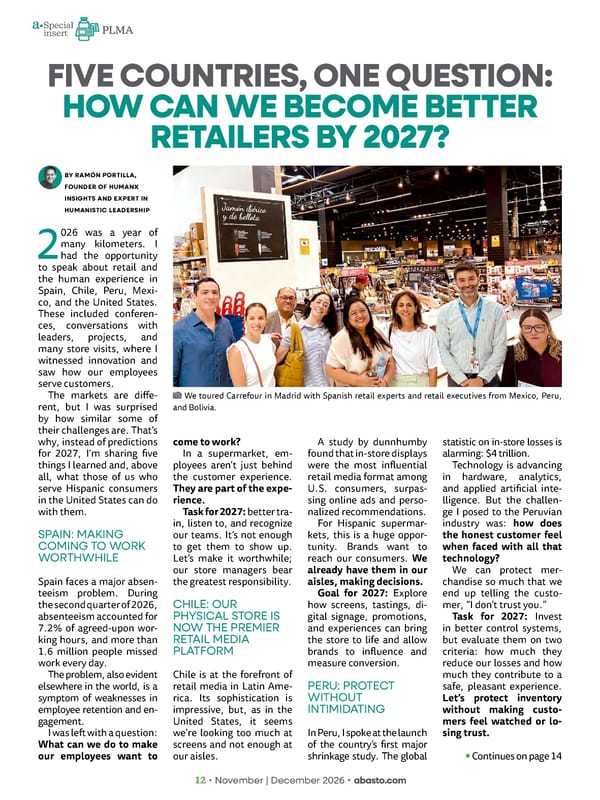
13 • November / December 2026• abasto.com
14 • November / December 2026• abasto.com Special PLMA insert MEXICO: PURPOSE IS DEMONSTRATED Mexico took me to Culia- cán, home to Coppel, the major retailer celebrating 85 years in business this year and well known to Mexican consumers in the United States. We talked about the customer expe- rience, but above all about purpose and trust. We can have NPS, sur- veys, dashboards, and customer journeys. But no tool can replace a more ba- sic question: Why should a customer trust us? Purpose isn’t just a slogan on the wall. It’s demons- trated when we streamli- ne the return process for a defective product or greet customers with a smile and address their concerns. Task for 2027: Turn our purpose into behaviors that every employee can understand and put into practice. Trust is built one interaction at a time. UNITED STATES: LISTENING, SERVING, AND PROTECTING WALLETS Back home: 2026 was a di- fficult year for many fami- lies, particularly our own. By mid-year, 71% of U.S. grocery shoppers said they were very concerned about inflation, and 77% were changing their spending habits. For part of our communi- ty, economic pressure was compounded by uncertain- ty and fear surrounding im- migration issues. That’s why Hispanic su- permarkets must be ob- sessed with listening to our customers, offering them the best possible value, and serving them exceptionally well. We have more tools than ever before. Now we need better inventory, logistics, and control systems that reduce costs and prevent stockouts, and, especia- lly, a customer relations- hip management (CRM) system that lets us get to know each customer indi- vidually. Consumers are ready: 85% of Hispanic consu- mers have at least one supermarket loyalty card, and 90% use a grocery shopping app during their visits. Task for 2027: Move from knowing the Hispa- nic consumer to knowing each Hispanic consumer. Implement or update our loyalty platform and help them save money through a personalized experience. FIVE COUNTRIES LATER... The big question 2026 lea- ves me with isn’t whether we need more technology, but what we need it for. To take care of our em- ployees. To energize our stores. To protect without intimidating. To build trust. To operate more effectively. And to listen to and serve our customers better. We Hispanic super- markets already have so- mething extraordinary: closeness, culture, and community. In 2027, we don’t need to become more hi- gh-tech supermarkets. We need to use techno- logy to become better su- permarkets. At the Enrique Coppel Tamayo Auditorium at Coppel, Culiacán, Sinaloa, Mexico. Retail Media Activa- tion at Falabella Stores, Santiago, Chile. Retail Media activation in Falabella stores, Santiago, Chile. • Continuation of page 12
15 • November / December 2026• abasto.com
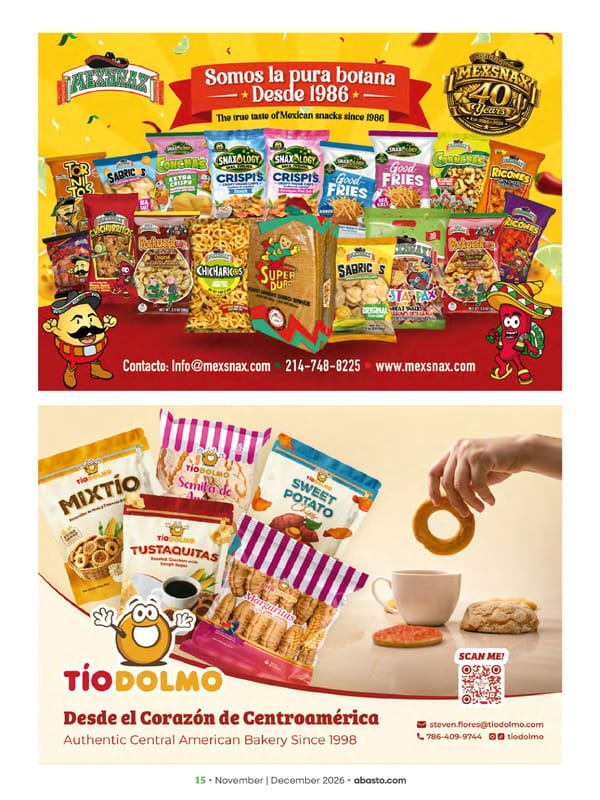
16 • November / December 2026• abasto.com
51 • November / December 2026• abasto.com
52 • November / December 2026• abasto.com BY MARY HESLEP TEN ACRE MARKETING W ith each passing year, the media noise gets louder and our abili- ty to pay attention sinks lower. The average attention span on a digital screen has shrunk to 47 seconds, down from 2.5 minutes in 2004, according to research by Gloria Mark of the University of California, Irvine. Mark has also found that it takes an average of 23 minutes and 15 seconds to return to a task after a single interruption. Productivity is a top issue for leaders- hip, and the produce industry is no excep- tion. Add today’s productivity accelerator, artificial intelligence, and the question be- comes: Is AI truly creating efficiencies, or is it adding to the challenge? Productivity was not the only hurdle in 2026. Across agriculture, labor and ta- riffs jockeyed for the top spot on the de- cision-making dashboard. On any given Turn Down the Volume, Win Back Trust Three ways produce leaders can regain consumer trust amid disruption. day, one of the two forced teams to aban- don their work and address the emergency du jour. Then spring came along and said, “Watch this.” Food safety issues such as Cyclospora and Listeria created a whodunit summer of confusion. Some consumers abandoned fresh produce altogether, guided by misin- formation or an attention span too short to absorb accurate information. The Interna- tional Fresh Produce Association said in a summer webinar that consumer trust in fresh produce had deteriorated by 88%. As we enter the fourth quarter, the challenges are only intensifying. Can this year be salvaged? Brilliant professionals across the produce supply chain are working tirelessly so we can enter the new year with optimism and opportunity. Here is how we protect our reputation as an industry and regain con- sumer trust. • Continues on page 54 • AGRICULTURAL INDUSTRY
53 • November / December 2026• abasto.com

54 • November / December 2026• abasto.com • Continuation of page 52 Our Workforce Has a Force From field labor to new talent entering agriculture, there is an opportunity to im- prove our workforce in every role along the supply chain. Federal funds continue to be earmarked for producers, and trade associations are getting louder and more public with their platforms. Consumers are hearing directly from those testifying to Congress just how fragile our domestic supply chain is. And it all hinges on labor. Trade associations such as the National Council of Agricultural Employers work to strengthen relationships with key officials at the Departments of Labor, Homeland Security, and Agriculture. NCAE focuses particularly on the latter, considering USDA a natural industry advocate in interagency discussions. Our workforce has a force be- hind it, ensuring that the wave of challenges we face never breaches the berm. Sharing your experiences in real time with these associations will strengthen their work. Consider where your story can have the greatest impact, and tell it. Global Challenges, Local Solutions Global conflicts can seem foreign and su- rreal when you step into your backyard, and the birds are still chirping. The reali- ty, however, is moving closer to home. Inflation can no longer be ignored. Gro- cery costs are rising, and fees, taxes, and surcharges on daily purchases are making that morning cup of joe unattainable. Small and local businesses have always fought the perception of price, but today, supporting them is no longer trendy; it’s a means of survival. Gas prices seem to have reached a new height with no plan to bring them down. With gasoline costs keeping people home and diesel costs climbing the farther the product travels, the solution seems to be investing in the local ecosystem, at least until the Strait of Hormuz reopens, should that happen in your lifetime. Consumers vote with their dollars, and the industry can help them understand just how impactful their actions are. The butter- fly effect is real, and change starts at home. Turn Down the Volume Saying it louder doesn’t guarantee your message is delivered. Whe- ther that message is a marketing value proposition for consumers, sa- les language for your customer, or an issues-driven plea to Congress, turning up the volume will not break through the noise. Instead, let’s try targeted, strategic messaging that lands in the right ears and in front of the right eyes at precisely the right time. It sounds like precision marketing because it is. Step one is understan- ding how your organization drives value for the partners and consumers you exist to engage. Do you know why they should choose you over your competition? Have you reminded them directly of that choice? Next, consider where your audience gets its decision-making infor- mation. Are you speaking to them directly in that channel? We are no longer everywhere all the time. Tailoring your message is the stan- dard, and it’s what your audience expects. Turn down the volume and speak clearly, with conviction and inten- tion. It’s what your audience needs in today’s distracted ecosystem. Outside factors will continue to disrupt business in the new year, but we can lead with intention, build trusted relationships, and pro- tect our reputation. Don’t fight the headwinds; spend the remainder of the year charting a course to navigate them. • AGRICULTURAL INDUSTRY
55 • November / December 2026• abasto.com
56 • November / December 2026• abasto.com Florida 20,6 % California 13.3 % COURTESY OF USDA/CHARTS OF NOTE Watermelon is a very popu- lar fresh fruit, with avai- lability peaking just in time for summer, though it is available year-round. In 2024, watermelon ranked third in per capita availability of fresh fruit in the U.S., behind only bananas and apples. With just over 15 pounds avai- lable per person, watermelon availability is double that of all other melon varieties combined. Watermelon’s popularity is su- pported by robust domestic pro- duction, spanning more than 100,000 acres nationwide. In 2025, the United States produced 3,870 million pounds of watermelons. Georgia surpas- sed Florida as the leading water- melon-producing state in 2025, with production reaching 813 million pounds and accounting for 21% of total U.S. production. Georgia’s production increa- sed year over year because of both expanded planted acre- age and above-average yields in 2025. Florida produced 798 million pounds of watermelon, accounting for 20.6% of produc- tion. California, Texas, North Carolina, and Indiana collecti- vely accounted for an additional 44.4% of production last year. As a warm-season crop, wa- termelon cultivation in the Uni- ted States begins in the spring and ends in early fall, with ship- ments typically peaking around July. To supplement year-round availability, fresh watermelons are also imported; imports peak seasonally in May and rise again in October as the domestic sea- son comes to a close. In 2025, imports totaled 1,800 million pounds, accounting for 34% of the domestic supply. Watermelon Production in the U.S. Reached 3,870 Million Pounds in 2025 Percentage of U.S. Watermelon Production by State, 2025 Sources: USDA, Economic Research Service, based on data from the USDA, National Agricultural Statistics Service, Annual Vegetable Survey. Note: Other states surveyed include: Arizona, South Carolina, Maryland, and Delaware. North Carolina 10.4 % Indiana 8.6 % Other states 14.0 % Georgia 21.0 % Texas 12.2 % • AGRICULTURAL INDUSTRY
57 • November / December 2026• abasto.com 1.Andr

58 • November / December 2026• abasto.com • Continues on page 60 John Ross: Curiosity, Family-Owned Stores, and What’s Next BY HERNANDO RAMÍREZ-SANTOS J ohn Ross still remembers when he came home from his first job at a supermarket, at age 16, with a verdict: “This is very, very hard. I never want to work in retail.” He never left. Decades later, the grandson of a West Virginia grocer is president and CEO of the Independent Grocers Alliance (IGA), which celebrates its 100th anniversary this fall and opera- tes about 8,000 stores worldwide. In an exclusive interview with Abasto Magazine, Ross spoke less like the leader of a global alliance and more like the store boy he once was. He admitted independent grocers are lagging with younger shoppers, argued that a supermarket should be “the most egalitarian business model there is,” and said the best part of his job is still helping a family-owned store grow. “It’s the coolest job there is,” he said. Interview edited for length and clarity. Your grandfather owned a gro- cery store, and you started as a parking attendant. How did that shape you as a leader? You could say the grocery business is in my DNA. Retail teaches you an IGA Celebrates Its 100th Anniversary: “Our Audience Is Everyone Who Eats” incredible work ethic and discipline. Those who end up loving it see a cus- tomer with a problem—or someone upset—and don’t see it as something to run away from, but rather some- thing to run toward. If you solve that problem, you create a connection that lasts forever. What does the centennial mean for IGA? It’s a great story. In 1926, the first national chains were driving sma- ll businesses out of the market left and right. IGA was formed so that independent stores could band toge- ther and use their collective strength to compete. The competitors have changed, but the need for this busi- ness remains the same. Anyone rea- ding this magazine who inherited the business from their parents and grandparents can rightly tell their fa- mily, “My job is harder than yours.” Think about the skills required to- day: loyalty programs, e-commerce, digital media, and social media. IGA continues to grow. Where is the opportunity? We’ll end this year with about 4,000 stores in the United States alone, and well over 8,000—close to 9,000— worldwide. The company has tripled in size in the United States alone over the past four or five years. But I be- lieve we’re just getting started. There are 30,000 independent stores in the country, and they’re not the same businesses they were 20 or 30 years ago. Hispanic business owners own many or serve Hispanic neighbor- hoods. JJohn Ross, president and CEO of Indepen- dent Grocers Alliance (IGA). • FOOD INDUSTRY / EXCLUSIVE INTERVIEW
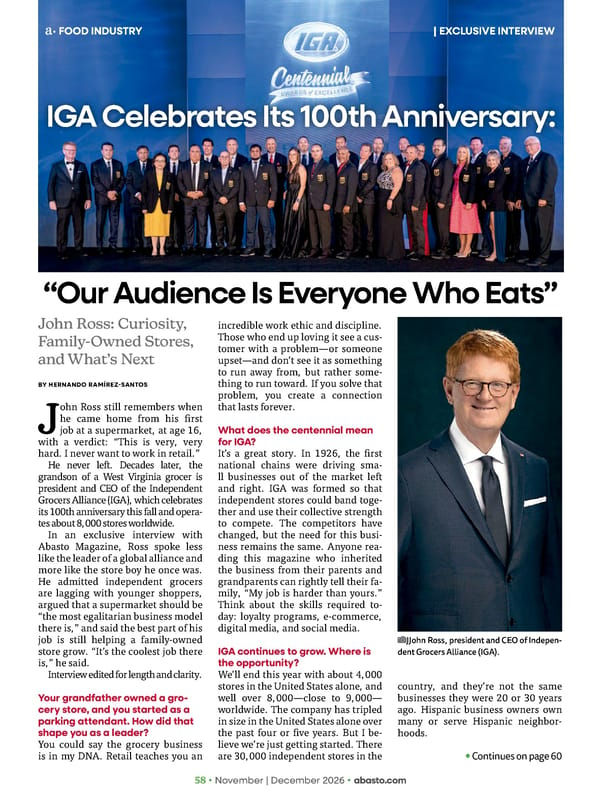
59 • November / December 2026• abasto.com
60 • November / December 2026• abasto.com • FOOD INDUSTRY / EXCLUSIVE INTERVIEW • Continuation of page 58 How are young and multicultu- ral shoppers changing the retail landscape? As a group, independent retailers tend to lag. Our stores focus on our primary cus- tomer today, who is increasingly older. We may not have the same connection with their children or grandchildren. That’s a shortcoming and a problem we need to solve. But no generation of con- sumers has ever been more passionate about food. They’re passionate about local products, authenticity matters a great deal to them, and they’re much more open to trying new things. In rea- lity, our audience is everyone who eats. You can’t afford to run a low-margin bu- siness like a supermarket and fail to ser- ve your entire community. What was the biggest challenge this year? To be honest, it’s tough. The policies coming out of Washington—from immigration to SNAP to tariffs—all conspire to make things harder for consumers. Inflation is very, very bad, and consumers need more va- lue. Our shoppers deserve the same deals, savings, and prices as someo- ne in a more affluent suburban nei- ghborhood. How can a small-town indepen- dent retailer use AI? I’m very optimistic about AI. I’m not at all interested in the big corporate AI deals that mega-retailers are ma- king. I’m interested in taking the data we already generate and brin- ging it down to the lowest levels, so that any young person in the produce department can walk down an ais- le with their cell phone and ask, in English or Spanish, “Are there any issues with any of the items on sale this week?” Hundreds and hundreds of stores are already doing this. What keeps you up at night? In general, I’m very optimistic. Many of our retailers make a 2% net profit on a good day, and they’ve managed to grow and stay afloat. But we have to be honest about succession plan- ning. Sometimes the children of the entrepreneurs who built these busi- nesses don’t want to work in this in- dustry the way their parents did. The hours are long. It’s very difficult. What do you like most about your job? When a family comes back and tells you, “We implemented your visual merchandising program, and sales went up 12%,” and you think: I pla- yed a small part in that. If I do my job well and the team does theirs, we help leave a legacy so that their chil- dren and grandchildren can continue to support those communities like no one else. That’s why it’s worth getting up every morning.
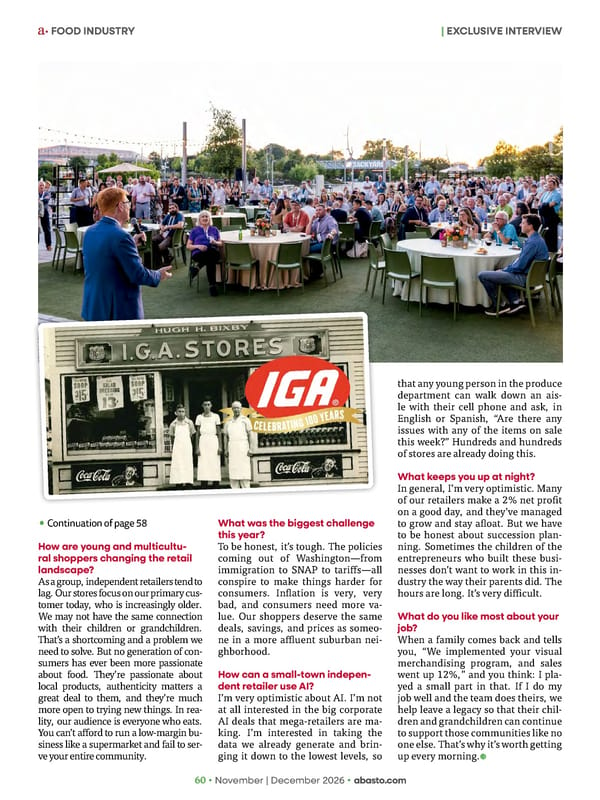
61 • November / December 2026• abasto.com
62 • November / December 2026• abasto.com • Continues on page 64 2026 Review: Challenges, Opportunities, and the Hispanic Market Industry leaders weigh in on this year’s defining moments and how the Hispanic community responded. BY VIOLETA MONTES DE OCA T he food and beverage industry navigated a tumultuous 2026 marked by policy shifts and price spikes, including rising fuel and fertilizer costs. Three industry experts consulted by Abasto Media said immigration, tariffs, and food safety concerns affected supermarket operations and shaped how the Hispanic community responded. DAVID HINOJOSA, CEO OF HERITAGE GROCERS GROUP What was the biggest challenge, and how did you adapt? Balancing consumer budget pres- sure with the need to improve busi- ness fundamentals. Our customers mental: fresh fruits and vegetables, meats, bakery, and prepared foods drive trip frequency, trust, and a deep connection with our commu- nities. We also saw strong momen- tum in digital engagement and loyalty program participation. The biggest opportunity is delivering outstanding fresh foods and a cultu- rally relevant assortment in-store, backed by improved digital tools, personalization, and clear value communication. What change or event will have the greatest impact? A highly value-conscious Hispa- nic consumer who is increasingly connected digitally. Retailers must compete on price, quality, cultu- ral relevance, and convenience. At the same time, shifting economic conditions and public policy chan- ges create additional pressure on household budgets and shopping habits. Winners will be those who understand their communities at a hyper-local level while building the technology, data capabilities, and operational discipline modern re- tailers require. are value-conscious, so we couldn’t manage inflation or operational pressures simply by raising prices. We focused on precise pricing, more effective promotions, labor and shrink discipline, better in- ventory and stock execution, and streamlined operations. Protecting value means giving customers the confidence to feed their families, helping them find the products that matter to them, and assuring them that we will con- sistently deliver value. What was the biggest opportunity? Getting closer to the customer and elevating category execution. Fresh produce departments are funda- • FOOD INDUSTRY
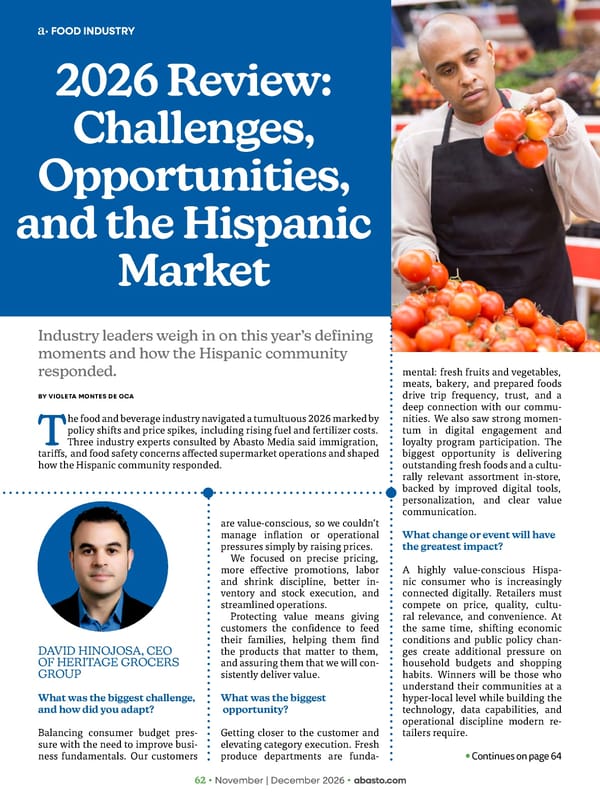
63 • November / December 2026• abasto.com
64 • November / December 2026• abasto.com • Continuation of page 62 • FOOD INDUSTRY JOHN ROSS, PRESIDENT AND CEO OF THE INDEPENDENT GROCERS ALLIANCE (IGA) What was the biggest challenge, and how did you adapt? It’s tough. A confluence of issues is making things increasingly diffi- cult for consumers, driven by poli- cies coming out of Washington on topics ranging from immigration to the SNAP program and tariffs. Everything is compounding to worsen the situation for consu- mers. Low- and middle-income fa- milies are feeling more pressure, and relief is nowhere in sight. Add to that an unrelenting global envi- ronment, with wars in two regions that drive up the cost of fertilizer and other agricultural inputs, ulti- mately raising the price of the final product on the shelf. Inflation is truly catastrophic, and consumers desperately need more value. We must ensure we have the right price on the shelf and leverage our collective scale to capture major CPG manufacturers’ attention. This isn’t optional: major brands must invest in our shoppers. Our customers deserve the same deals, savings, and pricing as sho- ppers in higher-income suburban areas. I believe this is the time for IGA to leverage its scale and ensure manufacturers don’t overlook us. DANTE GALEAZZI, PRESIDENT AND CEO OF THE TEXAS INTERNATIONAL PRODUCE ASSOCIATION (TIPA) What was the biggest challenge? It was very similar to last year: adap- tation. Changes are happening too fast and too frequently. Look at just a couple of issues we saw over the summer: high fuel prices going into contract negotiations. How do you approach buyers worried about food inflation and trying to keep retail prices down for consumers, who in turn see their dollars buy less and less food? The Hispanic demographic is one of the highest consumers of fresh produce in the United States. Yet that population, along with every other demographic group, is buying fewer fresh fruits and vegetables. Another major challenge has been food safety concerns. How do we balance it all? Adap- tation has certainly been one of our greatest hurdles. What was the biggest opportu- nity? Our messaging and communica- tion strategy. People are buying less produce because of the immense misinformation this summer su- rrounding cyclosporiasis and sal- monella outbreaks. Statistically, you are more likely to get into a car accident than to contract these ill- nesses. Fresh produce is safe and healthy, and families need to buy more of it because it’s essential for their well-being. What change or event will im- pact the Hispanic community the most? The food safety events that occurred this summer. Fresh fruit and vegeta- ble volumes in stores have dropped between 40% and 60%. Would you like me to draft news- letter subject line options or social media summaries for this article as well?
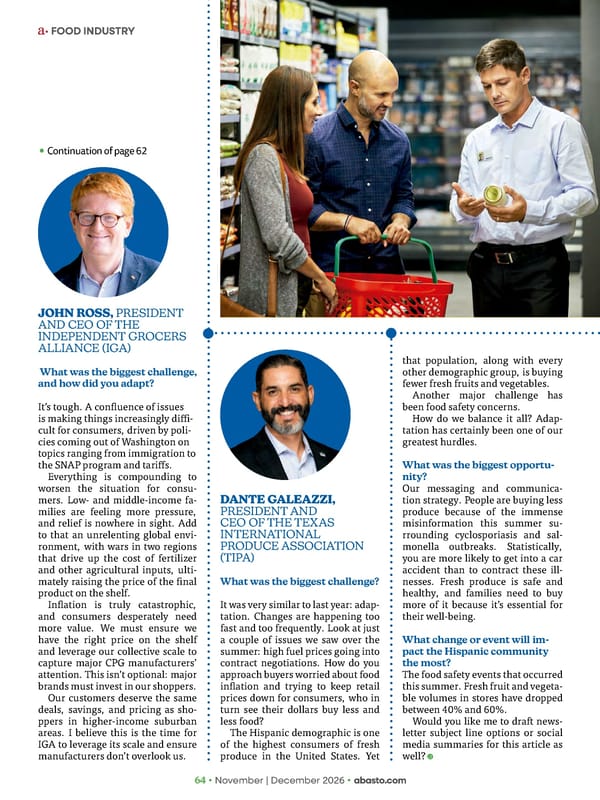
65 • November / December 2026• abasto.com
66 • November / December 2026• abasto.com • Continues on page 68 Tighter Stores, Stronger Year I f 2026 taught Hispanic retailers anything, it is that growth can no lon- ger be taken for granted. The funda- mentals still favor our channel. But 2027 will reward operators who run tighter sto- res, not just busier ones. Every Trip Counts Circana projects U.S. food and beverage sales will grow 2% to 3% in 2027. Most of that growth comes from price and mix while volume stays flat. Market share has to be earned one basket at a time. SNAP adds another layer. As of October 1, the federal government covers 25% of the program’s cost, down from 50%. The 2025 A 2027 Playbook for Hispanic Retailers BY RON MARGULIS budget law also shifts more costs to states in the years ahead. Expect some states to tigh- ten enrollment. That will squeeze the very households many of the stores serve. Hispanic neighborhoods also face pres- sure the general market does not. Che- draui reported that second-quarter sa- me-store sales at El Super and Fiesta Mart fell 2.3%. Management pointed to immi- gration enforcement, higher fuel prices, and reduced SNAP benefits. Independents are feeling the same chill. Yet the long-term story remains strong. Hispanic buying power is projected at $2.8 trillion in 2026 and is growing faster than the overall market. PDG Insights found that more than 30% of Latino consumers shopped a supermercado or bodega in the past year, up from 26% in 2024. Even be- tter, as I’ve written in previous columns, 60% of general-market shoppers under 45 say they would shop a Latino grocer more often if one were closer. • FOOD INDUSTRY
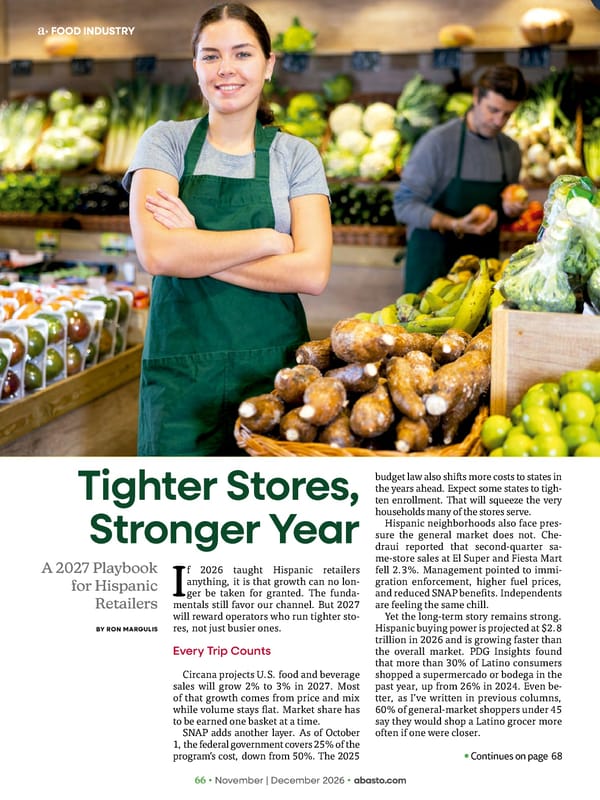
67 • November / December 2026• abasto.com
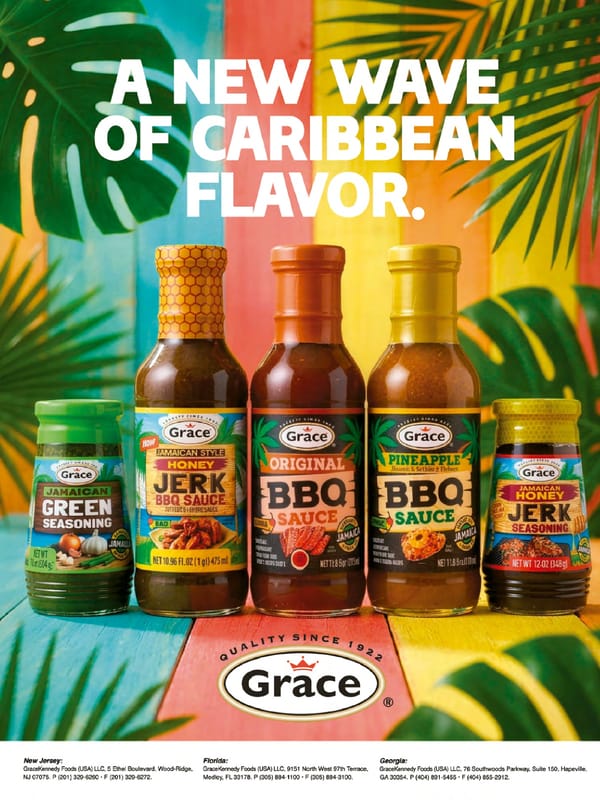
68 • November / December 2026• abasto.com • Continuation of page . 66 • FOOD INDUSTRY The GLP-1 Basket About 18% of American adults now use a GLP-1 medication, up from 14% a year earlier. These shoppers buy fewer chips, cookies, soft drinks, and candy. De- mand is growing for protein, produce, and yogurt. This is an opening for Hispanic food retailers. The carnicería, the produce de- partment, fresh cheeses, beans and hou- se-made aguas frescas already match what these customers want. The job is to tell that story out loud. From Pilot to Practice FMI reports that 68% of food retailers now use AI, up from 47% a year ago. Grocers spent nearly 2% of sales on technology in 2025, double the prior year. Independents do not need to match the chains dollar for dollar, but they do need to pick their spots. Immigration enforcement has pushed some Hispanic shoppers from in-store to online. The shift is rooted in safety, not preference. A store without a digital front door is leaving those customers to someo- ne else. Three Moves for 2027 1. Lead with fresh and better for you. Build bilingual signs and displays around protein, produce, and smaller portions. Present traditional foods as the healthy choice they often are. 2. Make one technology bet and measu- re it. Pick the problem that costs you the most, whether that is fresh shrink, labor scheduling, or online ordering. Set a clear payback target before you sign the con- tract. 3. Defend value and the SNAP shopper. Track your state’s SNAP changes, expand private label and bulk packs, and make sure every associate can explain EBT and WIC options with respect. 2027 will not be an easy year. But His- panic retailers have always known their customers better than anyone else in the market. Run the store with that same dis- cipline, and the year can be a good one. Immigration control measures, rising fuel prices, and cuts to SNAP benefits could be contributing to the decline in sales at brick- and-mortar stores.
69 • November / December 2026• abasto.com

70 • November / December 2026• abasto.com • FOOD INDUSTRY Beyond the Generic Label: Build a Store Brand Shoppers Recognize BY KEN NINOMIYA S tore brands are no longer merely lower-priced alternatives. They are an opportunity for independent gro- cers to own a distinctive promise around quality, value, local tastes, and every- day convenience. But even if a product is great, it might not be seen if its digital identity and packaging don’t match up on shelves, websites, and AI searches. The stakes are rising. The Private Label Manufacturers Association reports that sto- re brands’ sales in the U.S. increased 3.3% in dollar value to $282.8 billion in 2025 compared with 1.2% for national brands. In September 2026, NielsenIQ said that 51% of Americans used an AI-powered shopping tool in the prior month. A store brand name must now work for shoppers looking at pro- ducts in stores, as well as with AI. Key Tools Canva: Grocers can use it to develop a consis- tent visual system for private-label promotions that help market across AI platforms. This sys- tem might include color palettes, layouts for product photos, recipe cards, etc. It has AI-as- sisted design features that can quickly genera- te ideas for you to review. Adobe Express: Create branded materials and customize them to generate a more powerful AI digital footprint. Use approved photos and text of products to create short movies, social posts, banners, and signs for the store. Its AI-assisted creative tools keeps consistency in every store brand’s channel. Recognition, consistency and tasteing Recognition requires more than attractive graphics. Clear promise. Grocery stores should make a clear promise about the products they sell: line based on family favorites, regional flavors, or premium. That promi- se should be made clear on every mention. Digital consistency: For AI-assisted shop- ping, having brand consistency also helps shoppers find your products. Use the same name, brand spelling, picture of the pac- kage, and factual information in every sto- re’s website and mention. Tasteing: Start with one group, like snac- ks or sauces. Test the package and digital content with real customers first, and then see how well they are known, how many people try them, and how many people buy them again. It’s important to make a store brand that people will remember and look for on their AI engine. LiveAICourse.com has useful lessons on buil- ding a brand using AI and is taught in live online sessions.
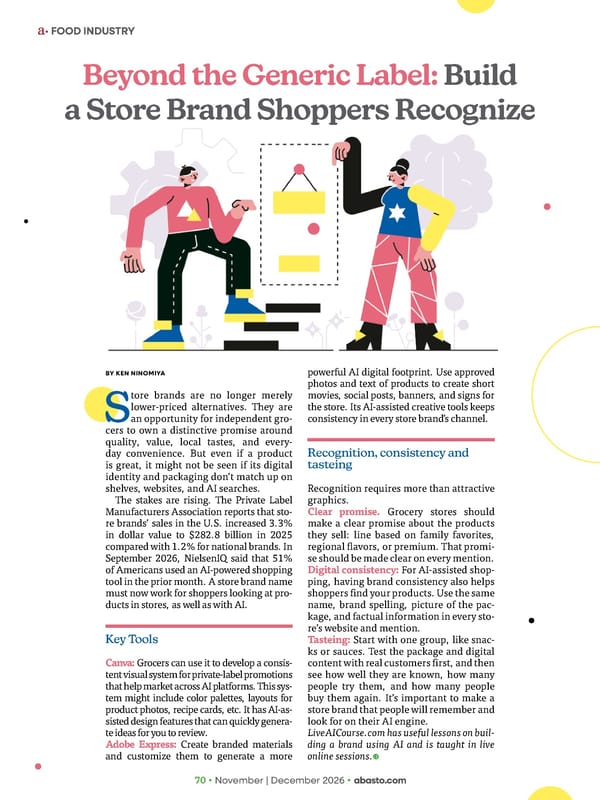
71 • November / December 2026• abasto.com
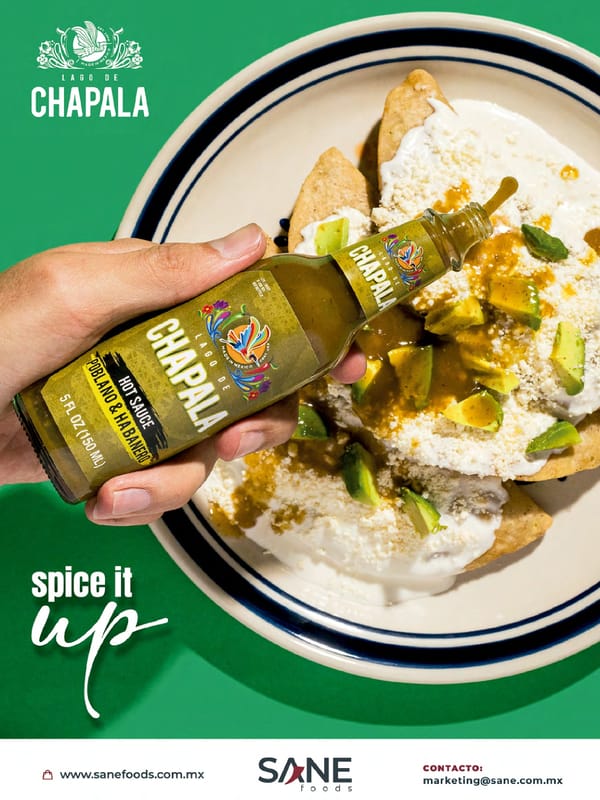
72 • November / December 2026• abasto.com • FOOD INDUSTRY Carlos Cotto began his career in the supermarket industry at age 15. Bagging groceries and collecting shopping carts were his first responsibilities. He also cleaned restrooms and has remained with the same chain throughout his career: Winn-Dixie. As a child, he wanted to be a doctor, but life steered him down a different path. “I joined the grocery sector without realizing it would become my platform for leadership, impact, and transfor- mation,” he shared in a recent LinkedIn post. Cotto uses the platform to inspire others because he takes his career journey very personally. “Becoming a store manager was a milestone, not the final destination,” he continued. From the Trade Show to the Shelf Carlos Cotto of Winn-Dixie Explains How He Selects New Products BY VIOLETA MONTES DE OCA S upermarket repre- sentatives attend tra- de shows with clear objectives: to do business, maximize their time, and plan what will hit their sto- res in upcoming seasons. For example, Carlos Co- tto, International Foods & Category Strategy Lead at Winn-Dixie, attends the an- nual Americas Food and Be- verage Show and Conferen- ce in Miami. He works for one of the largest supermar- ket chains in the Southeast, with stores across Florida and Georgia. “This is a great hub for talking to all the vendors. I work with 200 distribu- tors, and those distributors carry their own brands. Al- most every brand is here. When I come here, I hand- le holiday shows as well as regular day-to-day items to improve selection and deliver the best price to the customer—because that matters most. I connect with everyone here. And if we spot something new, I evaluate it to bring it to the chain and move forward,” he explained in an inter- view with Abasto Media. In fact, Cotto has already identified products that will arrive on Winn-Dixie shelves by summer, such as hydrating beverages. The First Step: Securing a Distributor When Cotto discovers a product—beyond tasting good and catching his eye—it has to be more than just a mockup. Registra- tion, FDA approval, pro- duction capacity, and port availability are essential requirements. “If I find a completely new company that doesn’t have a distributor, I need to connect that product with a distributor and tell them to talk and negotiate. After that, I review pricing, pro- fit margins, promotions, and what they plan to do to bring the product to mar- ket. Then we start onboar- ding it, finding it a home, and doing a category re- view. A lot of companies don’t understand that pro- cess,” he detailed. At large supermarkets, you need to open a plano- gram and assign a spot for the product so it can sell. Otherwise, it will never make it onto a display rack and will be discontinued in six months because of low sales. Invest in Market Research Cotto stresses that thorough market research is critical before introducing a pro- duct to a supermarket. The United States is complex and varies by region; a suc- cessful product in Florida Leadership Lessons doesn’t guarantee the same outcome in California. Before meeting with a buyer, suppliers must comply with all FDA regu- lations and import permits and have a pitch ready with pricing and promotional calendars. Otherwise, they risk heavy financial losses. Cotto suggests conducting research, aligning com- mercial expectations, and ensuring the product de- livers real value before ta- king the next step.
73 • November / December 2026• abasto.com
74 • November / December 2026• abasto.com • Continues on page 76 • FOOD INDUSTRY The Whole Year is Hispanic Heritage El Rio Grande Latin Market Makes Hispanic Culture a Year-Round Strategy BY HERNANDO RAMÍREZ-SANTOS F or El Rio Grande Latin Market, His- panic Heritage Month didn’t end on October 15. The locally owned su- permarket chain in the Dallas-Fort Worth (DFW) area has made Hispanic culture a driver of growth and promotions that its customers enjoy 12 months a year. That approach originates in the marke- ting department. Lizette Gómez, a recent arrival from California, leads the strategy for a company with nine stores and about 1,000 employees in Dallas, Fort Worth, Grand Prairie, Garland, and Mesquite. Abasto Media spoke with her about how the chain translates Hispanic culture into day-to-day business decisions. Identity Before Product Gómez anchored the Hispanic Heritage campaign—scheduled for September 15 through October 15—around a question that few supermarket flyers ask: What does it mean to you to be Hispanic? That question, however, doesn’t expire with the calendar. “Being Hispanic can be broad, right?” said Gómez. “You can be from anywhere. It’s not just Mexican; it’s everything.” To reflect that diversity, the executive recruited 15 influencers from across the Latin American diaspora. Instead of con- ventional sponsored posts, each creator shares personal culinary memories: tama- les with Grandma, ceviche at coastal festi- vals, pozole on winter Sundays. Gómez, who describes her roots as “coastal and tropical,” brings her own ex- perience to that creative direction. An In-Store Experience That same ambition extended to the aisles. Signage, floor decals, and special product highlights put Hispanic items front and center. The company is also de- veloping online offers to build on that mo- mentum. Gómez also planned a cultural cele- bration at one of the stores, featuring tastings, music, and a photo booth. She incorporated hand-painted ceramic ta- bleware—similar to what her grandmo- ther kept at home—for sale to the public. This detail reveals the goal: El Rio Grande Latin Market wants to sell an experience, not just products.
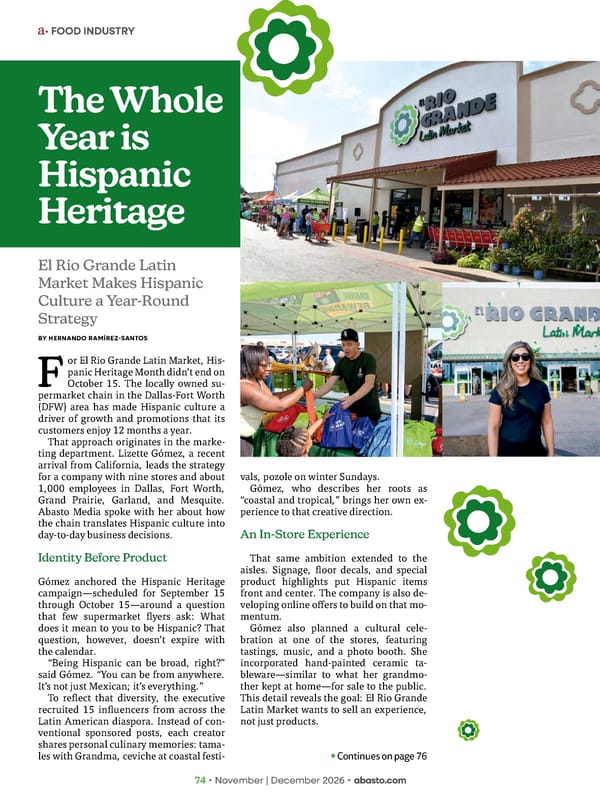
75 • November / December 2026• abasto.com

76 • November / December 2026• abasto.com • Continuation of page . 74 • FOOD INDUSTRY What’s Next Growth shows no signs of slowing down either. Gómez confirmed expan- sion plans, though she did not disclose locations or opening dates. She did reveal that a new depart- ment will be coming “pretty soon” to the entire chain, and that the managers of the nine stores are involved in the planning. The opportunity is real. Several regio- nal Hispanic chains in DFW have been acquired by national conglomerates in re- cent years, creating space for a locally owned format that offers authenticity to those who prefer an independent operator. That’s why Hispa- nic Heritage Month serves less as a conclusion than as a starting point: the first major public test of Gómez’s leadership and a trial run for a stra- tegy that embraces Hispanic culture 365 days a year. A Renovation in Step with the Customer This vision aligns with a major physical reinvestment. In July 2026, the company unveiled the renovation of its anchor store on North Buckner Boulevard in Dallas. The remodel featured a modernized merchandi- se layout, an expanded butcher shop, and a more prominent La Palapa Juice Bar. Gómez explains the juice bar expansion as a response to the changing profile of the Hispanic consumer—more health-cons- cious yet faithful to tradition. “As a Hispanic woman, when I don’t feel well, I drink a ginger shot,” she said. “Or if I feel bloated, I drink a turmeric shot.” The menu includes cold-pressed jui- ces and wellness shots. Gómez prefers to keep the surprise announcements under wraps, but she confirmed that the offe- rings will follow market trends. The butcher shop, for its part, listens di- rectly to customers. Its butchers ask for fee- dback on the selection—a simple approach that independent operators implement more nimbly than national chains. Bilingual by Principle In addition, the chain follows a clear rule in its communication: Spanish-speaking custo- mers should never have to make more of an effort than English-speaking ones. “I don’t want to leave anyone out,” said Gómez. In practice, the weekly advertising is bilingual, featuring “pork” alongsi- de “puerco,” and the store signage uses both languages. Social media, for its part, translates key messages rather than du- plicating posts. Gómez grew up speaking Spanish at home and English outside, and his advertising reflects that duality rather than flattening it into a single language. That cultural fluency also gives it a com- petitive edge. While national chains expand their multicultural marketing with varying degrees of authenticity, a regional operator retains a credibility that an external adverti- sing budget can hardly replicate. The Community, Now in the Spotlight Likewise, El Rio Grande Latin Market has been providing community services for years without publicizing them: money transfers, bill payments, food drives, and product donations to local hospitals. Gó- mez wants to change that discretion. “We receive requests, and we give,” she said. “But we haven’t really publicized it much yet.” With that goal in mind, the executive plans to organize a Day of the Dead event together with the local community. She also wants to give more visibility to the com- pany’s ongoing micro-donations: conchas for a hospital event or water for outdoor ga- therings during Texas’ sweltering summers. The chain has already proven it can create shareable moments. In May 2024, it earned a Guinness World Record for the world’s largest fruit display—an “avoca- do wonderland” it set up at a Dallas store that garnered national coverage. Gómez’s calendar follows that same logic: events that the community embraces and shares organically.
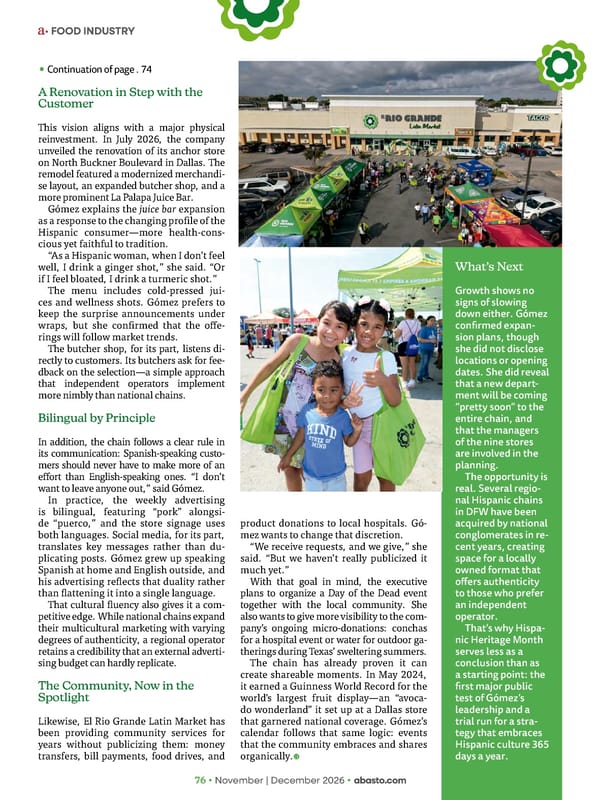
77 • November / December 2026• abasto.com
78 • November / December 2026• abasto.com • FOOD INDUSTRY Mars Envisions Automated Shopping and Stores as Destinations for Discovery BY ABASTO W alking down aisles to restock the pantry could become a thing of the past. That’s the vi- sion presented by Mars, which released a study on the future of shopping and retail on October 6. To develop the study, the company’s snacks division collaborated with consu- mer research firms Kantar and Synthe- sis. Together, they analyzed more than 180,000 data points across four conti- nents, including expert interviews, trade publications, podcasts, and news articles. Two Parallel Worlds The central finding describes a duality. On the one hand, artificial intelligence (AI) agents will take over routine shopping and turn it into a background service, almost invisible. On the other hand, physical stores and digital platforms will no longer resemble a traditional supermarket. Instead, they will function as spaces for discovery, play, and community that consumers will choo- se to visit. “We are on the cusp of a retail revo- lution—one in which people may never again have to shop for household staples manually,” said Neil Reynolds, global chief customer officer at Mars Snacking. Three Consumer Demands Based on this data, Mars identifies three demands that will define the next decade: effortless, personalized, and experiential shopping. Effortless. AI systems will recommend products based on preferences and inven- tory; the shopper will confirm. Accor- ding to BrightEdge, AI-driven referrals to e-commerce brands grew 752% year-over- year during the 2025 holiday season. Personal. The shopping journey will The Grocery Store of the Future: Less Chores, More Fun offer shortlists tailored to each individual and their health and wellness goals. Today, 39% of consumers expect personalized on- line experiences, according to TransUnion. Experiential. With daily routines taken care of, consumers will devote more time to what they enjoy. As a result, stores will focus on immersive experiences. Twen- ty-two percent of digital shoppers in the United States already make purchases via live streams, according to eMarketer. A Double Challenge As a result, retailers and brands face a double challenge. First, they must inte- grate predictive replenishment systems. They also need to transform their stores into sensory destinations that reward cus- tomers for leaving home. For the snacks category, the shift is sig- nificant. Mars anticipates that traditional browsing and impulse buying will give way to a supply process that occurs in the background. For this reason, Reynolds emphasized that no company can solve this on its own and called for working hand in hand with retailers and other partners. Mars, with 115 years of experience, states that it is investing to reinvent the category and in- novate at consumer touchpoints. That said, these findings should be viewed as the company’s own projections rather than consolidated market results. Even so, they offer supermarkets and in- dependent stores a roadmap for balancing the efficiency customers don’t see with the experience they remember. By the Numbers Behind the three key buyer demands. The bars show percentages exceeding 100%. Effortless +752% Year-over-year increase in AI-driven recommendations for e-commerce brands, 2025 holiday season Source: BrightEdge Personal 39% Of consumers expect personalized online experiences Source: TransUnion +15% Projected annual growth of health and wellness mobile apps through 2030. Experiential 22% Of U.S. digital shoppers already make purchases via live streams. Source: eMarketer +15.3% Year-over-year growth of immersive brand experiences Source: Mars press release
79 • November / December 2026• abasto.com
• FOOD INDUSTRY 80 • Noviembre / Diciembre 2026 •abasto.com IN THE HALLWAYS 1. Gabriel Cicero, Gustavo Blanco, and Yesenia Salas Blanco from Amaruyamyu. 2. Opening of the event. 3. Mauricio Menéndez, Francisco Menéndez, Sandra Martínez, and Erik Chet from Mesoamerica Foods. 4. Mariana Asayag, Valeria Vida, and José Miguel Fal- cón from Alicorp. 5. Mario Deras and Gracia Elías from Bocadeli. Americas Food & Beverage Show Marks its 30th Milestone BY VIOLETA MONTES DE OCA T he Americas Food & Beverage Show & Conference (AF&B), organized by the World Trade Center Miami (WTCM), concluded its 30th edition on September 16 at the Miami Beach Conven- tion Center. The event drew 11,700 attendees and representatives from 115 countries and territories over three days of hemispheric food and beverage trade, marking one of the broadest international presences in the show’s history. More than 13,000 professionals registe- red for this historic edition, and 990 exhi- biting companies occupied 22 internatio- nal pavilions in the exhibition hall. Thirty years ago, AF&B started as a gathering of a hundred companies with one goal: connecting the Americas through food and beverage trade,” said Ivan Barrios, President & CEO of World Trade Center Miami. “This year, we welcomed nearly 12,000 people and 115 countries and territories to Miami Beach, a true testament to what three decades of relationship-building can do for small and medium-sized businesses across our hemisphere.” Iván Barrios / President and CEO of the World Trade Center Miami Every number behind this show represents a real connection made on the floor,” said Alice Ancona, Chief Operating Officer of World Trade Center Miami. “Nearly 1,000 exhibiting companies and 22 international pavilions give you a sense of scale, but what stood out this year was the depth of participation – buyers and producers coming back year after year, and new markets showing up for the first time.” Alicia Ancona / Director of Operations at World Trade Center Miami. In their words • Continues on page 82 2 3 5 4 1
www.americasfoodandbeverage.com81•November / December 2026•abasto.com DATES: Sept. 27–29, 2027 VENUE: Miami Beach Convention Center Where the World Meets the Americas ThankYouforjoining us,seeyouin2027 !
• FOOD INDUSTRY • Continuation of page 80 Program Highlights The 30th edition of the Americas Food & Beverage trade show featured 51 sessions over three full days of programming, divi- ded among the conference program, the main stage (Center Stage), and the beve- rage stage (Beverage Stage), in addition to the trade show’s opening ceremonies. Florida Lieutenant Governor Jay Collins, the USDA’s Assistant Secretary for Com- merce and Foreign Agricultural Affairs, | Luke Lindberg, and Turkey’s Ambassador to the United States, Sedat Önal, were | 6 | 7 | | among the dignitaries who visited the ex- | | hibition hall during the event. | | This year’s edition also featured the Uni- | | ted States as the Country of Honor throu- | | gh NASDA’s “A Taste of the States” pavi- | | lion, which showcased 165 U.S. food and | | beverage companies to commemorate the | | nation’s 250th anniversary. | | In an exclusive interview with Abasto, | | Luke J. Lindberg shared his perspective | | on the 30th edition of the Americas Food | | & Beverage Show and analyzed the role of | 8 | U.S. agriculture in international markets. “I’m always impressed by the innova- tion in U.S. agriculture—these small and medium-sized businesses that invent new ways to use our high-quality products in ways that are truly culturally relevant to many markets around the world,” Lind- berg shared. • Continues on page 84 10 9 IN THE HALLWAYS 6. José Alvarado, Abraham Anaya, and Davor Her- vas from Tadin Herb and Tea. 7. César Mancipe from Comercial Mexicana. 8. Kevin Shin and the team from Pocas. 9. Luis Alfonso García and Guillermo Corona from Salsa Huichol. 10. Christopher Mahoney from National Retail So- lutions. 11 11. Pelayo Soneira from Avanti. 12 12. Rocío Fonseca from El Gran Chaparral. 82 • November / December 2026• abasto.com
83 • November / December 2026• abasto.com
• INDUSTRIA ALIMENTOS | • Continuation of page 82 | By the Numbers | | 13,000+ | | professionals | | registered | | 11,700 | 17 | | attendees on-site – | | up from 10,000 in | | 2025 | | 13 | 990 | | exhibiting | | companies – up | | from just over 900 in | | 2025 | | 22 | | international | | pavilions | 18 | | 115 | | countries and | | territories | | represented | | September | | 14 | | 27–29, | | 2027, | | when the AF&B | | Show will return to | | the Miami Beach | 19 | Convention Center for its 31st edition. 15 CHECK OUT THE HIGHLIGHTS FROM 20 THE TRADE FAIR: IN THE HALLWAYS 13. Antonio Carrasco, Jaqueline Gordillo, Katy Karpati, and Alejandro de la Hoz from Goya. 14. Ilse González, Ariel Ramos, and Mónica Serna from Multiglobal. 15. Camila García, Valentina Carrillo, Sandra Córtes, and Rafael Corredor from Innercia. 16. Francisco Alonzo from Idealsa. 17. Alice Ancona and Iván Barrios from the World Trade Center, Miami. 18. Karina González and Esteban Cuéllar from Manzela. 16 19. Sylvia Menéndez from ¡YaEstá!. 20. Anelyn Flores, Manuel Ordóñez, and Jazmín Cano from Tío Dolmo. 84 • November / December 2026• abasto.com
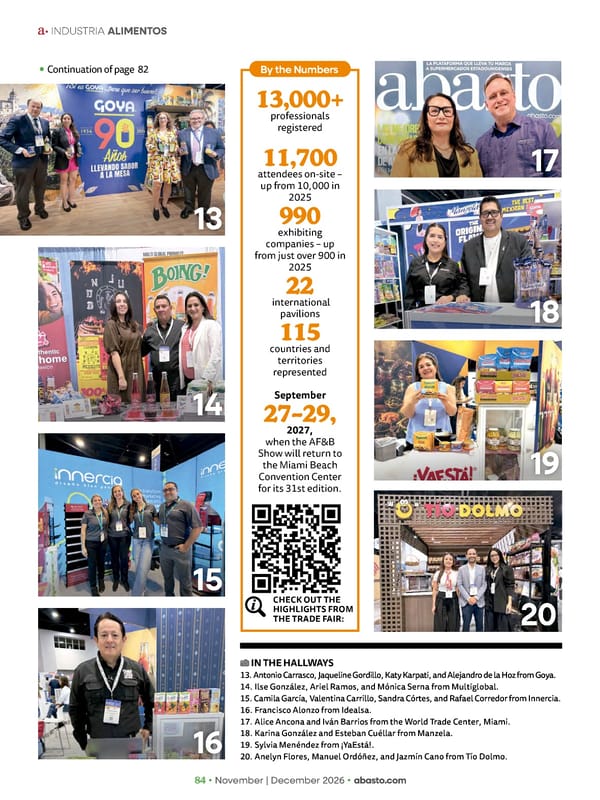
85 • November / December 2026• abasto.com
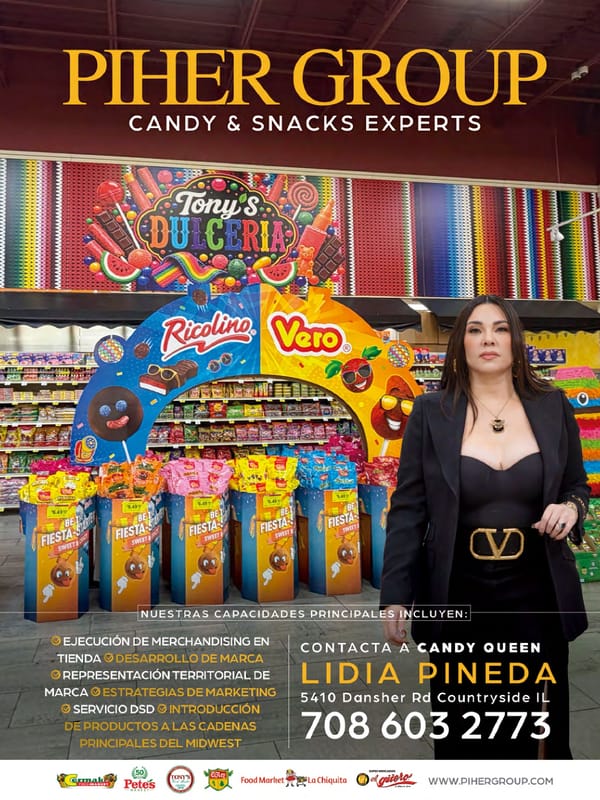
• FOOD INDUSTRY “Taste of the Americas” Breaks Records in Hollywood The NSA Florida trade show brings together more than 3,000 attendees. BY HERNANDO RAMÍREZ-SANTOS rowded aisles, back-to-back bu- Csiness meetings, and buyers with their sights set on year-end purcha- ses. That’s how the “Taste of the Ameri- cas” buying show unfolded on September | 23, hosted by the Florida National Super- market Association (NSA) at the Seminole | 1 | 2 | | Hard Rock Hotel & Casino. | | The 2026 edition brought together more | | than 3,000 attendees, including over 1,800 | | buyers and purchasing managers from the | | United States, the Caribbean, and Latin | | America. In addition, more than 300 exhi- | | bitors filled the hall in a single day. | | A Partnership That Pays Off | | This growth stems from the strategic collabo- ration between NSA Florida, Quirch Foods, | 3 | | and Lipari Foods. For Carlos Hernández, a | | member of the NSA Florida board of directors, | | this partnership made all the difference. | | “This partnership has brought in many peo- | | ple from the Caribbean, across the state of Flo- | | rida, and from Central and South America,” | | Hernández explained to Abasto magazine. “I | | think we broke a record this year.” | | Similarly, Francis Rodríguez, president | 4 | of NSA Florida, described the event as “the biggest show we’ve put on in 13 years.” Beyond the Members IN THE HALLWAYS 1. Juan Ramos, Juan I. Ramos, and Marta Santana 5 The trade show is no longer limited to asso- of JMA Import. ciation members. According to Rodríguez, 2. Michael Verdes, Michael Verdes Jr., and Alfredo retailers “from Jacksonville to Homestead” Moreno of Bravo Supermarkets; Alejandro Gon- attended, representing grocery stores, su- zález of One Insurance Services. permarkets, pharmacies, and liquor stores. 3. Luis Rivera, Gabriel Areas, Joanna Padilla, and This broader reach also showed up in Carlos García of Grace La Fe. the offerings, with the wine and spirits ex- 4. Fausto Ortiz, Ulricher Peña, and Peter Negrón of hibition taking center stage. “This is how Goya Foods; Carlos Piche of Café Santo Domingo. we’re expanding,” Rodríguez stated. “We 5. Jerry Hernández, member of the NSA Florida want to make the Taste of the Americas board of directors; Ana Montero and Bill Axelrod Show the best here in Florida.” of Greenland. 6. Julio González and Pedro Salas of Conchita 6 • Continues on page 88 Foods. 86 • November / December 2026• abasto.com
87 • November / December 2026• abasto.com
• FOOD INDUSTRY • Continuation of page 86 Shop to Save However, the enthusiasm was tempered by a shared concern: costs. Hernández, owner of National Supermarket in Hialeah and a representative of the distributor Lions Sales Group, noted that shoppers came “to buy and, more than ever, to save money.” In his view, the price hikes stem from factors beyond the supermarket’s control. Among these, he mentioned the immi- gration situation, import problems, and rising freight and fuel costs. “It’s not the supermarket that’s raising 7 8 prices,” he emphasized. He also explained that fuel costs affect every link in the chain, from the truck that transports the merchandise to the port to Looking Ahead the one that distributes it after unloading. to 2027 “Companies can absorb it for a while, but if this continues, you’ll see prices rise With the record alre- again,” he warned. ady set, the organizers That’s why the trade show serves a prac- are looking toward the tical purpose: to help stores secure better next edition. “For next terms so they can offer “the best possible year, we have to make | price” to customers in their neighbor- | a plan to continue | | hoods. | growing,” Hernández | | said, “and always offer | | Independent Pride | something even better | | to all the stores and | | For his part, Anthony Peña, president of | the entire industry.” | | the National Supermarket Association in | 9 | | the northeastern United States, traveled to | | support the Florida chapter. “A phenome- | | nal trade show—so many people, so many | | companies,” he summarized. | | Peña also reiterated the association’s mis- | | sion regarding independent supermarkets: | | “We’re giving them every opportunity to be | | better businesspeople and to bring all these | | products to the community.” | | IN THE HALLWAYS | | 7. Jorge Díaz and Jaime Piña, from Grupo Rica. | 10 | 11 | | 8. Israel Álvarez and Humberto Torres, from Natu- | | ras. | | 9. Jhon Andrade and Luis Martínez, from Sigma | | Foods-FUD. | | 10. Valeria López and Mauricio Aristizábal, from | | Cordialsa USA. | | 11. Madelin Díaz and Bladimir Díaz, from Key Food | | Store in Dade City. | | 12. Francis Rodríguez, president of NSA Florida; | | Frank Espinal, Ideal Food Basket; Kent Tavera, | | Juan Pérez, Raifiz Vargas, and Ronny Castillo, members of the NSA Florida board. | 12 | 13 | 13. Verónica Rodríguez, from BocaDeli. 88 • November / December 2026• abasto.com
89 • November / December 2026• abasto.com

90 • November / December 2026• abasto.com Anúnciate aquí: (336) 483-5892 • sales@abasto.com CARBÓN NATURAL / LEÑA PARA ASAR Marca privada disponible ¡Llama hoy! excelente promoción (956) 683-0453 PRODUCTOS LÁCTEOS 100% MEXICANOS Con todas las certificaciones de calidad. ¡Llama hoy! Las mejores ofertas. (956) 683-0453 BEBIDAS DE ALOE VERA Mango, piña, aloe, guayaba, fresa, coco, etc. Buscamos distribuidores. ¡Llama Hoy! (908) 313-4861 PRODUCTOS LATINOS Encuentra los productos de tu país Las Mejores Ofertas. Llama Hoy! (949) 456-2697 SAZONADORES MEXICANOS Chorizo, chipotle, carne asada. ¡Llámanos hoy!. Las mejores ofertas (800) 621-5422 SAL CON SAZONADOR Sazonador para tacos, especias finas. ¡Los Mejores Precios! (404) 766-5334 COBERTURA Y RELLENO CONGELADO PARA POSTRES Vainilla, chocolate, cobertura para confitería. ¡Llama Hoy! (800) 590-2575 VARIEDAD DE VELADORAS Religiosas, Esotéricas, tumblers, plain ¡Llama hoy! Excelente Promoción (954) 627-4653 DULCES 100% MEXICANOS Tamarindo y sandía con chile. ¡Buscamos Distribuidores! +52 55 55 02 5625 CHIPS DE PLÁTANO PREMIUM Chile limón, salsa verde ¡Excelentes ofertas! (281) 657-5702 SALSAS Y BOTANAS MEXICANAS Salsa negra, picante y habanera, tortillas, chips nacho style. ¡Buscamos distribuidores! (210) 907-9415 DULCE ENCHILADO CONFITADO Sabor a tamarindo ¡Las mejores ofertas! (773) 847- 4333 CHULETA AHUMADA Excelente producto mexicano, la mejor calidad. Buscamos distribuidores, ¡llama hoy! +52 378 121 43 61 ESPECIAS MEXICANAS Chile de árbol, cacahuates chile japonés. ¡Excelentes precios de oferta! (336) 495- 5000 DULCES Y SNACKS MEXICANOS Burritos de tamarindo, churritos, frituras, etc Las Mejores Ofertas! Llama Hoy!! (619) 271-0846 BEBIDAS ENERGIZANTES Blueberry, guaraná y frutos rojos. ¡Llámanos hoy! (800) 835 6190 Tortilla chips original y de salsa verde, palanqueta mix, chicharrones, frituras de maíz con sal y limón (832) 630-8494 Botanas mexicanas TORTILLAS DE MAIZ Con Sabor a Jalapeño con Frijoles y Queso. Trocitos de Maiz con Sabor a Queso (817)751-4675 Marketplace
91 • November / December 2026• abasto.com