
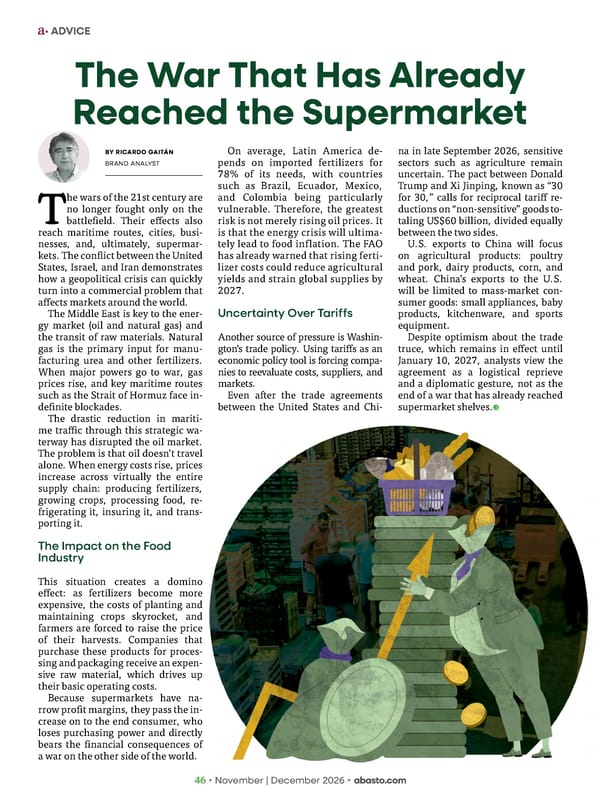
46 • November / December 2026• abasto.com BY RICARDO GAITÁN BRAND ANALYST • ADVICE T he wars of the 21st century are no longer fought only on the battlefield. Their effects also reach maritime routes, cities, busi- nesses, and, ultimately, supermar- kets. The conflict between the United States, Israel, and Iran demonstrates how a geopolitical crisis can quickly turn into a commercial problem that affects markets around the world. The Middle East is key to the ener- gy market (oil and natural gas) and the transit of raw materials. Natural gas is the primary input for manu- facturing urea and other fertilizers. When major powers go to war, gas prices rise, and key maritime routes such as the Strait of Hormuz face in- definite blockades. The drastic reduction in mariti- me traffic through this strategic wa- terway has disrupted the oil market. The problem is that oil doesn’t travel alone. When energy costs rise, prices increase across virtually the entire supply chain: producing fertilizers, growing crops, processing food, re- frigerating it, insuring it, and trans- porting it. The Impact on the Food Industry This situation creates a domino effect: as fertilizers become more expensive, the costs of planting and maintaining crops skyrocket, and farmers are forced to raise the price of their harvests. Companies that purchase these products for proces- sing and packaging receive an expen- sive raw material, which drives up their basic operating costs. Because supermarkets have na- rrow profit margins, they pass the in- crease on to the end consumer, who loses purchasing power and directly bears the financial consequences of a war on the other side of the world. The War That Has Already Reached the Supermarket On average, Latin America de- pends on imported fertilizers for 78% of its needs, with countries such as Brazil, Ecuador, Mexico, and Colombia being particularly vulnerable. Therefore, the greatest risk is not merely rising oil prices. It is that the energy crisis will ultima- tely lead to food inflation. The FAO has already warned that rising ferti- lizer costs could reduce agricultural yields and strain global supplies by 2027. Uncertainty Over Tariffs Another source of pressure is Washin- gton’s trade policy. Using tariffs as an economic policy tool is forcing compa- nies to reevaluate costs, suppliers, and markets. Even after the trade agreements between the United States and Chi- na in late September 2026, sensitive sectors such as agriculture remain uncertain. The pact between Donald Trump and Xi Jinping, known as “30 for 30,” calls for reciprocal tariff re- ductions on “non-sensitive” goods to- taling US$60 billion, divided equally between the two sides. U.S. exports to China will focus on agricultural products: poultry and pork, dairy products, corn, and wheat. China’s exports to the U.S. will be limited to mass-market con- sumer goods: small appliances, baby products, kitchenware, and sports equipment. Despite optimism about the trade truce, which remains in effect until January 10, 2027, analysts view the agreement as a logistical reprieve and a diplomatic gesture, not as the end of a war that has already reached supermarket shelves.
 Abasto Magazine November | December 2026 ENGLISH Page 45 Page 47