
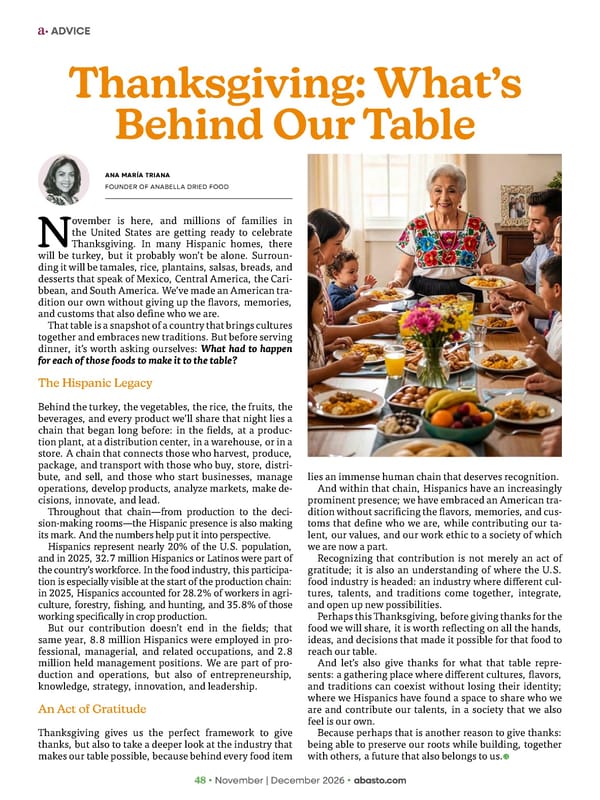
48 • November / December 2026• abasto.com ANA MARÍA TRIANA FOUNDER OF ANABELLA DRIED FOOD • ADVICE N ovember is here, and millions of families in the United States are getting ready to celebrate Thanksgiving. In many Hispanic homes, there will be turkey, but it probably won’t be alone. Surroun- ding it will be tamales, rice, plantains, salsas, breads, and desserts that speak of Mexico, Central America, the Cari- bbean, and South America. We’ve made an American tra- dition our own without giving up the flavors, memories, and customs that also define who we are. That table is a snapshot of a country that brings cultures together and embraces new traditions. But before serving dinner, it’s worth asking ourselves: What had to happen for each of those foods to make it to the table? The Hispanic Legacy Behind the turkey, the vegetables, the rice, the fruits, the beverages, and every product we’ll share that night lies a chain that began long before: in the fields, at a produc- tion plant, at a distribution center, in a warehouse, or in a store. A chain that connects those who harvest, produce, package, and transport with those who buy, store, distri- bute, and sell, and those who start businesses, manage operations, develop products, analyze markets, make de- cisions, innovate, and lead. Throughout that chain—from production to the deci- sion-making rooms—the Hispanic presence is also making its mark. And the numbers help put it into perspective. Hispanics represent nearly 20% of the U.S. population, and in 2025, 32.7 million Hispanics or Latinos were part of the country’s workforce. In the food industry, this participa- tion is especially visible at the start of the production chain: in 2025, Hispanics accounted for 28.2% of workers in agri- culture, forestry, fishing, and hunting, and 35.8% of those working specifically in crop production. But our contribution doesn’t end in the fields; that same year, 8.8 million Hispanics were employed in pro- fessional, managerial, and related occupations, and 2.8 million held management positions. We are part of pro- duction and operations, but also of entrepreneurship, knowledge, strategy, innovation, and leadership. An Act of Gratitude Thanksgiving gives us the perfect framework to give thanks, but also to take a deeper look at the industry that makes our table possible, because behind every food item Thanksgiving: What’s Behind Our Table lies an immense human chain that deserves recognition. And within that chain, Hispanics have an increasingly prominent presence; we have embraced an American tra- dition without sacrificing the flavors, memories, and cus- toms that define who we are, while contributing our ta- lent, our values, and our work ethic to a society of which we are now a part. Recognizing that contribution is not merely an act of gratitude; it is also an understanding of where the U.S. food industry is headed: an industry where different cul- tures, talents, and traditions come together, integrate, and open up new possibilities. Perhaps this Thanksgiving, before giving thanks for the food we will share, it is worth reflecting on all the hands, ideas, and decisions that made it possible for that food to reach our table. And let’s also give thanks for what that table repre- sents: a gathering place where different cultures, flavors, and traditions can coexist without losing their identity; where we Hispanics have found a space to share who we are and contribute our talents, in a society that we also feel is our own. Because perhaps that is another reason to give thanks: being able to preserve our roots while building, together with others, a future that also belongs to us.
 Abasto Magazine November | December 2026 ENGLISH Page 47 Page 49