
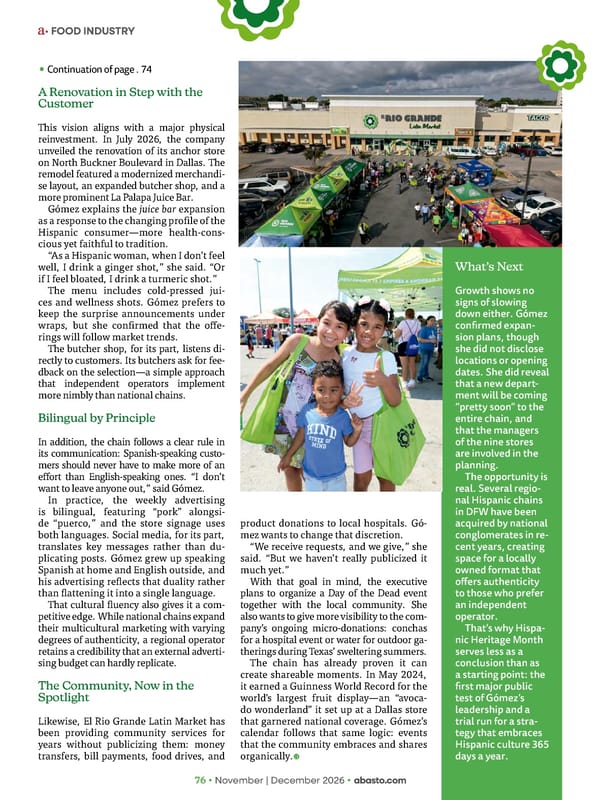
76 • November / December 2026• abasto.com • Continuation of page . 74 • FOOD INDUSTRY What’s Next Growth shows no signs of slowing down either. Gómez confirmed expan- sion plans, though she did not disclose locations or opening dates. She did reveal that a new depart- ment will be coming “pretty soon” to the entire chain, and that the managers of the nine stores are involved in the planning. The opportunity is real. Several regio- nal Hispanic chains in DFW have been acquired by national conglomerates in re- cent years, creating space for a locally owned format that offers authenticity to those who prefer an independent operator. That’s why Hispa- nic Heritage Month serves less as a conclusion than as a starting point: the first major public test of Gómez’s leadership and a trial run for a stra- tegy that embraces Hispanic culture 365 days a year. A Renovation in Step with the Customer This vision aligns with a major physical reinvestment. In July 2026, the company unveiled the renovation of its anchor store on North Buckner Boulevard in Dallas. The remodel featured a modernized merchandi- se layout, an expanded butcher shop, and a more prominent La Palapa Juice Bar. Gómez explains the juice bar expansion as a response to the changing profile of the Hispanic consumer—more health-cons- cious yet faithful to tradition. “As a Hispanic woman, when I don’t feel well, I drink a ginger shot,” she said. “Or if I feel bloated, I drink a turmeric shot.” The menu includes cold-pressed jui- ces and wellness shots. Gómez prefers to keep the surprise announcements under wraps, but she confirmed that the offe- rings will follow market trends. The butcher shop, for its part, listens di- rectly to customers. Its butchers ask for fee- dback on the selection—a simple approach that independent operators implement more nimbly than national chains. Bilingual by Principle In addition, the chain follows a clear rule in its communication: Spanish-speaking custo- mers should never have to make more of an effort than English-speaking ones. “I don’t want to leave anyone out,” said Gómez. In practice, the weekly advertising is bilingual, featuring “pork” alongsi- de “puerco,” and the store signage uses both languages. Social media, for its part, translates key messages rather than du- plicating posts. Gómez grew up speaking Spanish at home and English outside, and his advertising reflects that duality rather than flattening it into a single language. That cultural fluency also gives it a com- petitive edge. While national chains expand their multicultural marketing with varying degrees of authenticity, a regional operator retains a credibility that an external adverti- sing budget can hardly replicate. The Community, Now in the Spotlight Likewise, El Rio Grande Latin Market has been providing community services for years without publicizing them: money transfers, bill payments, food drives, and product donations to local hospitals. Gó- mez wants to change that discretion. “We receive requests, and we give,” she said. “But we haven’t really publicized it much yet.” With that goal in mind, the executive plans to organize a Day of the Dead event together with the local community. She also wants to give more visibility to the com- pany’s ongoing micro-donations: conchas for a hospital event or water for outdoor ga- therings during Texas’ sweltering summers. The chain has already proven it can create shareable moments. In May 2024, it earned a Guinness World Record for the world’s largest fruit display—an “avoca- do wonderland” it set up at a Dallas store that garnered national coverage. Gómez’s calendar follows that same logic: events that the community embraces and shares organically.
 Abasto Magazine November | December 2026 ENGLISH Page 91 Page 93