
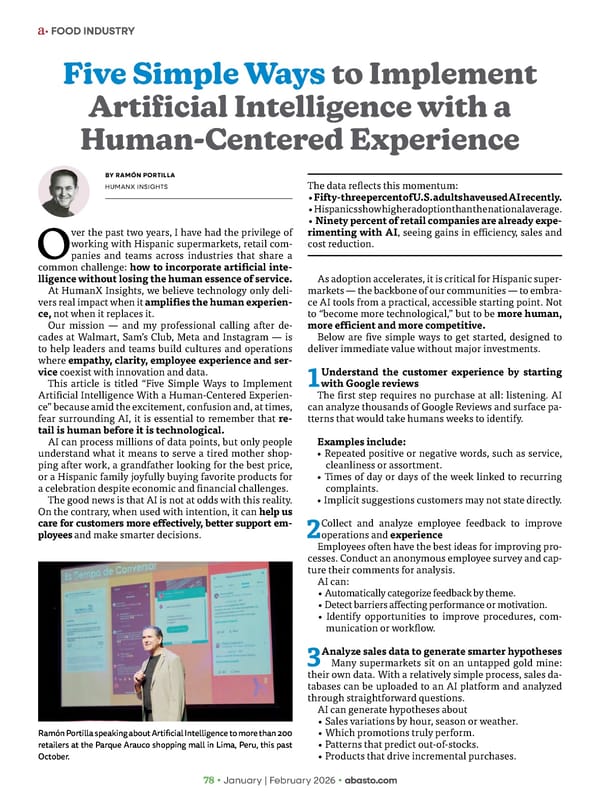
78 January | February 2026 abasto.com O ver the past two years, I have had the privilege of working with Hispanic supermarkets, retail com- panies and teams across industries that share a common challenge: how to incorporate artificial inte- lligence without losing the human essence of service. At HumanX Insights, we believe technology only deli- vers real impact when it amplifies the human experien- ce, not when it replaces it. Our mission and my professional calling after de- cades at Walmart, Sams Club, Meta and Instagram is to help leaders and teams build cultures and operations where empathy, clarity, employee experience and ser- vice coexist with innovation and data. This article is titled Five Simple Ways to Implement Artificial Intelligence With a Human-Centered Experien- ce because amid the excitement, confusion and, at times, fear surrounding AI, it is essential to remember that re- tail is human before it is technological. AI can process millions of data points, but only people understand what it means to serve a tired mother shop- ping after work, a grandfather looking for the best price, or a Hispanic family joyfully buying favorite products for a celebration despite economic and financial challenges. The good news is that AI is not at odds with this reality. On the contrary, when used with intention, it can help us care for customers more effectively, better support em- ployees and make smarter decisions. Five Simple Ways to Implement Artificial Intelligence with a Human-Centered Experience BY RAMN PORTILLA HUMANX INSIGHTS The data reflects this momentum: Fifty-threepercent of U.S.adults haveused AI recently. Hispanics show higher adoption than the national average. Ninety percent of retail companies are already expe- rimenting with AI , seeing gains in efficiency, sales and cost reduction. As adoption accelerates, it is critical for Hispanic super- markets the backbone of our communities to embra- ce AI tools from a practical, accessible starting point. Not to become more technological, but to be more human, more efficient and more competitive. Below are five simple ways to get started, designed to deliver immediate value without major investments. 1 Understand the customer experience by starting with Google reviews The first step requires no purchase at all: listening. AI can analyze thousands of Google Reviews and surface pa- tterns that would take humans weeks to identify. Examples include: Repeated positive or negative words, such as service, cleanliness or assortment. Times of day or days of the week linked to recurring complaints. Implicit suggestions customers may not state directly. 2 Collect and analyze employee feedback to improve operations and experience Employees often have the best ideas for improving pro- cesses. Conduct an anonymous employee survey and cap- ture their comments for analysis. AI can: Automatically categorize feedback by theme. Detect barriers affecting performance or motivation. Identify opportunities to improve procedures, com- munication or workflow. 3 Analyze sales data to generate smarter hypotheses Many supermarkets sit on an untapped gold mine: their own data. With a relatively simple process, sales da- tabases can be uploaded to an AI platform and analyzed through straightforward questions. AI can generate hypotheses about Sales variations by hour, season or weather. Which promotions truly perform. Patterns that predict out-of-stocks. Products that drive incremental purchases. Ramn Portilla speaking about Artificial Intelligence to more than 200 retailers at the Parque Arauco shopping mall in Lima, Peru, this past October. FOOD INDUSTRY
 Abasto Magazine January / February 2026 ENGLISH Page 77 Page 79